Reasons for holding foreign currencies:
- For t…
- To take advantage of …
- S…
Reasons for holding foreign currencies:
- For trade and investment purposes: if a domestic company wants to buy machinery from a foreign country, it has to first buy foreign currency, then buy the machinery in the foreign country using the foreign currency.
- To take advantage of interest rate differentials (interest rate arbitrage): arbitrageurs borrow money where interest rates are relatively low and lend it where rates are relatively high.
- Speculate: speculators are businesses that buy or sell a currency because they expect its price to rise or fall. They have no need for foreign exchange to buy goods or services or financial assets; rather, they hope to realize profits or avoid losses through correctly anticipating changes in a currency’s market value.
Participants in foreign currency markets:
1.
2.
3.
4.
Participants in foreign currency markets:
- Retail customers: include firms and individuals that hold foreign exchange for any of the three reasons given above.
- Commercial banks: is the most important
- Foreign exchange brokers: act as middlemen between buyers and sellers that do not usually hold foreign exchange. Brokers can also serve as agents for central banks.
- Central banks.
Exchange rate risks: c
Forward exchange rate:
the forward market.
Spot market:
. Hedging:
Hedging
Covered interest arbitrage:
Exchange rate risks: currencies are constantly changing in value, and as a result, expected future payments that will be made or received in a foreign currency will be a different domestic currency amount from when the contract was signed.
Forward exchange rate: the price of a currency that will be delivered in the future.
the forward market refers to the market in which the buying and the selling of currencies for future deliveries takes place.
Spot market: the market for buying and selling in the present. Hedging: bondholders and other interest rate arbitrageurs often use forward markets to protect themselves against the foreign exchange risk incurred while holding foreign bonds and other financial assets.
Hedging is accomplished by buying a forward contract to sell foreign currency at the same time that the bond or other interest-earning asset matures.
Covered interest arbitrage: The interest rate arbitrageurs use the forward market to insure against exchange rate risk.
Appreciation and depreciation
appreciation and depreciation:
Exchange rate systems:
- 3.
Appreciation and depreciation
The price of a currency (USD) rises relative to another currency (CAD), then there is an appreciation of the first currency (USD) and depreciation of the second currency (CAD).
Exchange rate systems:
- Flexible exchange rate system,
- fixed exchange rate system
- managed exchange rate system.
Under the flexible exchange rate systems:
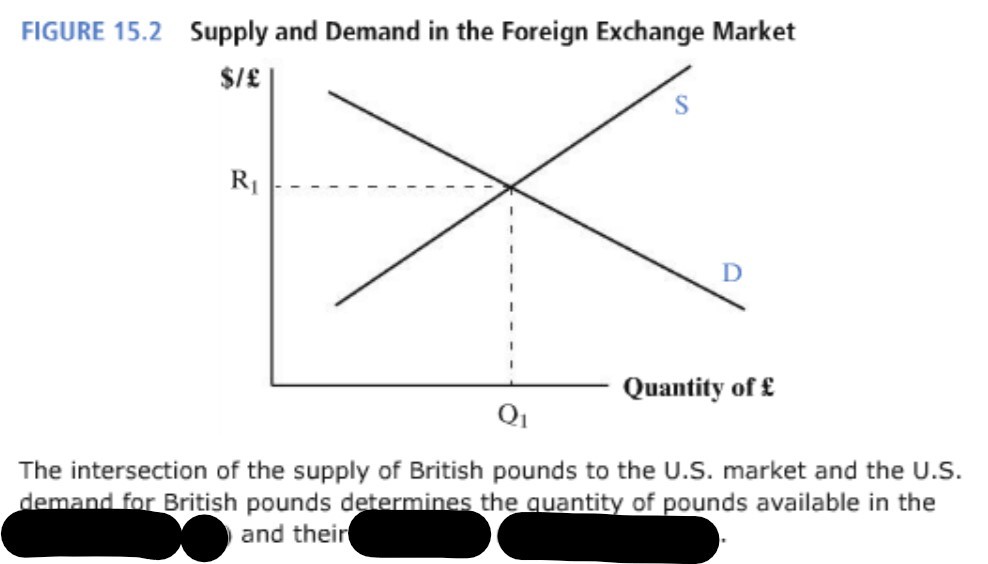
Supply and Demand with flexible exchange rates
Example: USA is the home country, and UK is the foreign country. Therefore, USD is the home …, and UK pound is the ….
The demand curve of UK pound in the USA (home) market and the supply curve of UK pound in the USA (home) market together determines the …
Please note here(image): the y axis is the price of … with respect to …. So the unit is … per …
Under the flexible exchange rate systems:
Supply and Demand with flexible exchange rates
Example: USA is the home country, and UK is the foreign country. Therefore, USD is the home currency, and UK pound is the foreign country.
The demand curve of UK pound in the USA (home) market and the supply curve of UK pound in the USA (home) market together determines the exchange rate/price of UK pound in the exchange market.
Please note here(image): the y axis is the price of foreign currency (UK pound) with respect to home currency (dollar). So the unit is US dollar per UK pound.
An increase in the demand for UK pound (foreign currency) in the USA market (home) leads to an … This also means …
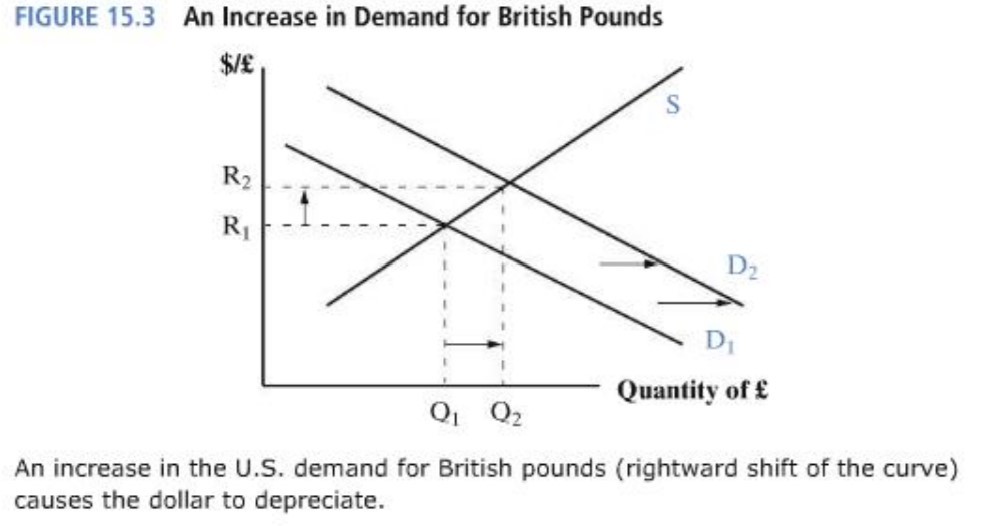
An increase in the demand for UK pound (foreign currency) in the USA market (home) leads to an appreciation of the UK pound (foreign currency). This also means USD (home currency) will depreciate.
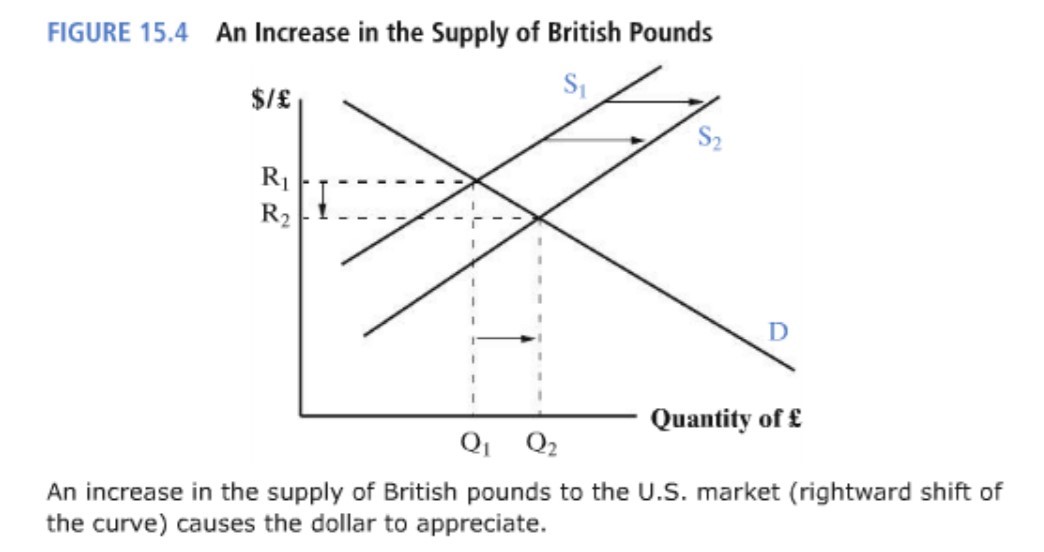
An increase in the supply of UK pound (foreign currency) in the US market (home) leads to the … (foreign currency). This also means USD (home currency) …
An increase in the supply of UK pound (foreign currency) in the US market (home) leads to the depreciation of the UK pound (foreign currency). This also means USD (home currency) will appreciate.
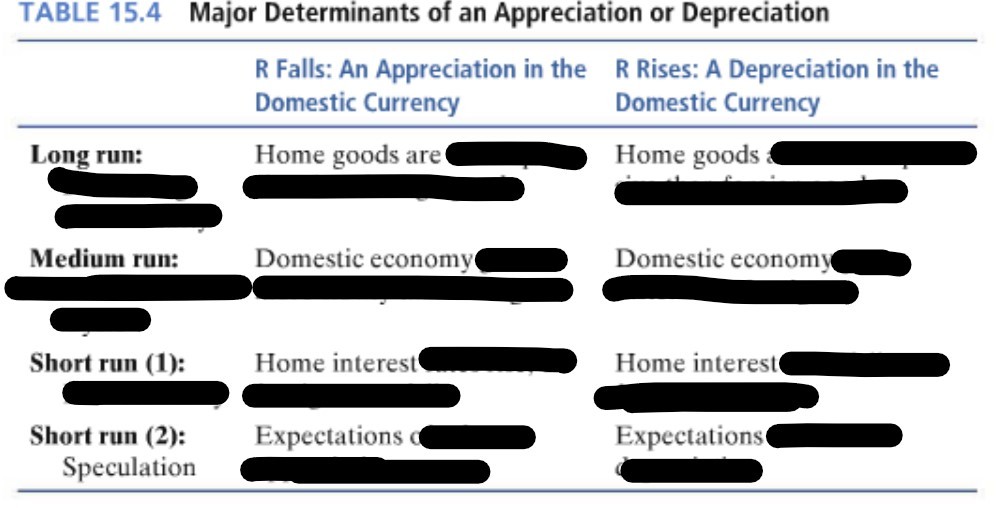
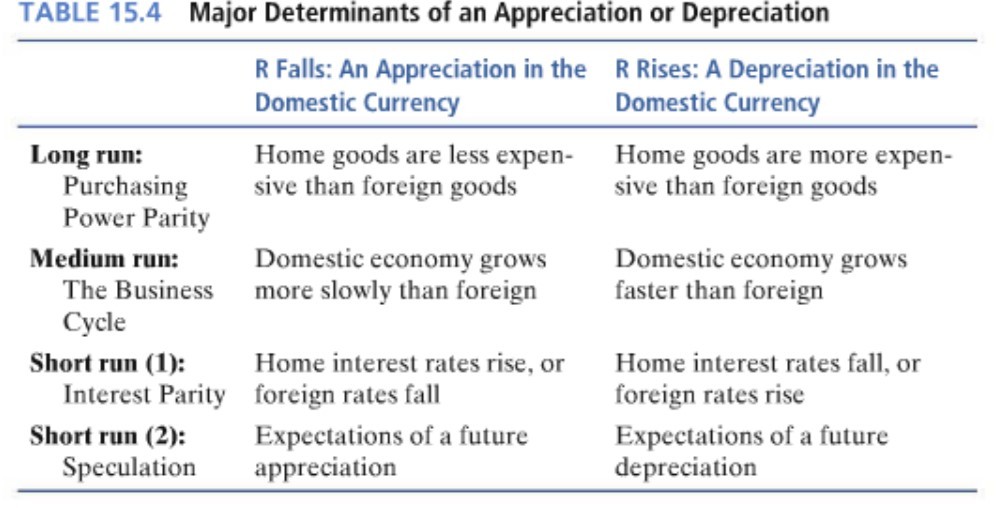
a. Long run:
Purchasing power parity: the equilibrium value of an exchange rate is at the level that allows a … abroad that it will buy at home. For instance, the equilibrium exchange rate is the point where the dollar buys pounds at a rate that k…
In the long run: The equilibrium exchange rate should move to the direction where the…
Example: It costs $150 to buy 10 burgers in the USA, and it costs £100 to buy 10 burgers of the same quality in UK. If the exchange rate of UK pound is $1.5/UK pound, then the purchasing power of USD in US is t… UK pound and spend in UK. The exchange rate …
a. Long run:
Purchasing power parity: the equilibrium value of an exchange rate is at the level that allows a given amount of money to buy the same quantity of goods abroad that it will buy at home. For instance, the equilibrium exchange rate is the point where the dollar buys pounds at a rate that keeps its purchasing power over goods and services constant.
In the long run: The equilibrium exchange rate should move to the direction where the purchasing power parity satisfies.
Example: It costs $150 to buy 10 burgers in the USA, and it costs £100 to buy 10 burgers of the same quality in UK. If the exchange rate of UK pound is $1.5/UK pound, then the purchasing power of USD in US is the same if we exchange it to UK pound and spend in UK. The exchange rate satisfy the purchasing power parity condition.
In the medium run: (The business cycle)
- Economic growth in domestic economy: a faster economic growth in domestic economy (USA) will… of UK pounds (foreign currency) in the…), because … will lead to … Therefore, the UK pounds…, and USD …. (figure 15.3)
- Economic growth in foreign economy: a faster growth in foreign economy (UK) will… (foreign currency) in the ….), because …means higher…, therefore UK pounds …, and USD …. (figure 15.4)
In the medium run: (The business cycle)
- Economic growth in domestic economy: a faster economic growth in domestic economy (USA) will increase the demand of UK pounds (foreign currency) in the USA (home), because higher income in the USA will lead to higher imports from UK to USA. Therefore, the UK pounds appreciate, and USD depreciates. (figure 15.3)
- Economic growth in foreign economy: a faster growth in foreign economy (UK) will increase the supply of UK pound (foreign currency) in the USA (home), because higher income in UK means higher imports from USA to UK, therefore UK pounds depreciate, and USD appreciates. (figure 15.4)
In the short run:
- … and 2…. These two forces often … and are capable…
- Interest rates:
a. Interest parity condition:
The difference …s is approximately equal to the …
: ….
where, …s are given by ..and.., and .. and … are the …
- Expectations about future exchange rates
a. If majority people expect the exchange rate of UK pound is going to appreciate in the future, this w… in the …, therefore, the …
b. Vise versa
C. Real exchange rate and nominal exchange rate: Real exchange rate is the … (nominal …) …
formula
Where: … is the r…., … is the ….. ..* is the … in …, and P is the … in the …
- Interest rates and 2. expectations about future exchange rates These two forces often influence each other and are capable of creating unpredictable interactions.
- Interest rates:
a. Interest parity condition:
The difference between any pair of countries’ interest rates is approximately equal to the expected change in the exchange rate: 𝒊 − 𝒊 ∗ ≈ (𝑭 − 𝑹)/𝑹
where, home and foreign interest rates are given by i and i*, and F and R are the expected future current exchange rates respectively.
- Expectations about future exchange rates
a. If majority people expect the exchange rate of UK pound is going to appreciate in the future, this will increase the demand for UK pound in the USA market, therefore, the UK pound will actually appreciate;
b. If majority people expect the exchange rate of UK pound is going to depreciate in the future, this will decrease the demand for UK pound in the USA market, and therefore, the UK pound will actually depreciate
C. Real exchange rate and nominal exchange rate: Real exchange rate is the market exchange rate (nominal exchange rate) adjusted for price differences.
𝑅𝑟 = 𝑅𝑛( 𝑃 ∗ / 𝑃 )
Where: 𝑅𝑟 is the real exchange rate, 𝑅𝑛is the nominal exchange rate. P* is the price index in foreign country, and P is the price index in the home country
- Alternatives to flexible exchange rates
Fixed exchange rate systems: are also called…… If the exchange rate is …. then it is a …; fixed exchange rates that … are …
Fixed exchange rate Systems:
a. …: the value of a currency is….with …, and that value is …
b. … exchange rate ….: the value of a currency is …., and that value is …
Under a fixed exchange rate system, the national supply and demand for foreign currencies may …y but the…. It is the responsibility of the …s (t….s) to keep the exchange rate…..
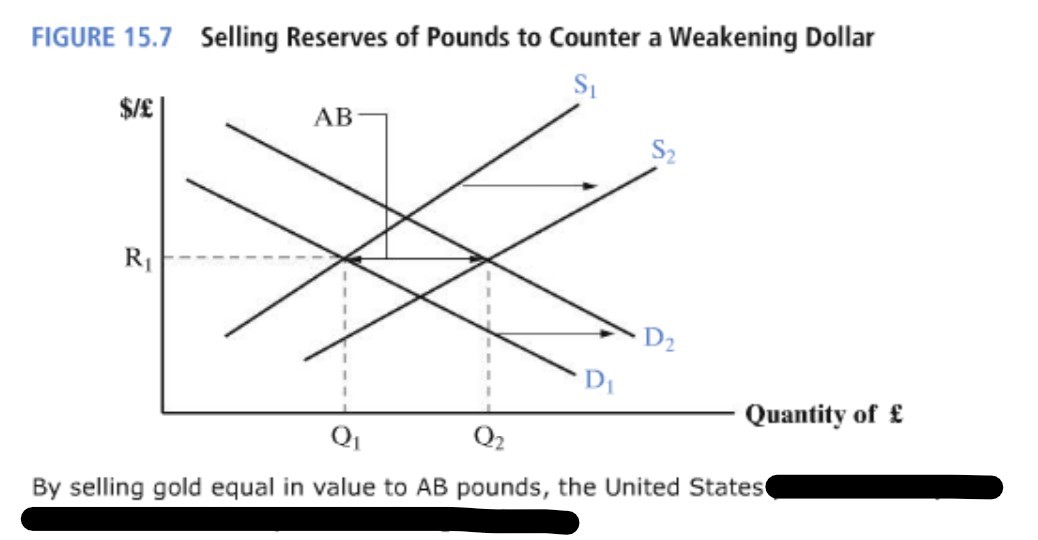
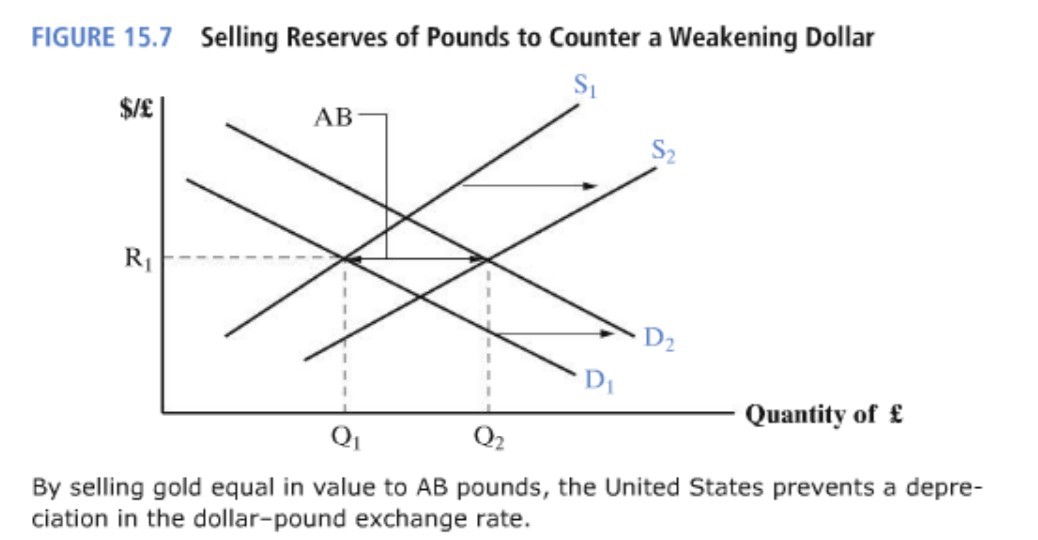
Example: Suppose US and the UK are both on the gold standard and the US demand for British pounds increases. If the nominal exchange rate R1 is fixed, then the US must counter the… dollar and prevent the r… R2. One option is to … …. The quantity of gold that must be sold is … by line segment AB below.
- Alternatives to flexible exchange rates.
Fixed exchange rate systems: are also called pegged exchange rate systems. If the exchange rate is not allowed to vary, then it is a hard peg; fixed exchange rates that fluctuate within a set bank are soft pegs.
A. Fixed exchange rate Systems:
a. Gold standards: the value of a currency is pegged with one ounce of gold, and that value is fixed.
b. Bretton Woods exchange rate system: the value of a currency is pegged with another foreign currency, and that value is fixed.
Under a fixed exchange rate system, the national supply and demand for foreign currencies may vary but the nominal exchange rate does not. It is the responsibility of the monetary authorities (the central bank or treasury departments) to keep the exchange rate fixed.
Example: Suppose US and the UK are both on the gold standard and the US demand for British pounds increases. If the nominal exchange rate R1 is fixed, then the US must counter the weakening dollar and prevent the rate from depreciating to R2. One option is to sell the US gold reserves in exchange for dollars. The quantity of gold that must be sold is equivalent to the value of the pounds represented by line segment AB below.




