Elasticity
Percentage change in one variable resulting from a 1-percent change in another
The general form of demand and supply. And how to transform them into price elasticity
𝐷𝑒𝑚𝑎𝑛𝑑 𝑓𝑢𝑛𝑐𝑡𝑖𝑜𝑛: 𝑄𝐷 = a − 𝑏𝑃
𝑆𝑢𝑝𝑝𝑙𝑦 𝑓𝑢𝑛𝑐𝑡𝑖𝑜𝑛: 𝑄𝑆 = c + 𝑑𝑃
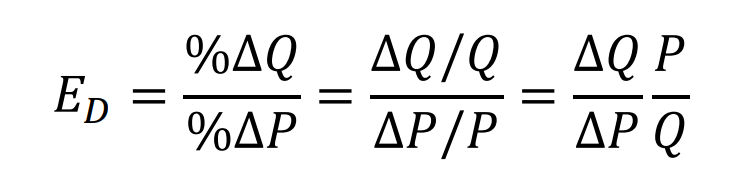
The price elasticity of demand
Ed=−b (𝑃 /Q) and
b= −𝐸𝐷 ( 𝑄 / 𝑃 );
The price elasticity of supply:
d∗ (𝑃 /Q) and
d = 𝐸S ( 𝑄 / 𝑃 );
Price elasticity of demand. What kind of number is it? When the price of a good increases the quantity of demanded …?The elasticity … as the quantity of demand increases?
estimates the percentage change in quantity demanded of a good resulting from a 1-percent change in its price.
The price elasticity of demand is usually a negative number. When the price of a good increases, the quantity demanded usually falls.
Elastic and Inelastic demand
- If ED>1 in magnitude, the demand is…, a 1% change in price leads to a … than 1% change in quantity demanded;
- If ED=1 in magnitude, the demand is … , a 1% change in price leads to 1% change in quantity demanded;
- If ED<1 in magnitude, the demand is … , a 1% change in price leads to … than 1% change in quantity demanded.
- If ED>1 in magnitude, the demand is price elastic, a 1% change in price leads to a greater than 1% change in quantity demanded;
- If ED=1 in magnitude, the demand is unit elastic, a 1% change in price leads to 1% change in quantity demanded;
- If ED<1 in magnitude, the demand is price inelastic, a 1% change in price leads to a smaller than 1% change in quantity demanded.
Factors that can affect price elasticities of demand
- Number of substitutes;
- Luxury goods and Necessity goods;
- Price of the goods relative to income;
- The time period under consideration.
Example of elasticity of demand
Alice’s demand for coffee can be expressed as a function:Q = 9 − 3𝑃 , the demand curve for coffee then can be drawn as:
- When P=3, Q=0; ED=…at this point; (the price elasticity of demand is …;
- When P=1.5, Q=4.5; ED=… at this point; (the price elasticity of demand is …);
- When P=0, Q=9; ED=… at this point; (the price elasticity of demand is …);
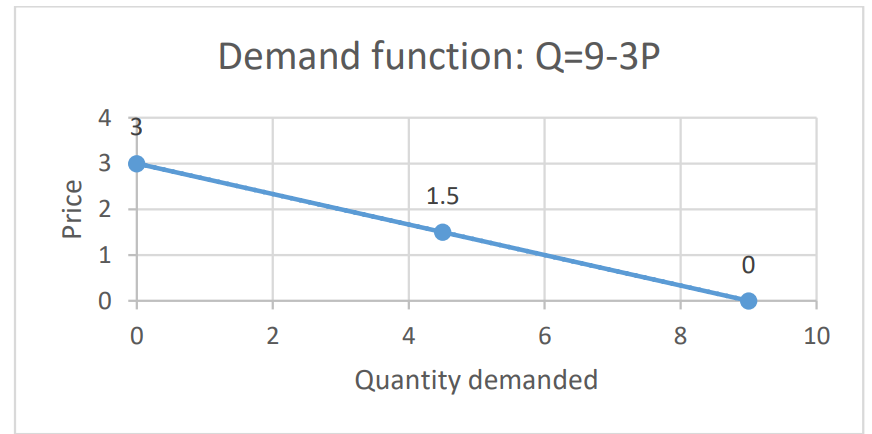
- When P=3, Q=0; ED=-∞ at this point; (the price elasticity of demand is perfectly elastic);
- When P=1.5, Q=4.5; ED=-1 at this point; (the price elasticity of demand is unit elastic);
- When P=0, Q=9; ED=0 at this point; (the price elasticity of demand is perfectly inelastic);
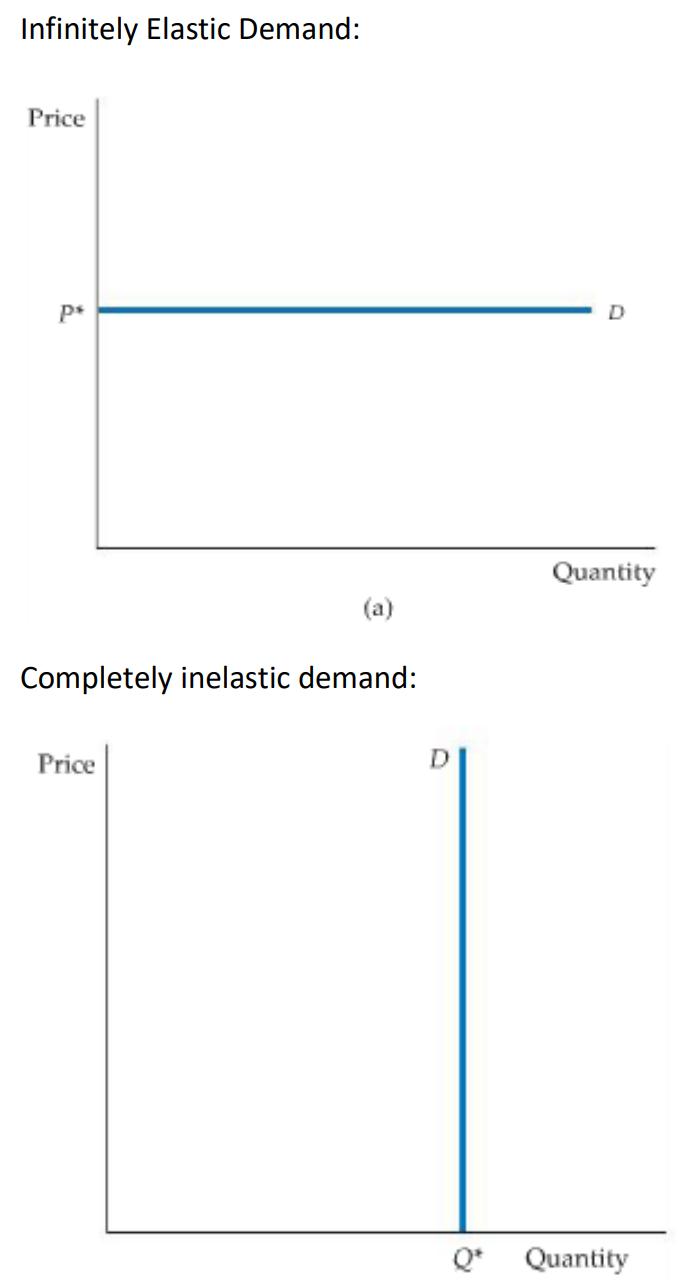
Infinitely Elastic Demand and Completely Inelastic Demand( curves included)
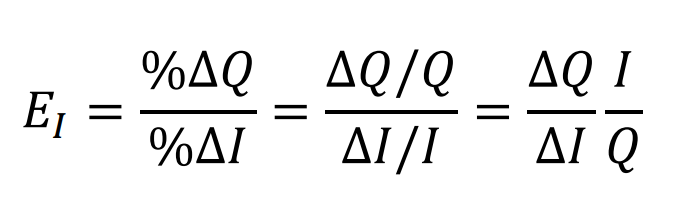
Income elasticity of demand. The demand for Luxury goods are … but demand for necessities are…The demand for Luxury goods are income … but the demand for necessities are income …
Percentage change in the quantity demanded resulting from a 1- percent change in income.
- The demand for Luxury goods are income elastic, but the demand for necessities are income inelastic.
- The income elasticities for normal goods are greater than zero; the income elasticities for inferior goods are smaller than zero.
Cross-price elasticity of demand.
- If goods are substitutes, the cross-price elasticities will be …; if goods are complements, the cross-price elasticities will be …
Cross-price elasticity of demand: Percentage change in the quantity demanded of one good resulting from a 1-percent increase in the price of another.

If goods are substitutes, the cross-price elasticities will be positive; if goods are complements, the cross-price elasticities will be negative.
Price elasticity of supply
- The easier and more rapid the transfer of resources, the … is the price elasticity of supply;
- The longer a firm has to adjust, normally the … the price elasticity of supply.
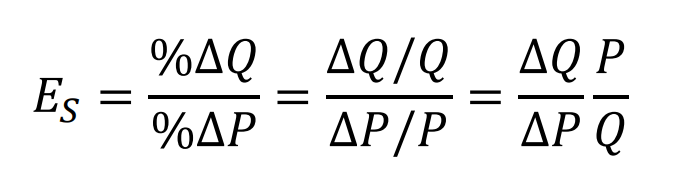
percentage change in quantity supplied resulting from a 1-percent change in price. The price elasticity of supply is usually positive because a higher price gives producers an incentive to increase output
- The easier and more rapid the transfer of resources, the greater is the price elasticity of supply;
- The longer a firm has to adjust, normally the higher the price elasticity of supply.
Point elasticity of demand and Arc elasticity of demand
- Point elasticity of demand: Price elasticity at a particular point on the demand curve. (see formula before)
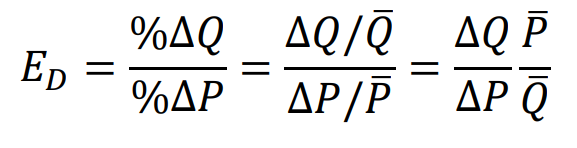
- Arc elasticity of demand: Price elasticity calculated over a range of prices.