Give an overview of patient centred care.
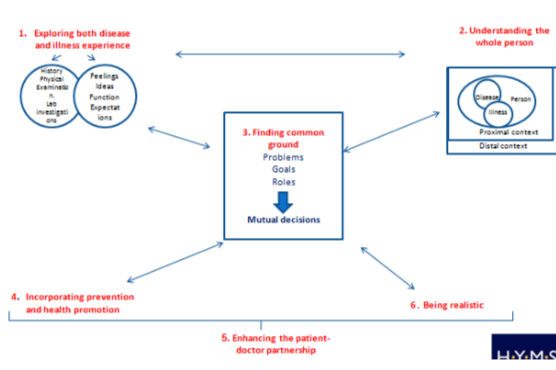
When understanding a person, what are the proximal and distal factors to take into consideration?
Proximal
- Family
- Financial
- Education
- Employment
- Leisure
- Social Support
Distal Factors
- Community
- Culture
- Economics
- Healthcare System
- Socio-historical.
- Geography.
How does patient centred care enhance the continuity of the Dr-patient relationship?
Compassion, empathy and caring
Sharing of power
Constancy and continuity
Healing
Self awareness
What is Food and Eating all about?
- Nutrition
- Identity
- Social Interaction
- Politics (e.g. global trends, impact on food security of other cultures etc.)
- Socio-economic change - e.g. urbanisation, industrialisation.
- Environment - how and where food is grown, transported.
- Science and technology - new developments e.g. GM foods, ready meals etc.
What determines the choices we make about eating?
Impact on health
Cost
Availability
Habit and custom, ‘tastes’ ‘tradition’
Sensuous gratification
Comfort
Other emotional and relational needs
Social and cultural constraints on choice….
o Religious beliefs
o Political beliefs (e.g. vegetarianism)
o Advertising, retailers etc
o Tastes
o Identity: gender, ethnicity, class
o Disease status (e.g. diabetes, CHD, coeliac)
o Meaning of food – morals and values (factory farming vs free range etc) o Time and ability to prepare and cook food
How does food affect ‘family’?
Food as a way of ‘doing’ family: meals are a parenting practice; we do family through meals. Gender roles (esp in relation to the preparation and management of food). Food as a way of celebrating events or identifying family. Food can be a way of articulating emotions which people find hard to verbalise.
How is food related to class?
Class: affects range and variety of food, adherence to dietary guidelines and whether or not one breastfeeds.
What is food poverty?
Food poverty is the term used to describe a form of social exclusion which makes it hard for some people to obtain a nourishing diet.
o ‘Food poverty is worse diet, worse access, worse health, a higher percentage of income on food and less choice from a restricted range of foods. Above all food poverty is about less or almost no consumption of fruit & vegetables’
o “poor diet is related to 30% of life years lost in early death and disability’ … there is a need to change the ‘food environment’ – that is, accessibility, affordability, culture – in which people live” FPH May 2005
What risks does food poverty increase?
Major contributing risk to…
- 50% of CHD deaths.
- 33% of all cancer deaths.
- Increased falls and fractures in older people.
- Low birthweight and increased childhood morbidity and mortality. Increased dental caries in children.
What can be used to decrease food poverty?
Foodbanks - Low incomes, unemployment and benefit delays have combined to trigger increased demand for foodbanks among the UK’s poorest familites.
What are the reasons for increased food poverty?
- The decline of urban and rural public transport, which particularly effects older people and single parents with young children
- The collapse of the independent food retail sector and supermarket expansion in urban and rural areas
- The commercial incentive for food manufacturers to push high-fat, low nutrition foods – particularly at the ‘value for money’ end of the market
- Low incomes
What is undernutrition?
A deficiency in one or more nutrients resulting from a poor diet. It is estimated to affect 2 million people in the UK at any one time. Typically around 10-40% of patients admitted to hospital are undernourished. The number of malnutrition related admissions has doubled since 2008-9. It is estimated that 10% of the over 65s are malnourished.
How much of a problem is Obesity in the UK?
- The proportion of adults with a normal Body Mass Index (BMI) decreased between 1993 and 2012 from 41.0 per cent to 32.1 per cent among men and from 49.5 per cent to 40.6 per cent among women.
- There was a marked increase in the proportion of adults that were obese between 1993 and 2012 from 13.2 per cent to 24.4 per cent among men and from 16.4 per cent to 25.1 per cent among women.
- While overall purchases of fruit and vegetables reduced between 2009 and 2012, consumers spent 8.3 per cent more on fresh and processed vegetables and 11.7 per cent more on fresh and processed fruit.
- In 2012-13, there were 10,957 Finished Admission Episodes (FAEs) in NHS hospitals with a primary diagnosis of obesity among people of all ages […] almost nine times higher than 2002-03 (1,275).
The socio-economic context…
- Commercialisation of energy intake and expenditure Over production of food in capitalist economies
- A focus on consumption and not production
These factors contribute to an obesogenic environment, characterised by sedentary lifestyles, fast convenient food and advertising
Policy responses…
Downstream
- Advice addressed to individuals o An ideology of choice
Up-stream
- Regulatory and legislative decisions o Affects populations
Give examples of how we are trying to tackle obesity.
- Sugary drinks tax
-
Is the 5-a-day thing legit?
Described as a political fudge. Very little evidence for it, politicians just chose a figure that was aspirational but not so high as to be perceived impossible to reach.
A study analysed the eating habits of 65,000 people, using eight years of the Health Survey for England, and matched them with causes of death.
Eating at least seven portions of fresh fruit and vegetables a day was linked to a 42% lower risk of death from all causes. It was also associated with a 25% lower risk of cancer and 31% lower risk of heart disease or stroke. Vegetables seemed to be significantly more protection against disease than eating fruit.
But the strength of the study, published in the Journal of Epidemiology and Community Health, is in the big numbers and the fact that the data comes from the real world.
European Prospective Investigation into Cancer and Nutrition (EPIC), found that people consuming eight portions of fruit and vegetables a day had a 22 per cent lower risk of dying from ischaemic heart disease (IHD) than those consuming three portions or fewer.
The World Cancer Research Fund has long recommended 5-10 portions.
In Denmark it’s six a day, in Australia seven, in Spain eight, in Greece nine, in Canada “up to 10” and in Japan seventeen.
What is rationing?
Rationing occurs when someone is denied or simply not offered an intervention that everyone agrees would do them some goods and they would like to have.
- Is there evidence of patient benefit and what is the cost of the treatment?
- Even if there is evidence of benefit, does the patient want the treatment?
Why is rationing necessary?
- Benjamin Franklin 1789 “in this world nothing can be said to be certain, except death and taxes”
- Wrong! The third certainty in life is scarcity of resources
- The central economic problem for society is how to reconcile the conflict between peoples
- virtually limitless desire for goods and services and the scarcity of resources (labour,machinery, raw materials and land) with which these goods and services can be produced.
- All choices about how to use scarce resources involve an opportunity cost (i.e. the value of
what is forgone when you make a choice).
o No such thing as a free lunch
Is there a funding crisis in the NHS?
- NHS Funding has been constant since 2010, and its funding is planned to stay constant (funds are static, adjusted for inflation).
- The demand for health care is rising
- Technological advances – are they more cost effective?
- Increasing age of population and co-morbidities.
- Expectations: public expect miracles?
Who rations healthcare?
- Central government decides funding for the NHS. This sum is then divided amongst the 4 national constituent parts of the NHS. Each of which may make slightly different choices about how to spend the funds e.g. prescription charges
- In England, the NHS budget is allocated by NHS England to Clinical Commission Groups (CCGs) on the basis of population weighted by “need”. NHS England funds specialist care
- CCGs fund hospitals on the basis of “Payment by Results” for 60% of activity; with the rest being funded by block grants ((PbR) i.e. payment by activity). They also fund community care. Primary care is funded by NHS England: a national/central QUANGO
- Doctors and other health professionals such as nurses ration patient access to care: you are the primary rationing agents!
- An average hospital consultant makes decisions which cost several million pounds per year. They usually and their patients typically know “nowt” about the cost of care! :”cost unconscious demand”
How should society and doctors ration care?
The Hippocratic oath includes:
Whatever houses I visit, I will come for the benefit of the sick, remaining free of intentional misjustice, of all mischiefs and in particular sexual relations with both female and male persons, free and slaves”]
A more modern, American equivalent declares:
o “I will apply for the benefit of the sick all measures that are required, avoiding the twin traps of over-treatment and therapeutic nihilism”
Ethics can be defined as “rules of conduct”. It has two perspectives.
The Hippocratic tradition requires doctors to maximise benefits of care for the patient regardless of opportunity cost, i.e. the focus of the practitioner is the individual patient in your care, not other patients waiting for care. This is the individual perspective.
The economic perspective, a form of societal perspective requires you to consider both the cost and benefit of treatment choices (including not treating). Use evidence of the comparative cost effectiveness of competing treatments and competing patients.
Inefficient treatment denies other patients of care from which they can benefit. Inefficiency can therefore be said to be unethical. The GMC should strike off doctors who practice inefficiently
What does Cochrane say on health rationing?
• “Allocations of funds and facilities are nearly always based on the opinions of senior consultants, but, more and more, requests for additional facilities will have to be based on detailed arguments with “hard evidence” as to the gain to be expected from the patient’s angle and the cost. Few can possibly object to this”
What does evidence based medicine/economics based medicine say on rationing?
Evidence based medicine (EBM One) requires doctors to deliver care that “works” i.e. improves the length and quality of life of patients (see e.g. Sackett quoted in AM (1997))
Economics Based Medicine (EBM Two) requires doctors to deliver care that benefits patients at least cost (see e.g. Maynard, Lancet, 1997)
EBM One may be inefficient and thus is it unethical as it deprives potential patients of care from which they could benefit. EBM Two is efficient but is it ethical?
How can manipulating price serve rationing in healthcare?
Rationing access to care in relation to willingness and ability to pay
User charges: pay for A&E attendance? Pay for GP visit?
“Most proposals for “patient participation in health care financing” reduce to misguided or
cynical attempts to tax the ill and/or drive up the total cost of health care while shifting
some of the burden out of government budgets” Stoddart, Barer and Evans (1979, 1994).
Stoddart et. al are collectivists who support universal health care cover which is publically funded. Some Conservatives/Republicans would support taxing the ill and reducing the role of government (see Maynard, 2012 “Privatisation: an exercise in ambiguity and ideology, BJGP, April)
Repeated advocacy of user charges is what Evans calls a “Zombie” health policy i.e. however well you reject, it continually “pops” up again in the political market place!
What are non-financial ways to implement rationing?
Waiting e.g. treat 95% of elective referrals within 18 weeks)
Age : young or old? e.g. the “fair innings” argument (Williams, BMJ, 1997)
Religion, ethnicity, education, mental health/disability and social class
Random allocation: Oregon experim,ent (2012) and (Harris, J.Med.Ethics, 2005)
Need: need is a supply concept. Need exists only when an individual patient is able to benefit from an intervention. With scarcity of resources inevitable, resource allocation should be guided by evidence of ability to benefit per unit of cost e.g. cost per quality adjusted life year (QALY)



