What are the three types of decision?
- Diagnosis - the process of determining the nature of a disorder by considering the patient’s signs and symptoms, medical background and - when necessary - results of laboratory tests and examinations. 2. Prognosis - an assessment of the future course an outcome of a patients disease, based on knowledge of the course fo the disease, together with the patients general health, age and sex. 3. Treatment - a choice of what action to take to treat the patient.
What are the theories of decision making?
- Normative - what you should be doing. 2. Descriptive - what are you doing? 3. Prescriptive - how can we improve what you are doing?
Describe the Hypoethetico-deductive model of decision making.
- Hypothetico-deductive model is more common in less experienced individuals.
- Hypoethetico-deductive model used for diagnostic problems used for diagnostic problems that are less familiar.
- Experienced clinicians who are familiar with diagnostic task more likely to use pattern matching.
- Use more deliberate reasoning when expert encounters a problem that is less common.
- Reflective practice. Also draw on both scientific and experimental knowledge.
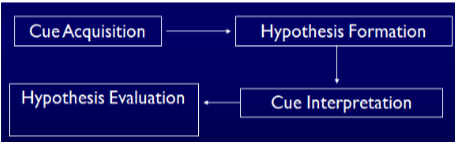
In the decision making process, what is ‘prospect theory’?
Prospect theory suggests that there are two phases in the choice process:
1) Framing and editing - the preliminary analysis of the decision problem
2) Phase of evaluation - framed prospects evaluated and prospect with the highest value is selected.
Decision processes can be influenced by how the decision problem is framed, and peoples values and beliefs associated with benefits and harms of different options
What is ‘framing’?
Framing theory suggests that the way a problem is presented to an audience can have an influence on the choices people make on how to process that information.
1) If the problem is framed according to lives saved, people are more likely to be risk averse (i.e. will choose surgery). If the problem is framed according to lives lost, people are more likely to be risk seeking (i.e. will choose radiotherapy).
Study showed that radiotherapy was chosen by 25% of individuals if framed as lives saved and 42% if framed as lives lost.
2) If the treatment is framed according to relative risk reduction, more will agree. If the problem is framed according to absolute risk reduction, the perceived effect tends to be smaller (more will say no).
Study showed that the statin was chosen by 88% of those shown the RRR data and 42% of those shown the ARR data.
Give a definition for Evidence.
- A broad definition for evidence is any factor that can and should influence clinical decision making.
- A more narrow definition is that evidence is the result of rigourous clinical trials and observational studies.
In order to get good evidence, we need to match the type of research study to the type of issue we need to address.
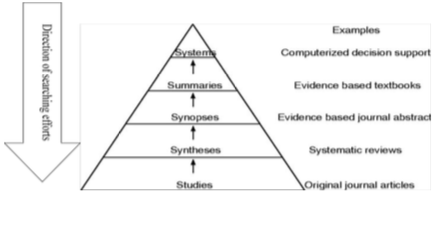
What is the 5S level of organisation of evidence?
Used in clinical decision making when designed to assist healthcare practitioners in targeting high levels of evidence information to aid in clinical decision making.
How do we use evidence in clinical practice?
In Diagnosis
- To identify most likely hypotheses.
- To evaluate likelihood of hypothesis being correct
- The accuracy of diagnostic tests.
In Prognosis:
- To evaluate what happened to other patients with the same condition.
In Treatment Decisions:
- To evaluate the likelihood of different options having an effect - do they work?
- To evaluate the likelihood of adverse events happening to the patient - do different options cause harm?
- Likely acceptability of the treatment by the patient.
Ethnicity is…
- Socially determined.
- Linked with countries of origin and residence, religion, social networks.
- Concept of race is biological and genetic.
- Ethnicity is best self-defined.
Why is ethnicity important?
- It is part of who we are
- It is a potentially sensitive subject
- Disease prevalence varies with ethnicity
- Response to treatment may vary with ethnicity
Treatment and Ethnicity…
- Approaches to best treatment may vary with ethnicity.
- Perception to treatment may vary with ethnicity.
- Ethnicity affects how people, including doctors, behave towards others.
- All this means that the effectiveness of treatment could vary.
Give an example of how disease is affected by ethnicity?
Relatively common conditions, more common amongst certain ethnic groups.
Sickle cell disease: caused by a change in the quality of the beta globin chain
Thalassaemia: caused by a reduction in the quantity of the alpha or beta globin chain
Sickle cell is caused by the presence of Haemoglobin S, in which a mutation results in the replacement of glutamic acid with valine at one position in the beta globin chain. In low oxygen tensions, HbS is less soluble and forms crystals. This causes blood cells to become deformed and rigid, resulting in sequestration of blood vessels and crises.
Recessive inheritance
2 A genes, Haemoglobin AA, No disease
A/S genes, Haemoglobin AS, SC trait
2 S genes, Haemoglobin SS, SC disease
Haemoglobin AS has a selective advantage in areas with malaria
A child can only have the disease if both parents have the disease gene
If both parents are carriers of the gene, 1/4 children will have disease, 1/2 will be carriers
and 1/4 will have no disease gene
Episodes of severe haemolytic anaemia
Painful crises with possible infarcts in bones, lung, spleen, brain
Infections
Sickle cell trait may present with minor symptoms
Impact on range of personal activities including school, work, social life
Impact on relationship with parents, other family members
Reduced lifespan
Concerns regarding parenting
Other possible reactions to inherited disease
Genetic anaemias are a major disease burden. Most common hereditary disorders in the world. UK estimated 12,500 Sickle Cell Disease, >700 Thalassaemia Major. In 2012/13 the screening programme identified 312 babies with a significant condition & 9,368 carriers. Not ethnocentricity, but public health issue.
In the field of management principles, what is primary, secondary and tertiary prevention?
Primary prevention - means taking measures to prevent disease or ill health. An example would be immunisations, which attempt to prevent people from developing a disease in the first place.
Secondary prevention - secondary prevention deals with latent diseases and attempts to prevent an asymptomatic disease from progressing to a symptomatic disease.
Tertiary prevention - attempts to reduce the damage caused by symptomatic disease by focusing on mental, physical and social rehabilitation. Unlike secondary prevention, which aims to prevent disability, the objective of tertiary prevention is to maximise the remaining capabilities and functions of an already disabled patient.
What problems does screening based on ethnicity pose?
- If tests are based on ethnicity, people may be stigmatised.
- Gives impression of ethnic minorities being sicker and bringing disease into the country.
- Potential resentment against resources being directed towards ethnic minorities.
What are the descriptive mechanisms for analysing population research?
Descriptive (what’s it like? - don’t need a control; point in time)
- Survey: to ask (many people) a question or a series of questions in order to gather information about what most people do or think about something.
- Case report - in medicine, a case report is a detailed report of the symptoms, signs, diagnosis, treatment and follow-up of an individual patient.
- Case Series - A case series (also known as a clinical series) is a type of medical research study that tracks subjects with a known exposure, such as patients who have recieved a similar treatment, or examines their medical records for exposure and outcome.
- Cross sectional studies take place at one point in time - a snapshot. The major challenge is how well the study represents the population. It is also impossible to judge cause-effect relationships.
What is analytical population research?
Experimental: The investigator is in control. Interventions are assigned by the investigator. If groups only differ in terms of intervention then changes observed are a consequence of the intervention.
- Randomised Control Trial - randomized controlled trial (RCT): A study in which people are allocated at random (by chance alone) to recieve one of several clinical interventions. One of these interventions is the standard of comparison or control.
- Observational - implies no intervention by investigator. An analysis of spontaneously occuring events. Group assignments (exposure or outcome) are not random. Often used to explore aetiology (cause).
What are the two types of observational study designs?
Cohort (start with exposure and compare outcomes) – A cohort is a group of people who share a common characteristic or experience within a defined period. in medicine, a cohort study is an analysis of risk factors and follows a group of people who do not have the disease, and uses correlations to determine the absolute risk of subject contraction
Case-control (start with outcome, compare exposures) – case-control study is always retrospective because it starts with an outcome then traces back to investigate exposures. When the subjects are enrolled in their respective groups, the outcome of each subject is already known by the investigator.
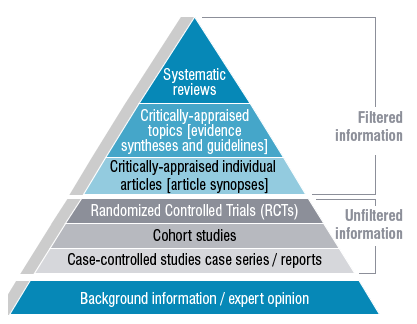
What is the hierachy of strength of evidence for treatment decisions?
What is ‘bias’?
Bias is defined as a systematic error in measurement. This is distinct from random error.



