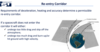
L1 - State Kepler’s three laws of orbital motion
- Kepler’s First Law:
The orbits of the planets are ellipses with the Sun at one focus - Kepler’s Second Law:
The line joining a planet to the Sun sweeps out equal areas in equal times - Kepler’s Third Law:
The square of the orbital period (how long it takes the planet to go around the Sun) is directly proportional to the cube of the mean distance between the Sun and the planet.
L1 - State Newton’s law of gravitation
Newton’s Law of Universal Gravitation:
Any two bodies attract each other with a force proportional to the product of their masses and inversely proportional to the square distance between them
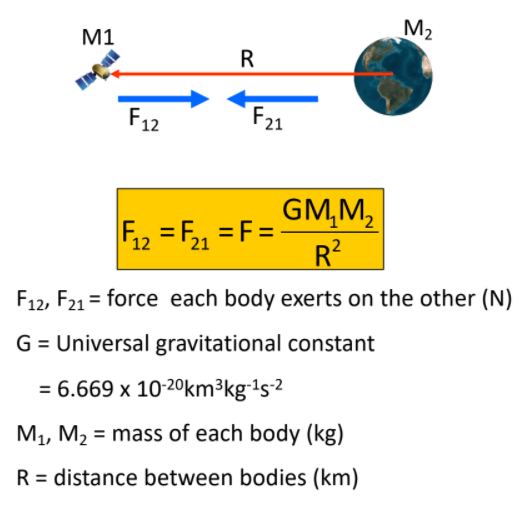
L1 - Describe the restricted two-body problem
Restricted Two-Body Problem:
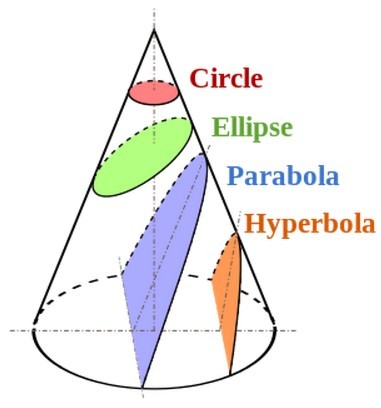
If there are only two bodies which have constant mass and are both exactly spherical, then the small one will follow a trajectory which is a conic section - a circle, ellipse, parabola or hyperbola.
If we apply Newton’s laws where:
- There are only two bodies
- The bodies have constant mass
- The bodies are exactly spherical
We find a small body will fly around a big one on a trajectory which is one of:
- Circle; e = 0
- Ellipse; 0 < e < 1
- Parabola; e = 1
- Hyperbola; e > 1
Eccentricity (e) is a measure of how non-circular the orbit/trajectory is.
Key Facts:
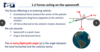
- A satellite rotates around the attracting body in a plane.
- The plane passes through the centre of mass of the attracting body
- A satellite moves along a circle, ellipse, parabola or hyperbola
- The size of the orbit is fixed

L1 - Describe the geocentric equatorial (ECI) co-ordinate system - PART 1
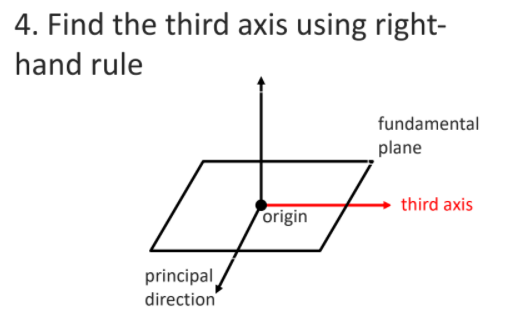
For Earth orbiting spacecraft we use the geocentric equatorial (ECI) system:
- Origin - centre of the Earth (geocentric).
- Fundamental plane - Earth’s equator (equatorial), soperpendicular plane is in the North Pole direction.
- Principal direction - vernal equinox/first point of Aries direction, ^.
- Third axis - found using right-hand rule
(For Sun-orbiting spacecraft we use the heliocentric ecliptic system)
L1 - Describe the geocentric equatorial (ECI) coordinate system - PART 2
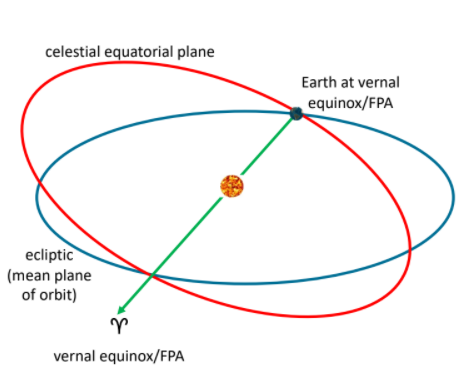
But what is the vernal equinox/FPA?
- The vernal equinox/first point of Aries (FPA) is the point in the Sky at which the Sun appears to be on the first day of spring (March 21) when the night and day have the same length.
- Vernal: spring
- Equinox: equal night
- This is also where the ecliptic (the plane defined by the Earth’s orbit) and the celestial equator (plane of the Sun) cross.
- The FPA moves about 1 degree every 70 years. It is no longer in Aries but in Pisces.
L1 - Explain different general types of orbit
Circular Orbit:
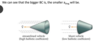
the smaller body has a close orbit around the bigger body, the altitude at the apoapsis equals the one of the periapsis and the eccentricity equals zero.
E.g.: a body in a circular orbit around Earth at 222 km altitude must have a velocity of 7,77 km/s
Excentricity: e = 0
Elliptical Orbit:
the smaller body has a close orbit around the bigger body, the altitude of the apoapsis is greater than the one of the periapsis and the eccentricity is greater than zero and smaller than one.
Excentricity: 0 < e < 1
Parabola Orbit:
the smaller body has an open orbit with respect to the bigger body, it moves upon the minimum escape trajectory and the eccentricity is strictly equal to one.
Excentricity: e = 1
Hyperbola Orbit:
the smaller body has an open orbit with respect to the bigger body, it moves upon an escape trajectory and the eccentricity is greater than one.
Excentricity: e > 1
ISS - Low Earth Orbit
- h = 400 km
- V = 7670 m/s
- T = 92 min
GPS - Medium Earth Orbit
- h = 20,000 km
- V = 3890 m/s
- T = 12 hr
Geosynchronous Orbit
- h = 35800 km
- V = 3070 m/s
- T = 24 hr
Inclination can vary between 0o and 180o and is used to classify a variety of
different sorts of orbit:
- Equatorial orbits i = 0°; i =180°
- Polar orbit i = 90°
- Direct/prograde orbit (moves in directions or Earth’s rotation) i
- Indirect/Retrograde orbit (moves opposite to the direction of Earth’s rotation)
L1 - Draw and label an orbit diagram
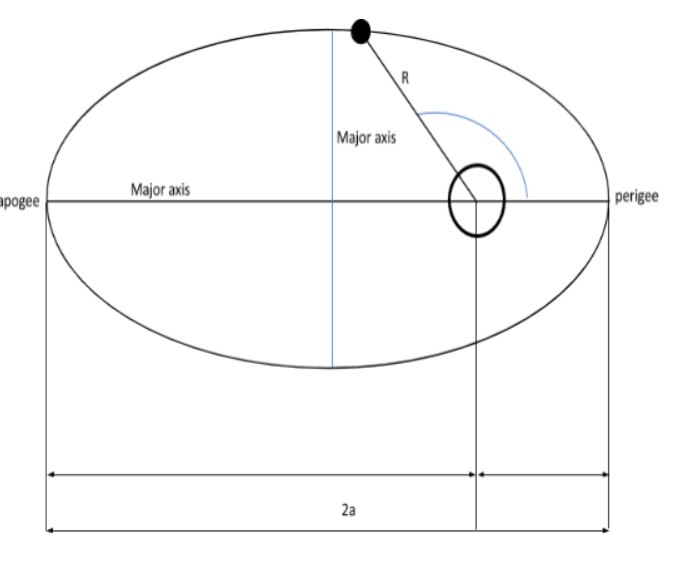
L1 - Use the Classical Orbital Elements (COEs) to define orbits
The orbit of a spacecraft is usually described using the Classical Orbital Elements:
(position)
- Size - Semimajor axis, a
- Shape - Eccentricity, e
- Position - True anomaly, ע
(velocity)
- Inclination, I
- Right Ascension of ascending node, omega
- Argument of perigee, ω
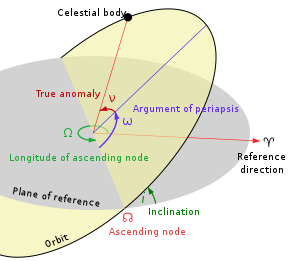
L1R - Define Orbital Velocity
Orbital velocity is constant only in circular orbits. In elliptical orbits it is greatest at perigee and smallest at apogee
L1R - Circular orbit period and velocity
For circular orbits, the period increases with altitude while the velocity decreases.
L1R - Co-ordinate Systems
- Earth orbiting - geocentric equatorial (ECI) system.
- Sun-orbiting - heliocentric ecliptic system.
L1R - Orbital Elements: What do we need to know to describe the motion of a satellite?
Six pieces of information: x,y,z (position) and x’,y’,z’ (velocity)
- Not very user-friendly though, as these all change all the time.
- Instead we use the six ‘orbital elements’ orginally created by Kepler.
- These are often known as Keplerian elements or Classical Orbital Elements (COEs).
- There are many other formulations of orbital elements, e.g. the equinoctial orbital elements.
L2 - Explain what is 3-level model of Space systems Engineering
- Program Level – The uppermost level of the hierarchy. The individual who understands the highest-level interrelationships (including missions, politics, national relations, etc.) can serve in several positions - Space Program Architect, Program Manager, Administrator, Minister of Space…
- Mission Level – The individual who understands the detailed interrelationship among the many vehicle and operational components that make up a mission is the “Mission Designer”
- Spacecraft Level - The individual who understands the detailed interrelationship among the many subsystems which make up a spacecraft is often designated the “Spacecraft Systems Engineer”
L2 - Understand program definition
Program definition can be a very simple statement with task(s) to be performed with all necessary information to begin work:
- Budgetary envelope
- Time frame
- Task to be performed
Example: the Apollo Program
- Time frame = before the end of the 60’s
- Budgetary framework = “no other space mission will be so expensive to accomplish”
- Task = Land a man on the moon and return him safely to Earth
Ø Apollo and Gemini projects resulted
Ø Produced the Saturn Launch Vehicles
Ø Created the lunar orbiter and lander project - Task was achieved in July 1969 (budget was largely overrun)
Program Definition
- It can be very complex with hundreds pages;
- Technical specification and statement of works:
- With different mission statements and all details of mission definition
- Requirements on mission design;
- Large document (hundreds of pages);
- Internally consistent with Technical Specification and Design Specification documents and statement of works with different mission
Space Program Level:
The Program level may integrate multiple
missions along with:
- Internal Agency Strategic Plans
- National Policy Issues
- International Space Law
- International Partnership Agreements
The ideal architect should be a man of letters, a skilled draftsman, familiar with historical studies, a diligent student of philosophy, acquainted with music; not ignorant of medicine, learned in the responsibilities of jurisconsults, familiar with astronomy and astronomical calculations. - Vitruvius, 25 B.C.
Space Program Architecture:
- Program Architecture: The topmost structure, arrangement, configuration of system elements and relationships required to satisfy both constraints and requirements
- In the 3-level Model, we characterize this highest level of integration as the Space Program Level
- Space program may contain several space missions.
L2 - Understand Space mission characteristics
Space mission:
Space mission refers to human activity for the exploration, development and utilization of space and celestial resources outside the Earth, which is an engineering project that uses space technologies to achieve specific goals and covers a wide range of areas.
Space and Celestial Resources:
The vast expanse of space has unique resources not available on Earth, such as
high and remote positions, high vacuum, ultra low temperature, microgravity,
ultra cleanliness, electromagnetic spectrum, solar power and celestial bodies.
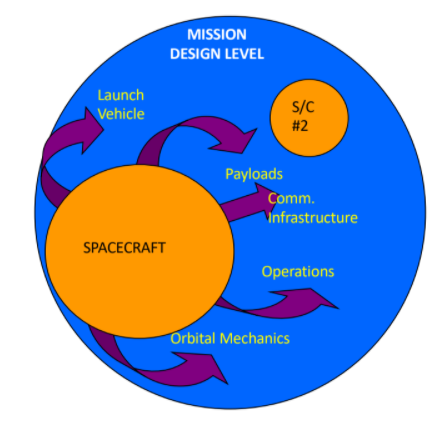
Mission Design Level
- The Space Mission is an integration of
many systems for:
- Spacecraft(s)
- Launch Vehicle(s)
- Orbital Mechanics
- Communications Infrastructure
- Operations
- One Mission may contain several
spacecrafts
Mission Example:
Chang’e 4
Mission definition:
The Chang’e 4 is a mission of Chinese Lunar Exploration program (2nd phase) for the soft-landing and robotic exploration on the far side of the moon.
Mission configuration is comprised of a lander, a rover and a relay satellite:
- Lander and rover are developed from mature Chang’e 3 and adaptively modified according to far-side terrain and relay communication conditions and the operation at moon night.
- A data relay satellite, launched 6 months ahead of the lander and the rover
Features of Space Missions:
- Major space missions basically come from the national or commercial space projects;
- Space missions require huge investments and are highly risky;
- Spacecrafts are normally not repairable and have to be adapted to harsh space environment;
- Space missions have high returns, especially from various application satellites such as communication satellites, navigation satellites, and earth observation satellites
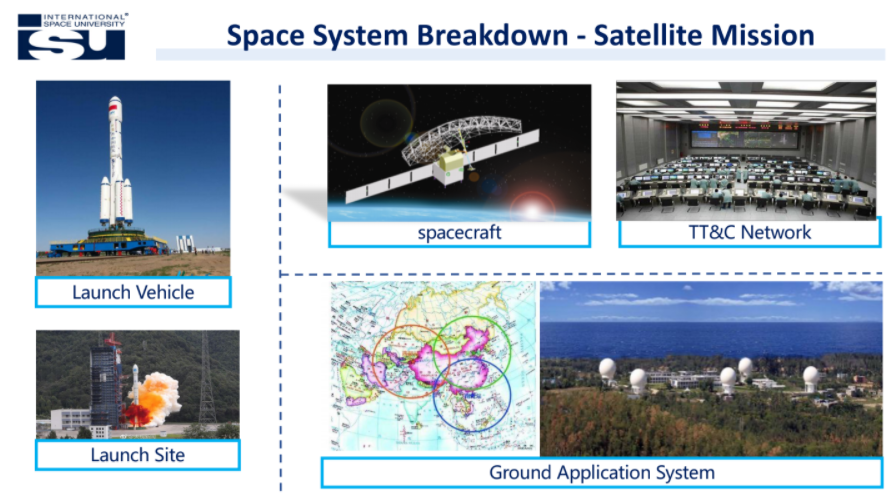
L2 - Describe space system breakdown
Space system: is a system integration which consists of spacecraft; space transportation system; launching site; ground operation and control system(TT&C* network); recovery and landing site; astronaut system(for manned missions) and application system to complete specific space missions.
*Telemetry, Tracking, and Command
Space System
- For space mission, Space system is a system integration of following Systems:
- Spacecraft system and/or Space Infrastructure; (ENG-L04)
- Space transportation system; (ENG-L08)
- Spaceports (Launching, recovery and landing); (ENG-L13)
- Ground operation and control system (TT&C network);
- Astronaut system (only for manned missions);
- Space application system to complete specific space missions.
- According to the general requirements and interface control documents,The systems work together to complete the mission objectives.
- It is essential to optimize all the systems with restrictions.
Space System Design
System design brings together many design elements to create a successful, end-to-end (pre-launch to payload disposal) space mission. See the 5 areas below:
- Payload(s)
- Science instruments / Human crews
- Spacecraft
- Transportation System
- Launch vehicles and upper stages/Cruise stages/Entry vehicles and landers
- Orbit and Flight Mechanics Planetary and transfer orbit selection
- Mission Operation
Communications infrastructure / Mission control facilities Success can be measured by the accomplishment of all the mission-level requirements within the mission constraints.
The core of space system design is to provide the optimal system solution and product under specified constraints including timeline, funding etc.
- Meet the user’s requirements of functions and performance, schedule and cost constraint;
- Carry out system optimization to prevent the local high performance;
- Implement step by step in accordance with the design procedure of the spacecraft;
- The design effort accounts for less than 15% of the life cycle cost of the system, but it decides more than 85% of the life cycle cost of the system.
Space System Design Content
The main tasks of system design :
- Analysis and breakdown of mission objectives and system requirements;
- Selection and analysis of payload;
- Selection and analysis of spacecraft orbit; definition of constellation and
- Analysis and preliminary design of spacecraft platform ;
- Selection and analysis of launch vehicle and launch site; analysis of TT&C and operation during launch and in-orbit operation; determination of interface between spacecraft and other system segments;
- Analysis and estimation of cost and schedule.
Space engineering requirements and trade-off study are the basic methods for system design. (ENG L06 and L10)
L2 - Describe how space projects are broken down into major phases
A space mission could be broken down into 7 phases:
- Phase 0: Mission analysis/needs identification
- Phase A: Feasibility study
- Phase B: Preliminary Design
- Phase C: Critical Design
- Phase D: Development, Manufacture, Integration and Test
- Phase E: Mission Operations and Data Analysis
- Phase F: End of File and disposal
Phase 0 and A:
- Development of system functional and technical requirements;
- Identification of system concepts;
- Selection of an optimum system;
- Demonstration of the feasibility of the project by design and analysis (assessments of technical and programmatic risk);
- Initiation of pre-development activities: Definition of a technical solution to the level necessary to produce realistic date for later stages.
Phase B:
- Definition of the system and subsystem designs in enough detail to allow Phase C/D to proceed smoothly.
- Production of subsystem requirements, design specifications, development plans, programs and proposals.
- Initiation of advanced C/D activities such as ordering of long lead-time items
Phase C/D
- Completion of all designs and analyses.
- Preparation of drawings and procedures
- Completion of all development and qualification testing.
- Manufacture of flight hardware;
- Finish Assembly, Integration and Testing.
Phase E/F
- Launch campaign
- In-orbit operations
- End of Life operations
- Disposal into graveyard orbit
- Disposal into atmosphere
This phase usually accounts for most of the cost of the mission – an important factor in optimization.
L2 - List important tasks that a system engineer carries out in a project team
Basic Requirements:
The tasks of mission design normally are done under the leadership of the systems engineer with team efforts.
- Systems engineer must have a general knowledge of space system engineering;
- Systems engineer should be expert of the details of mission element;
- Systems engineer should have a rich expertise of interaction with users and good skill for team and engineering management.
Key Tasks
- Key tasks for the system engineer in early phases include:
- Requirements identification/analysis
- Options identification and trade-offs
- Mission assessments
- Feasibility assessments
- Cost comparisons
- Concept selection
- These tasks continue through later phases and include:
- System optimization
- System and subsystem specification and definition
- Performance analyses
- Budget allocation/management
- Interface specification
- Support to assembly, integration and test
- Support to mission operations
L2 - Explain the term ‘system budget’ and list important parameters for which budgets are prepared.
About Budgets:
Budgets are used to ensure that all the elements are considered.
System Budgets
- A budget is a quantitative list of a system parameter.
- The first-order evaluation is always based on mass, then
Safety and reliability budgets:
- Reliability budget
- Crew Safety budget
- Specialized risk analyses
- Probability of mission success
Financial Budgets:
- Mass can be used to calculate first-order costs (Cost Estimating Relationships)
- Launch vehicle costs are known at most of the cases.
Understand System Budgets:
Major budgets at the spacecraft system engineering level:
- Mass and mass properties;
- Delta-V and associated propellant quantity;
- Power and energy;
- Pointing accuracy, alignment and stability rate;
- Data rate and storage capacity;
- Communication link budget;
- Reliability and Safety (mainly for Human mission);
- Cost
L3 - Characterise common Earth applications orbits
- Low-Earth orbit - LEO:
- 180 – 3000 km eg//ISS
- Medium Earth orbit - MEO:
- between LEO and GEO eg//GPS
- Geostationary orbit - GEO:
- period of ~24 hours (altitude 35790 km) and inclination of ~00 (in the plane of the equator). This is where the money is made! ITU regulates slots.
- (example – operational telecom satellites)
- Geostationary transfer orbit - GTO:
- an inclined elliptical orbit connecting LEO and GEO used to transfer communications satellites to their operational orbits in GEO.
- Sun-synchronous orbit - SSO:
- a polar orbit with permanent stable orientation of the orbital plane in respect to the Sun (more on this later) (example – SPOT orbit is ~825 km, i = 98.70)
- Highly elliptical orbit - HEO):
- an inclined orbit with an eccentricity e>0.2 (example – space observatory ISO: orbit 1000 ́ 70500 km).
- Mainly used for astronomical craft.
- Molniya orbit:
- high elliptical orbit (500 ́ 35790 km) with a period of ~12 hours and inclination of 630 (more on this later) (example – Molniya 1 satellite).
- Used for places far north or south on the planet.Eg//Russia
L3 - Interpret orbits based on spacecraft groundtracks
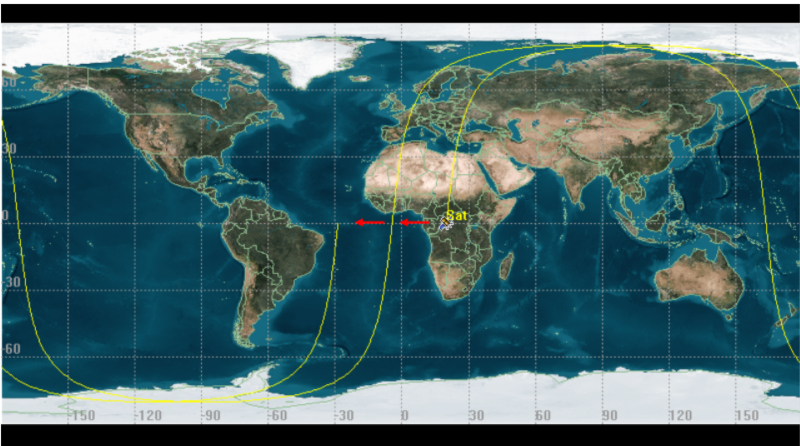
Ground Track
- The path of the satellite traces on the Earth’s surface as it orbits
- From the ground track, you can measure many interesting things:
- Orbital period - by measuring the westward shift of the ground track.
- Inclination of a satellite’s orbit - by looking at the highest latitude reached on the ground track (for direct orbits).
- Approximate eccentricity of the orbit - nearly circular orbits appear to be symmetric, whereas eccentric orbits appear lopsided.
- Location of perigee - by looking at the point where the ground track is spread out the most.
MORE:
The six COEs (classical orbital elements) allow us to visualise orbits in space, but it is important to be able visualise how orbits are seen from/on the Earth.
A ground track is the trace of the path that the satellite takes over the Earth’s surface.
All ground tracks are great circles, because the satellite orbits the centre of the Earth and so the orbit plane must also pass through this point.
- Great circle - any circle which ‘slices through’ the centre of the Earth, e.g. lines of longitude.
The main complexity when interpreting ground tracks arises from the fact that:
- The satellite orbits about the Earth
- The Earth rotates
Each time the satellite completes one orbit, the Earth has turned eastward underneath it, so the ground track shifts to the west.
See Image
We can determine useful information from this shift:
- We know that the Earth rotates at 15o/hour.
- We can measure the node displacement, ΔN, the shift in the track from one orbit to the next.
- From this we can calculate the orbit period and then the semimajor axis.
- As orbit size increases, the semimajor axis get bigger so ΔN gets smaller.
- This is because the satellite takes longer to make one revolution as the Earth rotates underneath it.
- When the period of the orbit is twenty-four hours, the orbit appears to perform a figure of eight and ΔN is zero.
- Geostationary orbit just looks like a spot.
We can also determine the orbit inclination by looking at the ground track.
- Direct orbit (0o < i < 90o) - inclination is given by highest latitude.
- Retrograde orbit (90o < i < 180o) - inclination is given 180o less highest latitude.
Inclination is very important in deciding on coverage patterns for satellites.
SEE image(in Slide p19)
All these orbits have a period of 4 hours, but they have different inclinations.
This can be seen by looking at the maximum latitude of their respective tracks.
Elliptical orbits ones are not symmetrical - they look different above and below the equator.
SEE image(in Slide p21)
Both orbits have P = 11.3 hours, i = 50o and e = 0.5.
However, the yellow has its perigee over the northern hemisphere, and red over the southern hemisphere.
L3 - Explain the major perturbations to Earth-orbiting satellites and their implications for the design of space missions
In the real life, a pure Keplerian orbit can never exists because of perturbations by forces other than central body gravity.
Peturbations:
Disturbing forces that act on a spacecraft to alter its orbit in some way
The primary forces perturbing the orbit are:
- Atmospheric drag - Drag acts in the direction opposite to velocity vector, used for aerobrakeing.
- Non-spherical mass distribution of the planet (Earth) - effects on the node and perigee positions have two very practical applications: 1) Sun-synchronous orbit, and 2) Molniya orbit
- Third body gravity (Sun, Moon, planets, etc.) - GEO orbits do not station in a point but in a bow.
- Pressure of solar radiation
- Solar wind
- Earth’s magnetic field
- Unexpected thrust from outgassing
Lead to:
- Need for drag make-up (LEO)
- Station-keeping (GEO)
- Sun-synchronous orbits (useful)
L4 - List and describe 5 different types of spacecraft
A spacecraft is composed of Spacecraft Bus (or platform) and Payload.
- Telecommunication satellite
- Navigation satellite
- Earth Observation satellite
- Space Science Spacecraft
- Human Space Spacecraft
- Earth observation
- Telescopes, radiometers, radars, spectrometers, IR sensors
- Typical missions: Landsat, Envisat, Hysat, RadarSat, Spot.
- Telecommunication
- Mainly transponder with different frequencies, also Laser terminals, etc.;
- Typical missions: Hotbirds, Intelsat, DFH satellites.
- Navigation
- Tracking and ranging hardware;
- -ypical missions: GPS, Galileo, Glonass and Baidou, etc.
- Human Spaceflight
- Spaceship and crew;
- Typical missions: Vostok, Apollo, Shenzhou
- Science mission:
- Payload directly links with mission objective
- Typical missions: Hubble Telescope, Mar express, Voyager-1…
L4 - List the main subsystems that make up a spacecraft
Main subsystems of Platform:
- Structure and mechanism;
- Power supply;
- Attitude and orbit control (including spacecraft propulsion);
- Communication (TT&C);
- Data handling (Data management);
- Thermal control.
Satellite platform is subsystems of Spacecraft to provide supporting functions necessary to make the payload work in all phases (launching, in-orbit operation and disposal).