What is Cosmology?
Cosmology is the study of the origin, evolution and the ultimate fate of the universe
How did the universe begin?
Today, the most widely postulated theory is the Big Bang theory
What is the Big Bang theory?
Lemaître (1931-33) first proposed that the expansion of the universe started by singular, “something”
Big Bang theory
- Universe formed as the result of a violent ‘cosmic bomb’
- All the concentrated matter of the universe expanded outwardly as a hot gas to form both space and time
- The hot gas condensed to form stars and galaxies
- Galaxies eventually separated and are still moving away from us today
Hubble’s Law
The further away a galaxy is, the faster it is receding.
Big Bang may have had two distinct periods
- Inflationary Period
Very rapid period of expansion immediately following the start of the BigBang and all the energy and matter in the universe was created
- Post-Inflationary period (today)
the universe continued to expand in a “coasting” fashion and continues like this to this day
What existed before the Big Bang?
In theory, this question is illogical! The Big Bang theory assumes that this singular event was responsible for the creation of both space and time. Hence, we cannot really talk about what existed before it
What is Astrobiology?
Astrobiology is the interdisciplinary study of the origin, evolution, dispersion and future of life in the universe (NASA definition)
3 Astrobiology Epochs
- Cosmic evolution of biogenic compounds
- Prebiotic evolution involving the synthesis of increasingly complex biogenic compounds e.g. amino acids
- The evolution of simple unicellular organisms (from precursor biogenic molecules) and the continued evolution to increasingly advanced life forms
Give a credible, scientific definition of life
The ability to sustain metabolism, reproduce, and evolve
The absence of death
Explain the concept of Habitability Zones
These are zones around stars where the probability of finding life is elevated (“The Goldilocks Zone”)
For example
Massive stars have short main sequence lives, hence organisms may not have sufficient time to evolve.
Likewise, Low mass stars may not provide enough luminosity to maintain liquid water (there may be exceptions).
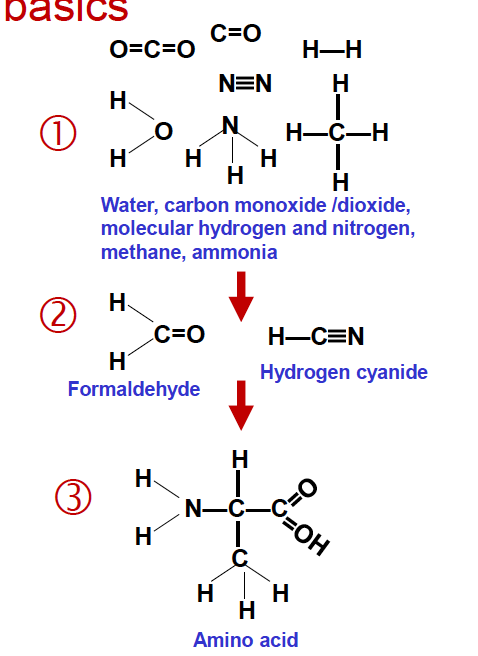
Explain the rudiments of prebiotic chemistry on earth, i.e. how simple molecules (carbon monoxide, carbon dioxide, molecular hydrogen and nitrogen, methane, ammonia) were processed by liquid water to eventually form amino acids
Prebiotic chemistry probably consisted of 3 levels
- The simple molecules like CO, CO2, NH3, H2O, H2, N2 and CH4 must have existed
- These then combined to compounds like formaldehyde (CH2O) and hydrogen cyanide (HCN), with the input of energy like radiation and heat from the Sun or heat from geological processes
- For level 3 compounds to form, bond energy was sufficient
Why was carbon dioxide important for the emergence and evolution of life on Earth?
- The early Earth was much colder than it is today as the Sun’s luminosity in its first 1 Ga was ~30% less than it is today
- CO2 compensated for the Sun’s initial low luminosity by creating a stable “greenhouse effect” which sustained liquid water, a key ingredient of life
- CO2 came from two main reservoirs
- Volcanic emissions
- Cometary bombardment
Summarize one theory, which accounts for the extinction of dinosaurs (and many other species) some 65 Ma ago
- Dinosaurs ruled the Earth for 135 Ma
- Most dinosaur extinction theories are cataclysmic/catastrophic
- Most popular theory (1980) suggests that an asteroid impacted the Earth at 64,000 km h-1 (1,778 m s-1, ≈5 Mach)
- It generated an enormous ejecta cloud that exploded outward
- There were tsunami’s
- The sky turned red and the heat generated burnt biomass and generated plumes of black smoke
- The sky cooled down after about an hour but remained black for many months
- The light loss produced freezing conditions and ceased much photosynthesis for perhaps three years…
What happened to Mars’ liquid water?
Mars is much smaller than Earth (circa half its diameter) and this has some important implications
- It has a lower gravitational field (35% of Earth’s), which allows liquid water to evaporate into interplanetary space. In this way, the Martian surface has become desiccated over time
- Small bodies lose internal heat more rapidly than larger bodies and internal heat powers geological activity.
Hence, Mars now has much less activity (volcanoes, earthquakes, etc.) than Earth that could melt water ice on or just below its surface
Summarize the three strands of evidence, which were originally presented by scientists proposing that the Martian meteorite, Allan Hills 84001, contains ancient evidence of life on the Red Planet
Mineral grains akin to those made by Earth bacteria
Within carbonate minerals, there are grains of iron oxide mineral magnetite (Fe3O4) and iron sulfide similar to some produced by bacteria on Earth and used as compasses to align themselves with the magnetic field. Note that similar grains can grow abiotically
Polycyclic aromatic hydrocarbons (PAHs), organic molecules that might be from decomposed organisms
Within carbonate globules are PAHs, ring compounds associated with the burning or decomposition of plants/animals. However, PAHs can also be synthesized abiotically
Objects that have comparable sizes and shapes to Earth bacteria
Rod-like objects on surfaces of carbonate globules were interpreted as fossilized bacterial colonies. They are ~0.01-0.1 µm long unlike Earth bacteria, which are generally >> 0.5 µm. However, “nanobacteria” have recently been discovered on Earth
Are there other theories about the origin of the universe?
No, but the “flawed” steady-state theory of Fred Hoyle et al. (1948) was, historically, a competitor
- It asserts that the universe has always existed and always will and that it is expanding
- Small amounts of matter are produced every year to support steady-state (~ 1 hydrogen atom per m3 per 109 years plus dark matter
- The theory is generally rejected by Cosmologists for several reasons, e.g. It fails to explain the 2.7 K CMB continuum
What evidence is there for the Big Bang theory?
The expansion of the universe
The expansion of the universe as deduced by observations of distant galaxies (“recession”) by Edwin Hubble and astronomers ever since
The 2.7 K Cosmic Microwave Background Radiation
- The Big Bang was a violent cosmic bomb
- We can observe the “cooled down remnant” of this fireball throughout the universe today as the CMB, a faint signal of the infant universe peaking in the microwave part of the spectrum
- Not perfectly isotropic
- CMB essentially identical to the theoretical spectrum calculated for a perfect radiator (perfect black body)
The nuclear abundances
The abundances of nuclei predicted by the Big Bang seem, at least superficially, to be in overall agreement with the nuclei we observe in the universe today
- Nuclear physicists can calculate how much hydrogen (H), helium (He) and deuterium were formed in the first three minutes after the Big Bang
- We can combine this work with the theory of the hot expanding universe to predict the types of elements produced
How old is the universe?
The universe is ~ 13.7 Ga
By measuring the rate of expansion of the universe and extrapolating it back to the start of the Big Bang, e.g. using the WMAP
The universe is ~ 11-18 Ga
By observing the oldest stars, they can give a lower limit to the age of the universe
Will the universe continue expanding forever?
The universe may stop expanding if there is enough matter in the universe (Critical Density)
- The galaxies are moving apart but their mutual gravities are trying to pull them together
- At some point in the future, the universe may stop expanding and start contracting (the “Big Crunch”)
What is Critical Density?
CD is a theoretical value at which the universe should cease expanding, stop, and then contract
Will CD affect the ultimate fate of the universe?
The critical density of the universe has not been established as astronomers can only observe a modest proportion of the total matter in the cosmos. This is because of dark matter (“missing matter”), which are bodies that are inferred to exist but appear invisible to astronomical detectors
What is dark matter?
= Matter assumed to exist but not directly observable (“dark”)
The precise composition of Dark Matter is still debated hotly in the astrophysics community but may include
- The elusive neutrino
- MACHOS (unobserved brown dwarfs, planets, mini galaxies, etc.)
- WIMPS (exotic particles)
- Other exotic contenders
Explanation
Astronomers could not explain the very rapid rotation of galaxies. Milky Way was behaving as if it was ten times more massive. A way of explaining these rapid motions is the existence of “Dark Matter”.
In the standard model of cosmology, data claims that:
26.8% = dark matter
What is Dark Energy?
Dark energy is a poorly characterized type of energy that is omnipresent in the universe and may explain the rate of expansion of the universe that we observe today
Explanation
Many cosmologists have argued that dark matter alone, cannot account for recent observational data and models of the geometry and total mass in the universe. The universe’s expansion is accelerating and dark energy can help explain this
• 68.3% = dark energy
Why was O2 (“free oxygen”) important for the evolution of life on Earth?
- Free oxygen (O2) was initially scarce as the dominant source of this gas (at least today) is biomass
- But increased O2 concentrations from photosynthetic cyanobacteria (like stromatolites) resulted in the first fully-assembled eukaryotic cells ~2 Ga ago
- Relatively sophisticated eukaryotic cells ultimately evolved into the multi-cellular animals/plants in the last 500 Ma (only)
Distinguish between different types of waves (mechanical, electromagnetic)
Mechanical wave
Is a disturbance of a medium due to the vibration (oscillation) of an object in contact with, or bonded to it
Mechanical waves are waves that require a medium in order to transport their energy from one location to another. Because mechanical waves rely on particle interaction in order to transport their energy, they cannot travel through regions of space that are void of particles. That is, mechanical waves cannot travel through a vacuum
Example: Sound
Needs a medium to travel through, molecules carry sound waves by colliding into each other. In space, there is no sound since there are no molecules around
Electromagnetic wave
Electromagnetic waves are waves that have an electric and magnetic nature and are capable of traveling through a vacuum. Electromagnetic waves do not require a medium in order to transport their energy
Example: Light
Do not need molecules to travel. They can travel through air and certain materials (e.g. glass, water) and through the vacuum of space
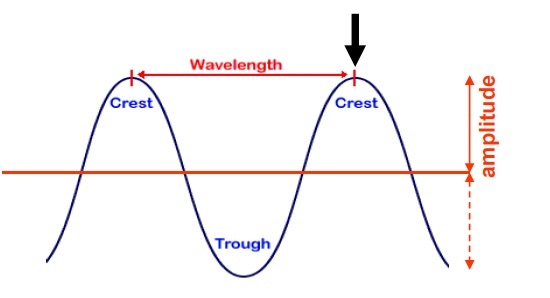
Describe some of the basic features of electromagnetic radiation: wavelength
Distance between one wave crest to the next. Is expressed in lambda, λ, in meters or nanometers
The concept applies to all types of waves
Explain the origin and name some basic characteristics of
electric fields
Electric field
A Region where forces are exerted on an electric charge by another electric charge or group of charges e.g. two adjacent protons, experience this force in the area around them
Created by
The mere existence of a charge
Electricity
- A basic, intrinsic, fundamental property of matter
- All matter is “electrical”
- A piece of “electrical matter” is called a “charge” (q)
- An electric charge (q) also has a mass (m)
- Examples of charge: electron (-), proton (+), ion (single or multiple + or -)






