List and explain the several rationales for government support of space activities
Space activities such as launching and operating satellites and other spacecraft are still expensive, risky and hard. So why do it?
- Private sector: the rationale is creating a profitable business
- Very wealthy individuals: the rationale is achieving a personal vision
- Governments: the rationale is to use space to serve a wide variety of national and public interests -> Political Rationale
Identify the purposes for which a particular government is currently undertaking space activities
- Increasing Scientific Knowledge
- Exploring the Unknown
- National Prestige and International Leadership
- Protecting National Security
- Enhancing Military Capabilities
- Keeping Space Secure
- Providing Tangible Benefits to Society
- Assisting in Sustainable Development
- Facilitating Space Commercialization
- Stimulating Technological Innovation
- Motivating Technical Excellence
- Extending Human Presence and Activity Beyond Earth
Discuss the reasons for government-sponsored programs to send humans into orbit and beyond
Humans living and working in space, especially in low Earth orbit or cislunar space, can carry out various activities more effectively than robots. Some argue that humans should travel beyond Earth orbit for one (or more) of several reasons:
- Superiority of humans as explorers
- Space settlement
- As an example of tension-reducing cooperation
- To extend human experience
- To ensure species survival
- Because it is human destiny
From the start of space activity, exploration missions to astro-objects in the solar system have been carried out robotically;
The vision of human exploration and eventual settlement beyond Earth orbit has been long-standing and remains alive today, but the vision must motivate governments to sustain a human exploration effort; Most large space agencies are today making plans for human space exploration.
Understand the main rationales for the development of space policy
Keeping space secure
To secure the uses of space by all, there is growing interest in finding ways to free space from threats (debris, overcrowding and weapons).
Three approaches to achieving this goal:
- Legally-binding treaties
- Voluntary international “codes of conduct” or “rules of good behavior”
- Space faring counties individually acting in the common interest
Compare the legal frames applicable to the seas, to Antarctica and to space
Outer Space / sea / antarctica = international zone and “common heritage of mankind”
- States shall establish an international regime to govern the exploitation of the Moon resources
- Similar to the deep sea bed regime (Convention on the Law of the Sea, 1982)
Law of the sea
Contain ancient rules and new rules to try to avoid disputes among states concerning seas and oceans. Territorial claims up to the second world war: states had only sovereignty over a small part of the sea. Slowly coastal states claimed jurisdiction over the seas. Finally, we decided to divide it into two different zones where states had rights and powers. The deep ocean has a lot of natural resources and belongs to everybody, states can only exploit if they accept the jurisdiction of an international organization. This organization will issues licenses for mining the ocean
Space
In Space law the same questions, states will ask rights in outer space. Until 1955, most of the sea was international. Because it became important in the economy, states wanted to extend force and this happens in space as well. The international court of justice can be used when diplomacy problems arise. It’s not the question of dividing the zone but see what each country needs, everybody wants to find a compromise.
Antarctica for scientific purposes. To avoid that Antarctica becomes a zone of conflict:
- Peaceful purposes only
- Freedom of scientific investigations and cooperation
- No territorial claims (everybody signs / no dispute)
1) United Nations Convention on the Law of the Sea of 10 December 1982
2) The Antarctic Treaty of 1 December 1959
Explain the difference between Treaties, Resolutions and Guidelines as they relate to space law
Treaties
Sometimes you have to comply with the treaties because it contains rule based on a practice of states so it’s an obligation
- Treaties are sources of law
- Rules contained in treaties are binding for States that have accepted to be bound by them: ratification
- Rules bind third parties if they have a customary value
- A custom is a non-written general practice accepted as law
Resolutions
The recommendation is not binding = political statement. Can’t force to comply with the text. However, most countries do in good faith. It’s binding if they represent customs = soft laws because they are only statements
- Resolutions are documents adopted by international intergovernmental organizations
- Resolutions adopted by the United Nations General Assembly are recommendations
- Recommendations are not sources of law
- Recommendations are not binding unless they represent customs
Guidelines
Not a source of law - not binding
Explain the principles of Non-appropriation as this is included in the UN Charter and in the different Space Treaties
General principle
“Outer space, including the moon and other celestial bodies, is not subject to national appropriation by claim of sovereignty, by means of use or occupation, or by any other means”
~ Outer Space Treaty, Article II
“The moon is not subject to national appropriation by any claim of sovereignty, by means of use or occupation, or by any other means. Neither the surface nor the subsurface of the moon, nor any part thereof or natural resources in place, shall become property. The placement of personnel, space vehicles, equipment and installations on or below the surface of the moon, shall not create a right of ownership over the surface or the subsurface of the Moon”
~ Moon Agreement, 1979, art. 11 2
Common heritage of mankind
“The moon and its natural resources are the common heritage of mankind […]. States Parties undertake to establish an international regime to govern the exploitation of the natural resources of the moon as such exploitation is about to become feasible”.
The regime shall include
- orderly and safe development of Moonnatural resources
- rational management of resources
- expansion of opportunities in the use of Moon resources
- An equitable sharing by all States Parties in the benefits derived from Moon resources
~ Moon Agreement, 1979, Art. 11
Moon agreement: states have the right to collect moon samples and use resources for institute activities. If you remain scientific, you are not violating the law. No property right on celestial bodies.
Explain the principles of Non-weaponization as this is included in the UN Charter and in the different Space Treaties
SPACE LAW
Peaceful purposes
- Outer space has to be used for peaceful purposes
- Celestial bodies have to be used exclusively for peaceful purposes
- According to a consensus among space faring nations, peaceful purposes means “non aggressive”
~ Outer Space Treaty, 1967 Article IV
~ Moon Agreement, 1979 –Article 3
Weaponization
- Partial non-weaponization of Earth Orbits
- Not possible to place in orbit around the earth any objects carrying nuclear weapons; any other kinds of weapons of mass destruction (WMD)
- Possible to place in orbit around the earth other weapons than WMD; use outer space around the Earth for the transit of WMD
- Complete non-weaponization of Celestial Bodies
- Not possible to install WMD on celestial bodies or around celestial bodies
- Not possible to test any type of weapons and conduct military maneuvers
~ Outer Space Treaty, 1967 - Article IV
~ Moon Agreement, 1979 - Article 3
Transparency
Each State of registry shall furnish to the Secretary-General of the UN, as soon as practicable, information concerning each space object carried on its registry
- General function of the space object
- Date and territory or location of launch
- Basic orbital parameters
~ Registration Convention, 1975 -Article IV
Application of UN Charter Principles
States shall carry on activities in outer space, in accordance with international law, including the Charter of the United Nations, in the interest of maintaining international peace and security
- e.g. Right to Self-Defense
~ Outer Space Treaty, 1967, Article III
DISARMAMENT LAW
Nuclear weapons testing
Obligation to prohibit, prevent, and not carry out any nuclear weapon test explosion, or any other nuclear explosion, at any place including outer space
- *Disarmament and non-proliferation**
1979: The Conference on Disarmament (CD) has been established as the single multilateral disarmament negotiating forum. The CD is the primary body for negotiating prevention on an arms race in outer space (PAROS)
TCBM’s Transparency & Confidence-building measures
- 2012 the Group of Governmental Experts (GGE) on Transparency and Confidence-building Measures (TCBMs) in Outer Space Activities was established. The GGE recommended that States consider actions and implement them on a voluntary basis
- e.g. expert visits to national space facilities
Note:
To develop space armies does not violate the treaty. because it isn’t an active measure, but a defensive one
Explain the main rules concerning activities of States in outer space
Freedom of outer space
includes freedom of access (to all zones), freedom of exploration (scientific activities), freedom of use (commercial activities), freedom of scientific investigation on celestial bodies
~ art 1, OST
It is not written that all states have the rights to access outer space, but that once the state is in outer space, it has access to all zones
Freedom of outer space concerns:
- all States including developing countries
- international intergovernmental organizations
- private companies and associations
~ art 1, OST
The private sector needs previous authorization from the state to access space
Status of Astronauts
- Astronauts are envoys of mankind in space – they have the right to be rescued regardless of their nationalities
- States shall render to them assistance in case of accident, distress, or emergency landing including safe and prompt return to the State of registry of their space vehicle
- In outer space, astronauts of one State shall render assistance to the astronauts of other States
~ Outer Space Treaty, Article V
~ Rescue Agreement
Jurisdiction and control
Ownership of space objects is not affected by their presence in outer space. The State of registry of an object launched into outer space shall retain jurisdiction and control over such object, and over any personnel thereof. The law of this State is applicable to the space object
Protection of environment
- Planetary Protection
1959, planetary protection was transferred to the Committee on Space Research (COSPAR); OST: States shall avoid harmful contamination of Space and also adverse changes in the environment of the Earth resulting from the introduction of extraterrestrial matter
~ Outer Space Treaty, Article IX; Moon Agreement, Article 7 - Nuclear power sources
- Minimize the quantity of radioactive material in space and the risks involved
- Guidelines and criteria for safe use
- Notification of re-entry
- Space debris
- No legal definition of space debris
- The term “space object” includes component parts of a space object as well as its launch vehicle and parts thereof
- Inter-Agency Space Debris Coordination Committee (IADC); UNCOPUO; The UN General Assembly (UNGA)
Cooperation among states
- Cooperation
co-operation and mutual assistance and respect of the corresponding interests of all other States - Consultation
in case of activity in outer space which would cause potentially harmful interference with activities of other States in outer space. In case of interferences, the way to solve them is the consultation
~ Outer Space Treaty, Article IX
~ Moon Agreement, Article 4
Scientific cooperation
- States agree to inform the Secretary-General of the UN as well as the public and the international scientific community of scientific activities conducted in outer space
- The Secretary-General of the UN should be prepared to disseminate this information
~ Outer Space Treaty, Article XI
~ Moon Agreement, Article 5
Respect of international law
States shall carry on activities in outer space in accordance with international law, including the Charter of the UN, that recognizes the use of self-defense in outer space
~ Outer Space Treaty, Article III
~ Moon Agreement, Article 2
Explain the concepts of responsibility, liability and registration
Responsibility
“who is responsible before the law” - it deals with the obligation to supervise and control the activities in outer space
- States shall bear international responsibility for national activities (public and private - space law is an exception since no other legislation says that a state is responsible also for the private sector) in outer space
- States shall ensure that national activities are carried out in conformity with the space law treaties
- The activities of non-governmental entities in outer space shall require authorization and continuing supervision by the appropriate State Party to the Treaty. Today we talk a lot of privatization and liberalization, but there won’t be any private space activity without the state authorization
~ Outer Space Treaty, Article VI
~ Moon Agreement, Article 14
Liability“who pay in case of damages”
- The regime is applicable to all damages resulting from a collision with space objects
- It does not apply to damages caused by the space service
- In case of damage caused on the surface of the Earth or to aircraft flight, the launching State is absolutely liable to pay compensation (the victim does not have to prove the fault)
- In case of damage caused in outer space the launching State is liable only if the damage is due to its fault (the victim does have to prove the fault)
~ Outer Space Treaty, Article VII
~ Liability Convention
Registration
“It is a way to identify an object in space in case of damages”
- National register
- When a space object is launched into space, the launching State shall register
- Where there are two or more launching States they shall jointly determine which one of them shall register
- International register
- Each State of registry shall furnish to the UN Secretary-General as soon as practicable information concerning each space object carried on its registry
- Other means of identification
- States shall cooperate to identify a space object which has caused damage
~ Registration Convention, Article
- States shall cooperate to identify a space object which has caused damage
Explain the main drivers of space activities and policies and link them to the theory of political science
The space activity has been structured by the political cycles of the 20th Century. Relationships between space and security have also been determined by military strategies and their historical and legal contexts.
Importance of the Cold War and of the Nuclear and Ballistic era
Cold war, state being the central actor, promotion of national interest and prevalence of foreign policy consideration
-> realism and constructivism
End of the Cold-War Era
New space nations, new space/private actors
- Public budget has played a key role in the rise of commercial space
- Commercial space can only develop if it makes sense and is supported politically
-> realism + plurism
Very different views depending on national interests and history
The driving force behind space:
Technological capabilities + political project
- Civilian space: episodic connection
- Military space: enduring connection
Explain the space political cycles and how they impact the evolution of space developments including military space
The space activity has been structured by the political cycles of the 20th Century
Importance of the Cold War and of the Nuclear and Ballistic era:
- US and USSR 2 first space faring countries
- Gradually, largely dominating role of the U.S. as a structuring actor for the space activity
End of the Cold War Era
- new political meaning for space (budgets, programs, etc)
- new countries, Public/Private actors
Historically, relationships between space and security have also been determined by military strategies and their historical and legal contexts
Strategic space
1955, Space was born from the nuclear induced military revolution and has remained alive over the years = an unsurpassable base
- Protecting against ballistic threats
- Ballistic launch detection
- Nuclear tests detection
- Outer space treaty (1967): Peaceful uses of outer space as a “pragmatic “ concept fully compatible with the “useful” military applications of space (monitoring, early warning, communications)
Operative/Tactical Space
1990, Space adapting to new strategic conditions: built for major theater wars
Wider use of space “on the battlefield”
- Triggered by the first Gulf War: Increasing needs for data and information (special forces, etc.)
- New applications for space systems): Guided weapons, telecommunication, monitoring and detection etc.
“Security Space”
1995-2000s, Mission extension determined by the emergence of new threats. Space applications at the heart of weapon as well as intelligence and information systems
Creates a “holistic” approach of national security federated by a comprehensive information system answering the need of
- military security
- environmental security
- “Homeland Defense”, security of the citizen
- “economic and industrial security”
–> evolution: more and more security and defense oriented (not only military per se)
Controlled space
Towards a new international political and legal era.
As soon as the end of the 90s, space has been perceived as a new vulnerability given its increasing role in Defense and security at large.
Space applications have gained a major economic and societal role, involving human security
- Military aspects: emergence of a “space control” doctrine
- Diplomatic aspects
New legal and policy-oriented norms aiming at preventing the development of conflicts in space and at promoting better transparency and
- Prevention of the development of space weapons
- Curbing the causes of satellite destructions (debris, intentional activities)
- Management of orbital positions and traffic
- Management of radio interferences
Many actors are involved while heavy political issues are at stakes: overarching organization not reached yet
Explain how in Europe multilateralism and the security dimension affects integration and programs in the space sector
A European Space Policy is not an option anymore but an obligation. Today: “space for security” in Europe. New connection between Policy and Space technology
- Idea of political maturity: Europe must assume its political identity
- Based on the traditional engine of the European construction, i.e. R&D (CERN, Euratom tradition)
- Space as a provider of soft power in a context where a common ESDP remains a “work in progress”
Space applications more and more devoted to societal security issues. Space has become (and has been recognized as) an element of the « Security of the European Citizen »
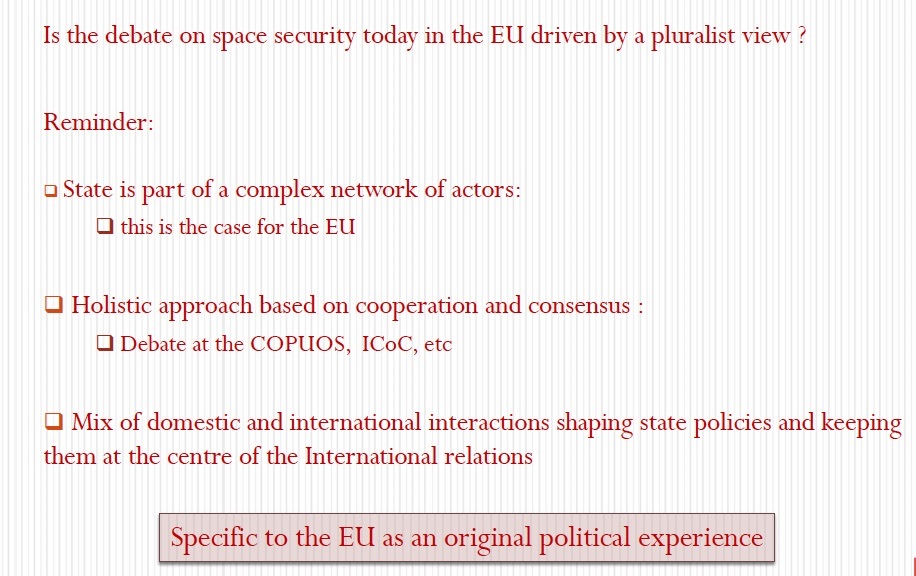
- Europe is used to think in cooperative terms (Dominant pluralist view)
- SSA in Europe showing a long term emergence of a pluralist view of International relations in Space
Is the debate on space security today in the EU driven by a pluralist view?
—-> A pluralist society allows its members to express their beliefs freely
Understand the difference between spin-off and spin-in
Spin-in has the advantage to share achievements of non-space technoloies to space (mature technology) Spin-Off has the advantage to bring technology to the market (cutting-edge tecnologies) and represents strong promotion for space activities.
Understand the difficulties to reach the final users with technology transfer.
The transfer of tech sounds easy on paper but is not easy in reality. Main difficulties: - Communication issues between scientist and practitioners - Spin-off publications are too scientific - First discussions with EO specialists and farmers were not successful (you need somebody in between) - Recently more intermediaries used - Insufficient emphasis and budgets (Peeters’ opinion) - In some countries: military impact (Export Control)
Explain why real-life examples and movies are efficient means to promote space spin-off.
Because people can better understand how space affects everyday life (spin off) – gps for blind people, sudden infant death syndrome prevention, prostheses parts for a para-olympion, use robotic technologies developed for iss and shuttle to move fake animals in theme parks. Movies show how astronauts are training for example (apollo 13) – not all them!!
Describe different methods that can be used to quantify the impact of spin-offs.
Most common used approach : Diffusion-based model, developed by BETA (UDS, Strasbourg) Measures 4 effects :- - Technological (direct) : new products originated? - Commercial (indirect) : increased networking/ reputation - Organizational (indirect) : Methods (PA, zero-fault, …) - Work factor : new skills acquired?
Understand the importance of spin-in.
- Budget cuts - Technology life times longer in space - Less globalisation, hence less technology transfer - Export control
Describe the underlying rationale of export control.
Technology transfer and export control are strong linked: • Countries are concerned about uncontrolled export of certain knowledge and technology • Concerns: – National security concerns – Prevent proliferation of Weapons of Mass Destruction (WMDs) and missile delivery systems – Restrict exports of goods/ technology that could contribute to military potential of adversaries/rogue countries – Traceability of transactions
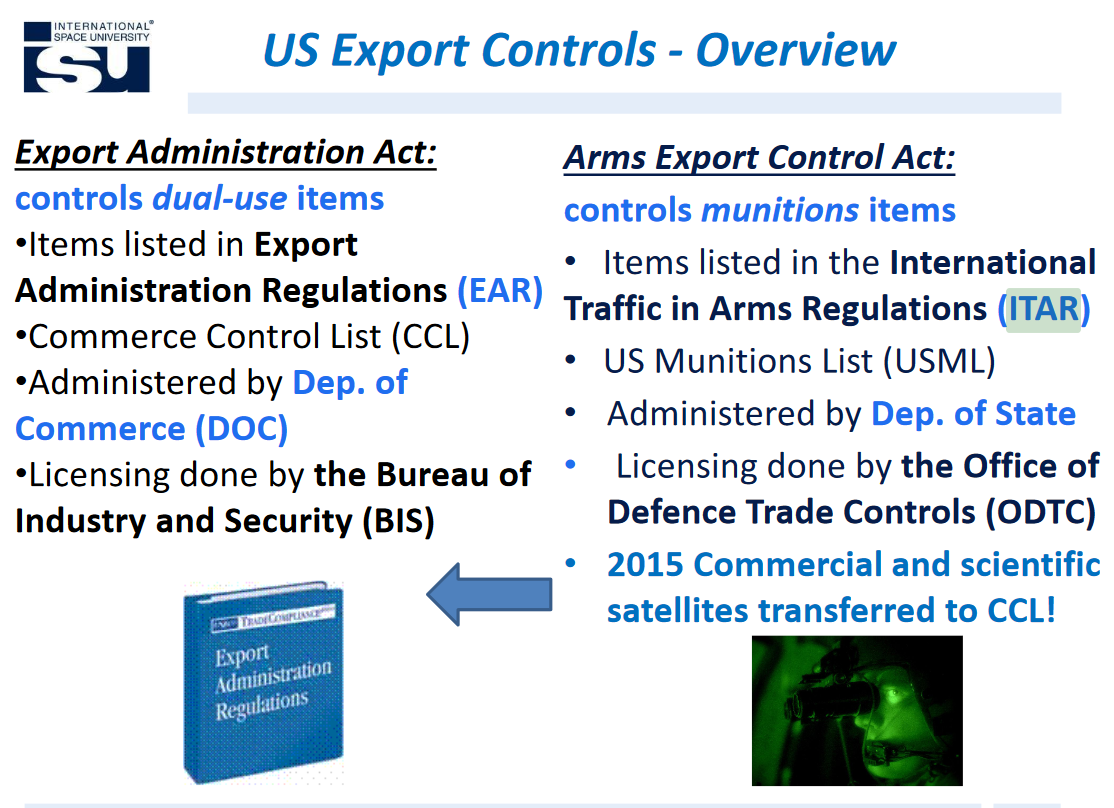
Understand the difference between ITAR and export control in general.
ITAR is one type of export control used by America for arms regulations. It is specific.
Describe the developing new markets in the different space regimes.
> Suborbital – you go up and come down. It is not difficult like the other two. Tourist Industry: • Companies selling tickets for the suborbital experience from $250K (Virgin Galactic) • Balloon rides to the stratosphere (World View). Research: • Microgravity (around 4 to 10 minutes crewed, 13 minutes sounding rockets) • Upper atmospheric measurements • Technology demonstrations • Life Sciences and Microgravity experiments. Point-to-Point Travel: • Travel from one location on Earth to another through space (point-to-point) > Orbital – satellite servicing, earth imaging, navigation, communications, broadband, finance, data security, tourist industry, research/applications > Deep space – tourism industry, research, mining in situ resource utilization, servicing a space-based economy, settlement
Discuss how governments are facilitating the birth of this new industry.
USA Government worked closely with industry to USA : Government worked closely with industry to fund studies that retired technological risks and enabled private enterprise to successfully create a new industry. Purchasing and using commercial space capabilities and services to the maximum practical extent. Actively exploring the use of inventive, nontraditional arrangements for acquiring commercial space goods and services. Refraining from conducting U.S. Government space activities that preclude, discourage, or compete with U.S. commercial space activities. Pursuing potential opportunities for transferring routine, operational space functions to the commercial space sector where beneficial and cost-effective. ESA: • ESA provides opportunities for entrepreneurs, start-ups, smaller companies and European businesses for available technologies, expertise, patents, systems and services from ESA’s space programs. ESA patents up to 20 inventions a year; portfolio of about 530 patent applications and patents. Subjects; radio-frequency payloads and systems, structures and pyrotechnics, electromagnetic technologies and techniques, material and processes, robotics, optics, electrical power and propulsion. Opportunity for entrepreneurs and start-ups to turn their ideas and inventions into successful businesses in Europe. Japan: The Japanese government, working with private ventures, establish a nearly billion-dollar fund to support the development of space startups in the country Luxemburg: Promote space resources, build regulatory framework, develop top-tier talent, offer R&D support, enable long-term investment
Discuss the growth of private financing for enabling new space companies to succeed.
Substantial rise in start-up space investment since 2015 and number of founded Companies. 2018 was a record year for the amount of private capital raised, and was the fourth consecutive year of $2.5 billion or greater investment in start- up space companies
Explain the political paradox of why an increased international cooperation and transparency can help enhance national security.
The space environment is highly specific and makes collective security and transparency necessary prerequisites for enhanced national security. • Any event in orbit, intentional or non intentional, may have undiscriminate effects on all space systems • It implies national restraints and collective information sharing.




