Give a broad description of 20th century space history and the space race
Russian, Konstantin Tsiolkovsky (1857-1935)
- First person to look at rocket-powered spaceflight
- Calculated the velocity needed to get into orbit
- Suggested the use of liquid hydrogen and oxygen engines
As a result of Tsiolkovsky’s work, in 1924 the USSR created the Bureau for the Study and Development of Rockets
American, Robert H. Goddard (1882-1945)
- Experimented liquid-fueled rockets
- Successfully launched the first rocket on 16th March 1926
- Was ignored by US Government
Austro-Hungarian/German, Hermann Oberth (1894-1989)
- Wrote the book “Ways to Spaceflight”
- Did the film “Frau im Mond”
German, Werner Von Braun (1912-1977)
In pre-war Germany, there were several amateur rocketry organizations which were strongly backed by the government. Von Braun was a young member of one of these
- Worked on the development of V2 rocket - 1st ballistic missile - 2000 of which were launched during WWII toward England
- Between 1946 and 1952, V2s were used for carrying scientific payloads and to allow America to develop its own rocketry expertise
- He popularized space through radio and TV
The USA got von Braun and his team, all their records and enough components to build 68 V2s.
Space Race
1957-1969, a competition between Communism and Democracy
- 4th Oct 1957, Russians launched an unmanned Sputnik satellite into orbit
- Oct 1958, US creates NASA, in order to put a human in space before the Soviets
- 3rd Nov 1957, Russians launched Sputnik II carrying the dog Laika
- 6th Dec 1957, American Navy “Vanguard” rocket explodes
- 31st Jan 1958, Von Braun ‘to the rescue’ launched Explore 1 in USA
- 15th May 1958, Russians launched Sputnik III, with way more mass than Explorer 1
- Oct 1959, Russians took the first photo of the dark side of the Moon from Luna 3 spacecraft
- Jul 1960, American unmanned Mercury-Atlas exploded right after lift-off
- Nov 1960, American unmanned Mercury-Redstone failed to launch
- Jan 1961, American Ham chimpanzee launched on suborbital flight
- Apr 1961, Russians launched Yuri Gargarin in one-orbit sub-orbital flight, “Man enters space” on the newspapers!
- May 1961, American Alan Shepherd launched on a sub-orbital flight
- July 1961, NASA launches Virgil ‘Gus’ Grissom on a sub-orbital flight
- Aug 1961, Russian Gherman Titov launched on a day-long, 17 orbit flight
- February 1962 - USA send John Glenn on orbital flight but he has to return early
- March 1965, Alexei Lenov conducted first spacewalk
- President John F. Kennedy (1917-1963) was not satisfied with America’s performance. In 1961, he launched the USA in a new direction
- 27th Jan 1967, Apollo 1 tragedy
- 20th July 1969, Neil Armstrong and Buzz Aldrin landed on the Moon in the Mare Tranquilitatis
- URSS manned lunar program beset by serious problems
- 1966, death of Chief Designer Sergei Korolev
- 1967, death of cosmonaut Vladimir Komarov after returning from the mission in Soyuz
- 1969, failure of the N1 heavy lift vehicle, destroyed the launch complex
Apollo was a great triumph for NASA. Even when Apollo 13 threatened to turn into a disaster, NASA was able to bring the astronauts home safely. The six Apollo moon missions extended our understanding on the Moon considerably
Explain possible reasons for exploring and utilising space
To understand, the Scientific Imperative
This embodies the drive of humans to understand our natural world and the Universe around us
- To seek knowledge and understanding of what surrounds us in space
- To find answers to fundamental questions of our origins and destiny
- To advance and sustain human experience and technological progress
Questions: where did we come from? What will happen to us in the future? Are we alone in the Universe?
To explore, the Cultural Imperative
This embodies the drive of humans to expand beyond set boundaries and to explore the unknown
- To expand the frontiers of human experience
- To fulfill the human need to advance and learn
- To inspire, educate and engage our youth and the public
To unify and prosper, the Political Imperative
This reflects the desire of nations to compete for technological superiority, but in a context that can unify interested nations
- To strive for worldwide co-operation and to enhance the “global common” we call Earth
- To achieve mutual security through challenging enterprise
- To seek wise utilization of the Earth and, in time, the Cosmos
*Also consider risks to human population if we don’t study space
*Also consider economic benefits of space applications (Global space economy continues to grow steadily)
Outline what the humanities are
Definition
The study of the social, cultural and personal domains as related to space activities and the application of related knowledge
1) Are disciplines that study human culture and values
2) Use methods that are primarily critical or speculative
3) Are notable different in approach from science/technology
* Examples*
- Space History and Future
- Space Philosophy and Ethics
- Space Anthropology and Sociology
- Space Art and Literature
- Space Architecture and Design
Give reasons for studying the humanities
- To help us think about the world and what we do
- To let us see the world in different ways
- To enable us to communicate/work better with others
- To allow us to gather/use ideas from great minds and become more creative
- To encourage us to become self-reflective and adaptable
- To promote our thinking about the past, present and future
Explain some general differences between the humanities and science
Both seek understanding and truth about the world, but the type of truth involved is different
Science
- Objective exploration of the universe
- Looks outward for external truth
- Answers are certain and stable over time and location
Humanities
- Subjective exploration of ourselves
- Look inward to find truth that is inside humans
- Answers can be ambiguous and change over time and location
Briefly describe different disciplines within the humanities
Anthropology
Study of humans, human behavior, and societies past and present
Art and Music
Expression or application of human creative skill in producing works to be appreciated primarily for their beauty, meaning or emotional power
Architecture/Design
Creation of a plan for construction of a building, object or system for human use
Communication/Outreach
Process by which humans exchange information and influence one another
Cultural Studies
Investigation of the role societal institutions play in shaping culture
Ethics
System of principle which defines what is good for individuals and society
Future Studies
Study of potential, possible, probable and preferable futures and the ideas they are based on
History
Study of the past to identify causes of past events and their impact on society
Religion
Study of cultural systems of particular practices linking humanity with transcendental/spiritual elements
Discuss what art is and give examples of different types
Definition
Art is what humans do when they make works intended to express their ideas and imagination and which they hope will be appreciated for their impact on human perceptions
Visual Arts
- Architecture
- Calligraphy
- Ceramics
- Conceptual art
- Drawing
- Painting
- Photography
- Printing
- Sculpture
Performing Arts
- Dance
- Opera
- Music
- Mime
- Singing
- Theatre
Literary Arts
- Drama
- Prose
- Poetry
Multidisciplinary Arts
Fine Art
intended to be aesthetic/beautiful or have intellectual appeal, but no other function
Applied Arts
Art used decoratively to make a space or object appealing
Modern Art
created 1850 - 1970s, abstract
Contemporary Art
1950 onwards, often combining diverse approaches
Describe space art and list and give examples of its different types
Definition
Genre of modern artistic expression that strives to show the wonders of the Universe
- Types*
1) Art that depicts space hardware and/or spaceflight
2) Art designed for realization in the outer space environment
3) Art on Earth viewed from space
4) Art made in space
5) Art designed for space habitats
6) Art attached to space hardware (e.g. rocket launchers, satellites, logos, Fallen Astronaut)
7) Art reliant on space technologies/materials
8) Performance art in either space or simulated micro-gravity
Outline what diversity and inclusiveness are
Diversity means “all the ways we differ”. Includes visible differences such as age, gender, ethnicity and physical appearance; as well as underlying differences such as thought styles, religion, nationality, and education.
Inclusiveness means a workplace where differences are valued; where everyone has the opportunity to develop skills and talents consistent with our values and business objectives. The aim is to create an organisation where people feel involved, respected, connected - where the richness of ideas, backgrounds and perspectives are harnessed to create business value.
Describe gender bias and its patterns
Gender Bias
the stereotypes towards or prejudice against a particular gender
Patterns
- “Prove It Again” - women have to work twice as hard to get half as far
- “Maternal Wall” - mothers assumed to be incompetent and uncommitted
- “Double Bind” - women must choose between being liked and being respected
- “Gender Wars” - gender bias turns into conflict against women
Explain confirmation, similarity and attribution bias and how they may be avoided
Confirmation Bias
Interpret information in a way that meets our expectations, ignore information that does not
Prevention
- be transparent, write down expectations
- question assumptions
- make sure that you are actually acting in a reflected manner and uncover your unconscious thought patterns for this
Similarity Bias
Rating people who are similar to us more positively because we unconsciously focus on this similarity
Prevention
- define criteria for evaluation
- standardize discussions
- think slowly
Attribution Bias
when unclear how much people contributed in a team, men are assumed to have contributed more
Prevention
- create transparency: ensure documentation of contribution
- demand transparency
- pause and reflect
What is gender inclusive language in communication?
Speaking and writing in a way that does no discriminate against a particular sex, social gender or gender identity, and does not perpetuate gender stereotypes
- Don’t assume others pronouns
- Use gender neutral terms
Create an organization or a team where people feel involved, respected and connected
- where everyone has the opportunity to develop skills and talents
- where the richness of ideas, backgrounds and perspectives are harnessed to create maximum value
Ensure women present on panels
- Track gender bias at events
- book a female keynote speaker
- book speakers early and invite more women than men
- establish a panel to get 50/50
- Diversify panel topics so that women’s voices are heard on “hard” topics like security, not just “soft” topics, like development (and vice-versa)
Identify intercultural risk situations
Generating critical risk factors of growing importance, defining the “impact of culture”
Risk situations can occur when different actors come together:
- States / Independent Organisations bring into play political cultures
- Agencies - public policies, corporate culture
- Professional - field/sector, education
- Individuals - private vs prof. sphere
- Non-humans - animals, androids
Describe different regimes of intercultural interactions
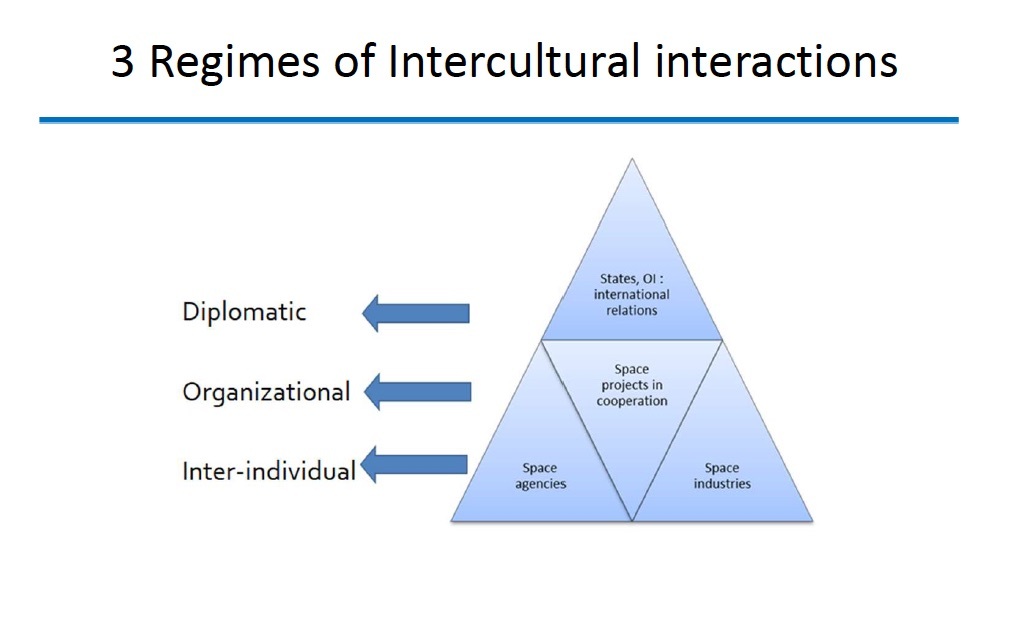
Name different tools of analysis
Milton Bennett’s IC Awareness - identifying cultures and interactions
“Describes the different ways in which people can react to cultural differences. Organized into six “stages” of increasing sensitivity to difference”
- sociological approach
- Ethno-relativism
Edward Hall’s Contextual Theory
- contextualizing interactions: low/high. context = the way we speak/our gestures. Oriental cultures are characterized by very rich context whereas communication in the US culture takes place in a mostly poor context
- time management: polychronic (doing several things at the same time) or monochronic (one thing at a time)
- Space management: proxemics (the study of human use of space and the effects that population density has on behavior, communication, and social interaction)
- Kinetics
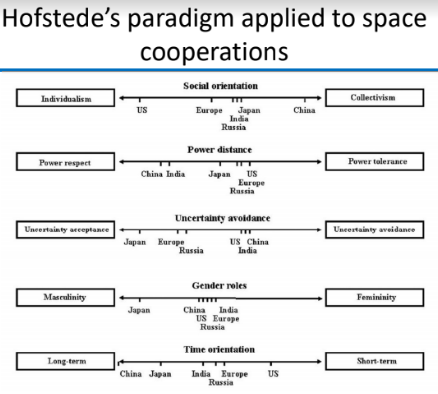
Gerd Hofstede’s Paradigm of 6 IC dimensions - understanding cultures relatively to one another in global context
- Individualism
- Power Distance
- Masculinity
- Uncertainty Avoidance
- Long-term orientation
- Indulgence: the good things in life
Interpret and discuss intercultural situations
ASTP: Critical Factors
- Ideological antagonism: intention to cooperate?
- Symmetrical scheme of cooperation?
- Vertical v. horizontal hierarchy
- Communication/language barrier
- Temporality
- Flexibility
- Culture of safety (HRO) and technological trust
- Compatibility: quality standards (testing, measure units, references, etc.)
Example: ASTP (1972-75) Apollo series test project
Describe historical relations between religion and human space exploration
Religion in Space
- Lunar Bible - Series of bibles sent to the Moon
- Bible left on the Lunar Rover
- Religious holidays celebrated on the ISS
Memorials
- Fallen Astronaut on the Moon
- Commemorative plaque for all lunar astronauts who have died
- Represents humanity’s efforts to go there and their loss
- Challenger Football – placed in space in memorial of the Challenger disaster
Overview Effect
The overview effect is a cognitive shift in awareness reported by some astronauts during spaceflight, often while viewing the Earth from outer space
“You develop an instant global consciousness, a people orientation, an intense dissatisfaction with the state of the world, and a compulsion to do something about it. From out there on the moon, international politics look so petty”
Apply the concept of reification to space exploration scenarios
To reify a concept
- Convert it into a concrete thing
- To perceive concrete things in their absence
Space station can be compared to the construction of a monastery
- E.g. Carthusian monastery – individual living quarters with shared communal spaces
Things reified by a space mission
- Community
- Worldview
- Social structure
- Communal support
- Outside relations
- Internal economy
Transformation of values
Lunar habitats probably more underground similar to monastery communal/private spaces instead of the hierarchy of city/skyscraper living.
Identify social, ethical and religious aspects of space
exploration
Social
- increased isolation
- human separation from nature
Ethical
- Seed Ships to bread
- One-Way Mars colonization
- Conservation
- Is “survival of humanity” a good enough argument to send unborn life into the unknown?
- Predetermining (individual) human life
- Sociological evaluation of human life
- Complicated: What really makes a human being
- Biodiversity
- If something happened to Earth, why are humans the only species being saved?
- Humankind is a part of biodiversity, not above biodiversity
- Contamination
- Planetary protection rules: a binding legal set of rules that are enforced for solar system missions
- Rules for contamination of other Moons, Planets and Earth
Religious Opposition
- Christianity, Earth is the world created by God. What happens to humans off of Earth when God returns?
- Biblical preservation of nature - Noah’s Ark
- spaceflight is seen as a human separation from nature and therefore separation from religion
- Which religions have “jurisdiction” in space (in terms of religious laws, codes, morals, etc.)
Appraise social, ethical and religious aspects through thought experiments in regard to their impact on space exploration
Conservation Scenarios
- Humankind would potentially destroy the desolate beauty of the Moon by going there and building structures
- The Overview Scenario gave way for largescale ecological/environmental conversation movements
- Preservation of Earth as a fragile planet
Conserving life and conserving humanity are VERY different concepts
- If something happened to Earth, the preservation of both humans and biodiversity are equally important
- We are all connected, but we are not all the same
- Ethical framing is humanity as a part of nature, NOT humanity as superior to nature
Space mission scenarios
Humans are at the top of the chain and things included in the mission are to solely help humans survive
Identify three space exploration issues which are shaped by ethical considerations
Two concepts of ethics
1) Applying a general theory of ethics
2) Taking a more pragmatic and situational approach
Applying a general theory of ethics
- Consequentialism: act in ways which maximize outcomes a.k.a utilitarianism.
- Deontology: act in line with individual rights and duties, not outcomes e.g. For off planet settlement what right would the individuals have?
- Virtue Ethics: actions should be shaped by good character
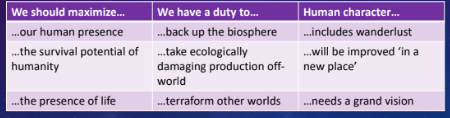
Space Exploration Issues
- See Table
Outline two ways in which inclusion has become an increasingly important aspect of space exploration
Sometimes this is framed as part of a broader process of ‘democratizing space’.
1) Inclusion maximizes expertise available to the sector
2) Inclusion should be an important part of all sectors, not just space. Every person has the right to equality.
e. g. The Apollo image of ‘the right stuff’ is a poor fit for our current ideas about equality and inclusion
Briefly explain why space agencies draw upon ethical considerations, but do not attempt to apply any general theory of ethics
All space agencies draw upon ethical considerations, but do not attempt to apply any general theory of ethics
Shifts in practice can, however, be understood by appeal to one or other general theory: the US and Russia are arguably less consequentialist than they used to be, and more concerned with rights.
The overall role of ethics in space-related activities tends to be in line with the pragmatic and situational understanding of ethics.
e.g. Space agencies are answerable to the government so if the government says get to the moon they will go.





