What is the World-Health-Organization (WHO) Definition of “Health”
Status of complete physical, mental and social well-being and not only absence of disease or infirmity
Define “Space Life Sciences” and describe the three objectives of Space Life Sciences
Space life sciences are the study of these in space:
- Microorganisms (e.g. bacteria)
- Fungi
- Plants
- Animals
Objectives
- Enhance fundamental knowledge in cell biology and human physiology
- Understand the risks associated to living organisms while in space and how to protect the health of astronauts
- Develop advanced technological, pharmacological and physiological countermeasures for improving crew health
List the objectives of Operational and Life Science Research
Objectives of Operational Research
- Closing operational gaps and deficiencies
- Preparing for extended space-flights in changing environments
- Enhance the health care provisions pre-, in-, and post-flight
- Develop advanced technology and applications for health care
Objectives of Life Science Research
Life Sciences are especially devoted to the working of the living world - from bacteria and plants to animals and humans
Describe the risks associated with human space flight
- Bone and muscle loss
- Cardiovascular deconditioning
- Neurovestibular deconditioning
- Fluid redistribution
- Living in confinement
- Psychiatric/psychological Issues
- Microgravity
- Radiation
- Closed environmental system (oxygen/carbon dioxide, water, preserved food)
- Confined environment
- Separation from loved ones
- Dangerous environment
- Distance/time from safety
Identify the roles, functions and responsibilities of Life Sciences, Space Physiology and Space Medicine
Life Sciences
- Are especially devoted to the working of the living world -from bacteria and plants to animals and humans
- On earth, all living organisms have developed under constant exposure to 1 g gravity
- Space life sciences open the door to understanding ourselves, our evolution without the constraining barrier of gravity
- Space life sciences include physiology, medicine and biology
- Space life science explores questions about the role of gravity in the formation, evolution, maintenance and aging processes of life on Earth
- Besides microgravity, living organisms are also affected by radiation, isolation, confinement, and chronobiological aspects during spaceflight
Space Physiology
- To characterize the response to the space environment, 0-g or fractional g
- Looks at system levels in humans
- Knowledge base and foundation for Space Medicine
- Focus is investigational, from standpoint of operational deliverables
Space Medicine
- To solve medical problems encountered in space-flight and during an astronaut’s career: suggest solutions/countermeasures to those problems.
- Includes some adaptive changes, such as space motion sickness and environmental exposures
- Includes some non-pathologic changes, which become maladaptive upon return to Earth, e.g. bone-loss
- Focus is operational, from standpoint of mission impact
Define key terms in human medicine
Human Anatomy
Is the scientific study of the body’s structures
- Gross Anatomy
Is the study of the larger structures and of the body, those visible without the aid of magnification - Microscopic (histological) anatomy
Is the study of structures that can only be observed with the use of a microscope or other magnification devices
Human Physiology
Is the scientific study of the chemistry and physics of the structures of the body and the ways in which they work together to support the functions of life
Homeostasis
Is the state of steady internal conditions, such as body temperature, heart rate, blood pressure, blood volume…
Human Pathology
Is the scientific study of the cause, origin and nature of human disease or human sickness or system malfunctions
Human Medicine
Is the science of the diagnosis, treatment, and prevention of disease
Human Psychology
Is the scientific study of human behavior and mind, embracing all aspects of conscious and unconscious experience as well as though
Define applied research & basic research, and understand the Difference
Applied research
Research aimed at solving a specific problem, without necessarily including the cause or mechanism of the problem. Often used interchangeably with operational research. Usually conducted by space agencies themselves, often with the aid of external subject matter experts who submit proposals for projects that could help solve the problem, after the problem in need of solution is made public. Funded by the space agencies.
Fundamental or basic research
Investigation of fundamental life science questions in space. Could be physiology, biochemistry, microbiology, plants, any living organism or organ system or cell type. May not immediately relate to any particular spaceflight medical issue. Usually conducted by researchers at universities – may be funded by space agencies, or by agencies that fund other fundamental biomedical research, like the US National Institute of Health or the National Science Foundation. E.g animal research/in vivo
From internet:
“Applied research is primarily defined by its focus on providing a practical solution to a defined problem while basic research is primarily defined by its focus on expanding knowledge. In other words, basic research is theory-oriented, applied research is practical-oriented”
List the objectives of applied and operational research
Operational/applied research
- Based on results and developments of research activities
- Application oriented
- Operational Research enhances the medical services provided to humans living and working in space
Objectives
- Closing operational gaps and deficiencies
- Preparing for extended space-flights in changing environments
- Enhance the health care provisions pre-, in-, and post-flight
- Develop advanced technology and applications for health care
Describe the risks associated with human research in space
Medical risks related to technical systems
✓ mitigate risk through technical measures
Medical risks related to the space- and microgravity environment
✓ mitigate risk through countermeasures, monitoring
Medical risks related to the biological system
✓ mitigate risk through selection and preventive medical program
make sure astronauts are screened properly e.g. for cardiovascular health
Describe the use of applied research results
Objectives
- Enhance fundamental knowledge in biology and human physiology
- Understand the risks associated to living organisms while in space and how to protect the health of astronauts
- Advance technological, pharmacological and physiological countermeasures for improving crew health
Research activities
- Life Sciences (fundamental research)
- Non-human life sciences
- Human Life Sciences
- Space Physiology
- Effects of Space Environment
- Technical R&D to support science
Clinical Activities
- Use in Occupational Medicine
- Use in (Operational) Space Medicine
- Risk Mitigation
- Technical R&D to support operations
Describe fundamental cellular structures and their function
Nucleus
Information storage, replication, repair mechanisms
- Contains the DNA
Mitochondria
Metabolizes sugar and oxygen into energy
- *Membrane**
1) Energy storage - Permits electric potential
- Permits osmotic potentials
2) Homeostasis
- Stable internal environment
- Waste removal / excretion
Golgi apparatus
Transporting, modifying, and packaging proteins and lipids.
Also have repair mechanisms.
Ribosomes
Perform protein synthesis and have repair mechanisms
Describe metabolism
Metabolism is the sum of all life-sustaining chemical reactions within the cells of living organisms. Conversion of food into energy, building blocks and elimination of waste.
Aerobic metabolism
Complete Metabolism of glucose into carbon dioxide and water yields 2881 kJ/mol, or 38 total ATP molecules, 2 from glycolysis, 2 from the Krebs cycle, and about 34 from the electron transport system
Glucose + Oxygen > Carbon dioxide + Water + Energy
Anaerobic metabolism - glycolysis
breaks down glucose without oxygen
- Products are 2 pyruvates (carbohydrates) that can be further metabolized anaerobically, to lactate or alcohol
- Overall, 1 glucose produces 2 ATP molecules
- Found in very simple (old) organisms
- Like those that lived on Earth before there was significant oxygen in the atmosphere
List the major physiological systems and subsystems and their functions
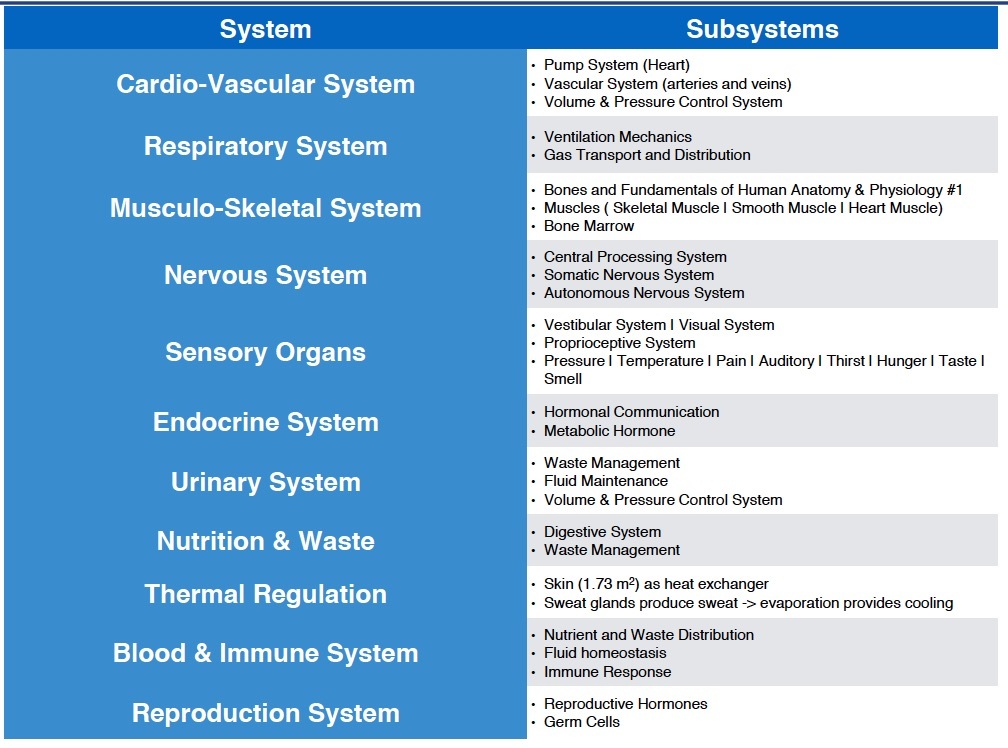
Describe the main features of the musculo-skeletal system
Weight-Bearing Structures
Long bones, spinal column, pelvis
Anti-Gravity Muscles
Extension muscles, spinal erectors, inter-vertebral muscles, thigh and calf muscles
Gravity Receptors and Proprioceptors
Gravity acts as a reference for several control systems that provide our body or body-parts’ position in the environment
Skeletal Muscle
Is the largest tissue in the body and accounts for about 40-45% of total body mass
Bone
Is a rather active tissue, which is remodeled every 3-5 months by bone resorption (osteoclasts) and bone formation (osteoblasts)
Describe the main features of the cardiovascular system
As organisms increased in size (number of cells) the resupply of nutrients and elimination of waste became essential and led to the development of a vascular system and a pump mechanism. This system has three main functions: Transport of nutrients, oxygen, and hormones to cells throughout the body and removal of metabolic wastes (carbon dioxide, nitrogenous wastes)
Basic Anatomy
- Arteries
- Veins
- Arterioles/Venules
- Capillaries
- Lung?
The heart
- Heart rate
- Blood pressure
- Systolic pressure
peak pressure in arteries, end of cardiac cycle, ventricles contracting, depends on the strength of the heart muscle - Diastolic pressure
minimum pressure in arteries, beginning of cardiac cycle, ventricles filled with blood, depends on the resistance of the peripheral vessels
Blood flow Parameters
- Blood flow
The transportation of nutrients, hormones, metabolic wastes, O2 and CO2 throughout the body to maintain cell-level metabolism, the regulation of the pH, osmotic pressure and temperature of the whole body, and the protection from microbial and mechanical harms.
- Stroke volume
The volume of blood discharged from the left ventricle with each contraction
- Cardiac Output
The amount of blood pumped by the heart in one minute
Vascular System
- The heart pumps blood through blood vessels to deliver oxygen to and return carbon-dioxide from various organs
- Contraction of leg-muscles helps to pump blood toward the heart (venous return)
- Smooth muscle around vessels maintains blood pressure
Describe the main features of the respiratory system
The respiratory/pulmonary system provides for distribution of gas components “nutrients” (oxygen) and elimination of “waste“ (carbon-dioxide)
- Nasal Cavity
- Pharynx
- Larynx
- Trachea
- Bronchi
- Bronchioles
- Lungs
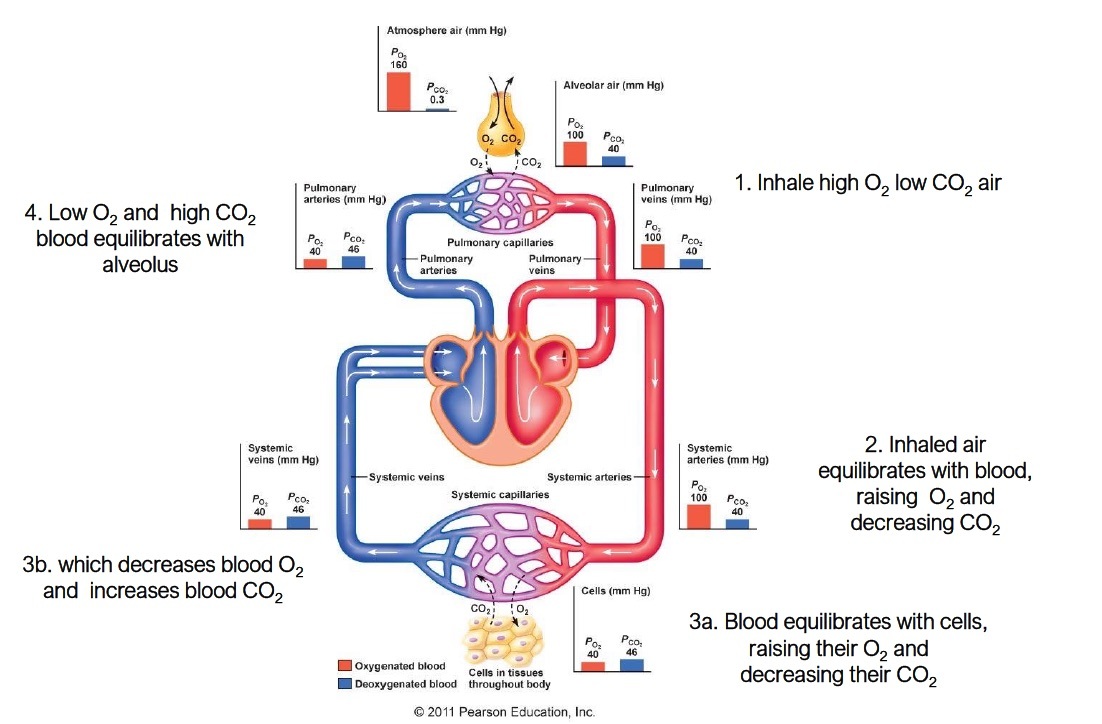
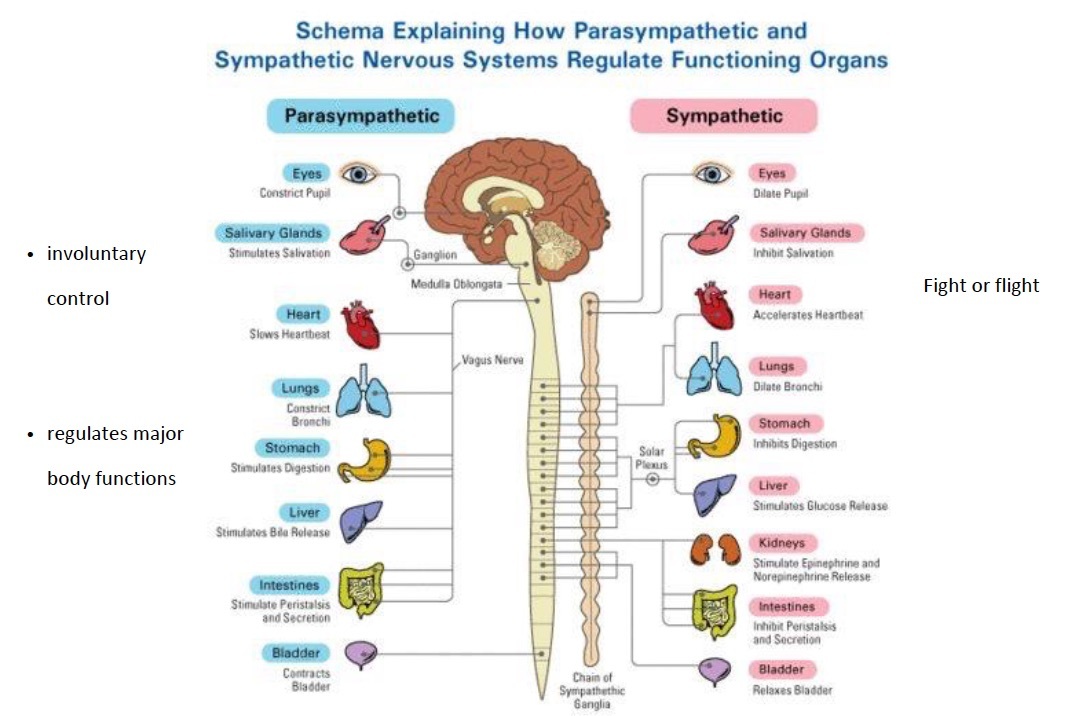
Explain the role of the autonomic nervous system
The autonomic nervous system is a component of the peripheral nervous system and a control system that acts largely unconsciously and regulates bodily functions, such as the heart rate, blood pressure, digestion, respiration, pupillary response, urination, and sexual arousal. It contains two anatomically distinct divisions:
- Sympathetic: “fight or flight”
- Parasympathetic “rest and digest”
In many cases, both of these systems have “opposite” actions where one system activates a physiological response and the other inhibits it (there are exceptions).
Describe the main features of the ear and vestibular system
- Semicircular Organ
- Otolith Organ
- Middle Ear
- Cochlea
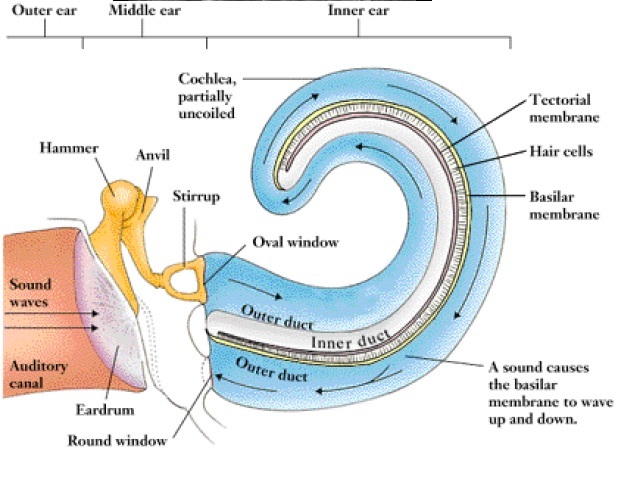
Explain the function of the hearing & vestibular sensory system
Deep inside the ear, positioned just under the brain, is the inner ear. In the inner ear contains the cochlea and the vestibular system
Hearing: Cochlea
- The sound event progresses as a traveling wave through the cochlea from the oval to the round window
- The basilar membrane contains the Organ of Corti, which senses the acoustic event
- The frequency-specific perception is possible through decreasing stiffness of the membrane
Vestibular Organ
In most mammals, it is the sensory system that provides the leading contribution to the sense of balance and spatial orientation for the purpose of coordinating movement with balance
- 3-axis acceleration
- Translational acceleration
- Gravity dependent
- Connection to eye muscles
There are two sets of organs in the inner ear: the semicircular canals, which respond to rotational movements (angular acceleration); and the otolith organs within the vestibule, which respond to changes in the position of the head with respect to gravity (linear acceleration).
Otolith Organ & Function
Small stone-like structures of calcium-carbonate (called otoliths) are layered on top of and within a gel, which embeds the hair-cells. During acceleration, the inertia of the otolith bends the hair-cells and a signal is sent to the brain for further processing. The otolith organs are composed of two chambers that detect acceleration (gravity)
- Utricle chamber: detects horizontal acceleration
- Saccule chamber: detects vertical acceleration
Semicircular Canal Organ & Function
- The three semi-circular canals detect angular motion in three axis
- The canals are filled with a liquid, which is moved through the canal by the corresponding motion
- The detection of this flow is achieved through sensors in the ampulla of each canal
Additional receptors
Information is integrated with visual and vestibular information.
To distinguish different kinds of movement, the brain needs more information, coming from proprioceptors. These are:
- Stretch receptors
- located in muscles, joints and tendons
Describe the main features of the urinary system
Urinary System | Clearance of Waste Products
- The kidney clears the blood from water-soluble waste products
- Preserves most of the initially produced excess water by re-absorption
- Average urine production 1.5-2 L/day
- Some ions and minerals are excreted and may cause kidney stone-formation
Kidney | Filtration in Glomerulus
- ≈180 Lof primary filtrate is produced every day
- Complete plasma volume of 3 Lis filtrated every 25 minutes
- All extra-cellular fluid (14 L) is cleared 12 times per day
Kidney | Loop of Henle
- In order to preserve water and minerals, most of them are reabsorbed and the urine is concentrated
- The kidney produces hormones that signal its status to the rest of the body
Describe processes controlling blood volume and blood pressure
Blood pressure
- Rapid transition from lying down to sitting to upright requires that heart and vessels adjust very quickly
- The baroreceptor reflex is the body’s rapid response system for dealing with changes in blood pressure
- Baroreceptors are mechanosensitive and located in the neck (carotid artery) and in the aorta
- A drop in blood pressure produces a drop in baroreceptor activity, which triggers an increase in sympathetic activity and a decrease in parasympathetic activity, which produces an increase in cardiac output and vessel constriction (total peripheral resistance). When they increase, so does blood pressure – in this case back to normal (the set-point)
- Spaceflight deconditions baroreceptor response, resulting in larger changes in baroreceptor distension needed to induce the same changes in heart rate compared to 1g.
Blood volume
- Increased blood volume increases blood pressure
- Reduction of blood volume is required to normalize the blood pressure
- Blood volume can be easiest reduced by excretion of excess water through the kidneys
- In spaceflight, the initially increased blood volume with subsequent increase of blood pressure due to the fluid shift is compensated by increased urine volume
dynamic motion and microgravity environments
Gain familiarity with effects of barometric pressure on human performance
Increased Barometric Pressure Affects the Central Nervous System
- CNS O2 toxicity
Oxygen can cause blurred vision, nausea, vomiting, twitching, irritability, incoordination, ataxia and seizures - Nitrogen Narcosis
Nitrogen is inert at 1 Atmosphere (sea level). N2is a depressant at 4 ATA, anesthetic > 6 ATA
High-Pressure Nervous Syndrome (Helium Tremors)
Divers at pressures over 150 m/ 500 feet (16 ATA) breathing Helium develops
- decreased alertness
- altered mental status
- tremors
- myoclonic jerks
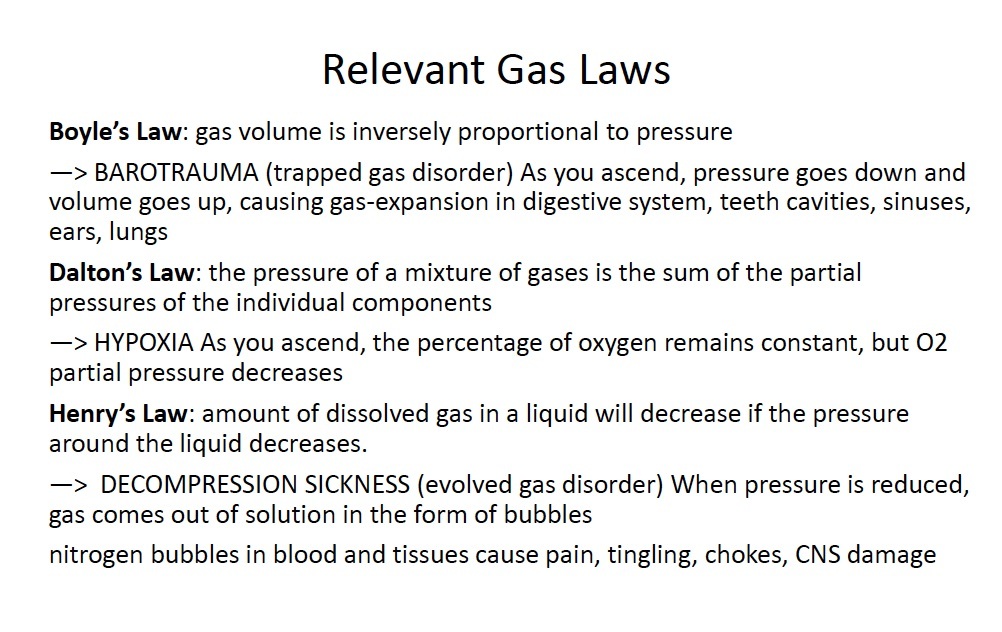
Barotrauma
Expansion of gas filled cavities. The worst situation is pulmonary over inflation syndrome with collapsed lungs, arterial gas embolism within seconds and air under chest, skin and in blood vessels
Hypoxia (hypoxic)
Reduced oxygen delivery to tissues within seconds to minutes: inadequate blood flow, inability to use oxygen at the molecular level, reduced oxygen carrying capacity, Ineffective gas exchange at lungs
- Fatigue
- Dizziness
- Rapid breathing
- Poor judgment
- Poor coordination
- visual field turns gray
- Euphoria
- Tingling
- etc.
Decompression Illness (DCI) aka DCS
With pressure reduction, evolved gas bubble from dissolved nitrogen can cause pain, pulmonary or nervous system damage within minutes to hours
- Type I DCI – Limb or Joint Pain (bends), cutaneous manifestations such as itching and rash (niggles)
- Type II DCI – Neurologic (headache, weakness, paralysis), cardiopulmonary “chokes”
Ebullism
Is the formation of gas bubbles in bodily fluids due to reduced environmental pressure, for example at high altitude. Example: Gas evolved from water (vapor pressure) below 47 mm Hg causes severe lung damage within minutes
Understand the adaptive responses and countermeasures used in aerospace environments
The human adaptive responses and countermeasures can mitigate most challenges in aerospace environments
In-flight Countermeasures
In-flight exercise and Low Body Negative Pressure (LBNP) have a protective effect on the increase in heart rate and fall in blood pressure during standing after flight
- Exercise Countermeasure Systems for the International Space Station (treadmill etc)
Reentry and Landing
- Fluid and salt loading
- Anti-G garment (lower body compression suit)
- Liquid cooling garment
- Recumbent seating during re-entry for flights > 30 days
Recognize physiologic challenges of extreme environments
Physiologic challenges of extreme environments vary with the specific environment and the individual adaptive traits
- The term ‘extreme’ refers to insufficiency or excess of one or more stressors, such as thermal energy, fluid availability, oxygen, pressure, hydrostatic pressure, gravity or environmental toxins
- Some environments are dangerous because they can incapacitate suddenly or in a subtle harmful way, or we lack receptors for detection or lack perception of their effect on the central nervous system
- Most dangers occur during exposures in artificial environments, unfamiliar circumstances, or with rapid excursions (ascents and descents)
Types of Extreme Environments
- Altered Barometric or Hydrostatic Pressure
- Hyperbaric
- Hypobaric
- Altered Atmospheric Composition
- Oxygen, Carbon Dioxide, Environmental Toxins
- Altered Thermal Environments
- Altered Gravito-Inertial Environments
- Microgravity
- Hypergravity
- Dynamic Motion Environments
- Remote, Isolated, and Confined Environments






