what CV changes occur in pregnant women? [4]
what does this means occurs in pregnant women with regards to daily life? [3]
changes in blood volume;
changes in heart rate;
changes in blood pressure;
changes in cardiac output;
what does this means occurs in pregnant women with regards to daily life? [3]
- dyspnoea (difficulty breathing)
- tachycardia
- reduced exercise tolerance
how does CO change with each uterine contraction? [1]
how does CO change with each uterine contraction? [1]
15-20% increase in CO
how does BP change during pregnancy? (systolic / diastolic?) [2]
- systolic BP does not change during pregnancy
- diastolic BP is reduced in trimester 1 & 2, retunrs to non-pregnant levels at trimester 3
what happens to peripheral resistance of pregnant women [2]
explain why this occurs [2]
- reduced peripheral resistance
- bc increased CO & decreased diastolic BP
- placenta acts as an arteriovenous shunt [1]
- peripheral vasodilating factors: oestrogen and progesterone [1]
- increased endothelial synthesis of prostaglandin E2 and prostacyclins [1]
why can pregnant women feel dizzy when lying on right hand side? [2]
what can be done to correct for this? [1]
why can pregnant women feel dizzy when lying on left hand side? [1]
- *venacaval compression from the gravid uterus which sig. reduces CO.**
- *so less blood to head and neck area**
what can be done to correct for this? [1]
turn her on to left side
where does venous pressure change during pregrancy? [1]
where does it not change? [1]
explain why these changes occur [1]
where does venous pressure change during pregrancy? [1]
changes in legs
where does it not change? [1]
arms
explain why these changes occur [1]
mech. obstruction of the uterus and contents
why would a fetus not come to harm if mother falls over? [1]
fetus is well cushioned by uterus and amniotic fluid
what is the ferguson reflex? [1]
what is it triggered by? [1]
what does it cause the release of? [1]
what is the ferguson reflex? [1]
when a woman’s body expels her baby without actively pushing. The reflex is involuntary
what is it triggered by? [1]
fetal presenting part impinging ripened cervix
what does it cause the release of? [1]
- *release of oxytocin from post pit.**
- *oxytocin binds to oxy receptors in the myometrium –> muslce contractions**
what is the rate of cervical dilation plotted on? [1]
what is the size of cervix for latent phase? [1]
what is the rate of cervical dilation plotted on? [1]
partogram
what is the size of cervix for latent phase? [1]
0-3 cm
what is a primiparae? [1]
what is a primiparae? [1]
women giving birth for first time
at what rate does cervix dilate for primiparae between 1-5cm [1] and 5-10 cm [1]?
at what rate does cervix dilate for primiparae between 1-5cm [1] and 5-10 cm [1]?
- *1-2 cm / hr (**between 1-5)
- *2-3 cm / hr** (between 5-10 cm)
which factors do we use to assess labour? [2]
what is labour not assessed on? [3]
- dilation of cervix
- descent of presenting part in relation ot ishial spines.
not on the frequency, duration or intensity of contractions
when is the first, second and third stage of labour? [3]
1st: -10cm dilation
2nd: full cervical dilation until delivery of fetus
3rd: expulsion of placenta
is the placenta a maternal or fetal organ? [1]
what is the function of the placenta? [6]
is the placenta a maternal or fetal organ? [1]
fetal
what is the function of the placenta? [6]
acts as lungs: gaseous exchange
provides nutrients for fetus
acts as kidney (excrete waste)
detoxifies drugs and metabolites
metabolically active (produces molecules like hCG)
makes long chain fatty acids for brain development
what is placental circulation like? [2]
two umbilical arteries: deoxygenated blood
one umbilical vein; oxygenated blood
how does amniotic fluid circulate through placenta? [1]
role of amniotic fluid? [4]
swallows it; excretes through urine
function: move in the womb, lungs to develop, keep constant temp, cushion from blows [4]
explain what happens during first couple of breaths of baby and why
- lungs previously filled with fluid need to fill with air
- first gasp: creates negative intra-thoracic pressure and air fills lungs
- 2nd & 3rd breathes much of the fetal lung fluid is expelled (rest is absorbed in the lymph)
how does PaO2 change during the first few breathes? [1]
what structure does this cause to close? [1]
how does PaO2 change during the first few breathes? [1]
2-3.5 kPa –> 9-13 kPa
causes ductus arteriosus to close
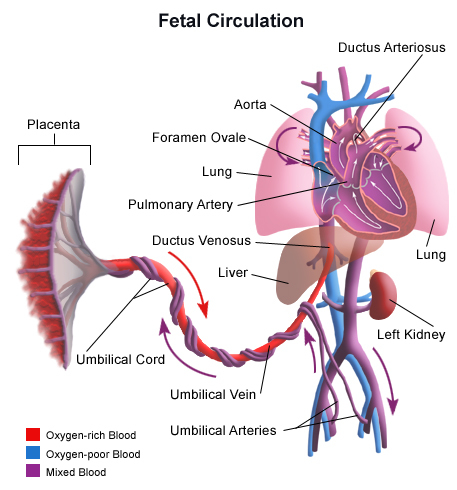
what happens to pulmonary vascular resistance after birth? what does this cause to occur? [1]
what happens to pressure on right side of heart? what does this cause to occur? [1]
what happens to pressure in IVC? what does this cause to occur? [1]
fall in pulmonary vascular pressure: causes pulmonary blood flow to increase
drop in presure on right side - no longer shunting from left to right atrium across the foramen ovale
drop in pressure in IVC; causes ductus venosus to closes
how does metabolism change in uterus to when the baby is born? [2]
why does a baby rely on fat stores during the first week of life? [1]
in utero: glucose
after birth: lipid based - have high free fatty acid levels
why does a baby rely on fat stores during the first week of life? [1]
until feeding is fully established
which organs of the baby utilise glucose and which utilise fats duirng early life?
brain: glucose
all other organse: fats
jaundice????
name 4 diseases that heel prick test screens [4]
name 4 diseases that heel prick test screens [4]
PKU
CF
SCA
Hypothyrdoism - TSH

-
FunMed Week 225
-
FunMed Week 3: SCA29
-
FunMed Week 4: Breast30
-
FunMed Week 5: Infection33
-
FunMed Week 6: AD23
-
FunMed Week 710
-
FunMed Week 8: Vaccination22
-
CR Week 126
-
CR Week 223
-
CR Week 324
-
Met121
-
Met222
-
Met329
-
Loco112
-
Loco25
-
Loco312
-
BB17
-
BB226
-
BB339
-
HD126
-
HD1b22
-
HD 225
-
HD 319
-
Seen PBL155
-
Seen PBL247
-
MET :O14



