Langerhans Cell structure and location
- Found mainly in the stratum spinosum.
- As abundant as melanocytes.
- Uniquely characterized by the marker antigens CD1a and langerin.
- Contains an unusual membrane-bound cytoplasmic organelle - The Birbeck granule.
Birbeck granule
- Membrane bound cytoplasmic organelle in Langerhans cells shaped like ping-pong paddles
- Part of the recycling endosome system that receive phagocytized antigens from endocytotic vesicles.
Langerhans cell function
- Part of the monocyte/macrophage cell family which presents antigens to T-cells via lymphatic system.
- Involved in the delayed immune response (ex. contact dermatitis).
Merkel cell
- Rare cell derived from the same stem cells as keratinocytes.
- Found in ares of high sensory receptivity such as fingertips and lips.
- Lie on the basement membrane and are not seen by LM.
- Have small electron-dense granules at the basal end of cell near expanded afferent nerve ending called a Merkel disc.
- Functions as touch receptor in thick skin.
Thick skin vs thin skin
Classified based on the thickness of the epidermis.
- Stratum corneum most varied.
- Thickness of dermis irrelevant.
Thick skin
Has all 5 epidermal layers - specifically stratum lucidum.
Found only on palms of hands and soles of feet aka hairless skin — glabrous skin.
Thin skin
No stratum lucidum by LM.
Found on most parts of the body.
Most have hair.
Vellus skin
Hairy skin
Functions of the dermis
Supports the epidermis.
Contains capillary networks that supply epithelium & helps regulate body temp.
Binds epithelium to hypodermis.
Common site of inflammatory and immune responses.
Papillary layer
- outer layer of dermis
- composed of loose connective tissue
- dermal papillae interdigitate with downward projections of the epidermis (epidermal pegs or ridges)
- Has thinner CT fibers (collagen, elastic, and reticular) and more CT cells
Epidermal attachment
Anchored to the dermis by a basement membrane (consists of a basal lamina and lamina reticularis).
Hemidesmosomes anchor epidermis to basement membrane.
Skin sensory innervation
- Free nerve endings - for pain and temperature
- Associated with receptors
- Merkel cells: touch mechanoreceptors
- Meissner’s corpuscules: mechanoreceptors for light touch
- Pacinian corpuscles: mechanoreceptors that respond to deep pressure or vibration.
Skin motor innervation
- Postganglionic sympathetic neurons supply
- blood vessels
- arrector pili muscles
- eccrine sweat glands
- apocrine sweat glands
- No parasympathetic innervation of integument.
- Sebaceous glands not innervated - hormonal stimulation.
Role of dermis in immune and inflammatory response
- Dermis is the site of WBC inflammatory/immune function.
- Lymphocytes, neutrophils, and macrophages found in dermis.
Dermal temperature regulation
- Arteriovenous anastamoses of the reticular layer of the dermis.
- Control of blood flow to capillary beds of papillary layer of dermis.
Meissner’s corpuscles
Encapsulated receptors found in dermal papillae.
Elongated ovals oriented perpendicular to skin surface.
Capsule formed by flattened Schwann cells oriented parallel to skin surface.
Contains one or two nerve endings.
Zigzag appearance by LM.
Pacinian corpuscles
Encapsulated receptors responding to deep touch or vibration.
Located in deep dermis or hypodermis, often in or near adipose tissue.
Much larger than Meissner’s corpuscles.
Capsul arranged in concentric layers around entral nerve fiber - onion like appearance in cross-section.
Hypodermis
Also called superficial fascia or panniculus adiposus.
Not part of the skin.
Consists of loose CT and adipose tissue that binds skin loosely to underlying organs.
Integumentary appendages
Hair
Nails
Sebaceous glands
Eccrine sweat glands
Apocrine sweat glands
*All develop from downgrowths of epidermal cells into the dermis.
*All can serve as soures of new epidermal cells following trauma.
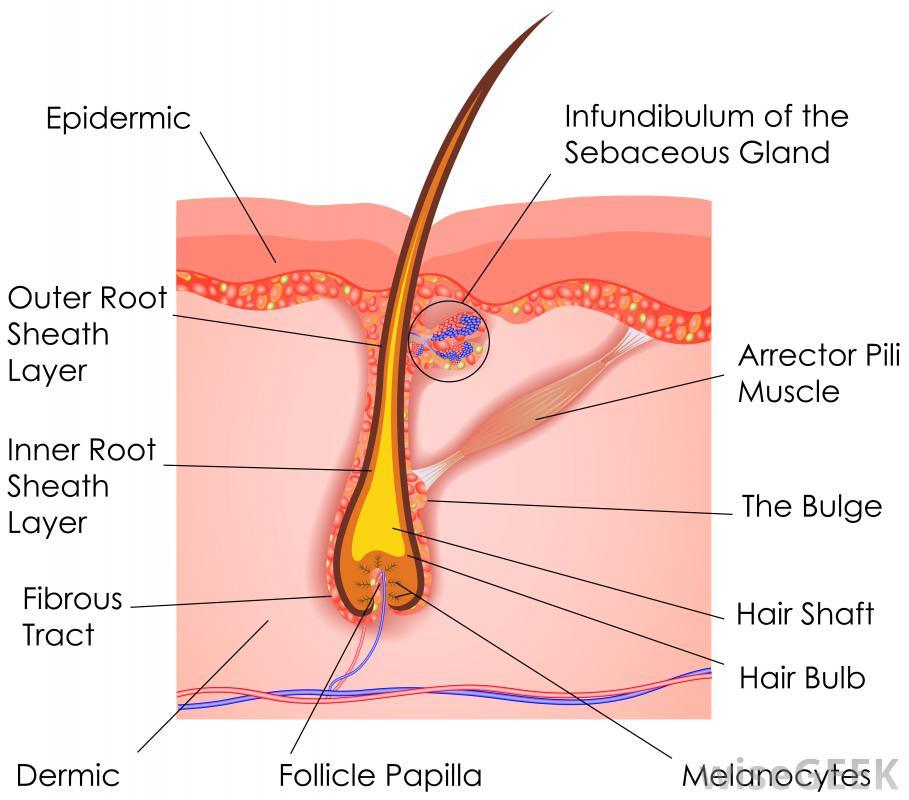
Hair follicle structure
- Glassy membrane: thick basement membrane that surrounds the hair follicle.
- External root sheath: composed of epithelial cells and is continuous with the epidermis.
- Hair bulb: base of the follicle expands to form the hair bulb.
- Epithelial cells of hair bulb called matrix cells which acts as stem cells for some parts of follicle.
- Contain melanocytes reponsible for hair color.
- Internal root sheath: lies between external shealth and hair shaft.
- Composed of soft keratin epithelial cells.
- Cells degenerate and slough off.
- Space left behind is where sebaceous glands and apocrine sweat glands secrete.
- Dermal papilla: partially surrounded by the hair bulb.
- Induces formation of follicle and required for it’s maintenance.
- Contains blood vessels that nourish the follicle.
- Hair shaft: contains hard keratin and has 3 parts.
- Medulla - the central region containing large, moderately keratinized, vaculoated cells; found only in terminal hairs.
- Cortex - heavily heratinized cells.
- Cuticle - outermost layer; composed of heavily keratinized flat cells like shingles on a roof
- Arrector pilli muscle: bundle of smooth muscle attached to skin and CT sheath outside glassy membrane
- Contraction raises hair shaft and causes dimpling of skin (goosebumps)
Phases of hair growth
Hair follicles produce and shed hairs in repeated cycles throughout life.
Stages:
- Anagen: period of active growth when matrix cells divide
- Catagen: period of involution when the lower part of the follicle below the arrector pili muscle atrophies
- Telogen: resting period between the end of follicular atrophy and shedding of the hair
Types of hair
Vellus hairs: thin, short, and poorly pigmented.
Terminal hairs: thicker, longer, and more heavily pigmented.
Type of hair produced at a follicle can change.
Ex. puberty or male pattern baldness
Color determined by amounts of eumelanin and pheomelanin.
Sebaceous glands
Acinar exocrine glands
Duct usually opens into upper hair follicle
Holocrine secretion of sebum
Occurs in thin skin
Stem cells rest on basal lamina, move up as they differentiate, become pyknotic, and die by apoptosis
Secrete in response to hormonal stimulation
Sebum
Secreted by sebacous glands
It is the debris from ruptured cells
Coats hair and lubricates skin
May have antibacterial or antifungal effects
Androgens increase secretion


-
Integument35
-
Hypothalamus and pituitary43
-
Thyroid and Parathyroid22
-
Adrenal Glands21
-
Cartilage and Bone41
-
Bone Formation and Joints36
-
Blood87
-
Hematopoiesis42
-
Cardiovascular System39
-
Lymphoid Organs48
-
Respiratory System25
-
Oral Cavity and GI Track56
-
Liver, Gallbladder, Pancreas32
-
Urinary System35
-
Testis and Male Reproductive Tract52
-
Female Reproductive84



