Question
A 25-year-old patient presents for evaluation of hypertrophic scars on his anterior chest, 9 months after sustaining burns in a workplace accident. The scars are raised, firm, intensely pruritic, and exhibit vivid erythema. He has tried silicone gel sheeting with minimal improvement and specifically wants treatment to reduce the redness and itching. Based on current evidence regarding laser treatment for hypertrophic scars, which of the following laser modalities is most appropriate to address his primary symptoms?
a) Fractional carbon dioxide (CO₂) laser
b) Q-switched neodymium-doped yttrium aluminum garnet (Nd:YAG) laser (1064 nm)
c) Pulsed-dye laser (595 nm)
d) Q-switched alexandrite laser (755 nm)
e) Fractional radiofrequency device
The correct answer is option C.
Rationale
The patient’s hypertrophic scars are characterized by prominent erythema and pruritus, which are driven by excessive angiogenesis and inflammation. The pulsed-dye laser (585–595 nm) selectively targets hemoglobin in the dilated microvasculature of hypertrophic scars, thereby reducing blood flow, decreasing inflammatory mediators, and alleviating both redness and itching. This wavelength is the evidence-based first-line laser choice for these vascular symptoms. In contrast, ablative lasers (e.g., fractional CO₂) (a) target water and cause controlled thermal damage but do not specifically improve erythema or pruritus. Q-switched lasers (b, d) target melanin or tattoo pigments (e.g., iron) and are used for tattoo removal or pigmented lesions, not for vascular scar features. Radiofrequency devices (e) deliver thermal energy to stimulate collagen remodeling but do not target the vasculature responsible for erythema and pruritus.
References
1. Kafka M, Collins V, Kamolz LP, Rappl T, Branski LK, Wurzer P. Evidence of invasive and noninvasive treatment modalities for hypertrophic scars: a systematic review. Wound Repair Regen. 2017.
2. Ogawa R. The most current algorithms for the treatment and prevention of hypertrophic scars and keloids: a 2020 update of the algorithms published 10 years ago. Plast Reconstr Surg. 2022.
If you would like to create additional questions or refine this format further, please feel free to share the next rationale.
Question
A 65-year-old man with Fitzpatrick skin type II undergoes a full-face ablative fractional CO2 laser resurfacing for severe actinic damage and rhytids. Preoperative prophylaxis with valacyclovir was administered. On postoperative day 5, he presents with concerns about his healing. The treated areas exhibit intense pruritus and a persistent, bright erythema. The erythema is more pronounced and diffuse than typical postoperative redness. A course of oral cephalexin was prescribed on day 3 for suspected cellulitis, with no improvement. Which of the following is the most appropriate next step in management?
a) Initiate oral trimethoprim-sulfamethoxazole
b) Prescribe a topical high-potency corticosteroid (fluocinolone acetonide)
c) Increase the dose of his current valacyclovir regimen
d) Prescribe oral fluconazole
e) Begin oral clindamycin
The correct answer is option D.
Rationale
This vignette describes a classic presentation of a fungal infection, specifically candidiasis, following ablative laser resurfacing. The key distinguishing features are severe pruritus and a diffuse erythema that fails to respond to antibacterial therapy. While viral (herpetic) reactivation is common, it is typically painful rather than intensely itchy and should be covered by the ongoing valacyclovir prophylaxis. Bacterial infections usually present with increasing pain, warmth, and purulence. According to the literature, Candida genus infections are an uncommon but recognized complication of ablative procedures due to the disrupted skin barrier. Fluconazole has demonstrated efficacy in both preventing and treating these post-laser fungal infections. The other agents are not effective against fungal pathogens: trimethoprim-sulfamethoxazole (a) is a antibacterial, corticosteroids (b) would be contraindicated as they can worsen an infection, valacyclovir (c) is antiviral, and clindamycin (e) is antibacterial and may even promote fungal overgrowth.
References
1. Murad A, et al. A prospective trial of fungal colonization after laser resurfacing of the face: correlation between culture positivity and symptoms of pruritus. Dermatol Surg. 2003.
2. Alster T, Lupton J. Treatment of complications of laser resurfacing. Arch Facial Plast Surg. 2000.
Question
A 45-year-old patient with Fitzpatrick skin type II presents for treatment of multiple solar lentigines on the face. The dermatologist plans to use a laser that delivers energy in extremely short, high-peak-power pulses to target the pigmented lesions while minimizing thermal damage to surrounding tissue. Which of the following features is most characteristic of the laser type best suited for this purpose?
a) A collimated beam with a constant cross-sectional diameter
b) Monochromatic light with a single output frequency
c) Continuous-wave energy delivery without interruption
d) Nanosecond-duration pulses with high peak power
e) Selectable output frequencies from a single laser module
The correct answer is Option D.
Rationale
The description matches a Q-switched laser, which is designed to produce nanosecond-duration pulses with very high peak power. This technology is particularly effective for treating benign pigmented lesions—such as solar lentigines, café-au-lait spots, and tattoos—by generating intense, localized photomechanical and photothermal effects that fragment pigment particles with minimal collateral thermal injury.
The other options are incorrect because they describe features common to many lasers or specific to other laser types:
* a) A collimated beam: This is a fundamental property of all laser light, not unique to Q-switched devices.
* b) Monochromatic light: All lasers emit monochromatic (single-wavelength) light; this is not distinctive of Q-switching.
* c) Continuous-wave energy delivery: This describes non‑pulsed (continuous‑wave) lasers, which have lower peak power and are not optimal for pigment‑specific treatments.
* e) Selectable output frequencies from a single module: Clinically useful multi‑wavelength lasers contain separate modules for each wavelength; this capability is not inherent to Q‑switched systems.
References
1. Halasiński P, Lubarska M, Lubarski K, Jalowska M. Lasers’ Q‑switched treatment in skin and subcutaneous lesions – review. Postepy Dermatol Alergol. 2023;40(2):181‑186.
2. Nisticò SP, Cannarozzo G, Provenzano E, et al. Nanosecond Q‑switched 1064/532 nm laser to treat hyperpigmentations: a double center retrospective study. Clin Pract. 2021;11(4):708‑714.
Question
A 32-year-old woman with Fitzpatrick type III skin presents for evaluation of moderate atrophic and “ice-pick” acne scarring on both cheeks. She has no active inflammatory lesions. On physical examination, the scars are well-defined and depressed, with noticeable textural irregularity. She has tried topical retinoids and superficial chemical peels without significant improvement. Based on evidence for the treatment of atrophic acne scarring, which of the following interventions is most likely to provide substantial improvement for this patient?
a) Nonablative 1064 nm Nd:YAG laser treatment
b) Fractionated carbon dioxide (CO₂) laser resurfacing
c) Jessner solution chemical peel
d) Alpha-hydroxy acid (glycolic acid) peel
e) Pulsed-dye laser (585 nm)
The correct answer is Option B.
Rationale
Fractionated carbon dioxide (CO₂) laser resurfacing is an ablative laser modality that creates microscopic columns of thermal injury, promoting collagen remodeling and significant improvement in atrophic and ice-pick acne scars. It is considered a gold-standard treatment for moderate to severe scarring, especially in patients with Fitzpatrick skin types I–III who have not responded to more superficial therapies.
The other options are incorrect:
* a) Nonablative 1064 nm Nd:YAG laser: This laser primarily targets deeper dermal pigmentation or vascular lesions and has limited efficacy for significant textural remodeling of atrophic scars.
* c) Jessner solution peel & d) Alpha-hydroxy acid peel: These are superficial peels that do not penetrate deeply enough to effectively remodel dermal collagen in atrophic or ice-pick scars.
* e) Pulsed-dye laser (585 nm): This laser targets oxyhemoglobin and is used for vascular lesions, erythema, or hypertrophic scars, not for atrophic scarring.
References
1. Boen M, Jacob C. A review and update of treatment options using the acne scar classification system. Dermatol Surg. 2019;45(3):411-422.
2. Gozali MV, Zhou B. Effective treatments of atrophic acne scars. J Clin Aesthet Dermatol. 2015;8(5):33-40.
A 16-year-old girl presents to the plastic surgery clinic with hypervascular, erythematous burn scars on her neck and chest, sustained from a scald injury one year ago. The scars are immature and causing significant psychosocial distress due to their appearance. The patient desires a noninvasive treatment option to improve the erythema and overall appearance of the scars. Which laser is the most appropriate for managing this patient’s burn scars?
A. Pulsed-dye laser
B. Ruby laser
C. Alexandrite laser
D. Fractional carbon dioxide laser
E. Nd:YAG laser
Correct Answer: A. Pulsed-dye laser
The pulsed-dye laser (PDL) is the most appropriate treatment for hypervascular, erythematous burn scars in this patient. This laser emits light at a 585-nm wavelength, which specifically targets hemoglobin in hypervascular tissue. It is particularly effective in treating immature burn scars by reducing erythema and improving scar quality through selective photothermolysis of blood vessels.
Explanation of Other Laser Options:
• Ruby laser (694-nm wavelength): Targets melanin and is typically used for pigmentary conditions like freckles, melasma, or tattoo removal, not for burn scar erythema.
• Alexandrite laser (720-780 nm): Also targets melanin, often used for hair removal or pigmentary disorders, but is not effective for hypervascular scars.
• Fractional carbon dioxide (CO2) laser (10,600 nm): Targets water in the skin and is used for ablative resurfacing and collagen remodeling, often for mature hypertrophic scars or skin rejuvenation. However, it is not specifically suited for treating hypervascular erythematous scars in the early stages of healing.
• Nd:YAG laser (1,064 nm): Targets deeper vascular structures but is less effective for superficial erythema compared to the PDL.
Using a PDL in this case would address the patient’s concerns by reducing the vascular component of the scars, thereby improving both appearance and symptoms like itching or discomfort.
A 38-year-old woman comes for consultation regarding facial laser resurfacing. Physical examination shows Fitzpatrick Type III skin with facial dyschromia. Which of the following is the most likely side effect of fractional carbon dioxide laser resurfacing in this patient?
A ) Contact dermatitis
B ) Dermal scarring
C ) Ectropion
D ) Hyperpigmentation
E ) Rosacea
The correct response is Option D.
Pigmented skin, Fitzpatrick Type III or IV, tends to absorb about 40% more laser energy than nonpigmented skin. Thermal damage can extend beyond the area of treatment. For these reasons, physicians should be aware of the side effects and complications of ablative laser treatment in pigmented skin.
The most common side effect is hyperpigmentation. Hyperpigmentation usually occurs within 6 weeks to 6 months following laser ablation and is present in 100% of darkly skinned patients. Hyperpigmentation is most often transient and can persist for 9 months to 1 year. Recommended treatment is hydroquinone.
Contact dermatitis can occur secondary to topical antibiotic therapy such as neomycin or bacitracin. Less common side effects include dermal scarring, herpetic infections, or ectropion.
A 27-year-old woman presents with a multicolored decorative tattoo on her leg. She is interested in laser tattoo removal. On physical examination, over 80% of her tattoo has red and orange colors. Which of the following laser treatments would be most effective on the orange and red areas?
A) 755-nm Q-switched alexandrite
B) 532-nm Q-switched Nd:YAG
C) 1064-nm Q-switched Nd:YAG
D) 694-nm Q-switched ruby
The correct response is Option B.
Successful tattoo removal can be performed using different types of laser wavelengths. The 532-nm Q-switched Nd:YAG would be used for targeting red, yellow, and orange color tattoos. Black pigments can be effectively removed with Q-switched Ruby 694-nm, 755-nm Alexandrite, or 1064-nm Nd:YAG lasers. Purple ink responds best to the Q-switched 694-nm ruby laser and green ink best removed with the Q-switched 755-nm Alexandrite laser. The Q-switched Ruby 694 nm laser creates a red light that is highly absorbed by green, blue, and dark tattoo pigments.
Common Laser Types and Wavelengths:
Nd:YAG Laser:
-1064 nm: Ideal for removing black and dark blue inks. This wavelength is highly absorbed by dark pigments.
-532 nm: Effective for red, orange, yellow, and other warm-toned colors.
Alexandrite Laser:
-755 nm: Best for green and light blue inks. This wavelength is particularly effective for stubborn colors that are difficult to remove.
Ruby Laser:
-694 nm: Also used for green and blue inks, especially lighter shades.
Picosecond Lasers:
These lasers can operate at multiple wavelengths (e.g., 532 nm, 755 nm, 1064 nm) and deliver ultra-short pulses, making them effective for a wide range of colors and faster ink particle breakdown.
Key Points:
Multiple Wavelengths: Effective tattoo removal often requires using multiple wavelengths to target different colors within the same tattoo.
Light Absorption: The principle of light absorption is crucial; the laser wavelength must be well-absorbed by the tattoo ink to break it down effectively.
Treatment Sessions: Colored tattoos typically require several sessions for complete removal, as different colors respond differently to laser treatment.
An 18-year-old woman has a large arteriovenous malformation on the face that has ulcerated and bled vigorously several times. Which of the following is the most appropriate treatment option?
(A) Intralesional administration of interferon
(B) Distal embolization under superselective angiographic control
(C) Ligation of the feeding vessels
(D) Intralesional excision to minimize tissue loss
(E) Aggressive resection with immediate flap reconstruction
The correct response is Option E.
This 18-year-old woman has a large arteriovenous malformation (AVM) on the face characterized by ulceration and bleeding. The most appropriate management is aggressive resection to eliminate the lesion immediately. In addition, because aggressive resection of an AVM typically exposes vital structures and leaves a cosmetically disfiguring defect, immediate reconstruction with a flap is indicated. Arteriography, Doppler ultrasonography, and/or MRI should be obtained preoperatively to delineate the extent of the lesion.
Distal embolization of the lesion can be performed under angiographic control before excision to limit blood loss but is not an effective treatment in itself.
Ligation of the feeding vessels without subsequent resection will further worsen the AVM because it will result in the development of new collateral vessels. Intralesional excision is associated with a high risk for recurrence.
Intralesional interferon has not been shown to provide benefit in the treatment of arteriovenous malformations.
In a 5-year-old child who has a large capillary vascular malformation on the upper eyelid, which of the following lasers is most appropriate for removal?
(A) Alexandrite
(B) Carbon dioxide
(C) Nd:YAG
(D) Pulsed dye
(E) Q-switched ruby
The correct response is Option D.
Removal of the capillary vascular malformation, or port-wine stain, is best accomplished with use of a flashlamp-pumped pulsed dye laser. This laser delivers short pulses (450 msec) of 585 nm of yellow light that are selectively absorbed by hemoglobin and oxyhemoglobin chromophores. Multiple treatments will result in ablation of the malformation.
Vascular lasers and other pigment-specific lasers function according to the principle of selective photothermolysis, which describes the resultant localized tissue damage. Target tissue damage occurs when light of a particular wavelength is delivered to and absorbed by the target, but not the surrounding tissue, during a pulse duration less than or equal to the thermal relaxation time of the target.
Carbon dioxide lasers act to vaporize water within the tissues. The mechanism of these lasers is similar to chemical peeling and dermabrasion and is inappropriate for port-wine stains.
At 1064 nm, the Nd:YAG laser is outside of the absorbable spectrum for hemoglobin; therefore, this laser is not recommended for the treatment of port-wine stains.
Which of the following findings is more likely in patients who undergo resurfacing with the erbium:YAG laser than in patients treated with the carbon dioxide laser?
(A) Erythema
(B) Hypopigmentation
(C) Scarring
(D) Skin tightening
(E) Transudate wound
The correct response is Option E.
The erbium:YAG (Er:YAG) laser is now the treatment of choice for ablative resurfacing of the skin. This laser emits light at a wavelength of 2940 nanometers (nm) and is absorbed by water within the epidermis a minimum of 10 times more efficiently than the carbon dioxide laser. The decreased dermal heating that occurs during treatment with the Er:YAG laser results in minimal long-term contraction of the dermis, but produces a transudative wound once the epidermis has been eliminated. The transudation becomes more profuse as the surgeon ablates deeper into the dermis.
Because the mechanism of action of the Er:YAG laser is photomechanical rather than photothermal, coagulation necrosis is limited and hyperemia is decreased. As a result, permanent hypopigmentation occurs in less than 5% of patients undergoing treatment with the Er:YAG laser. In contrast, permanent hypopigmentation has been reported in as many as 40% of patients undergoing carbon dioxide laser therapy.
Scarring may occur with any type of laser and is related to the amount of heat generated from the laser, also known as its pulse.
Likewise, skin tightening occurs with both the Er:YAG and the carbon dioxide laser.
A 35-year-old woman seeks tattoo removal after five treatments with a Q-switched Nd:YAG (1064 nm) laser. Red pigment remains. What is the most appropriate next treatment?
(A) Erbium: YAG (2940 nm)
(B) Q-switched alexandrite (755 nm)
(C) Q-switched Nd:YAG (532 nm)
(D) Q-switched ruby (694 nm)
(E) Ultrapulsed CO2 (10,600 nm)
The correct response is Option C.
The Q-switched Nd:YAG (532 nm) laser effectively targets red ink. Q-switched lasers rapidly deliver energy, breaking down pigment for lymphatic drainage. The Nd:YAG (1064 nm) laser penetrates deeply but is less effective for bright colors. CO2 and erbium lasers are better for resurfacing than tattoo removal.
A 54-year-old woman comes to the office because of severe facial rhytides and photodamage. Examination shows Fitzpatrick skin type III. Ablative laser resurfacing is planned. Which of the following is the most likely complication of laser resurfacing in this patient?
A) Acneiform eruption
B) Bacterial infection
C) Erythema
D) Hyperpigmentation
E) Scarring
The correct response is Option D.
Hyperpigmentation is the most common adverse effect of laser resurfacing. It occurs in 36% of patients and is most common in people with Fitzpatrick skin Types III to VI. Treatment consists of hydroquinone and tretinoin. Sun exposure should be avoided. Rates of hyperpigmentation can be reduced in those pretreated with retinoic acid and bleaching agents. While hyperpigmentation can be permanent, with proper treatment it usually resolves within a few months.
Acne can occur post-laser treatment. It is especially common in patients with a prior history and should be treated with standard acne therapies. Infection risk from bacteria is minimized with prophylactic antibiotics and good topical care. Viral herpes simplex outbreaks can occur in those with and without a history. Antiviral prophylaxis is now used in all patients undergoing laser resurfacing. Yeast infections are also a possible infectious complication. These respond well to systemic antifungals. Scarring can occur with improper technique that causes excessive thermal damage (i.e., too many passes and excessive energy fluencies). Areas that develop scarring can be treated with topical and intralesional corticosteroids, silicone sheeting, and pulsed-dye laser. Erythema is not considered a complication and is a normal part of the healing process. It can last 1 to 4 months depending on the type of laser used.
A 22-year-old man comes for consultation regarding laser removal of a tattoo located on the upper lateral arm. He said his friend tattooed him 6 years ago using a sewing needle and black pen ink. Physical examination shows Fitzpatrick Type IV skin. Which of the following laser treatments is most likely to decrease the risk of scarring in this patient?
A ) Argon-pumped tunable dye
B ) Carbon dioxide
C ) Er:YAG
D ) Flash lamp-pumped pulsed-dye
E ) Q-switched ruby
The correct response is Option E.
Most amateur tattoos are characterized by pigment deposited at variable, sometimes excessive depths compared with those produced by a professional apparatus. This may compromise the ability to erase the tattoo in a single session or at all without resorting to more traditional measures, such as direct excision. The chromophore of the carbon dioxide laser is water; therefore, it will indiscriminately destroy unaffected skin, as well as the skin containing tattoo pigment. Fitzpatrick Type IV skin is that which, while resistant to sunburn, is more likely to demonstrate a genetic predisposition to hypertrophic scarring. Ablative laser treatment has been shown to adversely affect the risk of hypertrophism. Current safety guidelines require that all individuals present during laser therapy don appropriate eyewear, selected according to the laser wavelength. Q-switched lasers, including ruby, Nd:YAG, and alexandrite types, are based on the principle of selective photothermolysis. They are suited for removal of black tattoo pigments as well as a variety of colors while minimizing the risk of scar.
Which of the following is most effective in decreasing the risk of fire when using a carbon dioxide laser for facial resurfacing?
A) Clamp the laser cord to surgical drapes
B) Intubate laser patients to prevent oxygen accumulation on the field
C) Provide supplemental oxygen with a nasopharyngeal cannula
D) Use conscious sedation, nerve blocks, and no supplemental oxygen
E) Use foot pedals only for activating the laser
The correct response is Option D.
Carbon dioxide laser treatments can cause operating room fires. Several papers have shown that a nasopharyngeal oxygen delivery can decrease oxygen levels in the operative field when it is required, but the best way to decrease the level of oxygen on the field is not to use it. Foot pedals can be accidentally activated and should be avoided. Clamping the laser cord can damage the fibers and ignite the laser fiber sheath. Laser skin surfacing can be accomplished without intubation.
A 58-year-old woman with a history of rosacea is scheduled to undergo Er:YAG laser resurfacing to improve the appearance of perioral rhytids. When compared with a carbon dioxide laser, for which of the following does the Er:YAG laser have a greater affinity?
A) Hair follicle
B) Hemoglobin
C) Melanin
D) Papillary dermis
E) Water
The correct response is Option E.
Use of nonsurgical skin rejuvenation has increased exponentially over the past 20 years, with over 4.6 million cases performed annually. This increase has led to expansion of different types of devices for resurfacing. The use of lasers for facial resurfacing has been discussed since the 1980s, initially with carbon dioxide lasers and then with erbium-doped yttrium aluminium garnet (Er:YAG) lasers in the late 1990s. Ablative laser treatments have been used to target actinic skin damage and moderate to heavy rhytides.
Lasers work by means of a wavelength of light being absorbed by specific targets (chromophores) in the tissue, causing thermal damage. The targeted chromophore absorbs energy, which is converted to heat. Tissues that are heated to 60° to 70°C (140°F to 158°F) coagulate; above 100°C (212°F), vaporization occurs. The carbon dioxide laser has a wavelength of 10,600 nm with a target chromophore of water. In the mid 1990s, the ability to deliver increasing power over shorter amounts of time allowed temperatures to be reached that would allow ablation of the epidermis. However, even with ablation there was a zone of coagulation surrounding the ablation that ranged between 70 and 120 ?m. The Er:YAG laser has a wavelength of 2940 nm. The peak absorption of water is nearly 2900 nm, which means that an Er:YAG laser has an absorption 12 - to 16-fold greater than carbon dioxide laser. Because of this unique feature, the ablation threshold of Er:YAG is only 1 J/cm2 compared with the carbon dioxide laser’s ablation threshold of 5 J/cm2. The clinical relevance is that a much higher percentage of targeted tissue is ablated rather than heated, so that the resultant surrounding coagulation zone is only 5 to 20 ?m of tissue.
It is a common mischaracterization of full-field resurfacing options to state that “erbium is more superficial than carbon dioxide.” This is only true for a single pulse and equivalent energies, as the erbium wavelength is rapidly absorbed in water at a rate 11 to 16 times higher than carbon dioxide. However, such a statement is contrary to the fact, as erbium allows ablation of the dermis and the epidermis, unlike carbon dioxide, which can only ablate epidermis. Erbium can easily ablate the dermis on successive pulses until the skin, muscle, and even bone can be totally obliterated. Carbon dioxide can only affect deep tissue by stacking pulses and creating “bulk heat” that melts the tissue rather than ablating, and is both imprecise and dangerous.
Erbium provides a controlled depth of ablation with a minimal underlying thermal zone of coagulation. This decrease in thermal injury leads to a faster recovery following erbium laser ablation compared with carbon dioxide laser. The smaller coagulative zone results in a lower rate of hypopigmentation and allows for a more controlled depth with each pass. Carbon dioxide lasers can have variable depth of penetration, especially after the first pass when the dermis is exposed, and the residual thermal injury creates a “char,” which becomes thicker with each pass, making penetration increasingly difficult.
After laser removal of an elaborate multi-color tattoo, a patient has residual green ink remaining. Which of the following is the most appropriate treatment for this residual pigment?
A) Carbon dioxide laser
B) Intense pulsed light
C) Long pulse Nd:YAG (1064-nm) laser
D) Q-switched alexandrite (755-nm) laser
E) 70% Trichloroacetic acid peel
The correct response is Option D.
Green tattoo ink responds effectively to treatment with a 755-nm Q-switched alexandrite laser. As of 2013, a picosecond-domain alexandrite laser became commercially available, giving 75% clearance of green pigment in just one to two treatments in fair-skinned patients. Alternatively, ruby lasers, with a 694-nm wavelength, can be used.
The 1064-nm wavelength is very effective for black and other dark colors when a Q-switched or picosecond machine is used. Typically, this wavelength is less effective for green, with this color commonly being left behind after completion of a 1064-nm treatment series.
The long-pulse Nd:YAG is used for hair removal and varicose veins. It does not have the short pulse width required for effective tattoo removal. Similarly, intense pulsed light (IPL), even when filtered to the correct wavelength, doesn’t give the short pulse width required for tattoo removal. Long-pulse laser or IPL pulses in the millisecond domain usually result in incomplete tattoo clearance, thermal damage to surrounding tissues, and scarring.
Trichloroacetic acid (TCA) peels are not pigment-specific. They have become popular with the do-it-yourself patient population, with unregulated sales over the Internet, leading to reports of hypertrophic scarring and chemical burns requiring formal excision and skin grafting. A TCA peel is not recommended as a tattoo treatment, even in the more commonly used concentrations of 30 to 40%, which are used for facial resurfacing.
Carbon dioxide laser is not effective at targeting tattoo pigment.
A healthy 48-year-old woman comes to the office for consultation regarding laser resurfacing of fine facial wrinkles in the perioral region. Her skin color is light brown and she states that she rarely gets sunburned (Fitzpatrick Type IV). Examination shows rhytides in the perioral region, on the forehead, and in the lateral canthal region. Compared with a patient who has a lighter skin color (Fitzpatrick Type I-III), which of the following is this patient at increased risk for after laser resurfacing in the perioral region?
A) Freckles
B) Herpetic lesions
C) Hypertrophic scars
D) Post-treatment hyperemia
E) Postinflammatory hyperpigmentation
The correct response is Option E.
Understanding the potential complications after facial resurfacing is important to know, especially those complications that occur in patients with darker skin. Traditionally, the Fitzpatrick Scale is used to assess skin tone and risk for both the development of skin cancer and also response to post-treatment pigmentation issues. Herpetic lesions can develop in individuals with any skin color after laser treatment. While hyperemia can develop in any patient after laser resurfacing, post-inflammatory hyperpigmentation is of greatest concern in those with darker skin color, especially in an individual like the one described, who has a Fitzpatrick Type IV skin type. While there are different ways to mitigate the issue of pigmentation both before and after treatment, it is a risk factor that should be discussed with patients undergoing skin resurfacing, especially in darker skin individuals. Laser therapy has been used to treat hypertrophic scars and freckles.
An 8-month-old boy is brought to the office for evaluation of a capillary malformation involving the right side of the chest and right cheek. Physical examination shows red cutaneous discolorations in a dermatomal distribution. Which of the following lasers is most appropriate to treat this condition?
A ) Carbon dioxide laser (10,200 nm)
B ) Nd:YAG (1064 nm)
C ) Pulsed-dye (585 nm)
D ) Q-switched alexandrite (755 nm)
E ) Q-switched ruby (694 nm)
The correct response is Option C.
Pulsed-dye laser with epidermal cooling remains the standard means of treating port-wine stains in the pediatric population. Intense pulsed-light devices have also been used with some effectiveness. The principles of selective thermolysis play a critical role in optimizing the treatment of port-wine stains. Oxyhemoglobin serves as the target chromophore, exhibiting three absorption peaks (418, 542, and 577 nm). Currently, the 585-nm and 595-nm pulsed-dye lasers appear to be the most popular choices and are most effective because of their proximity to an absorption peak and even deeper penetration. Depth of penetration is further enhanced by using a larger spot size (10 mm).
Neodymium: yttrium-aluminum-garnet (Nd:YAG) laser treatment has surfaced as an effective treatment for superficial venous malformations. The Q-switched alexandrite laser is effective in tattoo removal of black, blue, and green inks. The Q-switched ruby laser is effective in removing tattoos with minimal scarring and removes black, blue-black, and green ink.
Which of the following characteristics of the carbon dioxide laser best explains the greater level of peripheral dermal injury that occurs with this laser than with the Er:YAG laser?
(A) Decreased thermal diffusion
(B) Less collagen contraction
(C) Limited coagulative necrosis
(D) Lower affinity for water
(E) Shorter pulse duration
The correct response is Option D.
Although the carbon dioxide and Er:YAG lasers are both absorbed by water, the Er:YAG laser has an affinity for water that is ten times greater than the carbon dioxide laser. It has an efficient rate of absorption and a short duration of exposure; each pass of the laser results in only minimal tissue necrosis. In addition, the pulse duration of the Er:YAG laser is shorter. Because it produces limited coagulative necrosis, the effect of erbium is photomechanical, rather than photothermal, and the amount of collagen contraction is much less than that produced by the carbon dioxide laser. Although the Er:YAG laser is well suited for fine ablation of the epidermis, it does not stimulate continued collagen remodeling.
In contrast, the carbon dioxide laser produces a greater thermal effect on surrounding tissue and subsequent collateral injury, resulting in continued remodeling of collagen and a greater overall cosmetic improvement.
Which of the following laser wavelengths is ideal for treating the lesion shown above?
(A) 532 nm
(B) 585 nm
(C) 788 nm
(D) 810 nm
(E) 2940 nm
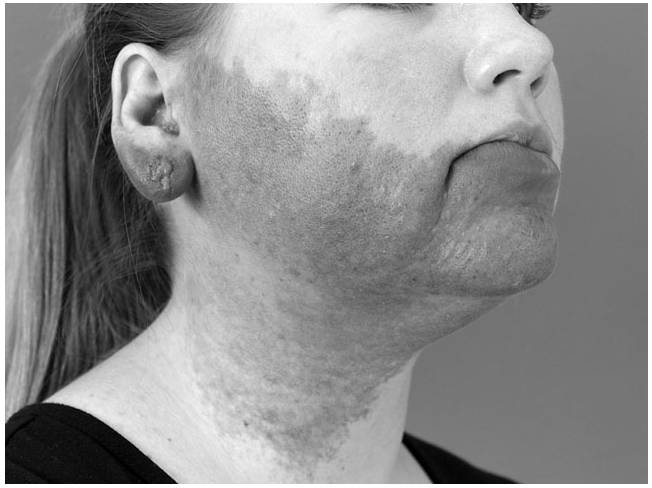
The correct response is Option B.
The patient depicted in the photograph has a port-wine stain in the VBIII distribution of the trigeminal (V) nerve. These lesions may occur anywhere on the body but are most commonly seen on the face. They occur unilaterally in 85% of patients and involve more than one dermatome in almost 70% of patients. These lesions are more commonly seen in women than in men (3:1) and may be hereditary (25%). The natural progression of these lesions with age includes darkening of the lesion due to the presence of deoxyhemoglobin, with thickening of the dermis and a cobblestoning appearance. It should be noted that as the lesions get darker, they are more difficult to treat. Because of its depth, penetration, and specificity for vascular targets, the 585-nm laser is the best treatment choice for these lesions. Treatment with the pulsed-dye laser typically results in less epidermal injury and risks for scarring. It should be used with caution in patients with pigment.
The 532-nm laser (KTP) is useful for superficial vascular telangiectasis. Both the 788- and 810-nm lasers are useful for pigmentation as well as hair removal. Finally, the 2940-nm laser (erbium) is a resurfacing device and is not specific for vascular targets.
A 32-year-old woman comes to the office for consultation regarding removal of a black and red tattoo from the left breast. The most effective intervention for removal of this patient’s tattoo is treatment with which of the following types of lasers?
(A) Carbon dioxide
(B) Pulsed-dye
(C) Q-switched alexandrite
(D) Q-switched Nd:YAG
(E) Q-switched ruby
The correct response is Option D.
The current standard of care for removing most unwanted tattoos is use of specific lasers to target the wavelength of the color pigments. No one laser can selectively target each pigment type in the spectrum of colors used by professional tattoo artists.
A Q-switched laser delivers short pulses, which reduces damage to surrounding normal skin. A frequency-doubled Q-switched Nd:YAG laser has a crystal that doubles the frequency of the Nd:YAG laser from 1064 nm to 532 nm. In the 532-nm (green) wavelength, the laser removes red pigments effectively. When switched to the full 1064-nm (red) wavelength, it effectively removes black pigments. The mechanism of action is believed to be selective fragmentation of the targeted pigment followed by phagocytosis and lymphatic clearing.
A carbon dioxide laser removes tattoos by targeting water in the skin. Therefore, it nonselectively destroys tissue, including pigment-bearing cells. Because it poses a high risk of hypopigmentation and hypertrophic scarring, it is not the laser of choice for removing professional tattoos.
A pulsed-dye laser has a wavelength of 510 nm; it can remove red pigments but is a poor choice for black pigments. A Q-switched alexandrite laser, with a wavelength of 755 nm, is excellent at removing black and green pigments but not reds. A Q-switched ruby laser, which has a wavelength of 694 nm, also is excellent for removing black pigments but is poor at targeting reds. In addition, it may produce more damage to surrounding tissue than the alexandrite laser.
A 50-year-old woman comes to the office because she developed a vesicular rash five days after undergoing full face carbon dioxide laser resurfacing to treat sun-damaged skin and acne scars. Which of the following is the most appropriate initial step in management?
A ) Administration of an antibiotic
B ) Administration of an antimicrobial scrub
C ) Administration of an antiviral agent
D ) Administration of a corticosteroid
E ) Observation
The correct response is Option C.
The patient described has most likely suffered from an outbreak of herpes simplex virus (HSV), which may occur with any resurfacing procedure, including laser, peels, and dermabrasion. Oral antiherpetic medication, such as acyclovir, valacyclovir, or famciclovir, should be prescribed prophylactically for all patients receiving resurfacing treatment, to start two days prior to the treatment and continuing for 7 to 10 days while the patient heals. HSV infection has a three- to five-day incubation period from the time of the procedure to the onset of clinical infection. If outbreak occurs €”and this rarely happens while taking antiviral prophylaxis €”treatment dosing of antiviral medication must be administered.
A 59-year-old woman comes to the office because she is unhappy with the long-term results of carbon dioxide laser resurfacing performed three years earlier to treat rhytides on the upper lip. Which of the following is the most likely complication that is causing her dissatisfaction?
A ) Hyperpigmentation
B ) Hypertrophic scarring
C ) Hypopigmentation
D ) Persistent erythema
E ) Telangiectasia
The correct response is Option C.
Carbon dioxide laser resurfacing is a highly effective treatment of rhytides of the upper lip that will last for a long time (more than six years) with low rates of recurrence. The success of carbon dioxide laser skin resurfacing is generally attributed to long-term neocollagenesis and neoelastogenesis. The main drawback is a high rate of hypopigmentation, which is very distressing to patients. Although persistent erythema and hyperpigmentation can be troublesome in the first year after treatment, neither is typically seen as long-term sequelae of the procedure. Hypertrophic scarring is a possible complication of treatment; however, it is not reported as a common long-term complication of the procedure in several large series of studies.
A 54-year-old man with Fitzpatrick type II skin is scheduled to undergo photoaging treatment with a carbon dioxide fractional laser. Which of the following measures is most likely to decrease this patient’s risk of hypertrophic scarring?
A) Decreasing fluences
B) Heat stacking
C) Increasing surface area coverage
D) Treating the neck skin
E) Using multiple laser passes
The correct response is Option A.
Fractional laser resurfacing of photo-damaged or acne-scarred skin has supplanted traditional carbon dioxide ablative laser devices while diminishing the incidence of adverse effects and effecting a more rapid recovery. However, hypertrophic scarring (HTS) is a noteworthy complication that requires the utilization of preventive measures to minimize its occurrence. Conservative treatment of the neck is foremost among these measures. Use of lower fluences (energy density, defined as Joules/cm2) treating reduced surface areas, abstinence from heat stacking, and avoiding multiple passes by a carbon dioxide laser all contribute to less incidence of HTS. Patient selection, preoperative education, and preparation for treatment of this complication are appropriate adjunctive measures as well.


-
Anesthetics - Critical Care152
-
Basic Surgical Principles203
-
Blepharoplasty - Oculoplastic105
-
Body Contour - Abdominoplasty - Liposuction184
-
Breast Augmentation, Mastopexy182
-
Breast Reconstruction177
-
Breast Reduction / Gynecomastia81
-
Burns principles and treatment136
-
Chest/Abdomen/Trunk/Rec/Congenital193
-
CL & CP, CL Nose, VPI161
-
Coding27
-
Craniofacial Anomalies - Migraine212
-
Ear Reconstruction - Microtia - Trauma118
-
Oculoplastic - Eyelid Reconstruction38
-
Facelift - Browlift110
-
Facial Palsy - Cheek and Lip reconstruction77
-
Facial Rejuvenation - Chemical Peel / Fillers / Botox / Non-Surgical115
-
Facial Trauma - OMF - Mandible171
-
Flaps - Principles - Complex Flap Recons.151
-
Genital, Urinary, Gender Affirmation, Pelvic52
-
Grafts: Skin, Fat, Cartilage and Bone97
-
Hand & Lower Extremities - General75
-
Hand - Amputation, Replantation, Dupuytren's235
-
Hand - Arthritis47
-
Hand - Extensor and Flexor Tendon Injury147
-
Hand - Fractures - Dislocations77
-
Hand - Limbs - Congenital105
-
Hand Nerve Injury - Compression - Brachial plexus198
-
Hand - Tumors77
-
Hand - Wrist ligament injuries and fractures97
-
Head and Neck Anatomy - Embryology76
-
Head and Neck Congenital105
-
Head and Neck Tumors / Parotid156
-
Infections - Soft Tissue - Hand106
-
Lasers50
-
Lower Extremity218
-
Lymphedema / venous Inssuficiency43
-
Mandible - OMF93
-
Microsurgery principles51
-
Nasal Reconstruction52
-
Orthognathic, TMJ, Chin138
-
Practice management - Health Care System - Ethics - Legal - Research79
-
Pressure Injuries55
-
Rhinoplasty - Septoplasty127
-
Scalp, Forehead, Cranial Reconstruction - Hair Restoration48
-
Skin Lesions Benign, Malignant SCC BCC (No-melanoma)158
-
Skin Melanoma45
-
Tissue Expansion18
-
Wound Healing, Hypertrophic scars and Keloids, Transplant125
-
Vascular Tumors And Malformations - PAD - Trauma111



