A 54-year-old woman undergoes breast reconstruction using a deep inferior epigastric artery perforator (DIEP) flap. Arterial thrombosis is noted after performing the microanastomosis. Which of the following is more likely to occur with local administration of tissue plasminogen activator (tPA) as an adjunct to revision microanastomosis as compared with revision microanastomosis alone (without tPA)?
A) Decreased flap salvage rate
B) Decreased incidence of fat necrosis
C) Increased flap salvage rate
D) Increased incidence of fat necrosis
E) Increased incidence of operative hematoma
The correct response is Option B.
Administration of tissue plasminogen activator (tPA) during revision of a microanastomosis has a decreased rate of subsequent fat necrosis. The suspected mechanism of action is thrombolysis of distant “shower” emboli in the microvasculature.
The administration of tPA as an adjunct to microanastomotic revision has no effect on flap salvage rates. In addition, there is no change in hematoma risk since the dose is low (2 mg) and is usually injected directly into the flap artery, which is maintained locally in the flap. Only if larger doses of tPA were given systemically would there be a risk of operative hematoma.
When harvesting the profunda artery perforator flap for breast reconstruction, which of the following structures does the perforating vessel travel through in the majority of patients?
A) Adductor longus muscle
B) Adductor magnus muscle
C) Gracilis muscle
D) Septum between the adductor longus and sartorius muscles
E) Septum between the adductor magnus and semimembranosus muscles
The correct response is Option B.
Proximal thigh profunda artery perforators most commonly course through the adductor magnus muscle not the adductor longus muscle. In these cases where musculocutaneous proximal perforators are used, fibers of the adductor magnus muscle will be divided for PAP flap harvest.
* The profunda artery perforator (PAP) flap is a fasciocutaneous flap frequently employed for breast reconstruction as an alternative to the deep inferior epigastric artery perforator flap. The PAP flap has also been described for lower extremity resurfacing and burn scar contracture release, as well as pedicled for perineal reconstruction. The PAP flap skin paddle is harvested as either a transverse skin paddle beneath the gluteal and groin crease or with a vertical skin paddle harvested in the frog leg position. The most common donor site skin paddle orientation for breast reconstruction is a transverse ellipse of skin inferior to the gluteal crease to camouflage the donor site scar.
* The profunda artery perforators emerge from the profunda vessels longitudinally down the postero-medial aspect of the thigh. Most patients have a proximal perforator that supplies the transverse ellipse of skin and adipose tissue most commonly employed for breast reconstruction. However, enough variability exists in perforator location, that preoperative CT angiography is recommended to confirm the presence of a proximal perforator.
* The PAP flap perforating vessel may travel in a septocutaneous plane between the gracilis and adductor magnus at the level of the deep investing fascia and between the adductor longus and magnus closer to its origin but not between the muscles listed as alternate septocutaneous choices.
* The transverse upper gracilis (TUG) flap perforator travels through the gracilis muscle before perfusing the medial thigh skin.

An otherwise-healthy 50-year-old man undergoes resection and immediate reconstruction with an anterolateral thigh free flap for recurrent squamous cell carcinoma of the oral cavity. Medical history includes resection, primary closure, and radiation. Intraoperatively, the patient is receiving low-dose phenylephrine infusion for blood pressure maintenance. Which of the following strategies is most likely to decrease the risk for pedicle thrombosis in this patient?
A) Administration of intravenous fluid boluses to wean off phenylephrine
B) Anastomosis to nonradiated recipient neck vessels
C) End-to-end anastomosis instead of end-to-side anastomosis
D) Intravenous heparin bolus 10 minutes before pedicle ligation
E) Venous anastomosis to internal jugular vein instead of the external jugular vein
The correct response is Option B.
Anastomoses performed in radiated fields have higher rates of flap loss as compared with nonradiated recipient neck vessels in head and neck reconstruction.
* Systemic heparin has not been shown to decrease pedicle thrombosis. However, vessel irrigation with topical heparin has been shown to decrease thrombosis at the anastomosis site in animal models, and therefore, most microsurgeons perform this practice.
* Vasopressors do not increase the risk for pedicle thrombosis. A recent meta-analysis showed a decreased rate of pedicle thrombosis with perioperative vasopressor administration in head and neck reconstruction, likely due to improved hemodynamics and decreased detrimental effects of fluid overload.
* There is no difference in pedicle thrombosis rate between end-to-end and end-to-side arterial or venous anastomosis, as shown in a recent meta-analysis.
* There is no proven difference in vessel patency rates between the internal jugular and external jugular systems.
A 55-year-old man with a history of squamous cell carcinoma undergoes glossectomy and reconstruction with a free radial forearm flap. Intraoperatively, the patient experiences hypotension, and norepinephrine is administered. Which of the following is the most likely effect of this treatment on the outcome of the free flap?
A) Delayed wound healing
B) Microvascular thrombosis
C) Partial flap loss
D) Total flap loss
E) No effect
The correct response is Option E.
In patients undergoing free flap reconstruction, the use of vasopressors is typically avoided when possible because of concerns that vasoconstriction of the anastomoses will result in microvascular thrombosis. When feasible, intravenous fluid administration should be attempted first to address hypotension. However, numerous studies have examined the effect of intraoperative vasopressors on free flap reconstructions and have generally not found an increased risk of postoperative complications.
An 18-year-old man is brought to the emergency department for thumb replantation. After an uneventful microsurgical anastomosis of the digital arteries and veins, papaverine is applied to the vessels. This medication works as a vasodilator through which of the following mechanisms?
A) Blocking calcium channels
B) Decreasing platelet aggregation
C) Inactivating thrombin and factor Xa
D) Inhibiting glycoprotein IIb/IIIa
E) Inhibiting phosphodiesterase
The correct response is Option E.
Papaverine is a phosphodiesterase inhibitor and is a commonly used vasodilating agent in microsurgery. It is administered as a liquid, directly to the adventitia of blood arteries, leading to vasodilation. The proposed mechanism of action of papaverine is by induced increase in cyclic adenosine monophosphate (AMP) levels, causing smooth muscle relaxation in the vessels. It is this mechanism of papaverine that has also led to its use for treatment of cardiac and neurovascular vasospasm.
Nifedipine is another common topical vasodilator, which is a calcium channel blocker. The remaining choices are all used to prevent clotting. Glycoprotein IIb/IIIa inhibitors are antiplatelet agents along with aspirin. Heparin inactivates thrombin and factor Xa through an antithrombin dependent mechanism.
A 51-year-old woman is undergoing free flap breast reconstruction. Following anastomosis, the patient sustains a venous thrombotic event, and the decision is made to flush the flap with tissue plasminogen activator (tPA). Which of the following is the primary mechanism of action of tPA as used in this scenario?
A) Antithrombin III activation
B) Fibrinolysis
C) Inhibition of platelet aggregation
D) Protein C activation
E) Prothrombin cleavage
The correct response is Option B.
During microsurgical procedures, the normal clotting mechanism may disrupt flow at the anastomosis. Multiple medications are available to limit clotting following the failure of an anastomosis. However, only certain medications are fibrinolytic and actively break down clots, whereas others limit the formation of further clots. Tissue plasminogen activator (tPA) is one such fibrinolytic agent, which increases the cleavage of the zymogen, plasminogen, to its active form, plasmin. Plasmin is directly fibrinolytic.
Prothrombin cleavage, to form activated thrombin, is primarily facilitated by factor X and results in increased thrombogenesis. Aspirin is a common drug that inhibits platelet aggregation, but this does not have a fibrinolytic effect and is not the mechanism by which tPA functions. Antithrombin III activation is the main mechanism of action of heparin, which limits multiple points in the thrombosis pathway. This medication is not fibrinolytic. Activated protein C is a powerful anticoagulant that inhibits both factors V and VIII in the coagulation cascade. Use of a recombinant protein C has been used in septic shock, but its benefits remain controversial. tPA does not function by protein C activation.
A 52-year-old man is admitted to the intensive care unit (ICU) for monitoring after debridement and anterolateral thigh free flap coverage of a traumatic lower extremity wound. He has a history of smoking and type 2 diabetes mellitus. Which of the following methods of free flap monitoring is associated with the highest salvage rate following microvascular compromise?
A) Clinical examination
B) Fluorescent angiography
C) Hand-held Doppler
D) Hyperspectral imaging
E) Near-infrared spectroscopy
Correct answer is option E
A 48-year-old woman underwent delayed right breast reconstruction with a DIEP flap in which the internal mammary vessels were used as the recipient vessels. One day after surgery, the skin paddle of the free flap appears congested and Doppler examination of the perforator shows diminished arterial signal. Emergent operative exploration shows that the venous pedicle is thrombosed. Local infusion of which of the following agents is most effective in reestablishing circulation?
A ) Dextran
B ) Heparin
C ) Lidocaine
D ) Milrinone
E ) Tissue plasminogen activator
The correct response is Option E.
Tissue plasminogen activator (TPA) catalyzes the conversion of plasminogen to plasmin. Unlike the other previously used thrombolytic agents, urokinase and streptokinase, TPA is more specific because its efficacy is enhanced by the presence of fibrin. In theory, this results in fewer bleeding complications than the less specific thrombolytic agents, which are no longer available in many hospital pharmacies.
Most large free flap series report that venous thrombosis is more commonly encountered than arterial compromise. Free flap monitoring is the most important aspect of free flap care with a low threshold for reexploration critical to the success of free flap salvage. Once thrombosis of a vascular pedicle is observed and the anastomosis taken down, thrombectomy followed by thrombolysis can often result in flap salvage.
Intravenous dextran and heparin have been used for platelet inhibition and anticoagulation to improve free flap patency rates. Heparin irrigation locally is used to prepare vessels for anastomosis. Lidocaine and papaverine are used locally to vasodilate vessels. Milrinone is a systemic vasodilator but has not been shown to improve free flap patency.
A 43-year-old woman is evaluated 6 hours after undergoing delayed breast reconstruction with deep inferior epigastric artery perforator flaps. On Doppler examination, arterial signals are present. Capillary refill time is 3 seconds on the right and 1 second on the left. A photograph is shown. Which of the following is the most appropriate management of the left breast?
A) Administration of systemic heparin
B) Administration of systemic tissue plasminogen activator
C) Application of leeches
D) Return to the operating room
E) Observation
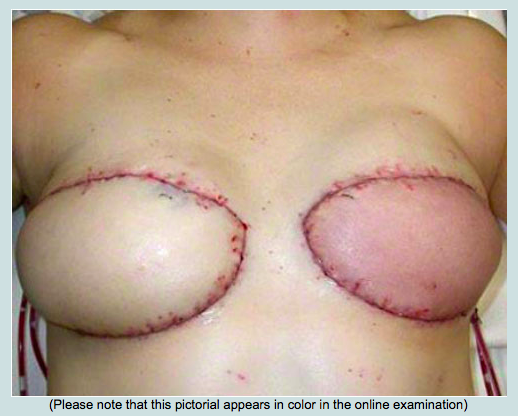
The correct response is Option D.
The most appropriate management is exploration of the left flap to assess anastomotic patency and pedicle orientation. This flap is hyperemic with brisk capillary refill and present arterial signals. These are all signs of venous insufficiency, and emergent exploration is indicated to assess the vascular pedicle for kinking or thrombosis. Application of leeches will drain excess blood from the flap but will not address the underlying problem. Observation is unacceptable because there are signs of venous insufficiency, and this requires urgent intervention. Systemic heparin will prevent further clot formation but will not dissolve an acute clot or resolve pedicle kinking. Systemic tissue plasminogen activator would greatly increase this patient’s risk of bleeding. This agent should only be used within a flap.
Question: A 62-year-old woman undergoes autologous breast reconstruction with a deep inferior epigastric perforator (DIEP) flap. On postoperative day 1, the flap shows signs of venous congestion with rapid capillary refill, darkening color, and increased turgor. She is taken emergently back to the operating room for exploration. Thrombus is identified at the venous anastomosis, which is revised. Despite re-establishing venous outflow, the flap remains congested with no improvement in capillary refill or color after 30 minutes. Which of the following pharmacologic agents is most appropriate to administer at this time to improve flap salvage?
a) Intravenous heparin
b) Topical papaverine
c) Intra-arterial alteplase
d) Oral apixaban
e) Subcutaneous argatroban
The correct answer is option C.
Rationale: In the scenario of a free flap with persistent congestion despite surgical revision of the anastomosis, the most likely cause is microvascular thrombosis within the flap’s distal vasculature. Alteplase, a recombinant tissue plasminogen activator, is the most appropriate thrombolytic agent for this situation. It works by converting plasminogen to plasmin, which lyses fibrin clots, thereby directly addressing the underlying microthrombi that surgical revision cannot reach. Heparin (option A) is an anticoagulant that prevents new clot formation but does not lyse existing thrombi. Papaverine (option B) is a vasodilator but does not address thrombosis. Apixaban (option D) and argatroban (option E) are anticoagulants that inhibit specific coagulation factors but lack the direct fibrinolytic action required to dissolve established microthrombi in a compromised flap.
References:
1. Barhoum F, Tschaikowsky K, Koch M, et al. Successful free flap salvage surgery with off-label use of alteplase: a case report, review of the literature and our free flap salvage algorithm. Int J Surg Case Rep. 2020;75:398-402. doi:10.1016/j.ijscr.2020.09.035
2. Wimbauer JM, Heinrich KM, Schwaiger K, et al. Anterograde injection of alteplase salvages deep inferior epigastric perforator flap in reconstructive breast surgery. Plast Reconstr Surg Glob Open. 2022;10(6):e4415. doi:10.1097/GOX.0000000000004415
3. Chang EI, Mehrara BJ, Festekjian JH, Da Lio AL, Crisera CA. Vascular complications and microvascular free flap salvage: the role of thrombolytic agents. Microsurgery. 2011;31(7):505-509. doi:10.1002/micr.20905
A 64-year-old man presents with biopsy-proven squamous cell carcinoma of the tongue. Excision and reconstruction are planned. Allen tests on both sides show complete radial dominance, which is confirmed with non-invasive ultrasound. The plan is to proceed with an ulnar artery perforator flap from the non-dominant hand. When comparing the ulnar artery perforator flap to the radial forearm flap, which of the following is a major benefit of the ulnar artery flap?
A) It has a larger pedicle artery diameter
B) It has a longer pedicle length
C) It has a lower flap thrombosis rate
D) It is a better choice to incorporate bone as an osteocutaneous flap
E) It is less likely to result in tendon exposure at the donor site
The correct response is Option E.
On the basis of the more proximal location of the ulnar artery perforator flap, the donor site is able to be closed primarily more commonly than a radial forearm flap. When it is not closed primarily, typically the exposed deeper structures are muscle bellies rather than peritenon or tendon in the more distally located and radially positioned radial forearm flap. Another benefit is that the ulnar side of the arm is less hair-bearing and therefore may serve as better choice for intraoral reconstruction.
The other options are incorrect:
* The radial forearm flap has a longer pedicle.
* The ability to incorporate bone into the flap is better reported in an osteocutaneous radial forearm.
* The flap thrombosis rates have been shown to be equivalent
* The arterial diameter is similar or larger in the radial artery depending on the publication.

During surgical exploration for a failing free flap, a surgeon revises the anastomosis, performs mechanical thrombectomy with a Fogarty catheter, and injects the flap with tissue plasminogen activator (tPA). Which of the following is the mechanism of action of tPA in fibrinolysis to increase flap survival and decrease fat necrosis?
A) Activates plasmin binding to fibrin
B) Converts plasminogen to plasmin
C) Forms a complex with plasminogen
D) Inhibits plasminogen activator inhibitor type-1
The correct response is Option B.
Tissue plasminogen activator (tPA) is a protease that cleaves a peptide bond in plasminogen, converting it to plasmin. tPA and urokinase have similar mechanisms in converting plasminogen to plasmin through cleavage. Plasmin is an enzyme that lyses the cross-linking between fibrin molecules and therefore breaks up clot formation. Streptokinase, which is derived from Streptococcus and is no longer commercially available in the United States, forms a complex with plasminogen, which then converts to plasmin. Plasminogen activator inhibitor type-1 (PAI-1) binds to tPA and inactivates it by forming a complex. An inhibitor of PAI-1 would facilitate the pathway of fibrinolysis, but tPA does not act in this manner.
A 64-year-old man is evaluated 2 days after undergoing soft-tissue coverage of an open distal tibia fracture with a free rectus abdominis flap. On examination, the flap appears dark and swollen. Doppler signals are not present. The patient is brought to the operating room for reexploration, and thrombus is noted within the artery and vein. In addition to thrombectomy, which of the following is the most appropriate treatment to salvage this flap?
A) Aspirin
B) Intra-flap heparin
C) Intra-flap tissue plasminogen activator
D) Systemic dextran
E) Systemic urokinase
The correct response is Option C.
The most appropriate treatment in this patient is thrombectomy to restore flow within the artery and vein and administration of intra-flap tissue plasminogen activator (tPA) to dissolve clot formed within the flap.
Systemic urokinase will carry a high risk of bleeding from all surgical sites and is unlikely to dissolve clot in both the arterial and venous systems of the flap. Administration of intra-flap heparin will prevent further clot formation but will not dissolve the clot in the flap pedicle. Systemic dextran following thrombectomy might prevent clot formation and has mild thrombolytic properties, but it is not nearly as effective as tPA in lysing clot within the flap. Aspirin will potentially prevent further clot formation but has no thrombolytic properties and a slow onset of action.
A 58-year-old man requires free tissue transfer for soft-tissue reconstruction of a head and neck defect. Which of the following surgical interventions is most likely to improve flap survival?
a. End-to-end anastomosis
b, Multiple perforators
c. Muscle flap only
d. Supercharging
e. Venous coupler
The correct response is Option E.
In a recent study of 2296 head and neck free tissue transfers, Chang et al demonstrated that the use of a venous coupler had a significantly decreased complication rate compared with performing a hand-sewn anastomosis. Other authors have demonstrated the benefits of venous couplers in head and neck free tissue reconstruction as well.
* Further analysis yielded no significance in survival rates with supercharging, use of multiple perforators, or orientation of anastomosis.
* They noted an increased risk for failure with muscle-only flaps compared with fasciocutaneous or osteocutaneous flaps.
Reference(s)
- Chang EI. Zhang H, Liu J, Yu P, Skoracki RJ, Hanasono MM. Analysis of risk factors for flap loss and salvage in free flap head and neck reconstruction. Head Neck. 2016;38(suppl 1): E771-E775.
- Kruse AL, Luebbers HT, Grätz KW, Obwegeser JA. Factors influencing survival of free‐flap in reconstruction for cancer of the head and neck: a literature review. Microsurgery. 2010;30(3):242-248.
- Zhang T, Lubek J, Salama A, et al. Venous anastomoses using microvascular coupler in free flap head and neck reconstruction. J Oral Maxillofac Surg. 2012;70(4):992-996.
A 16-year-old boy develops a severe left first web space contracture 8 months after undergoing skin grafting for a soft-tissue avulsion injury. At the time of contracture release, a pedicled fasciocutaneous flap is planned for coverage of the soft-tissue defect. On the basis of the preoperative markings for the flap in the photographs shown, the flap pedicle is located between which of the following muscles?
A) Brachioradialis and extensor carpi radialis longus
B) Brachioradialis and flexor carpi radialis
C) Extensor digiti minimi and extensor carpi ulnaris
D) Extensor digiti minimi and the extensor digitorum communis
E) Extensor digitorum communis and extensor carpi radialis brevis
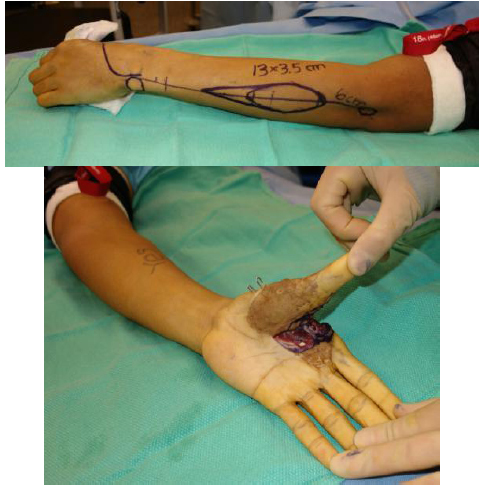
The correct response is Option C.
The photograph illustrates the markings for a reverse posterior interosseous artery (PIA) flap. The reverse PIA flap is a thin, pliable fasciocutaneous flap that can provide reliable coverage of soft-tissue defects involving the dorsal hand, metacarpophalangeal joints, and first web space.
* Some surgeons report success using this flap for coverage of palmar wounds and soft-tissue injuries of the thumb as well.
* Perfusion of the flap is based on retrograde flow through the posterior interosseous artery, which sends septocutaneous perforators to the overlying skin.
* The axis of the flap can be marked corresponding to a line between the lateral epicondyle and the radial aspect of the ulnar styloid.
* The location of the posterior interosseous artery pedicle is between the extensor digiti minimi and the extensor carpi ulnaris.
* Retrograde perfusion through the flap relies on an intact communication of the PIA with the dorsal branch of the anterior interosseous artery, which is present in nearly all cases.
* This anastomosis is located 2 cm proximal to the radial aspect of the ulnar styloid; therefore, it corresponds to the pivot point of the flap.
* One of the advantages of this flap is that it does not require sacrifice of a major arterial source of blood to the hand.
The other responses do not correctly describe the location of the PIA. Of note, the interval between the brachioradialis and the flexor carpi radialis represents the location of the radial artery fasciocutaneous flap pedicle.

A 154-lb (70-kg), 54-year-old man is evaluated because of oliguria and malaise 2 days after he underwent subtotal glossectomy with reconstruction with a free radial forearm flap. History includes chronic renal insufficiency (baseline creatinine concentration was 1.8 mg/dL and is now 3.3 mg/dL). After the procedure, administration of aspirin 81 mg by mouth daily and dextran 40 at 20 mL/hr was initiated. Temperature is 99.9°F (37.7°C), heart rate is 88 bpm, respiratory rate is 20/min, and blood pressure is 110/60 mmHg. On examination, the flap is pink and soft. Urine output is 15 mL/hr. Which of the following is the most appropriate management?
A) Administer a 500-mL bolus of Ringer’s lactate
B) Administer a diuretic
C) Administer dopamine
D) Discontinue dextran
E) Return to the operating room for neck exploration
The correct response is Option D.
This patient is presenting with an uncommon but major complication of dextran administration, specifically acute renal failure, thought to be caused by either direct toxic effect on the tubules and glomeruli or intraluminal hyperviscosity. Surgeons who employ its use must be aware of this potential side effect as well as other serious side effects such as anaphylaxis, volume overload, pulmonary edema, cerebral edema, and platelet dysfunction. At-risk patients include those with a history of diabetes, renal insufficiency, or vascular disorders. It is recommended to avoid dextran in patients with chronic renal insufficiency for this reason.
This head and neck cancer patient also was on aspirin for anticoagulation. It should be noted that a prospective randomized study of dextran- and aspirin-related complications in 100 patients undergoing microsurgical flap reconstruction for head and neck malignancy demonstrated that aspirin and dextran were actually equally efficacious in preventing flap failure. However, despite this, it was demonstrated that patients on dextran had a 3.9- to 7.2-fold increased relative risk of systemic complications after 48 and 120 hours of dextran infusion, respectively. Given this, aspirin should be used over dextran if anticoagulation is desired.
A 500-mL bolus of Ringer’s lactate would not be warranted because it contains potassium, which would already be elevated in acute-on-chronic renal failure and would exacerbate the hyperkalemia.
Administration of a diuretic would not be warranted in this case because there is no evidence of fluid retention.
Low-dose dopamine is commonly administered to critically ill patients in the belief that it reduces risk of renal failure by increasing renal blood flow. This has never been definitely proven, however, in multiple trials. This patient has chronic renal insufficiency exacerbated by dextran administration. Low-dose dopamine has not been demonstrated to confer any benefit in this clinical scenario.
If a hematoma, arterial insufficiency, or venous congestion were suspected, returning to the operating room would be the next most appropriate step. As this is not the working diagnosis, this would be inappropriate.
A 39-year-old woman successfully undergoes immediate bilateral breast reconstruction with coverage with free deep inferior epigastric artery perforator free flaps. Postoperative flap monitoring is planned. Vascular compromise is most likely to occur during which of the following time periods postoperatively?
A) 0–1 days
B) 2–3 days
C) 4–5 days
D) 6–7 days
E) 8–9 days
The correct response is Option A.
Free flaps can be monitored by several different modalities in the postoperative period. The main reason for monitoring free flaps postoperatively is to detect vascular complications in a timely fashion, before permanent injury to the flap occurs, and to maximize the possibility of flap salvage. Reviews of large consecutive series of free flaps indicate that the most likely time period for a vascular compromise is early on, usually within the first 24 hours after successful transfer from the operating room. Therefore, postoperative monitoring protocols should be designed to closely follow flap perfusion during this period of time. Vascular events leading to issues with flap perfusion do occur at later times, but such events are generally infrequent and more difficult to salvage.
When compared with liberal fluid administration for pressure support, vasopressors have which of the following effects on the overall success of deep inferior epigastric artery perforator (DIEP) flap breast reconstruction?
A) Delay in postoperative patient mobilization
B) Increase in the risk of total or partial flap loss
C) Increase in the risk of venous congestion
D) No difference in the rate of pedicle thrombosis
The correct response is Option D.
Traditionally, the use of vasopressors in free flap surgery has been avoided due to the presumed risk of pedicle vasospasm leading to flap failure. However, recent studies have indicated that this assumption may not be accurate. Additionally, the fear of vasopressor-associated flap complications has led to the practice of liberal fluid administration, which has failed to demonstrate any benefits when compared with a fluid-restrictive vasopressor strategy. Multiple prospective interventional trials and meta-analyses have reported that the use of vasopressors results in no detectable negative impact on flap survival or overall patient outcome. Specifically, intraoperative use of phenylephrine, ephedrine, or calcium chloride as an intravenous bolus does not increase in the risk of total or partial flap loss, delay postoperative patient mobilization or increase the risk of venous congestion. The use of vasopressors in free flap surgery is not contraindicated.
A 45-year-old woman with a history of systemic lupus erythematosus requires a free flap reconstruction of her right lower extremity. She has never had a thrombotic event. She is on corticosteroids for collagen vascular disease. Which of the following perioperative measures is most appropriate?
A) Intraoperative and postoperative anticoagulation
B) Intraoperative anticoagulation alone
C) Preoperative and postoperative aspirin therapy
D) Preoperative hypercoagulability workup
E) Preoperative vitamin A therapy
The correct response is Option D.
The most appropriate management would be to get a formal hematology consult and anticoagulation workup prior to surgery. Collagen vascular diseases target connective tissues and have multiorgan manifestations secondary to deposition of antigen-antibody complexes. Affected patients are intrinsically prone to thrombosis from the inflammation of the connective tissue disorder itself and the synergistic effect of having increased chances of having concurrent hypercoagulability risk factors such as anticardiolipin or lupus anticoagulant.
Therefore, in this patient population with the threat of vascular compromise, it is most prudent to perform preoperative hematologic evaluation, especially if they exhibit a history of previous clotting and flap failure. As a more prudent measure, all of these patients should have a detailed hypercoagulability evaluation, including a detailed history and hematology consultation with a laboratory panel looking for hypercoagulability factors. If positive, steps should be taken perioperatively to decrease the risk of thrombotic complications, and chemical anticoagulation should be considered, but if negative with no history of previous thrombotic complications, then no added chemical anticoagulation is needed. Studies have not shown an increase in thrombotic flap failures in such patients, despite their intrinsic risk of thrombosis.
Aspirin therapy has not been shown to decrease flap loss rates. Vitamin A is indicated in this patient, not to decrease thrombotic flap loss rates, but rather to counteract the immunosuppressive medications.
A 38-year-old woman undergoes bilateral breast reconstruction using microvascular free tissue transfer from the abdomen. The patient is evaluated 8 hours later because the right breast flap appears mottled and engorged. Administration of which of the following is CONTRAINDICATED in this patient?
A) Heparin irrigation to the flap vessels
B) Papaverine to the flap vessels
C) Systemic heparin
D) Systemic thrombolytics
E) Thrombolytics to the flap vessels
The correct response is Option D.
Heparin may be used locally or systemically during flap salvage attempts in an effort to encourage further propagation of clot and irrigate existing thrombus. Papaverine and thrombolytic agents are used locally on or within the flap vessels, but not systemically due to concern for systemic complications.
A 68-year-old woman undergoes partial glossectomy, resection of the anterior floor of the mouth, and bilateral modified radical neck dissection to treat squamous cell carcinoma of the ventral tongue and anterior floor of the mouth. The resulting defect is reconstructed with a 5 × 6 cm radial forearm free flap. The free flap is anastomosed to the left facial artery and left internal jugular vein. The forearm donor site is reconstructed with a split-thickness skin graft from the thigh. In addition to Current Procedural Terminology (CPT) code 15758 (free fascial flap with microvascular anastomosis), which of the following is most appropriate?
(A) 13152: Complex repair, mouth, 2.6–7.5 cm
(B) 15100: Split-thickness skin graft, arm; less than 100 cm²
(C) 35761: Exploration of vessels without repair
(D) 40840: Anterior vestibuloplasty
(E) 69990: Use of operating microscope
The correct response is Option B.
Free flap procedure codes are global and include the following:
- Elevation of the flap
- Isolation of donor flap vessels used for microvascular anastomosis
- Transfer of the flap to the recipient site
- Isolation of the recipient vessels used for microvascular anastomosis
- Microvascular anastomosis of one artery
- Microvascular anastomosis of one or two veins
- Inset of the flap at the recipient site
- Primary closure of the donor site
If a free flap procedure involves components beyond these global elements, it is appropriate to report them as additional codes, as they are considered over and above the standard procedure. These may include:
- Vein grafts
- Neurorrhaphy
- Nerve grafts
- Skin grafts (donor site or recipient site)
- Closure of the donor site that is more extensive than primary closure
- Wound preparation of the recipient site
Additionally, CPT 69990 (use of the operating microscope) is included within the free flap codes and should not be reported separately.
A 48-year-old woman undergoes delayed reconstruction of the right breast with a deep inferior epigastric artery perforator (DIEP) flap. Medical history includes failed tissue expander–based right breast reconstruction because of infection 5 months ago. On postoperative day 5, the patient comes to the emergency department with a swollen, purple flap, which she noticed after showering. The venous anastomosis is revised and flap thrombolysis is performed with tissue plasminogen activator, successfully restoring flap perfusion. Which of the following clinical factors is LEAST likely to increase this patient’s risk of thrombotic flap complications?
A) Antiphospholipid syndrome
B) Antithrombin deficiency
C) BRCA1 or BRCA2 genetic mutation
D) Factor V Leiden mutation
E) Perioperative tamoxifen therapy
The correct response is Option C.
This patient has developed a late venous thrombosis and may be predisposed to a hypercoagulable state. The BRCA1 and BRCA2 genes are tumor suppressor genes involved in DNA repair. Mutations in these genes dramatically increase a woman’s risk of developing breast and ovarian cancer over her lifetime, and are the most common cause of hereditary forms of breast and ovarian cancer. But BRCA genetic mutations do not appear to increase the risk of blood clots over baseline and would be unlikely to contribute to this patient’s condition.
The other options are incorrect because each carries higher than average risk of blood clots. Perioperative tamoxifen therapy increases the risk of thromboembolic events in general and for flap complications and flap loss during microvascular breast reconstruction in particular. Tamoxifen is an estrogen receptor antagonist and is used both to treat and prevent breast cancer. Some authors recommend cessation of tamoxifen at least 14 days prior to microvascular breast reconstruction to minimize thrombosis risk.
Factor V is a protein involved in the coagulation cascade. Factor V Leiden mutation is an inherited condition that confers a hypercoagulable state, increasing the risk of thrombotic complications.
Antithrombin III is a protein similarly involved in anticoagulation. Deficiency may be either inherited or acquired, and it confers an increased risk of venous thrombotic events.
Antiphospholipid syndrome is an acquired autoimmune disorder which also confers a hypercoagulable state. Venous or arterial thrombosis, as well as fetal loss, are characteristic of this disorder. Some patients will have an associated autoimmune disease, such as systemic lupus erythematosus.
A healthy 55-year-old woman underwent bilateral breast reconstruction with free deep inferior epigastric perforator (DIEP) flaps. Tissue oximetry-based flap monitoring is used. Which of the following is the main advantage of this technique over a hand-held Doppler with clinical assessment?
A) Direct blood flow measurement
B) Ease of use
C) Improved flap salvage rate
D) Less expensive modality
E) Operator must be bedside
The correct response is Option C.
The main advantage of using tissue oximetry-based monitoring is that it improves flap salvage rates. Tissue oximetry, or near-infrared spectroscopy, is increasing in popularity among microsurgeons and has been shown to be the third most commonly used technique after clinical examination and hand-held Doppler. Rather than directly monitoring flow, tissue oximetry uses infrared light to measure the relative concentrations of oxygenated and deoxygenated hemoglobin. By measuring oxygenation rather than flow, the probe is relatively unaffected by movement artifacts. Recent studies emphasize its value in identifying flap compromise before clinical signs of arterial or venous thrombosis. In a 2011 study, Lin et al. reported an increased flap salvage rate at their institution with the use of near-infrared spectroscopy, from 57.7 to 93.8% (p = 0.015), despite no significant increase in their rate of reexploration, attributing this improvement to earlier recognition of vascular compromise. In a recent small prospective cohort study, Lohman et al. followed 38 free flaps with physical examination and five technologies, including handheld Doppler, implantable Doppler, and tissue oximetry. Although primarily a descriptive study, they concluded that tissue oximetry was the first technology to record signs of flap compromise.
Though tissue oximetry-based flap monitoring is easy to use, so is a hand-held Doppler, so that is not the main advantage. It does have a higher financial investment to buy the system, but over time it could be argued it more than pays for itself given the improved flap salvage rates. Unlike the hand-held Doppler, this modality has a continuous read on the monitor, the examiner need not be in the presence of the patient, and, in fact, can visualize the readings on a smart phone through an app.
A 53-year-old woman is evaluated in the recovery room during the first hour after microsurgical breast reconstruction with a free flap. On examination, the skin paddle appears bluish with a rapid capillary refill. There is a strong cutaneous arterial Doppler signal. Which of the following actions is most appropriate to increase the likelihood of flap salvage in this patient?
A ) Administration of systemic heparin
B ) Administration of systemic tissue plasminogen activator
C ) Application of a body warmer
D ) Application of leeches
E ) Emergent exploration
The correct response is Option E.
The patient has a venous thrombosis. The success of free tissue transfer is greater than 90% at most major microsurgical centers. Between 5 to 25% of free flaps require reexploration due to vessel compromise, as venous congestion is more common than arterial compromise. The flap salvage rate is influenced by the timing of reexploration across multiple studies. In one study, flaps that were reexplored within 5 hours had a higher flap salvage rate.
All studies point to early recognition of flap compromise as important and rapid reexploration as the most important factor to improve flap salvage. Administration of heparin, use of thrombolytics, and application of leeches will not increase the salvage rate in the scenario described. Increasing the patient’s temperature also does not improve flap salvage.


-
Anesthetics - Critical Care152
-
Basic Surgical Principles203
-
Blepharoplasty - Oculoplastic105
-
Body Contour - Abdominoplasty - Liposuction184
-
Breast Augmentation, Mastopexy182
-
Breast Reconstruction177
-
Breast Reduction / Gynecomastia81
-
Burns principles and treatment136
-
Chest/Abdomen/Trunk/Rec/Congenital193
-
CL & CP, CL Nose, VPI161
-
Coding27
-
Craniofacial Anomalies - Migraine212
-
Ear Reconstruction - Microtia - Trauma118
-
Oculoplastic - Eyelid Reconstruction38
-
Facelift - Browlift110
-
Facial Palsy - Cheek and Lip reconstruction77
-
Facial Rejuvenation - Chemical Peel / Fillers / Botox / Non-Surgical115
-
Facial Trauma - OMF - Mandible171
-
Flaps - Principles - Complex Flap Recons.151
-
Genital, Urinary, Gender Affirmation, Pelvic52
-
Grafts: Skin, Fat, Cartilage and Bone97
-
Hand & Lower Extremities - General75
-
Hand - Amputation, Replantation, Dupuytren's235
-
Hand - Arthritis47
-
Hand - Extensor and Flexor Tendon Injury147
-
Hand - Fractures - Dislocations77
-
Hand - Limbs - Congenital105
-
Hand Nerve Injury - Compression - Brachial plexus198
-
Hand - Tumors77
-
Hand - Wrist ligament injuries and fractures97
-
Head and Neck Anatomy - Embryology76
-
Head and Neck Congenital105
-
Head and Neck Tumors / Parotid156
-
Infections - Soft Tissue - Hand106
-
Lasers50
-
Lower Extremity218
-
Lymphedema / venous Inssuficiency43
-
Mandible - OMF93
-
Microsurgery principles51
-
Nasal Reconstruction52
-
Orthognathic, TMJ, Chin138
-
Practice management - Health Care System - Ethics - Legal - Research79
-
Pressure Injuries55
-
Rhinoplasty - Septoplasty127
-
Scalp, Forehead, Cranial Reconstruction - Hair Restoration48
-
Skin Lesions Benign, Malignant SCC BCC (No-melanoma)158
-
Skin Melanoma45
-
Tissue Expansion18
-
Wound Healing, Hypertrophic scars and Keloids, Transplant125
-
Vascular Tumors And Malformations - PAD - Trauma111



