Wounds & Bleeding
what is a wound
- A wound is a break in the continuity of tissues; it frequently includes a break in the surface of the skin or mucous membrane (an open wound) making it exposed to infection.” (IHCD, BTM 3rd Ed)
- Management of wounds centres on:
- Control of bleeding • Prevention of infection
- Prevention of further complications
Types of Wound
- Contusion
- Laceration
- Incision
- Puncture
- Gunshot
Bleeding & Blood Loss
Types of bleeding
describe
Types of bleeding:
1.External
2.Internal
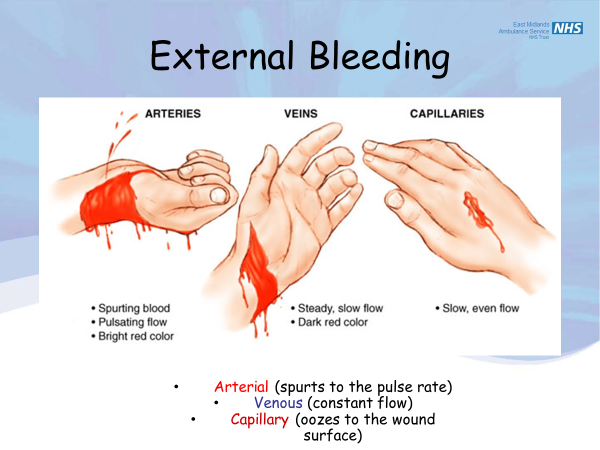
1.External Bleeding – can be seen at source and may be:
- Arterial (spurts to the pulse rate)
- Venous (constant flow)
- Capillary (oozes to the wound surface)
External Bleeding
Bleeding and Blood Loss
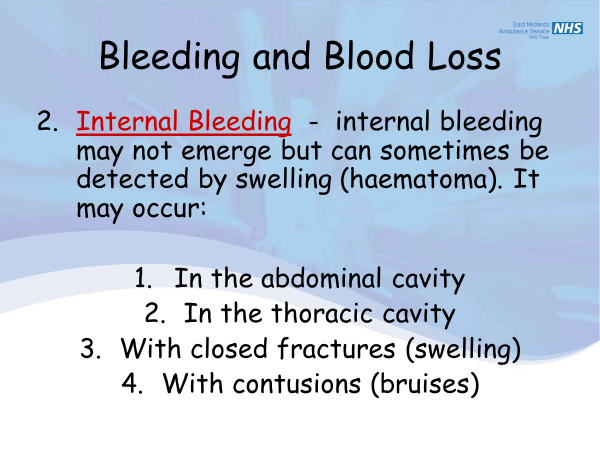
Internal Bleeding
Look for:
“blood on the floor and four more”
list
Look for:
“blood on the floor and four more”
- External
- Chest
- Abdomen
- Pelvis
5Long bones
Describe the characteristics of blood appearing from damage to the following organs:
- Lungs
- Stomach
- Kidneys
- Large Intestine
- Brain
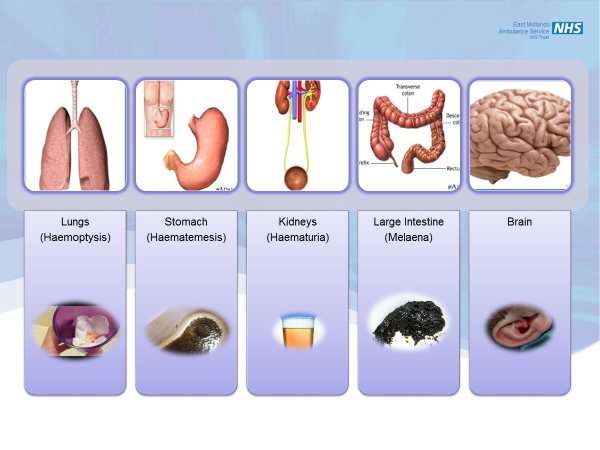
Blood Loss
It is the percentage of blood loss that is of importance in the development of the clinical picture.
A small amount of haemorrhage in a child may be of serious significance whereas a similar volume lost by an adult may be of no consequence
To assess blood loss look out for blood lost:
- In body tissues • On the patient’s clothing
- On the floor • In wound dressings etc..
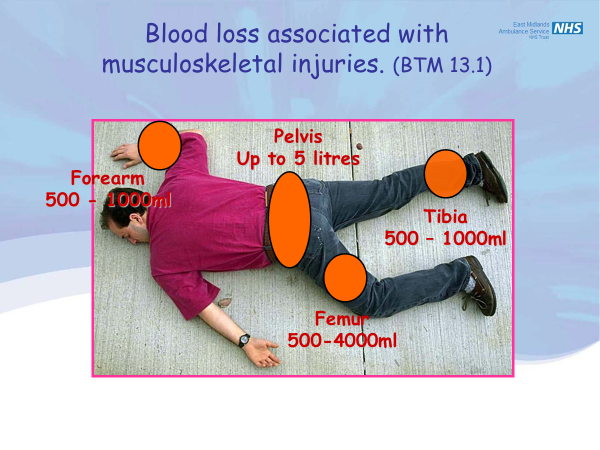
Blood loss in injuries
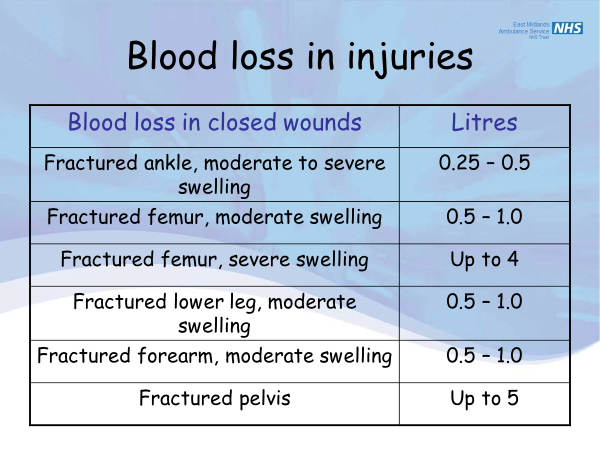
Blood loss associated with musculoskeletal injuries
Factors Affecting Bleeding
Bear in mind the:
Bear in mind the:
- Depth, type and size of wound
- Size of the blood vessel
- Duration of bleeding - ? anticoagulants
- Position of the injury
- Age or size of the patient
- Seriousness of scalp wounds
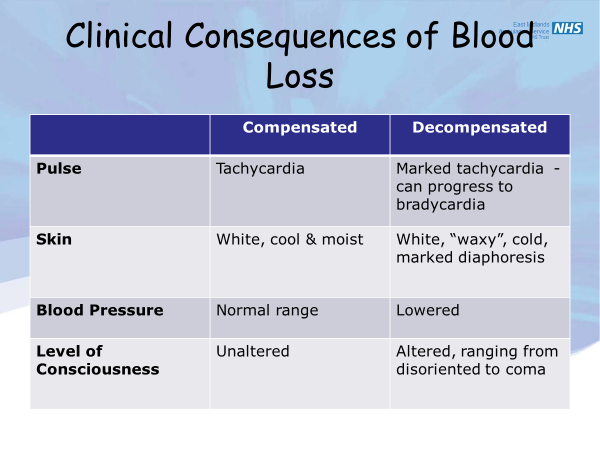
•Identify, in writing, the clinical consequences of bleeding and state how observation of the patient assists in assessing the severity of their condition.
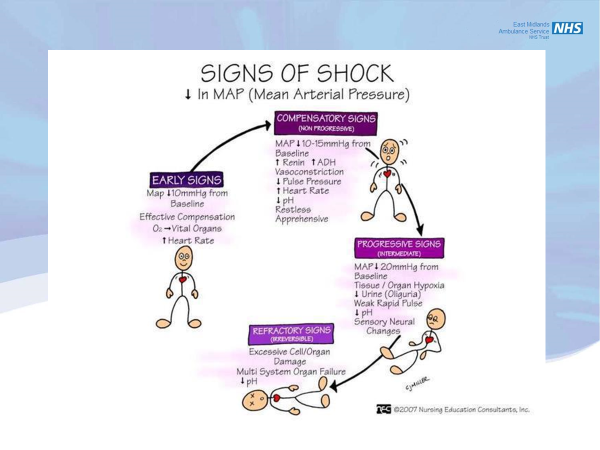
Signs of shock
Management
Bleeding and Blood Loss
Because blood can spurt or splash, use appropriate BSI precautions.
Management of External Bleeding
Effective management may be achieved by:
- ABC
- Controlling any catastrophic haemorrhage
- Inspecting for foreign bodies or debris
- Applying direct pressure
- Elevating the injured area
- Placing the patient in a position of rest
- Dressing wounds
- Immobilising the injured area
- Re-checking wound dressings for effectiveness
- Observing for control of bleeding and impairment of circulation - ? Tourniquet if exsanguinating/catastrophic haemorrhage
- Treating for shock
Wound Dressings
Should be:
Should be:
- Large enough to completely cover the injury
- Sterile
- Absorbent, non-adherent material
- Applied to provide sufficient pressure to control bleeding
exposed bowel
- Cover exposed bowel with warmed dressings soaked in a crystalloid solution
- Do Not attempt to push organs back into the abdomen
Foreign Bodies Wound Dressings
- Construct a built up dressing of sterile pads around the wound
- Cover and seal with a large wound dressing to provide indirect pressure without disturbing the foreign body
- Secure long objects to prevent their movement
Management of Internal Bleeding
Effective management may be achieved by:
- Ensuring an open airway
- Providing oxygen therapy
- Assessing the pulse and acting on your assessment
- Positioning the patient appropriately for their injuries and level of consciousness
- Elevating the lower limbs
Loosening restrictive clothing
- Anticipating vomiting and giving nothing by mouth
- Moving the patient as little as possible
- Keeping constant observation of pulse, respiration, level of consciousness
- Observing closely for signs of shock
- Consider pain relief
Amputations
- Wrap in sterile gauze, moistened
- Seal in plastic bag
- Place on ice if possible
- Never directly onto ice
- Dress stump with moist dressings
- Pain relief
Briefly describe the following terms:
- Contusion
- Epistaxis
- Haematemesis
- Haematoma
- Haematuria
- Haemoptysis
- Haemorrhage
- Hyphaema
- Melaena
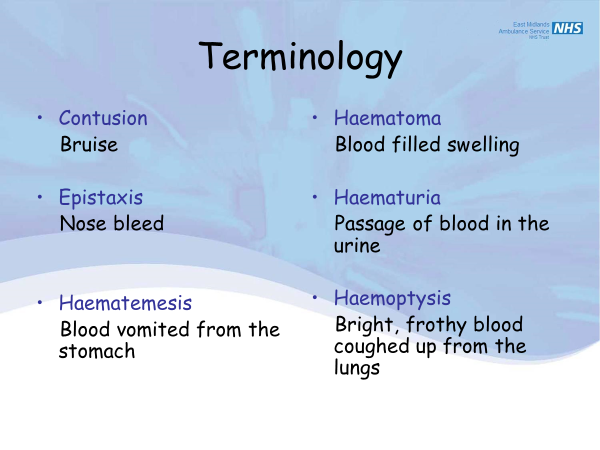
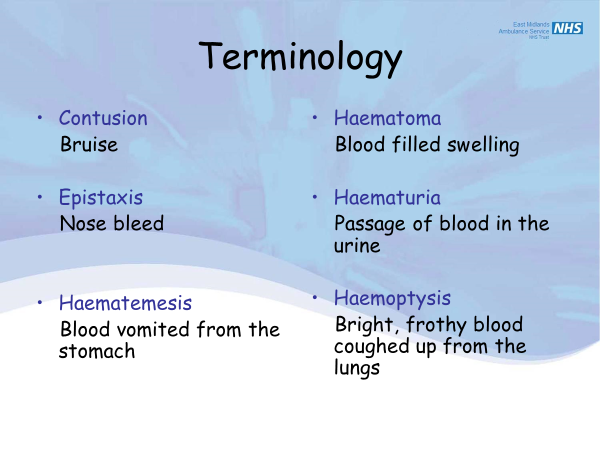
Terminology
- Contusion
- Epistaxis
- Haematemesis
- Haematoma
Haematuria
- Haemoptysis
- Haemorrhage
- Hyphaema
- Melaena
•Haemorrhage
Bleeding
•Hyphaema
Blood in the anterior chamber of the eye
•Melaena
Blood contained in the faeces

-
MOD E TECH 26 Child protection/vulnerable adults/domestic violence41
-
MOD E Tech 27 Nervous System37
-
MOD E Tech 28 Nervous Disorders24
-
MOD E Tech 29 Skeletal System18
-
MOD E Tech 30 Musculoskeletal injuries18
-
MOD E Tech 31 Injuries to the Spine and Pelvis25
-
MOD E Tech 32 Head & Maxillofacial injuries29
-
MOD E Tech 33 Vehicle Extrication/Helmet Removal2
-
MOD E Tech 34 Wounds & Bleeding22
-
MOD E Tech 35 Burns and Scalds17
-
MOD E Tech 36 Trauma Management31
-
MOD E Tech 37 Disease Information19
-
MOD E Tech 52 Introduction to Pharmacology32
-
MOD E Tech Abdominal Trauma24
-
MOD E Tech Paediatric Trauma14
-
MOD E Tech Trauma in Pregnancy13
-
MOD E Tech Trauma in the Elderly14
-
MOD E Tech 28 Nervous Disorders COPY24



