Abdominal Trauma
You are presented with a 21 year old male patient who has what appears to be a deep stab wound to the lower margin of the left hypochondrium in the anterior axillary line. He appears to be profoundly shocked
Primary Survey
- Catastrophic Haemorrhage – none evident
- Airway – Clear
- Breathing – tachypnoeic, bilateral b.s.
- Circulation – tachycardic, weak, abdomen rigid
- Disability – unresponsive to voice or pain
Baseline Observations:
•
- Pupils – dilated but reactive
- Pulse – 130/min
- Skin – pale, cool, moist
- Resps. – 40/min
B.P. – 90/50
Abdominal Trauma
- A leading cause of preventable trauma death
- Often goes unrecognized
- Internal injury difficult to assess in the field
- Massive blood loss can lead to shock and death
Abdominal Trauma
The abdomen is divided into 3 anatomical areas:
- Abdominal cavity
- Pelvis
- Retroperitoneal cavity
Pathophysiology
Abdominal Trauma
Abdominal cavity:
•
•Solid organs (liver, spleen) haemorrhage
•
•Hollow organs (small intestine, colon) filled with enzymes and bacteria
•
•Can hold large volume of blood (“Silent reservoir”)
Pelvis
•Contains the bladder, lower part of the large intestine and, in the female, the uterus and ovaries
•
•The iliac artery and vein lie over the posterior part of the pelvic ring and may be torn in pelvic fractures
Retro-peritoneal Area
- Lies against posterior abdominal wall
- Contains kidneys, ureters, pancreas, abdominal aorta, vena cava and part of duodenum
- These structures often injured by shearing forces produced in rapid deceleration
Shear Injury
Pathophysiology
Retroperitoneal cavity:
•Solid organs (kidneys, pancreas)
•
- Large blood vessels (aorta and vena cava)
- Potential space that can hold massive amount of blood
Mechanism of injury
•Abdominal injury can result from both blunt and penetrating forces
•
•All penetrating abdominal trauma must be recognised as serious injury, regardless of the cause
Assessment
•Observe the mechanism of injury
•
•In RTC’s look for impact speed and severity of deceleration. Was a seat belt worn? – lap belts are particularly associated with perforated abdominal structures
•
•In cases of stabbing and gunshot wound, what was the length of weapon, or the type of gun and range?
Restraint Devices
What types of injuries should you anticipate?
Stab Wounds
- Low energy
- Multiple wounds from a single weapon
- Cone of injury
- A knife, ice pick, and scissors are common weapons. Injuries are usually limited to depth and area of penetration.
Would a longer knife have a larger cone of injury?
Stab Wounds: Key Issues
•Type of weapon
•
•Number of wounds
•
•Depth of penetration
•
- Anatomic structures along potential path
- Stab injuries MUST be assumed to have done serious damage until proved otherwise
•
•Mortality from isolated stab wounds is approx. 1-2%
•
- Damage to liver, spleen or major blood vessels causes massive haemorrhage, although many isolated stab injuries cause little major damage due to the mobility of intra-abdominal structures such as the intestines
- Upper abdominal stab wounds may have caused major intra-thoracic damage if the weapon was directed upwards.
•
•Lung, direct cardiac injury and pericardial tamponade can all result from an “upper abdominal” stab injury.
•
- Similarly, chest stabbing wounds may injure abdominal and thoracic organs if the diaphragm is penetrated
- Upper abdominal stab wounds may have caused major intra-thoracic damage if the weapon was directed upwards.
•
•Lung, direct cardiac injury and pericardial tamponade can all result from an “upper abdominal” stab injury.
•
•Similarly, chest stabbing wounds may injure abdominal and thoracic organs if the diaphragm is penetrated
Gunshot Wounds: Cavitation
Blunt trauma
Blunt impact will create a definable injury pattern:
- Compression
- Crush
- Shearing
- Collision
Ejection
Assessment
- ABCD’s
- Evaluate whether “time critical” or “non-time critical”
•
•Load & Go with time critical patients and continue management en route
•
•Perform a secondary survey on non-time critical patients
1.Consider the mechanism of trauma
●
2.Inspect from nipples to knees, including the flanks
●
3.Palpate the area that you have inspected
●
4.Auscultate the abdomen for dullness or bowel sounds indicative of bleeding
Specifically assess:
•Both chest and abdomen
•
- Examine abdomen for external wounds, contusions, seat belt abrasions, evisceration (DCAP, BTLS)
- Assess all four quadrants by gentle palpation for tenderness, guarding and rigidity
- Consider the potential for pelvic injuries and gently assess lower ribs for fractures
•
•Shoulder tip pain could indicate splenic injury.
•
Many patients found later to have significant intra-abdominal trauma show little or no evidence of this in the early stage, so do not rule out injury if initial examination is normal
Management
•Ensure <c>ABCD’s</c>
•
•High flow oxygen (target SpO2 94-98%)
•
•Assist ventilation if required (12-20/min)
•
•Obtain IV access as needed en route to hospital
Specifically consider:
•Cover exposed bowel with warm dressings soaked in crystalloid
•
•Do NOT attempt to push eviscerated organs back in
•
•Leave impaled objects in situ
•
- Ensure position of comfort whilst ensuring spinal immobilisation
- Administer Entonox if required but be cautious if the injury could also affect the thoracic cavity
•
•Consider Paramedic assistance for IV pain relief.
You are dispatched to a high-speed RTC. Your patient is the 18-year-old unrestrained male driver of the van.
On the basis of the kinematics, what internal injuries do you suspect?
Primary Survey
- A - Gurgling with breathing
- B - Rapid and shallow
- C - Minor bleeding from scalp laceration, radial pulse rapid and weak, skin cool and diaphoretic
- D - GCS score 8 (E-2, V-2, M-4)
- E - Obvious left wrist deformity
- Why is this patient in shock?
Primary Survey
- A - Patent
- B - Rapid and shallow; decreased BS on left side
- C - No external hemorrhage, fast radial pulse, cool and clammy skin
- D - Anxious, GCS score 15
- E - No other injuries noted
How would you manage this patient?
Primary Survey
- A - Patent
- B - Rapid; BS equal
- C - No external hemorrhage; radial pulse absent; rapid carotid pulse; skin pale
- D - GCS score 13 (E-3, V-4, M-6)
- E – legs in an unnatural position
What are the potential causes of shock?
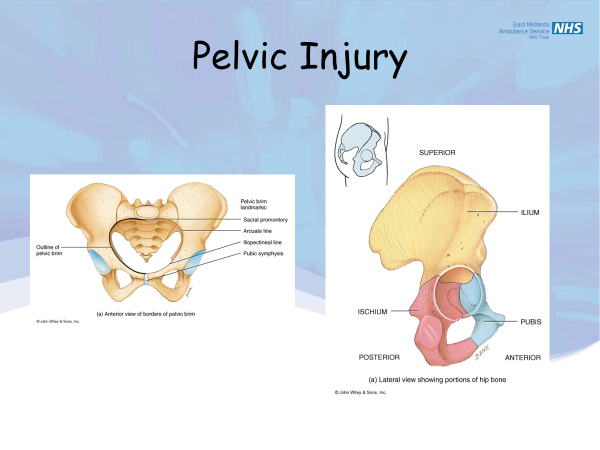
Pelvic Fractures
How can pelvic fractures be recognized and managed in the prehospital setting?
Your patient sustained a close-range shotgun blast to the abdomen. A segment of bowel is eviscerated.
How are eviscerations managed?
Impaled Objects
How are impaled objects managed in the field?
Summary
•Maintain high index of suspicion - always consider kinematics
•
•Stabilise pelvic injury
•
•Survival may depend on rapid transport to an appropriate facility where surgical intervention is immediately available

-
MOD E TECH 26 Child protection/vulnerable adults/domestic violence41
-
MOD E Tech 27 Nervous System37
-
MOD E Tech 28 Nervous Disorders24
-
MOD E Tech 29 Skeletal System18
-
MOD E Tech 30 Musculoskeletal injuries18
-
MOD E Tech 31 Injuries to the Spine and Pelvis25
-
MOD E Tech 32 Head & Maxillofacial injuries29
-
MOD E Tech 33 Vehicle Extrication/Helmet Removal2
-
MOD E Tech 34 Wounds & Bleeding22
-
MOD E Tech 35 Burns and Scalds17
-
MOD E Tech 36 Trauma Management31
-
MOD E Tech 37 Disease Information19
-
MOD E Tech 52 Introduction to Pharmacology32
-
MOD E Tech Abdominal Trauma24
-
MOD E Tech Paediatric Trauma14
-
MOD E Tech Trauma in Pregnancy13
-
MOD E Tech Trauma in the Elderly14
-
MOD E Tech 28 Nervous Disorders COPY24



