how does excess fluid get back into the veinous system?
how is the lymphatic system split up?
lymphatic system drains back into the right and left venous angle: junction where subclavian vein and internal jugular vein meet
lymph system is split into:
thoracic duct: drains the left head and neck, left upper limb, left thorax and both of lower limbs . then goes into the left venous angle
right lymphatic trunk: right arm, right thorax, right head and neck
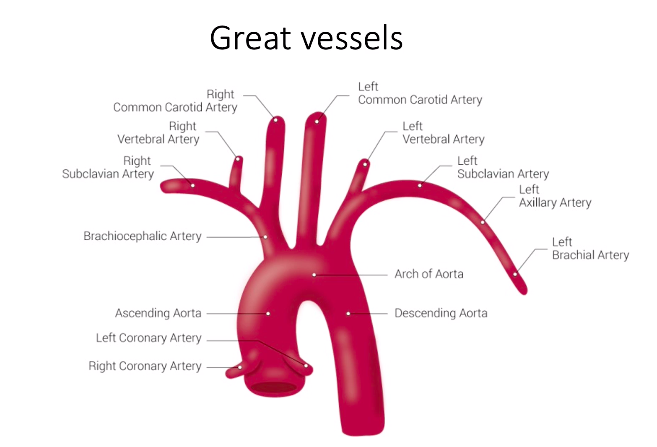
label this
describe where the main ones lead blood to
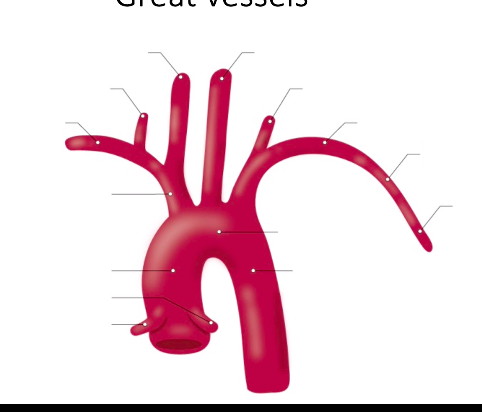
- descending aorta: continues down to thorax, goes to abdomen
3a. brachiocephalic artery goes into the right common carotid artery -> supplies right side of head and neck
b. brachiocephalic artery -> right subclavian artery: supplies upper right limb
4. left common carotid artery -> supplies left side of head and neck
5. left subclavian artery -> supplies left upper limb. goes under clavicle
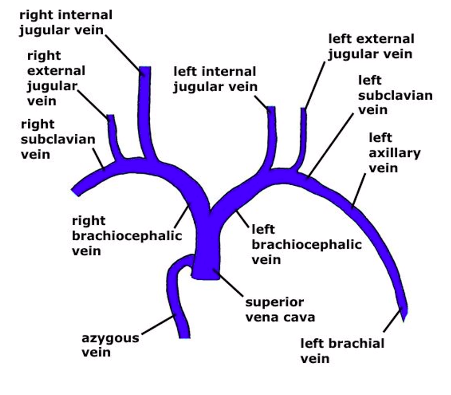
label the venal return back to the heart
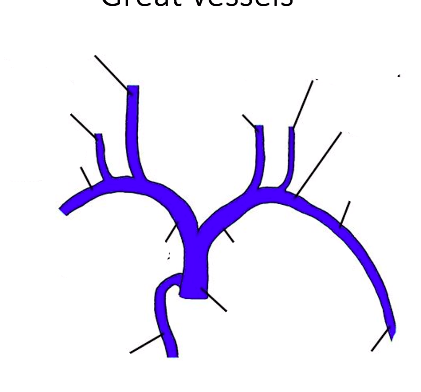
right and left internal juglar veins - drain the head and neck
right and left subclavian veins - drain limbs
what is the function of the lymphatic system?
- removal of excess interstitial fluid
- transport of bacteria and other harmful sub. away from tissue
- transport of antigen-presenting cells
what happens when change in temperature is activated? (input vs output?)
which areas detect the change of temp from warm and cold?
what does this cause to change?
Goes to control centre: brain - specifically the hypothalamus:
Input:
- *- preoptic area (POA)** monitors core temperature: recieves input from warm receptors from skin and and internal receptors
- *- paraventricular (PVN) and dorsomedial hypothalamic (DMH) nuclei:** recieve input from cold receptors
- *Integration and Output to Effectors:**
- *- Preoptic area (POA):** regulate blood vessels in skin (vasoconstriction / dilation). stimulates posterior pituitary: conserves water
- *- paraventricular (PVN) and dorsomedial hypothalamic (DMH)** nuclei: regulates skeletal muscle (shivering). brown fat stimulation (aka:) non-shivering thermogenesis.
what do increases (2) and decreases (4) in body temperature cause in effectors?
heat increase / decrease stimulate effectors that will enhance / decrease heat loss
- To reduce heat gain:*
- Sweating initiated - (as long as air is dry, evap. of sweat is efficient)
- cutaneous vasodilation - blood flow near capillaries increases. heat lost by radiation. automated by autonomic nervous system by a reduction in vasomotor tone
- To increase heat gain:*
(adrenaline, catecholines and noradrenaline stimulate:)
- metabolic heat increased by vol. skeletal muscle contraction: shivering
- non-shivering thermogenesis: brown fat
- thyroid hormones increase o2 consumption on most cells: increases basal metabolic rate and heat production during cold
- cutaneous vasoconstriction: increase in sympathetic activity. mediated by noradrenaline on alpha adrenoreceptors. arteriovenous** **anastomoses are richly supplied by sympathetic adrenergic fibres
how can we classify solutes?
which one of these ^ has greater osmotic power?
what is osmotic pressure?
electrolytes:
- inorganic salts (Na+, K+, Cl-), all acids and bases, some proteins
non electrolytes:
- glucose, urea, lipids etc
electrolytes have greater osmotic power than non-electrolytes
osmotic pressure: process that controls movement of solvents across a membrane. movement occurs when there are differences in osmotic pressure across a membrane.
which regions in the brain control thirst? [2]
how are these structures characterised? - what does this allow?
- Subfornical organ: in the hypothalumus
- OVLT
both have:
a) extensive vasculature b) lack of normal blood brain barrier
- allow for linkage between CNS and peripheral blood flow
how does aldosterone make kidney cells recapture sodium?
- causes to produce more
a) ENAC (Na channel) - can reabsorb more Na
b) Na/K pump ( pumps Na in / K out)
what are the normal pH blood limits?
which pH ranges lead to death?
7.35 (venous) to 7.45 (arterial)
Below 6.8 and above 8.0 = DEATH
body’s concentation of hydrogen ions is regualted by which systems? [3]
how long does it take for each system to regulate?
1. chemical buffer system in blood and ICF
- immediate action
2. Respiratory centre in brain stem
- acts within 1-3 minutes
3. kidneys
- hours to days
what are the three major chemical buffer systems in the body?
Bicarbonate (HCO3-) buffer system
Proteins (Hb and albumin) buffer system
Phosphate buffer system
what is the normal anion gap?
how do you measure?
- measure the conc of Na, Cl and HCO3- in blood. - cations should be greater by anions by 8 to 12 mEq/L.
- (remember cations = anions)
[Na+] - ([Cl-] + [HCO3-]) = 8 to 12 mEq/L
how does resp. centre change acid levels?
How? Eliminate or retain CO2
- CO2 transported into rbc as HCO3-
- HCO3 recombines to CO2 and H20 when in capil. next to lungs
- CO2 expelled via respiration - reduces the acid levels (increased CO2 in blood increases likelihood of acidosis)
centre only deals with volatile acids (CO2)
how do you control acid / base balance (physiologically?) via resp. centre?
what controlled by?
how quick is change?
lter rate and depth of respirations
- change incurred by Pons and medulla
- rapid change
only the kindeys can get rid of what? [1]
what does kindeys getting rid of acids prevent? [1]
metabolic acids: (phosphoric, uric, lactic acids and ketones)
prevents metabolic acidosis
in order to maintain acid base balance - what do the kidneys have to do? [2]
- reabsorb all filtered bicarbonate
- excrete the daily acid load
where is most of filtered bicarbonate reabsorbed? which transporter is used?
- at proximal convoluted tubule via Na/HCO3- symporter channel: reclamation of 4500 mEq of HCO3- each day. 70 - 90%.
- 10 - 30 % is filtered back at the end of nephron
all bicarbonate is reabsorbed !!
how do kidneys make bicarbonate?
Kidney can produce bicarbonate
- Glutamine -> glucose, HCO3-, NH4+ (excreted out and used to combine with H+ ions to make sure excreted into urine)
when the body is in acidosis, how do we ensure H+ stay out of renal tubule cells?
when the body is acidosis:
@ distal proximal tubule:
H+ get secreted out of renal tubule cell into lumen. BUT want to stay here. SO, use NH4+ and H2PO4 buffes to keep the H+ in the filtrate
describe the structure of two motors in ATP synthase
what are they used for?
function: converting ion gradients to ATP
in ATP synthase:
- 2 motors - one electrical, one chemical
- one motor location: membrane - powered by flow of protons
- one motor location: intermembrane space: powered by ATP
WHEN ONE TURNS, CAUSES THE OTHER TO TURN



