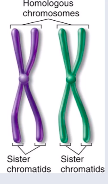
what are sister and homologous chromosomes?
sister chromatids are identical copies of same chromatid (i.e both from mother / father)
homologous chromosome: a pair of chromosoemes, each derived from one parent
explain each phase of cell division
G0 phase: cells outside of cycle and have stopped dividing. can return to G1 phase.
G1 phase: normal growth phase. prep for DNA synthesis
S phase: DNA synthesised and duplicated
G2 phase: cell prepares for cell division.
M phase: proper cell division
what are the G phases?
gap / growth phases:
- cell undergoes normal function.
- NOT growing or replicating
- allows cell time to monitor the env to check conditons correct for replication
- act as regulatory phases / checkpoints: indicate of cell should continue dividing or undergo apoptosis
Explain the S phase
Synthesis Phase
DNA duplicated: 23 -> 46
explain the M phase
Mitotic phase:
Made of 4 stages:
Prophase, Metaphase, Anaphase, Telophase
then have cytokinesis (splitting of cytoplasm into 2)
- explain process of crossing over / recombination. when does it occur?
- explain what independent assortment. when does it occur?
Crossing over
MAIN SOURCE OF GENETIC VARIATION BETWEEN GENERATIONS = zygote
- essentially a balanced translocation
- occurs at chiasmata
- can occur in prophase or metaphase
Independent assortment
- sister chromatids during metaphase II, are randomly allocated from one side to the othe
what is difference between meiosis I and meiosis II? (general)
during anaphase in meisois II, get seperation of sister chromatids rather than homologous chromsomes
meisois II: more similar to mitosis
how is the cell cycle controlled? name and explain the checkpoints
- very tightly regulated (if escape leads to cancer)
G1 checkpoint: end of G1. controls if cell enters S phase. is environment favourable? checks for growth factors, nutrients, cell size and DNA damage
G2 checkpoint: end of G2. environment favourable? is all DNA replicated? checks for cell size, DNA damage and DNA replication
Metaphase checkpoint: are all chromsomes attached to spindle?
what do transcription factors do?
how can transcription factors change cells?
- proteins that attach to promoter regions of gene and allow the gene to be transcribed. (if the DNA in promoter region is methylated, the transcription factor cant transcribe to the gene)
- transcription factors can turn on at different times during cell differentation
- as cells mature, different transcription factors can act on gene expression and change cells specification
-
what are the different commitment stages of cell differentiation?
- specification: capable of differentiating autonomously wihen placed in a neutral environment, not when placed in non-neutral env. reversible. (e.g. might be liver cell but dont know yet which cell)
- determination: capable of differentiating autonomously even when placed into another embryonic region. irreversible (committed to cell lineage bc have turned on more transcription factors).
describe basic differences between apoptosis and necrosis mechanisms
necrosis:. recovery possible.
occurs by: swelling of ER and mitochondria, membrane blebs, plasma membrane breaks bc can’t hold fluid inside. cells organelles released. inflammatory process undergone
(cells burst)
apoptosis: irreverisble. cells shrink and condense (including chromatin). cell fragments into apoptotic bodies. phagocytosis of apoptotic cells and fragments. avoids release of cell contents
why is apoptosis highly regulated?
what are two apoptopic pathways?
apoptosis cannot be stopped once is has started: regulation
2 pathways:
extrinsic apoptopic pathway
- enviroment around the cell could cause cell death.
- tumour necrosis factor (TNF) binds to death receptor. activates caspases
intrinsic apoptopic pathway:
- targets the cell’s mitochondria -> activates caspases
explain how stem cell division occurs
- stem cell division: asymmetrical or symmetrical
- asymmetrical: one daughter cell becomes new stem cell, other daughter cell becomes differentiated
- symmetrical: one stem cell divides into two stem cells OR stem cell will commit two daughter cells to differential lineages. both daughter cells have same fate
- creates a constant pool or stem cells
explain what acetylcholine does in cardiac muscle
acetylcholine triggers membrane hyperpolarisation (moving away from potential to trigger activation)
- acetylcholine binds to acetylcholine receptor on heart muscle (called muscarinic receptor)
- muscarinic receptors are G protein coupled receptors that activate ionic channels via a second messenger cascade
- this causes hyperpolarisation and a decrease in cardiac activity
explain effect of acetylcholine on skeletal muscle?
acetylcholine triigers membrane depolarisation in skeletal muscle
- acetylcholine binds to skeletal muscle cell receptors called nicotinic acetylcholine receptors (nAChR)
- depolarisation occurs (action potential more likely to happen)
- contraction of skeletal muscle
explain how g-protein linked receptor initites enzyme action
- signal molecule binds to extracellular side of receptor
- causes G protein to intracellular part of receptor
- G-protein activated
- subunit in G-protein activates enzyme
- Activated enzyme leads to biological respons
what are the 8 hallmarks of cancer?
all contribute to sustaining proliferative signalling -> then to tumour developement and malignant progression
- self sufficiency in growth signals
- insensitivity to anti-growth signals
- evading apoptosis
- limitless reproductive potential
- sustained angiogenesis
- tissue invasion and metastasis
- deregulating cellular energetics
- avoiding immune detection
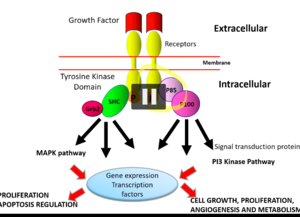
give over view of cell signalling in normal cell when a growth factor binds to growth factor receptor xx
- growth factor binds to receptor. two receptors interact (dimerization)
- intracelllar side: phosphorylation of tyrosine
- siganlling proteins bind to P-tyrosine
- causes cascade of phosphorylation events
- activates two pathways: MAPK pathway and PI3 Kinase Pathway
- once pathways are activated, activate gene expression and transcription factors occur.
explain the ras pathway and how mutation leads to kras cancer
- when ras switched on: (normally ras is switched on by binding to GTP) can switch on ERK and AKT pathways. (ras regulates the pathways by turning on / off the ERK and AKT pathways)
- mutated ras (kras): hydrolysis of bound GTP (first stage in pathway) occurs v slowly. GTP is bound to ras in unhydroloysed form - ras is permenantly switched on. continois proliferation and growth.
where is type 4 collagen found?
basal membane
where are reticular fibres found?
what role do they play / associated with?
- supporting stroma for highly cellular organs (like liver).
- found at boundary of connective tissue and epithelium.
- wound healing and scar tissue.
- branching pattern -> loose to allow passage of cells and fluid
- made of type III collagen. dont bundle
- produced by fibroblasts
which cells produce alpha smooth muscle actin? [1]
myofibroblasts
what are the three main mechanism of gene alterations that activate oncogenes? [3]
- point mutations: single base change in DNA (e.g. Ras oncogene)
- chromsomal rearrangements: translocation of chr activates oncogene by using regulatory elements from a highly transcribed gene to drive expression of oncogene
- gene amplification (e.g HER2)
how does a point mutation in H-ras result in oncogene activation? what is the point mutation that occurs?
- (ras is a GTPase (converts GTP into GDP)
- normally regulates cell proliferation and survival)
- single nucleotide exchang_e GGC TO GTC_ in bladder cancers (glycine -> valine)
- get different isoforms of ras gene resulting in different cancers (see photo)



