what are the two mechanisms of cartilage production?
a) interstitial growth: from chondrocytes within the cartilage
b) appositional growth: undiff. cells at the surface of the cartilage (perichondrium)
describe the intra and extracellular ion concentrations that sets up the cells resting membrane potential.
- Na+ greater outside cell
- K+ greater inside cell
- A- (proteins) greater inside cell
= creates a resting membreane potential: +ve outside, -ve inside
how do cells get over asymmetrical ionic charge distribution caused by proteins not being permeable?
- *1. Active Na/K diffusion**
- 3Na+ from intracellular to extracellular
- 2K+ from extracellular to intracelluar
effects:
- high Na+ conc in extracellular space, low intracellular
- high K+ conc in intracellular space, low extracellular
32- results in +ve extraceullar space c.f. intracellluar space: sets up resting membrane potential
- *2. membrane permeability:**
- K+ (50:1 difference): more +ve charged ions move out of the cell: sets up more -ve charge inside cell. neuron plasma membrane is 50-100 times more permeable to K+ than Na=
- resting membrane potential of cell: approx. -70mV
how is resting membrane potential set up?
- passive ionic diffusion
- active ionic diffusion (e.g. Na / K pump)
- Gibbs-Donnan equilibrium (effect):
a) objective: obtain electroneutrality
b) impermeable protein ions: too big to diffuse through: causes asymmetrical distribution of charged ions (Na/K)
which ion Na+ or K+ has more passive leaking out / in cell?
what is resting membrane potential of cell?
- K+ (50:1 difference): more +ve charged ions move out of the cell: sets up more -ve charge inside cell. neuron plasma membrane is 50-100 times more permeable to K+ than Na=
- resting membrane potential of cell: approx. -70mV
* what is the resting membrane potential a consequence of? * [2]
concentration gradients of ions across the plasma membrane
AND
- relative ion impermeabilities of the membrane
how does an AP work?
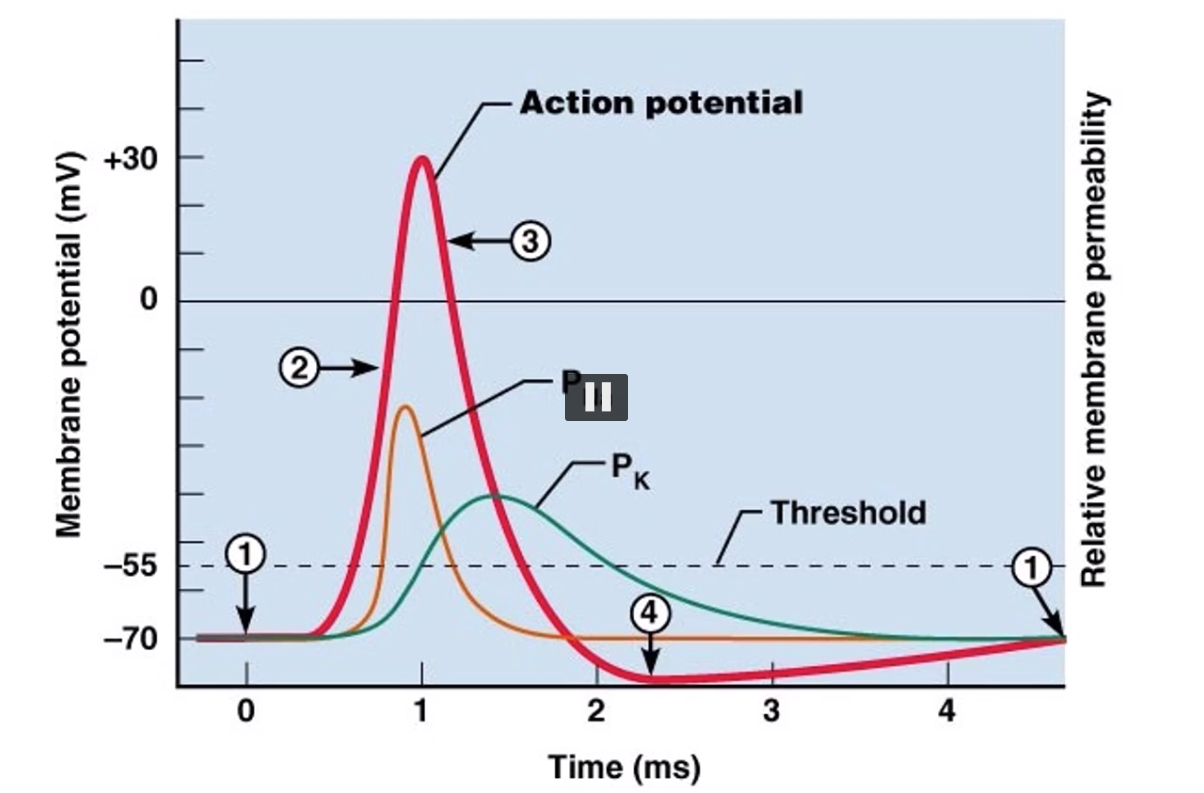
- resting potential starts at -70mV
- Na+ ions enter cell: depolarisation (more +ve mV). Na+ channels open
- leads to action potential
- 1ms after AP (3), inactivation gate of Na+ close, K+ channels open up: repolarisation (more -ve mV)
- K+ stay open longer than neccessary (4)
- K+ channels close
- Na/K ATPase pump, leak channels and proteins re-establish resting membrane potential
explain whats going on at repolarisation of AP
explain whats going on at hyperpolarisation of AP
explain whats going on at repolarisation of AP
- after depol: fires AP
- *- Na channel ions close** (blockage of inactivation gate: ball on chain)
- K channel opens (repolarisation)
= restores intracellular -ve charge
explain whats going on at hyperpolarisation of AP
- **K+ channels stay open
- Na+ channels go back to resting state**
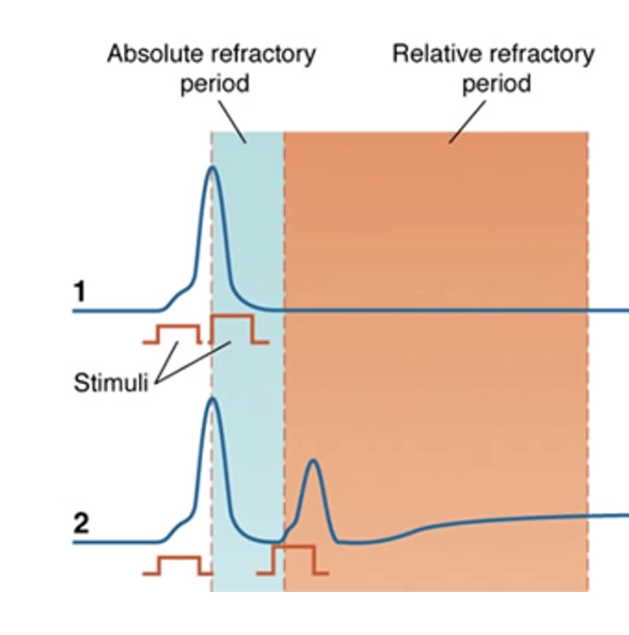
explain what absolute v relative refractory periods are
refractory periods:
period time where cell membrane is resetting itself.
- absolute refractory period:
the period of time during which a second action potential absolutely cannot be initiated.
- occurs due to inactivation of Na channels
- relative refractory period:
- period after firing of nerve when partial repolirasation has occurred a greater than normal stimulis / depolarisation can stimulate a second response
- peak of AP will be lower (but still goes over threshold)
- recovering Na channels and open K channels
how do local anaesthetics work?
- bind to open Na+ channel: become inactivated
- physically prevent Na+ reopening and generating AP: drugs stablises inactive state
- cant depolarise cell
- pain fibres cant send pain to brain
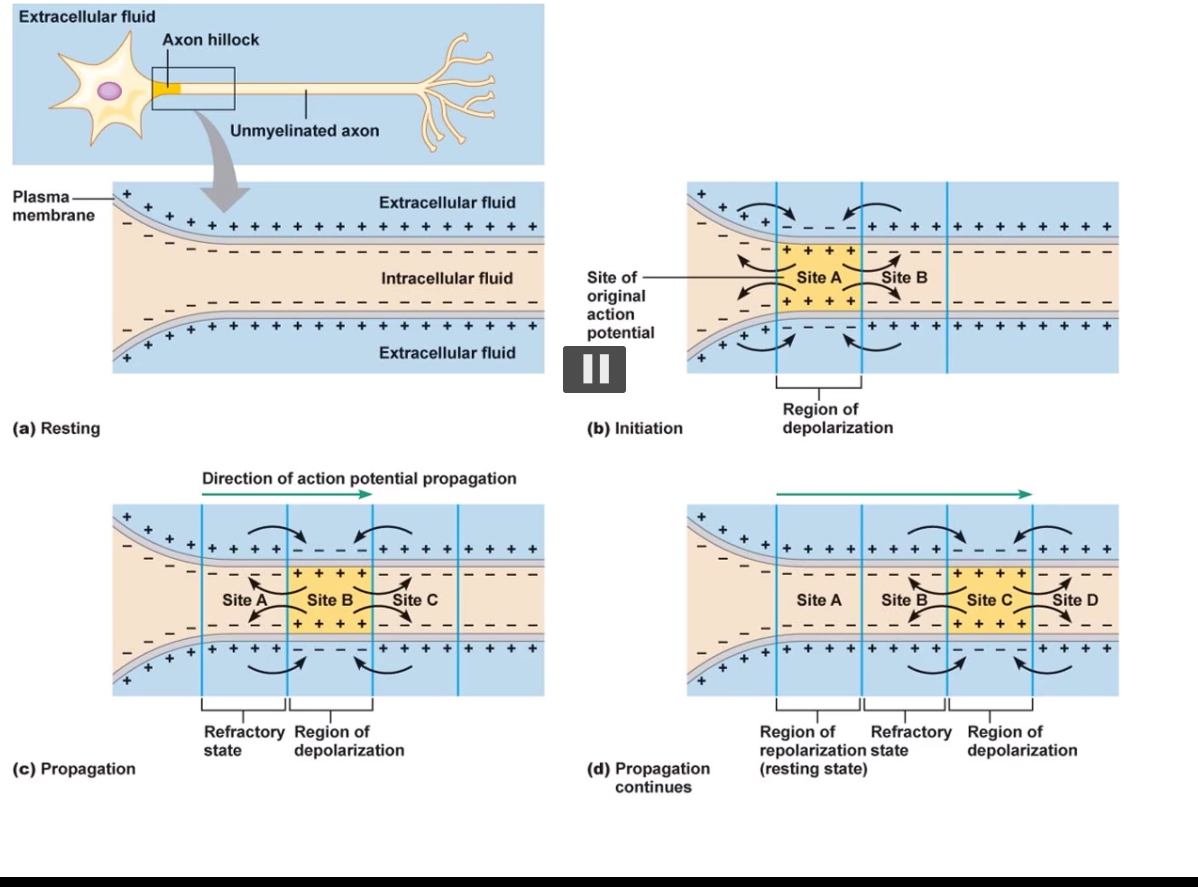
how does resting state -> propogation of an action potention occur of an unmyelinated axon occur?
where is the trigger zone?
continous propogation:
trigger zone: axon hillock / aka axon initial segment
resting state: high conc of Na+ outside cell, extracellular env: +ve. -70mV inside cell
initiation: voltage gated Na+ channel opens: Na+ go to site A. creates a local zone in both extraceullar and intracellular fluid with a sudden change in charge.THEN go to Site B (which is an area of high conc negative charge) and sodium Na+ ions open here
propogation: Na+ at Site B attracted to -ve chrge –> go to site C. Also attracted to site A, but cant go back bc thats an absolute refractory period: only goes in one direction
propogation continues: Na+ go along site D etc. Site A is now region of repolarisation (new AP can occur)
how does electrical synpase work?
- AP in presynaptic terminal goes through gap junction channel
- coupling potential
BOTH DIRECTIONS
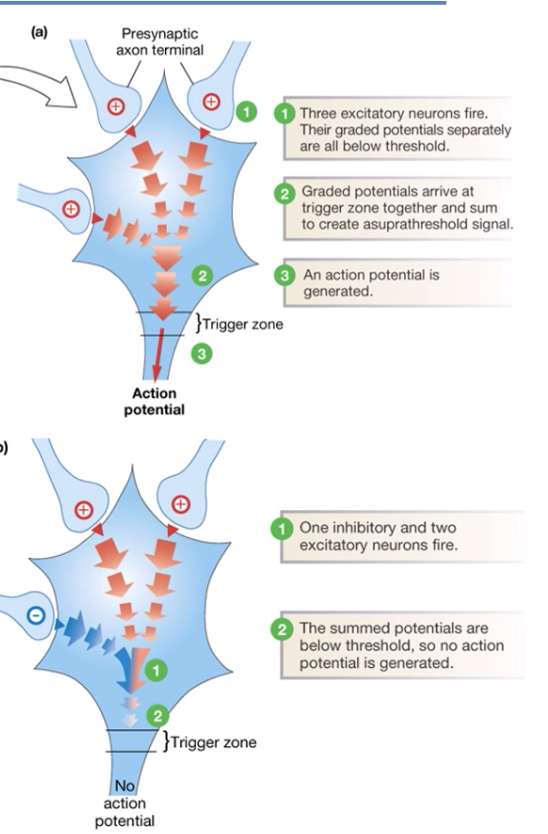
how do different excitatory or inhibitory NT work together / agaisnt each other on post-synaptic cleft.
what is the name for this?
- analogue (aka graded) potentials can arrive at trigger zone together and their sum create a suprathreshold signal to cause an AP
OR
- could get one inhibitory and two excitatory -> summed potentials are below threshold so no AP !
addition of excitatory and inhibtory signals = summation
what is temporal summation?
what is spatial summation?
temporal summation
- post synaptic potentials at same syanpse (A&A) occur in rapid succession
- first potential doesnt have time to dissipate: next potentials add to previous once
spatial summation
- multiple postsynaptic potentials from different synapses (A+B) occur same time and add
- alone, EPSP not strong enough to cause AP. reinforce each other = AP.
what is temporal summation?
what is spatial summation?
temporal summation
- post synaptic potentials at same syanpse (A&A) occur in rapid succession
- first potential doesnt have time to dissipate: next potentials add to previous once
spatial summation
- multiple postsynaptic potentials from different synapses (A+B) occur same time and add
- alone, EPSP not strong enough to cause AP. reinforce each other = AP.
what are two methods that inhibitory post synpatic potentials can cause inhibition? [2]
- K+ permeability increased
OR
- increased Cl- perm.
give an example of direct and indirect inhibitory post synaptic pontetial
indirect: Muscarinic ACh receptor:
- G-protein activated
- acts via 2nd messenger
- indirectly opens K+ channel
direct: GABAA receptor:
- opens Cl- channel
BOTH: = hyperpolarisation
what and describe are the two classes of cell surface receptor types for synapses?
ligand gate ion channels:
- opens pore for ions
- very fast
- aka ionotropic
G-protein coupled receptors (GPCR)
- activated receptor activates G proteins that affects enzymes
- metabotropic
- slow
- can have bigger effect
describe basic overview of glutamate G-protein coupled receptor response?
G-protein coupled receptor –> G protein comple (intracellular) –> enzyme (+/-) –> 2nd messenger
its the second messenger which causes varied responses:
- e.g. cAMP released: inhibitory
- IP3 or DAG released: excitatory
why do you need more ionotropic transport proteins cf. GPCRs?
GPRC: secondary messengers amplify signals to downstream target molecules - can need just one ligand binding to one GPCR
how does receptor modulation by NTs occour?
receptor modulation by other NTs:
- NTs influence accumulation of opposite NTs on post-synaptic membrane
e.g. ionotropic glutamate receptor fires excitatory response BUT also feedback to GABA receptor and causes to disperse (and vice versa)
causes a balance of inhib and excitatory systems.
what is tonic adaptation?
what is phasic adaptation?
Tonic receptors adapt slowly and inform about the presence and strength of a stimulus.
phasic receptors adapt rapidly



