Sternal Congenital Abnormalities
Variation in the size and number of sternebrae, and in the shape of the manubrium and xiphoid process, is common and is usually incidental. Cats commonly have a ventrally deviated xiphoid process, which can be painful.
- SternaI dysraphism is the failure of the left and right cartilaginous sternal precursors to fuse. It leads to a ventral defect that is only closed by thoracic fascia and pleura. In the absence of diaphragmatic defects, sternal dysraphism has no adverse respiratory or circulatory consequences.
- The absence, splitting or malformation of the xiphoid cartilage has been associated with peritoneopericardial diaphragmatic hernia, which can be a useful radiographic feature in distinguishing this condition from other pericardial diseases.
Ostechondroma
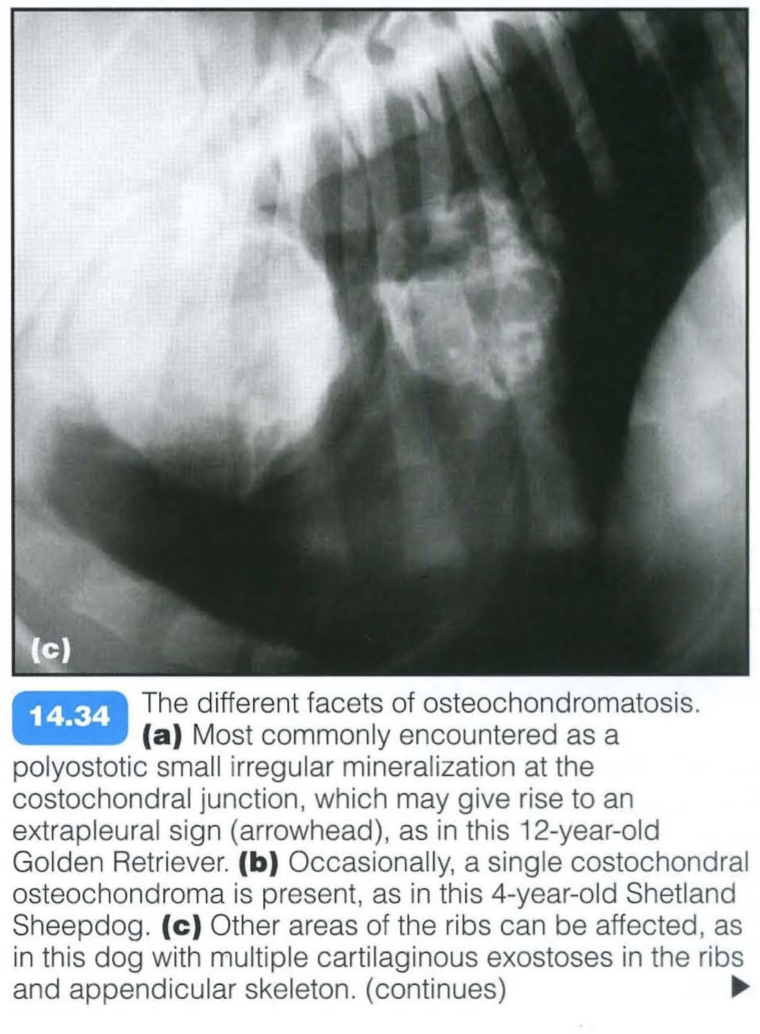
Osteochondroma
This is a skeletal dysplasia (a form of hamartoma) associated with expansile bony lesions, which usually arises from the osteochondral junction of bones. The lesion usually stops growing at the time of skeletal maturity.
Aetiological theories include:
- Herniation of part of a physis
- Proliferative response to stress at the physeal margin
- Biochemical disorder, allowing redirection of physeal growth
- Periosteum regaining its perichondral potential due to an unknown factor.
- It is potentially a hereditary condition.
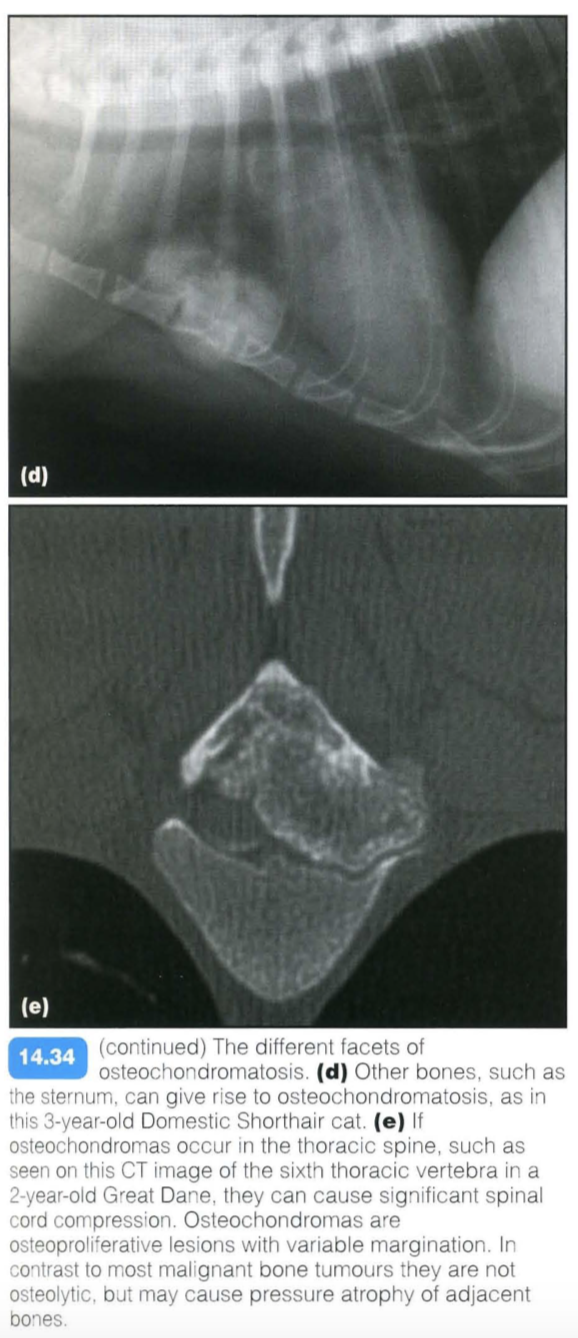
In rare cases malignant transformation may occur. Commonly affected areas are the costochondral rib junctions; less frequently, the metaphyses of the long bones and vertebrae may be involved. Small rib lesions are common in dogs, but rare in cats. The condition can affect multiple sites simultaneously (multiple cartilaginous exostoses).
Clinical signs are usually related to lameness or paresis/paralysis in the case of spinal cord compression.
Radiography:
- There is one or more bone mass of variable opacity and margination
- Often cauliflower or soapy bubble-like
- Active lesion irregular in opacity and poorly marginated
- Inactive lesions are homogenously opaque and smoothly marginated.
- Differentiation of osteochondroma from malignant neoplasia and healed rib fracture is based on the typical location at the costochondral junction of several ribs.
Other imaging techniques: CT or magnetic resonance imaging (MRI) may be used to assess spinal cord compression of vertebral osteochondroma.
Rib Tumors
Primary rib tumours:
- Relatively rare in dogs and very rare in cats
- No known sex or breed predisposition
- Also seen in young animals.
- Osteosarcoma and chondrosarcoma are the most common
- Fibrosarcoma, haemangiosarcoma and benign neoplasms (osteoma, chondroma) are seen less frequently.
- Primary tumours are often located in the distal third of the rib (costochondral junction).
- They tend to metastasize to the lungs and other organs.
- Primary rib tumours are rare compared with appendicular primary bone tumours.
Metastatic, bone marrow and invading soft tissue neoplasia in ribs have certain features:
- Metastatic rib tumours are usually small and located in the proximal or middle portion of the rib
- Multiple myeloma frequently affect the ribs along with the vertebrae and other bones, where changes are more easily recognizable
- Primary bone lymphoma or bone involvement in multicentric lymphoma is rare in dogs and cats. Young animals can be affected. Primary bone lymphoma can preferentially affect the metaphyses in growing bones
- The most common soft tissue mass of the chest wall is fibrosarcoma, which is particularly common in cats. Fibrosarcomas can usually be distinguished from diffuse processes, such as cellulitis or haemorrhage, by their focal distribution and their propensity to grow toward the thoracic cavity. They can be difficult to differentiate from primary rib tumours. There is often polyostotic involment in soft tissue tumours
- Pleural neoplasia (mesothelioma) can affect multiple ribs and be difficult to differentiate from other types of neoplasia .
- Lipoma and liposarcoma may arise from the thoracic wall.
Radiography:
- Osteolysis is seen but can be subtle to detect.
- There may be an irregular to sunburst periosteal reaction and amorphous new bone.
- Fractures may be present, with unsharp margins (pathological fracture) .
- The extrapleural sign (focal inward deviation of the pleural and pulmonary structures) may be seen. There may be displacement of adjacent ribs.
Primary rib tumours:
- Monostotic
- Preferentially distal third of the rib (costochrondral junction)
- Displaced adjacent ribs, which are otherwise normal
- Often very large intrathoracic component
Metastatic rib tumours:
- Often polyostotic, but randomly oriented
- Preferentially middle and proximal third of the rib
- Often small at time of detection.
Soft tissue tumour invading the ribs:
- Soft tissue mass with variable external component
- Osteolysis, periosteal reaction, fractures of multiple adjacent ribs
- Any part of the rib can be affected
- Mesothelioma: abundant pleural effusion, no external chest wall mass, periosteal reaction on several ribs possible.
Multiple myeloma and lymphoma:
- Multiple myeloma: multiple punctate lucencies without periosteal reaction or sclerosis; pathological fractures are uncommon
- Lymphoma: irregular periosteal reaction and punctate or diffuse lysis in metaphyseal area; pathological fractures are uncommon.
Lipoma and liposarcoma:
- Fat opacity in lipoma lesions, which distinguishes them from soft tissue masses
- Liposarcoma may have fat and/or soft tissue opacity
- Can be difficult to differentiate from obesity- related fat deposition
External masses should marked for radiography to explain opacity changes.




