Definition of Asthma
- Asthma is a chronic inflammatory disorder of the airways in which many cells and cellular elements play a role, in particular, mast cells, eosinophils, T lymphocytes, macrophages, neutrophils, and epithelial cells.
- In susceptible individuals, this inflammation causes recurrent episodes of wheezing, breathlessness, chest tightness and coughing, particularly at night or in the early morning.
- These episodes are usually associated with widespread but variable airflow obstruction that is often reversible either spontaneously or with treatment.
- The inflammation also causes an associated increase in the existing bronchial responsiveness to a variety of stimuli.
Asthma Pathogenesis
- classic view: T-helper-type-2 cell dependent IgE associated allergic disease
- multiple phenotypes/endotypes
Extrinsic vs Intrinsic
Atopic vs Nonatopic
TH2high vs TH2low
Type2 vs Non-type2
Eosinophilic vs Non-eosinophilic
Two Forms of Eosinophilic Asthma
- allergic eosinophilic airway inflammation
- nonallergic eosinophilic airway inflammation
Hygiene Hypothesis
Increased hygiene and cleanliness and/or the widespread use of antibiotics and immunizations may deprive the developing immune system of environmental cues shaped by evolution to skew adaptive immunity away from Th2 responses.ypothesis
Inciting Factors for Asthma
- Allergens
- Infections
– Viral Respiratory Infections
- Air Pollution
- Occupational Exposures
- Exercise
- Cold Air
- Drugs
– Aspirin, NSAIDs
• Emotions
Diagnosis of Asthma
• Symptoms
– Wheeze, cough, dyspnea, chest tightness
• Exam
– May be normal between attacks
– Chest
- Expiratory > inspiratory wheeze
- Prolonged expiratory time
- Hyperinflation
- Accessory muscle use
- Spirometry
Deifinition of COPD
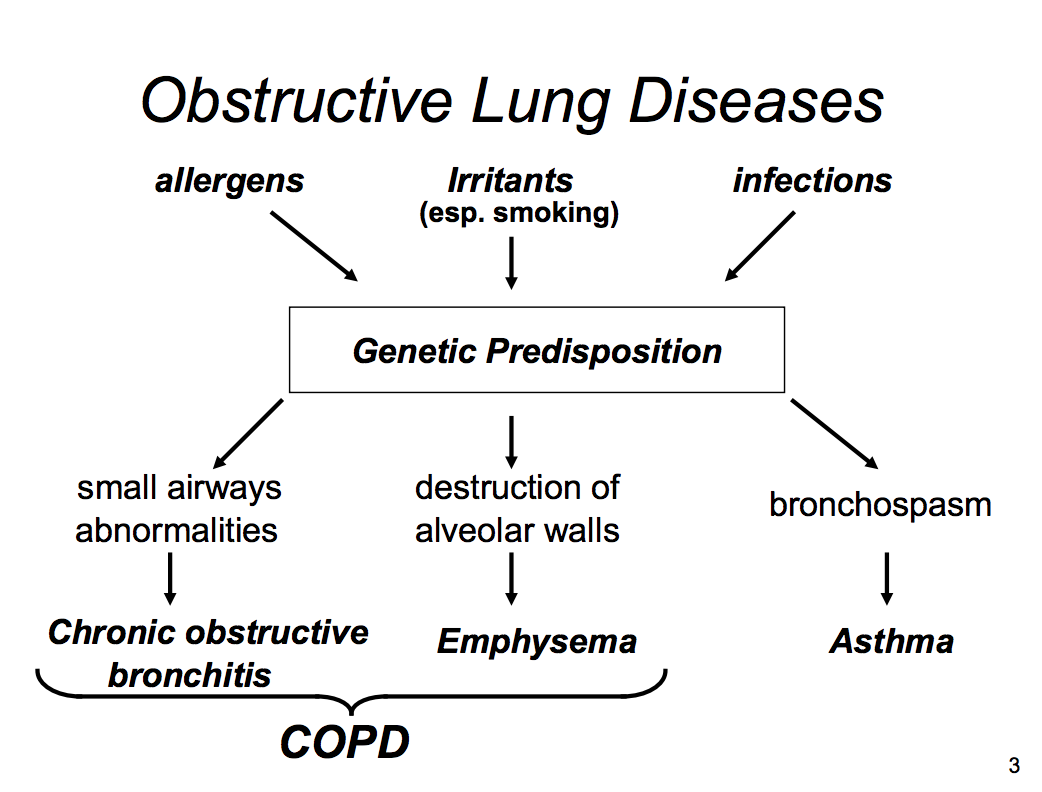
- COPD is a disease state characterized by airflow limitation that is not fully reversible.
- The airflow limitation is usually both progressive and associated with an abnormal inflammatory response of the lungs to noxious particles or gases, primarily caused by cigarette smoking.
Alpha-1 Antitrypsin Deficiency
- Most common genetic cause of emphysema (2-3% of patients)
- SERPINA1 gene encodes alpha-1 antitrypsin (AAT)
—protease inhibitor
– Autosomal inheritance; normal allele termed “M”
– Multiple abnormal alleles identified but most common severe deficiency—”Z” allele
– Low levels and severe emphysema with ZZ genotype
– Slight reduced levels with MZ genotype—unclear risk for emphysema
• Suspect if:
– Emphysema at young age (<45 years)
– Nonsmoker
– Bibasilar disease (panlobular emphysema vs upper lobe predominant centrilobular with smoking)
– Chronic liver disease
– Family history emphysema or liver disease
Clinical Features of COPD
- Typically smokers – mean 20 cigarettes/day for 20 years
- Usually present in fifth or sixth decade of life
- Progressive dyspnea with exertion and cough
- Often first diagnosed after an acute chest illness
- History of wheezing and dyspnea may lead to misclassification and a diagnosis of asthma
- Exam
– Prolonged expiratory phase
– Hyperinflation (hyperresonant to percussion; increased A-P diameter of chest)
– Decreased breath sounds
– Wheezes, especially with forced expiration
– Crackles may be heard at posterior lung bases
– No clubbing
Differential Diagnosis of COPD
• Other broncho-pulmonary diseases
– e.g., asthma, bronchiectasis
- Congestive heart failure
- Ischemic heart disease
- Valvular heart disease
- Pulmonary embolism
- Pulmonary hypertension
In asthma, the predominant inflammatory cell is the […] and in COPD the […].
In asthma, the predominant inflammatory cell is the eosinophil and in COPD the neutrophil.
This difference in inflammatory cell type is important in the therapeutic response to corticosteroids between asthma and COPD.

-
Respiratory System: Structure and Function30
-
Mediastinum17
-
Thoracic Wall, Pleura and Lungs42
-
Gas Transport38
-
Ventilation and Diffusion21
-
Ventilation and Perfusion26
-
Pressure/Volume25
-
Respiratory System - Histology31
-
Body Cavities and Lung Development24
-
Respiratory Resistance and Airway Obstruction48
-
Mechanics of Breathing17
-
Pulmonary Circulation28
-
Venous Thromboembolism25
-
Control of Ventilation26
-
Cystic Fibrosis35
-
Sleep Apnea10
-
Clinical Concepts/Integration23
-
Acute Respiratory Failure I and II and Chronic Respiratory Failure34
-
PFT Lab10
-
Obstructive Lung Diseases12
-
Pediatric Lung Diseases39
-
COPD48
-
Diffuse Interstitial (Restrictive) Lung Diseases39
-
Pulmonary Hypertension23
-
Pleural Effusion33
-
Drugs20
-
Pulmonary Infections and Imaging48
-
Lung Tumors24
-
Pneumoconiosis28



