Distribution Function
- The pulmonary circulation distributes the entire cardiac output to a network of capillaries at the alveolar gas-exchanging surface (85-95% of surface in contact with capillary blood flow).
- Pulmonary capillaries are so small that erythrocytes pass through them one at a time, allowing maximum exposure to gas exchange. A high percentage of the alveolar wall has capillaries available for gas exchanges.
Vessel and Blood Flow Characteristics
- The pulmonary system is a low resistance, low pressure system.
- Compared to the systemic circulation the arteries have thinner walls with less muscle, less elastin and less ability to constrict.
- Pulmonary capillaries are flattened causing most of surface to be exposed to alveolar membrane. They are very thin-walled and exist in the negative (relative to atmosphere) interstitial pressure of the lung. Thus the relatively positive atmospheric pressure can compress them.
- Pulmonary capillary flow is very responsive to both vascular and alveolar pressures. Hydrostatic factors (i.e. gravity generated pressure gradient) are important in determining blood flow distribution.
- The network is also well-designed to perform an active role in filtering the blood both physically and metabolically
Effects of Gravity on Vascular Pressures
- Gravity will affect vascular pressures in the upright lung so that the vascular pressure will be lower at the apex (top) and higher at the base (bottom) of the lung.
- Think of the vascular system as a column of fluid. There will be a hydrostatic pressure difference in the pulmonary vasculature that will be roughly equal to the height of the lung.
- The walls of the capillaries are very soft, thus distending and reducing resistance under high pressure at the base -or- collapsing due to low vascular pressure at the apex.
- The interstitial pressure is most negative at the apex of the lung. Thus the relative alveolar pressure is also greatest at the apex of the lung and the distended alveoli push on the capillaries, collapsing them, increasing resistance and decreasing flow.
Perfusion Zones of the Lung: Zone 1
PALVEOLAR > PARTERIAL > PVENOUS
No flow conditions, vessel collapsed shut
In Zone I regions, the pressure of alveolar gas is greater than the arterial pressure perfusing the lung. In this case the pulmonary capillaries will be compressed by the alveolar gas pressure and will close off. There will be no flow. This is alveolar dead space.
Perfusion Zones of the Lung: Zone 2
Recruitment: Flow depends upon arterio-alveolar pressure difference
In Zone II regions, the arterial pressure is greater than alveolar so that there is some flow. Both are greater than venous pressure. Because of the collapsible nature of the vessels, this acts as a Starling Resistor and the pressure determining the amount of flow is the difference between arterial pressure and alveolar pressure. Venous pressure does not offer a relevant back pressure and so does not oppose flow. It is almost like a waterfall where the water pressure below the waterfall has no impact on flow over the cascade.
Perfusion Zones of the Lung: Zone 3
Continuous flow: Flow depends on arterio-venous pressure difference
This is the way things usually work. The pressures at either end of the system determine flow; i.e. the difference between the pulmonary artery and the left atrium.
Pulmonary vascular resistance is the sum of large (arteries) and small (capillary) vessels.
The large vessels that are extra-pulmonary are not exposed to alveolar pressures and are distended at the apex due to the negative pleural pressure (reducing resistance at apex), while large vessels at the base are compressed (increasing resistance at base). This counteracts the distribution of capillary resistance (greater at apex)
Passive Effects on Pulmonary vascular Resistance
- Vascular Pressures
- Lung Volume
Vascular Pressures and Exercise
•Increased cardiac output will raise pulmonary arterial pressure. This will then reduce the pulmonary vascular resistance in two ways:
- Vessels will be distended and their increased radii will lead to decreased resistance.
- Opening of closed vessels (recruitment) increases the total cross-sectional area of the pulmonary arterial bed and reduces resistance. Zone 1 regions will be recruited (Zone 2) and with enough pressure will become Zone 3 regions.
•This reduction in resistance will allow a reduction in pulmonary pressures. Thus, the system can accommodate dramatic increases in cardiac output with little or no change in pulmonary artery pressures.
Vascular Pressures adn Shock
•Decreased cardiac output will drop pulmonary arterial pressures. This will increase pulmonary vascular resistance in two ways:
- Vessels will be collapse and their decreased radii will lead to increased resistance.
- Closing of open vessels (de-recruitment) decreases the total cross-sectional area of the pulmonary arterial bed and increases resistance. Zone 3 regions will be derecruited (Zone 2) and with enough drop in pressure will become Zone 1 regions.
•This increase in resistance will maintain perfusion pressure. However, alveoli in Zone 1 regions are not perfused and are dead space ventilation. Thus, physiologic dead space will increase as shock worsens and cardiac output decreases.
Lung Volume and Extra-Alveolar Vessels
- Extra-alveolar vessels are the pulmonary arteries and arterioles that are not exposed to the alveolar pressure because they are not in the walls of the alveol.
- At low lung volume: Extra-alveolar vessels collapse and increase resistance.
- At high lung volume: Extra-alveolar vessels expand and decrease resistance.
Lung Volume and Intra-Alveolar Vessels
- Intra-alveolar vessels are the pulmonary capillaries that are exposed to the alveolar pressures.
- At low lung volume: Intra-alveolar vessels are less compressed by alveolar gas pressure and so decrease resistance
- At high lung volume: Intra-alveolar vessels are more compressed by alveolar gas pressure and so increase resistance.
Intra and Extra Alveolar Vessels
The intra-alveolar vessels are in series with the extra-alveolar vessels. Thus, the change in the total pulmonary vascular resistance with lung volume will be equal to the sum of the two types of vessel.
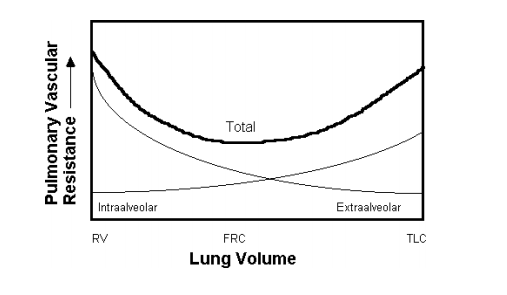
This graph demonstrates three concepts:
Intra-alveolar vessels have the lowest resistance at residual volume.
Extra-alveolar vessels have the lowest resistance at total lung capacity.
The total pulmonary vascular resistance is lowest at FRC; i.e. in the range of lung volume that we normally maintain.
Active Regulation of Pulmonary Vascular Resistance
- Neural Control
- Local Control
- Humoral Control
Neural Control
- Innervation of by both sympathetic and para-sympathetic supply.
- Systemic hypoxia does increase large vessel resistance by muscle constriction. This is probably a minor effect.
Local Control
- Alveolar hypoxia causes vaso-constriction. This is a very important response to maintain normoxia.
- Acidosis, hypercapnia (high PaCO2), and prior smooth muscle hypertrophy of the vessel due to disease all accentuate this response to hypoxia.
Alveolar Hypoxia
- vasoconstriction
- If part of the lung is hypoventilated and thus decreases alveolar oxygen, then blood flow should be shunted away from this region to an area with normal ventilation and normal alveolar oxygen. Examples would include reducing blood flow in a collapsed lobe or in an area of pneumonia. This process helps to maintain ventilation/perfusion balance. This is mediated by nitric oxide (NO), a vasodilator that decreases with alveolar hypoxia. Further, this vasoconstriction is only responsive to alveolar oxygen and not to the partial pressure of oxygen in the pulmonary capillary.
- Acidosis, hypercapnia (high PaCO2), and prior smooth muscle hypertrophy of the vessel due to disease all accentuate this response to hypoxia.
Humoral Control
•vasoactive substances can have an impact on smooth muscle tone in the pulmonary vasculature
Pulmonary Hypertension
Pulmonary hypertension means high pressure in the pulmonary circulation which is almost always due to a high pulmonary vascular resistance. It can occur acutely due to lung disease such as hyaline membrane disease, acute respiratory distress syndrome, or due to a pulmonary embolism (a blood clot blocking the pulmonary arterial system)
Chronic Pulmonary Hypertension
•Chronic pulmonary hypertension is usually divided into arterial, venous, hypoxic, thromboembolic, or miscellaneous. It may be idiopathic in nature or secondary to lung disease, chronic hypoxia due to obstructive sleep apnea, vasculitis due to auto-immune disease, drug toxicity, left sided heart disease, metabolic conditions, and some malignancies.
The key issue is that chronically increased pulmonary vascular resistance and pressures can lead to right sided heart failure, intrapulmonary shunting, and even pulmonary hemorrhage.
Management of Chronic Pulmonary Hypertension
The management consists of treating any condition leading to the problem. In idiopathic disease pulmonary vasodilators (epoprostenol, sildenafil, bosentan) and anti-thrombosis drugs are used. In most cases, oxygen is used to maintain high arterial saturations in the hope that these represent high alveolar oxygen levels which will cause pulmonary vasodilation. Unfortunately, cardiotonic medications such as digoxin often have no impact on the right sided heart failure and can potentially increase pulmonary vascular resistance.
Management of Acute Pulmonary Hypertension
In acute pulmonary hypertension often mechanical ventilation is used to cause hyperventilation with an increase in blood ph leading to pulmonary vasodilation. This may be combined with giving inspired nitric oxide to further dilate the well-ventilated lung.
Fluid Movement Through the Lung - Starling’s Law
- Capillary hydrostatic pressure favors movement of fluid OUT of the capillary.
- Plasma colloid oncotic pressure favors movement IN to the capillary.
- Tissue hydrostatic pressure favors movement IN to the capillary (Except in the lung where tissue hydrostatic pressure is negative)
- Tissue colloid oncotic pressure favors movment OUT of the capillary.
- These come together in the STARLING EQUATION
Net fluid out = K[(Pc - Pi) - σ(πc - πi)] = 3 mmHg
Thus, there is a continuous small leak of fluid out of the capillary into the interstitium of the lung. This must be cleared by the lymphatics.
The lymphatics are very efficient at pumping this fluid out of the lung and can increase the lymph flow by 10-fold if needed.

-
Respiratory System: Structure and Function30
-
Mediastinum17
-
Thoracic Wall, Pleura and Lungs42
-
Gas Transport38
-
Ventilation and Diffusion21
-
Ventilation and Perfusion26
-
Pressure/Volume25
-
Respiratory System - Histology31
-
Body Cavities and Lung Development24
-
Respiratory Resistance and Airway Obstruction48
-
Mechanics of Breathing17
-
Pulmonary Circulation28
-
Venous Thromboembolism25
-
Control of Ventilation26
-
Cystic Fibrosis35
-
Sleep Apnea10
-
Clinical Concepts/Integration23
-
Acute Respiratory Failure I and II and Chronic Respiratory Failure34
-
PFT Lab10
-
Obstructive Lung Diseases12
-
Pediatric Lung Diseases39
-
COPD48
-
Diffuse Interstitial (Restrictive) Lung Diseases39
-
Pulmonary Hypertension23
-
Pleural Effusion33
-
Drugs20
-
Pulmonary Infections and Imaging48
-
Lung Tumors24
-
Pneumoconiosis28



