Boyle’s Law
Under constant temperature, the volume occupied by a gas varies inversely with its pressure.
- On inspiration you use inspiratory muscles to raise alveolar volume. This decompresses the gas leading to lower Palveolar that then causes air to flow from the higher pressure in the room to the lower pressure in the alveoli.
- On expiration you relax the muscles allowing elastic recoil to reduce alveolar volume thus compressing the gas and raising the Palveolar. The air then flows from the higher Palveolar to the lower pressure in the room.
Dalton’s Law of Partial Pressures
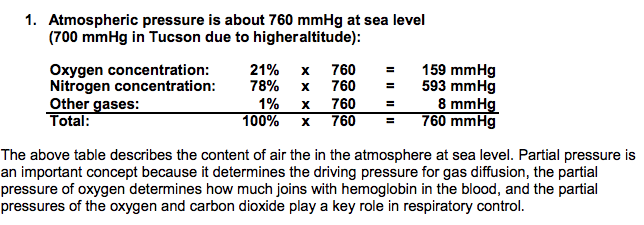
Each gas in a mixture of gases exerts a pressure that is proportional to its concentration. The sum of the partial pressures equals the total pressure.
Water Vapor Pressure
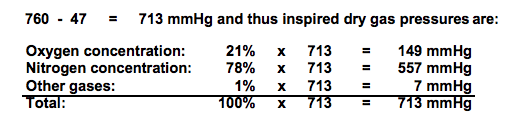
Inspired air is humidifed and water vapor pressure exerted is independent of Dalton’s law and is dependent upon the temperature (47 mmHg at body temp) so we need to calculate dry gas partial pressures.
Ventilation
Volume of gas exchanged per unit time
V’E= RR x VT
V, E = minute ventilation (L / min) (E stands for expired)
RR = respiratory rate (breaths / min)
VT = tidal volume (L)
Respiratory Quotient
R = CO2 production / O2 consumption
- R ranges from 0.7 to 1.0, i.e. from fat to carbohydrate metabolism T
- his cannot be easily measured, but rather is inferred from the RESPIRATORY EXCHANGE RATIO measured at steady state (RER = V’CO2/V’O2).
Diffusion
Diffusion is the passive movement of gas molecules from regions of high concentration (partial pressure) to regions of low concentration (partialpressure).
O2 Diffusion
PAO2 = 100mmHg
PaO2 = 40 mmHg
•Thus, the driving pressure for oxygen diffusion across the alveolar membrane from the alveolus to the capillary is 100- 40 = 60 mmHg
CO2 Diffusion
PACO2 = 40 mmHg
PaCO2 = 45 mm Hg
•Thus, the driving pressure for carbon dioxide diffusion across the alveolar membrane from the capillary to the alveolus is only 45- 40 = 5 mmHg.
O2 Diffusion vs. CO2 Diffusion
From a molecular standpoint oxygen diffuses about 17% faster than carbon dioxide because it is a lighter molecule; however, carbon dioxide is more soluble in membranes and water and from this standpoint diffuses about 20 times faster than oxygen. However, since the driving pressure for carbon dioxide is only 5 mmHg compared to 60mmHg for oxygen, the two gases complete diffusion at about the same time in the pulmonary capillary
Fick’s Equation
Flow of gas = Area x Diffusion Coefficient x Driving Pressure/ Thickness of Membrane
•Thus, high solubility, light gases will diffuse well and heavy, insoluble gases will diffuse poorly
Diffusion Time
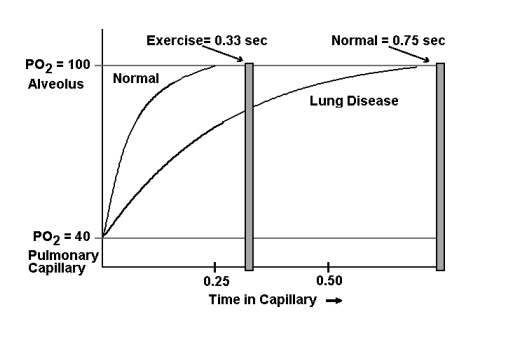
At rest the red blood cell only takes around 0.75 seconds to transit the pulmonary capillary. In health complete diffusion has occurred in 0.25 seconds. Thus, diffusion does not normally limit the transfer of gas in the lung.
Physiologic Dead Space
VT = VA + VD
VT = tidal volume (note that VT and TV are interchangeable)
VA = alveolar volume
VD = physiologic dead space volume
•Physiologic dead space consists of the sum of:
- Gas in the conducting airways that anatomically cannot exchange gas: ANATOMIC DEAD SPACE (conducting airways) (2.2 ml per kg; i.e.154 ml in a 70 kgperson)
- Gas in alveoli that are not perfused and therefore cannot exchange gas: ALVEOLAR DEAD SPACE (5-10 ml total in health)
Diffusion Limitation vs. Perfusion Limitation
•Under normal conditions, gas transfer in the lung is perfusion limited.
-Diffusion occurs so rapidly that the blood gas pressures equilibrate rapidly with the alveolar pressures and diffusion stops. If more blood could be delivered (perfusion) then more gas could be transferred. This is called PERFUSION LIMITATION and is the normal state.
- It makes good sense because if cardiac output is increased with exercise then this increased perfusion will take up more oxygen to meet the body’s metabolic demands.
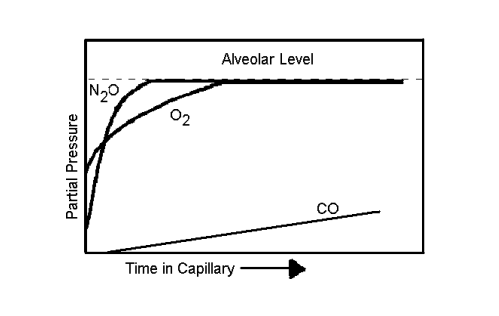
- Diffusion is so rapid that both oxygen and carbon dioxide have completed their diffusion in 0.25 seconds. Since the pulmonary blood takes 0.75 seconds to transit the pulmonary capillary, this means that the diffusion is complete in 1/3 of the distance along the pulmonary capillary.
- N2O is relatively in blood, so the partial pressure rapidly rises and equilibrates with the alveolus. Oxygen is more ‘soluble’ because of hemoglobin and so it takes longer to equilibrate, but it manages to do so in about 1/3 of the way through the alveolar capillary bed. At low levels of carbon monoxide (0.3%), the driving pressure is low and transfer is DIFFUSION LIMITED so the levels of CO never equilibrate with the alveolus.
- Transfer of gas is DIFFUSION LIMITED when the gas tensions in the alveoli and the pulmonary capillary blood fail to reach equilibrium during the time of red cell transit. For oxygen, this is an abnormal state and leads to de-oxygenated blood reaching the left atrium so that the arterial oxygen level is decreased and the patient is hypoxemic.
Conditions that Might Cause O2 Transfer to Become Diffusion Limited
- Thickening of the alveolar capillary membrane: This increases the time for diffusion across the membrane and decreases the rate of diffusion.
- High altitude or low FIO2: These conditions decrease the alveolar oxygen pressure and hence the driving pressure across the alveolar membrane. This decreases the rate of diffusion.
- Increased pulmonary blood flow
Thickening of the alveolar capillary membrane
Several pulmonary diseases can cause diffusion limitation due to thickening of the alveolar membrane. The classic example is pulmonary fibrosis. This can occur due to the body’s immune system attacking the lung or due to the toxicities of some anti-cancer drugs orradiation.
High altitude or low FIO2
- This cause of diffusion limitation is particularly important if a patient has lung disease with borderline diffusion capacity due to thickened alveolar membranes. If they ascend to a high altitude then they may become diffusion limited and become hypoxic.
- It is worth noting that commercial aircraft are pressurized at the same barometric pressure as 8,000 ft altitude (approx. 590 mmHg). The alveolar gas equation states that the PAO2 will be equal to 0.21 x (590 – 47) – (40/0.8) = 64 mmHg. Thus, driving pressure (PAO2 - PcO2) has dropped from 60 mmHg to only 24 mmHg and diffusion slows down dramatically. Usually, the patient will respond by hyperventilating to drop PACO2 and thus raise the PAO2 under these conditions.
Increased pulmonary blood flow
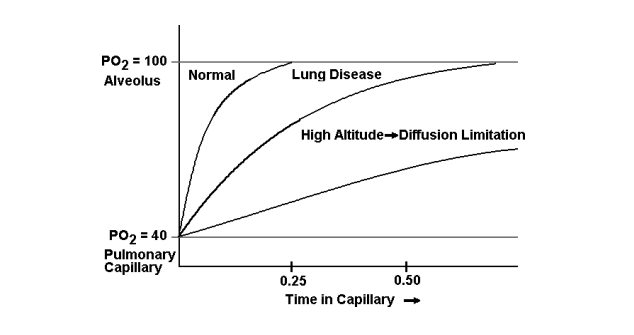
- With increased cardiac output the blood may move so rapidly through the lung that completely saturation is not acheived; i.e. diffusion is not fast enough to keep up with perfusion. This is particularly the case when combined with lung disease and/or high altitude.
- Patients with lung disease causing poor diffusion might be able to completely diffuse at rest when the blood takes 0.75 seconds to move through the pulmonary capillary bed.
- However, with exercise and increased cardiac output, the time in the capillary may become inadequatefor complete diffusion.
- In this example of vigorous exercise there is a reduction from 0.75 seconds to only 0.33 seconds in the capillary. The normal individual is still completing diffusion. The patient with lung disease has now become diffusion limited and hypoxic because incompletely saturated blood will be reaching the pulmonary veins and left atrium. We sometimes use an exercise test to assess this type of diffusion limitation in a patient with lung disease. It is particularly useful in children who can’t perform a diffusion capacity to carbon monoxide test (see below) because they can’t cooperate with the test procedure.
Carbon Dioxide Diffusion
- Carbon dioxide is more soluble than oxygen and diffuses 20 times more rapidly through the membranephase.
- Carbon dioxide is also more soluble in the blood and this slows equilibration.
- The driving pressure for carbon dioxide is much lower than oxygen; i.e. 5 mmHg as compared to 60mmHg for oxygen
- The net effect is that carbon dioxide equilibrates in about 0.25 seconds; i.e. at the same time in the pulmonarycapillary
Basic Principle of Diffusing Capacity Measurement
We cannot measure the area or thickness of the alveolar membrane but we can simplify Ficks’s equation to estimate the diffusing capacity of the lung
DL = Flow of gas / ∆Pressure
- Where DL = Diffusing capacity of the lung
- DL includes area, thickness and diffusing properties of the gas.
- Thus, we are not trying to parse out the various components of Fick’s equation. We simply need to figure out the driving pressure and measure the diffusion of gas into the body. From this we can then get a lumped variable, the diffusing capacity, that includes the diffusion coefficient, membrane thickness, and membrane area. The diffusion coefficient is a constant. We can adjust for area differences by measuring lung volume. Thus, we can use the diffusion capacity to estimate the function of the alveolar membrane. This is particularly useful in diseases that thicken the alveolar membrane like pulmonary fibrosis.
Carbon Monoxide Diffusion Capacity
We use carbon monoxide, CO, because:
- CO is diffusion limited
- PACO (alveolar partial pressure of CO) is easily calculated based upon the inhaled CO.
•PaCO (pulmonary capillary partial pressure of CO) approximates zero because CO is tightly bound to hemoglobin.
DLCO = V, CO / PACO
- This test is done by giving the subject a low (and safe) partial pressure of CO to breath and then measuring CO in the exhaled gas.
- By subtracting the exhaled CO from the inhaled CO we know how much CO was taken up by the body over a fixed time period, the V’CO.
- We calculate the PACO from the inspired concentration and then plug these into the above equation to get the DLCO.
- If we want to estimate the function of the alveolar membrane, then we need to adjust the DLCO for the area of the lung. We therefore measure TLC using a helium gas dilution method and adjust the raw DLCO for the volume of the lung.
Limitations of DLCO
Unfortunately the concentration of hemoglobin affects diffusion because of the time required for CO to bind chemically with hemoglobin. Thus, anemia can cause a falsely lowered DLCO and polycythemia, pulmonary vascular congestion, or pulmonary hemorrhage can cause a falsely elevated DLCO. We compensate for this by adjusting the DLCO result by the patient’s hemoglobin. Lung volume and hence diffusing area also impacts diffusion rates and so we measure lung volume with a tracer gas like helium and report out a DLO/VA; i.e. DLCO after adjusting for lungvolume.

-
Respiratory System: Structure and Function30
-
Mediastinum17
-
Thoracic Wall, Pleura and Lungs42
-
Gas Transport38
-
Ventilation and Diffusion21
-
Ventilation and Perfusion26
-
Pressure/Volume25
-
Respiratory System - Histology31
-
Body Cavities and Lung Development24
-
Respiratory Resistance and Airway Obstruction48
-
Mechanics of Breathing17
-
Pulmonary Circulation28
-
Venous Thromboembolism25
-
Control of Ventilation26
-
Cystic Fibrosis35
-
Sleep Apnea10
-
Clinical Concepts/Integration23
-
Acute Respiratory Failure I and II and Chronic Respiratory Failure34
-
PFT Lab10
-
Obstructive Lung Diseases12
-
Pediatric Lung Diseases39
-
COPD48
-
Diffuse Interstitial (Restrictive) Lung Diseases39
-
Pulmonary Hypertension23
-
Pleural Effusion33
-
Drugs20
-
Pulmonary Infections and Imaging48
-
Lung Tumors24
-
Pneumoconiosis28



