Tidal Volume (TV or VT)
- Tidal volume is the amount of air exchanged with each breath. This volume moves in and out like the tides and hence the name.
- It is usually about 7 ml per kg of body weight. Thus, an infant weighing 3 kg usually takes a breath of about 21 mls (or 2/3 of an ounce) and a 70 kg adult takes a breath of almost 0.50 liters (or about 17 ounces). If this adult breathes at a rate of 15 breaths per minute then the total minute ventilation will be 15 breaths per minute x 0.50 liters per breath = 7.5 liters per minute
Residual Volume (RV)
- Residual volume is the volume of gas left in the lung after a complete expiration.
- We are unable to completely empty the lung because we can’t compress the chest wall far enough and because of airway closure at low lung volumes. Residual volume makes up about 25% of the total lung capacity (TLC).
Inspiratory Reserve Volume (IRV)
•This is the volume of air that can be inspired from the end of a tidal inspiration to total lung capacity. It is the inspiratory reserve that we can call on if we need to take a deeper breath to cough, talk loudly, or exercisevigorously.
Expiratory Reserve Volume (ERV)
•This is the volume of air that we can exhale from the end of a tidal expiration to residual volume. It is the expiratory reserve we can call on to forcibly exhale, particularly during coughing. It makes up an important part of functional residual capacity.
Total Lung Capacity (TLC)
•Total lung capacity is the total volume of gas in the lung at the end of a maximal inspiration.
TV + RV + IRV + ERV = TLC
•At total lung capacity both the lung and the chest wall are vigorously recoiling inward to cause expiration unless opposed by inspiratory muscles. TLC is the volume at which the inspiratory muscles are no longer strong enough to overcome the inward (expiratory) recoil of the lung and chestwall.
Vital Capacity (VC)
•Vital capacity is the volume of air that can be exhaled from total lung capacity to residual volume. It is made up of all the volumes except residual volume and accounts for about 75% of total lung capacity.
TV + IRV + ERV = VC
•We can easily measure vital capacity by asking a patient to inspire completely and then expire into a device called a spirometer. The total amount of gas exhaled is the vital capacity. If severe enough, most kinds of lung disease will ultimately result in a decrease in vital capacity.
Finctional Residual Capacity (FRC)
•Functional residual capacity is the volume of gas residing in the lung at the end of a tidal expiration. It is the sum of expiratory reserve volume and residual volume.
ERV + RV = FRC
- With a volume of 3-4 liters in the average adult, it is much larger than the 500-600 ml tidal volume that is taken with each breath. We draw on the large reservoir of gas in the FRC to continuously maintain oxygen delivery and carbon dioxide uptake from the body. It is this reservoir of gas that keeps us from becoming short of oxygen (hypoxemic) and turning blue when we exhale during tidal breathing.
- Without the FRC, we would turn blue just after the end of an expiration and pink just after the end of an inspiration.
Inspiratory Capacity (IC)
•Inspiratory capacity is the complement of functional residual capacity.
TLC = FRC + IC
TV + IRC = IC
- It is the amount of gas we can inspire from functional residual capacity to total lung capacity. Thus, inspiratory capacity is the sum of tidal volume plus inspiratory reserve volume.
- We commonly measure IC at the bedside in patients on mechanical ventilation to predict their ability to breath without mechanical assistance. We also ask patients to do repeated deep breaths following abdominal operations to prevent collapse of the lung. These inspirations from FRC to TLC are called “IC maneuvers” and help to stretch the lung and inflate any alveoli that are tending to collapse.
Elasticity
The tendency to return to a resting shape or position after being stretched or deformed.
Transpulmonary Pressure
- the pressure stretching the lung
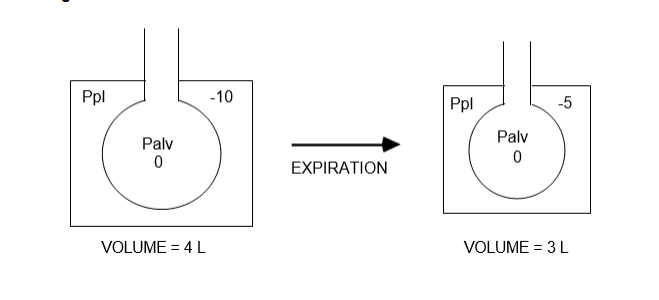
- the difference between alveolar pressure and pleural pressure
- Pleural pressure is always lower than atmospheric pressure during normal tidal breathing. Thus, pleural pressure is considered to be negative (lower than zero) and transpulmonary pressure is positive. As we inspire we use our inspiratory muscles to make the pleural pressure more negative. This change in pressure stretches the lung and brings in air from the atmosphere.
Compliance
Compliance = Volume/Pressure
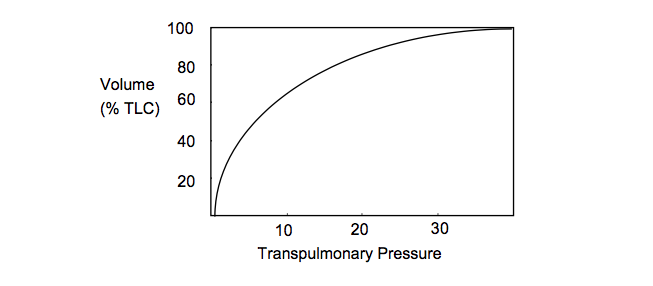
- This diagram demonstrates the exhalation of air from an excised lung. Volume is shown decreasing from total lung capacity (100% TLC) to effectively zero. The compliance curve in this volume/pressure diagram is very flat near TLC. Thus, ∆V/∆P is low and the lung is therefore non-compliant near TLC. This occurs because the lung has been stretched as far as it can go and has reached its ‘elastic limit’.
- In contrast, near FRC (40% TLC) the compliance curve is relatively steep. Thus, ∆V/∆P is high and the lung is compliant at this volume. Since we breathe in the volume range from FRC to FRC+TV, it is mechanically advantageous to have a compliant lung at this volume.
- Patients who become short of breath (dyspneic) due to lung disease tend to breathe at higher lung volumes. For obvious reasons, this is mechanically quite disadvantageous
Specific Compliance
- As the lung grows, its compliance increases. Thus, the lungs of adults are more compliant than the lungs of children - and- the lungs of large adults are more compliant than the lungs of small adults.
- Adults need to take bigger breaths because of greater metabolic need and yet the pressures used are comparable to those that an infant uses to take a breath. Thus, the lung must be more compliant the larger it gets.
- We can correct for this by dividing the absolute compliance by lung volume to give the specific compliance:
Specific compliance (1/ cmH2O) = Compliance (L/ cmH2O) / TLC (L)
Elastic Forces in the Lung
- Physical Structure of Lung Tissue
- Surface Tension at the Air-Liquid Interface on the Alveoli
Tissue Forces
- Elastin and collagen
- Airway Structures
- Pulmonary and bronchial vessels
Surface Forces and the Air-Liquid Interface
Surface Tension
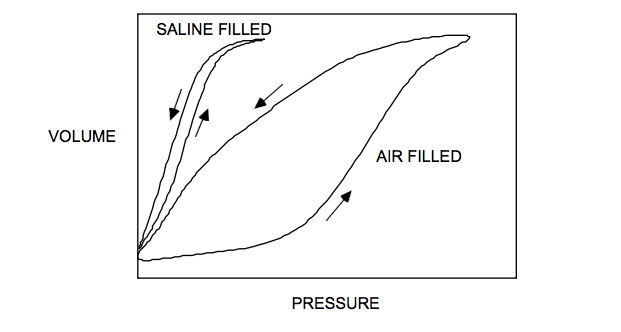
- The saline-filled lung is more compliant than the air-filled lung because of the lack of surface forces. Indeed, the saline filled lung only has tissue forces to overcome during inflation. The air filled lung has both tissue and surface forces to overcome and therefore is less compliant.
- The saline filled lung volume/pressure curve also shows less looping (hysteresis) than the air filled lung. In other words, when the lung is filled with saline, the volume at any given pressure is pretty much the same between inflation and deflation. In contrast, when the lung is filled with air, the volume is much higher for any given pressure on deflation than it is on inflation. This is due to a substance called surfactant disrupting the surface forces.
Surfactant
•Surfactant, a complex protein/phospholipid opposes the Laplace law by having low surface tension when surface area is small (i.e. low radius; small alveoli) and a higher surface tension when surface area is large. It is produced by the granular or type-II pneumocytes. The main phospholipid is dipalmitoyl phosphatidyl choline (DPPC).
Pleural Pressure Gradient
- There is a pleural pressure gradient along the vertical distance of the lung of about 0.25 cm H2O per cm of lung such that the apex is more negative. This occurs because of the weight of the lung. Where there is no gravity (zero-G), the pleural pressure is equally negative all over the lung surface.
- In a gravitational field (on earth) the positive pressure generated by the lung’s weight is added to the negative pleural pressure. At the top of the lung (apex) there is no weight to add and the pleural pressure is at its most negative. At the bottomof the lung (base) the whole weight of the lung is added in causing a less negative pleuralpressure.
- The density of the lung is such that 0.25 cmH2O pressure is added for every 1 cm in height down from the top. This pleural pressure gradient results in the alveoli at the apex being at a higher percent of their maximum volume than the alveoli at base of the lung. The more negative pressure in the apical pleural space stretches the apical alveoli more than the less negative pressure at the base does to basal alveoli. Remember, the pressure in the alveolar gas is atmospheric when there is no flow going on. Since atmospheric pressure is greater than the negative pleural pressure (by definition) it pushes on the alveolar walls and stretches the alveoli; i.e. the transpulmonary pressure is greater at the apex than the base resulting in higher resting alveolar volumes at the apex of the lung.
Regional Ventilation
•An important impact of the pleural pressure gradient is to cause greater ventilation at the base of the lung than at the apex. Since more blood flow goes to the base this tends to match up ventilation with perfusion, which is after all the primary role of the lung.
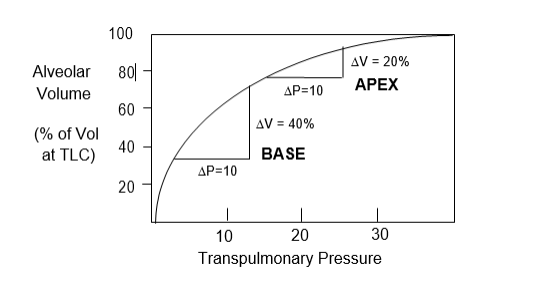
The base of the lung is at a […] pleural pressure and its alveoli are at a […] relative volume. Thus, alveoli at the base are […] compliant.
The base of the lung is at a less negative pleural pressure and its alveoli are at a lower relative volume. Thus, alveoli at the base are more compliant.
The apex of the lung is at a […] negative pleural pressure and its alveoli are at a […] volume. Thus, alveoli at the apex are […] compliant.
The apex of the lung is at a more negative pleural pressure and its alveoli are at a higher volume. Thus, alveoli at the apex are less compliant.
The pressure change due to inspiration will be roughly […] in all lung zones and thus […] compliant alveoli will change their volume […].
The pressure change due to inspiration will be roughly the same in all lung zones and thus more compliant alveoli will change their volume more.
During each breath the alveoli at the […] will change volume more than those at the […] and thus they will ventilate […] than those alveoli at the […].
During each breath the alveoli at the base will change volume more than those at the apex and thus they will ventilate more than those alveoli at the apex.

-
Respiratory System: Structure and Function30
-
Mediastinum17
-
Thoracic Wall, Pleura and Lungs42
-
Gas Transport38
-
Ventilation and Diffusion21
-
Ventilation and Perfusion26
-
Pressure/Volume25
-
Respiratory System - Histology31
-
Body Cavities and Lung Development24
-
Respiratory Resistance and Airway Obstruction48
-
Mechanics of Breathing17
-
Pulmonary Circulation28
-
Venous Thromboembolism25
-
Control of Ventilation26
-
Cystic Fibrosis35
-
Sleep Apnea10
-
Clinical Concepts/Integration23
-
Acute Respiratory Failure I and II and Chronic Respiratory Failure34
-
PFT Lab10
-
Obstructive Lung Diseases12
-
Pediatric Lung Diseases39
-
COPD48
-
Diffuse Interstitial (Restrictive) Lung Diseases39
-
Pulmonary Hypertension23
-
Pleural Effusion33
-
Drugs20
-
Pulmonary Infections and Imaging48
-
Lung Tumors24
-
Pneumoconiosis28



