Central line placement - Femoral
Indications
Contraindications
Complications
Reducing complications
Equipment
Anatomy
Preparation
Procedure - US guided
Procedure - non-US guided
Troubleshooting
Indications:
- Obtain emergency vascular access (more accessible than internal jugular or subclavian during resuscitation)
- To perform hemodialysis
- Provide large or caustic infusions
- To perform cardiac catheterization
Contraindications:
- Uncooperative patient
- Operator inexperience / lack of supervision
- Obesity (if impairs ability to find vein)
- Trauma or distorted anatomy
- Bleeding risk
- Overlying infection
Complications
- Infection
- Hematoma
- Arterial puncture and inadvertent catheterization
- Catheter or wire fragment in central circulation
- Fistula
- Pseudoaneurysm
- Arterial or venous laceration
Preventing complications
- Reduce number of attempts
- Apply pressure (at least 10 minutes if arterial poke
- Sterile dressing
- Accessing under sterile conditions
- Avoid manipulation
- Remove as soon as possible
Equipment
- IVF and tubing
- Lidocaine
- Central venous catheter kit
- Chlorhexidine
- Sterile drape, gauze
- Lidocaine and saline
- Sharps disposal cups
- Syringe and small guage saftey needle for topical anesthesia
- Introducer needle for finding vessel
- Guidewire and no. 11 scalpel
- Dilator
- Central venous catheter
- Most distal port is brown
- Under 2 years: 3 F
- 2-7 years: 4 F
- 8 years and over: 5 F
- Use larger single lumen set in trauma patients
- Need: staples or suture on curved needle, transparent adhesive dressing.
- Blood drawing equipment
- Cap, face shield, sterile gloves and gown
Anatomy
- From lateral to medial: NAVEL
- Nerve
- Artery
- Vein
- Empty space
- Lymphatics
Preparation
- Head of bed should be flat
- Restrain lower extremities and trunk
- Abduct patient leg away from midline and externally rotate the hip
- Consider use of towel role under gluteal muscle to improve exposure of vein
- Assess with US whenever possible to ensure vein does not lay directly over or under artery
- Palpate femoral artery 1.5 cm under inguinal ligament, halfway between ASIS and pubic symphisis. Femoral vein lies 0.5 to 1 cm medially
- Catheter length is estimated as the distance from the insertion site to the umbilicus
- Wash hands
- Open kit
- Mask, gown, glove self in sterile fashion
- Prep kit
- Add sterile saline for line flush
- Flush catheter ports with sterile saline
- Remove distal port cap to allow guidewire to exit the port
- Test connection with needle and syringe - the needle should disconnect easily
- Prep skin with chlorhexidine - larger area than needed, allow to dry x 30 seconds
- Drape
- Anesthetize region w/ lido + bupivicaine + epi
Procedure - US guided
- Objects close to probe appear at top of screen
- Index marker on probe corresponds to green dot on monitor
- Choose linear high frequency probe
- Place jelly into sterile cover, place US probe in cover, place sterile jelly on outside of cover
- Position probe with marker on patient’s right - your left now corresponds to left on monitor
- Position vein in centre of probe
- Insert needle at centre of probe and watch monitor to see needle pierce vein
- Remove probe once see flash of blood
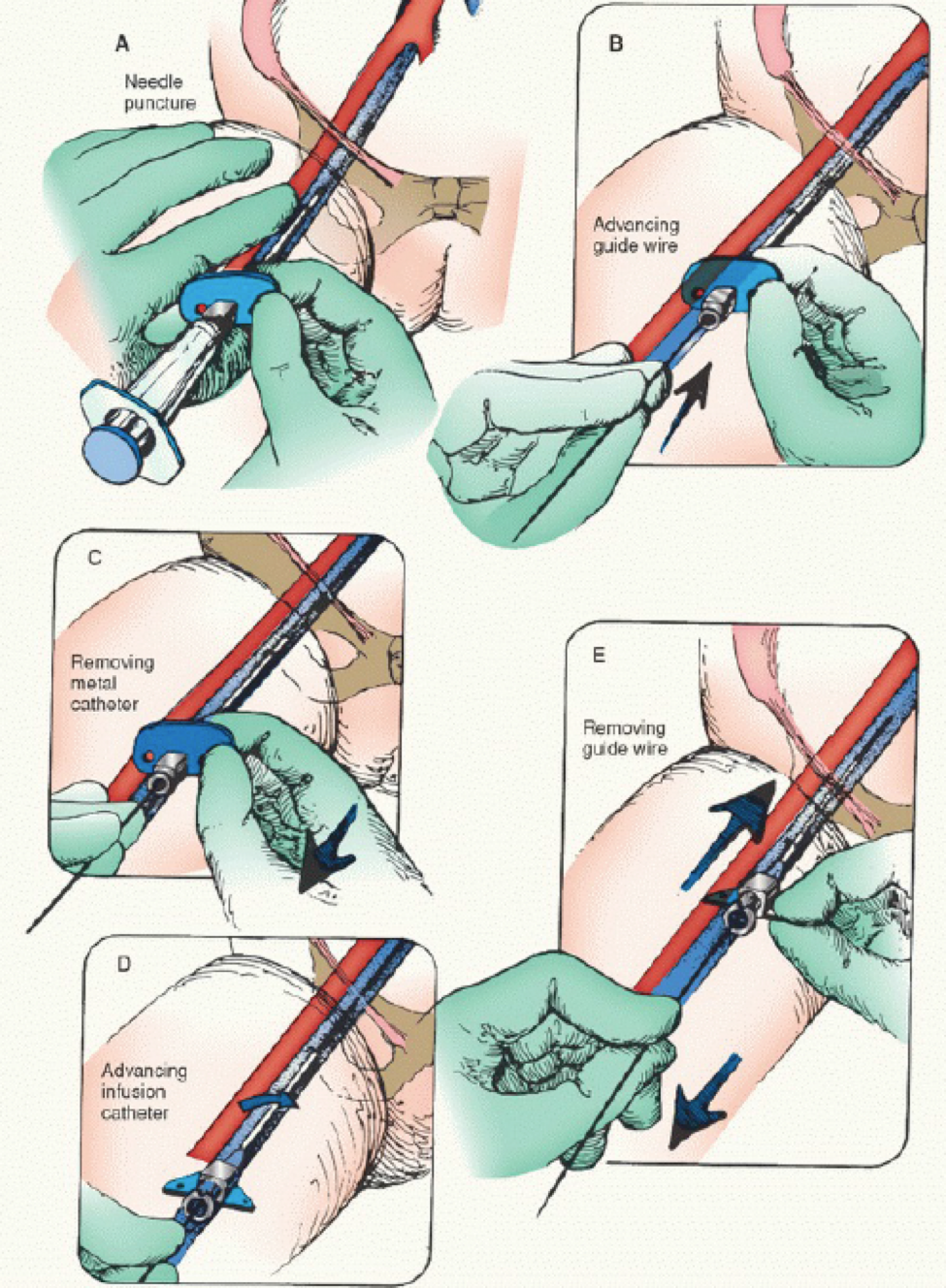
- Modified Seldinger:
- Find vein with intoducer needle - non-pulsatile venous blood - see below
- Advance guidewire into lumen several cm passed the tip of the needle in a cephalad direction
- Withdraw needle, use scalpel to knick skin adjacent to wire. Hold with scalpel blade away from wire.
- Insert dilator to make track through tissues - use twising motion to advance. Usually heavy bleeding after removed.
- Advance catheter over guidewire. Hold catheter at skin. Do not allow to pass through skin until wire passed through distal port and grasped firmly. Advance catheter and remove guidewire. Do not let go of the guidewire.
- Suture / staple
- Apply sterile, transparent occlusing dressing
- Remove all sharps and place in sharps container
- Location of the catheter should be documented with radiograph or ultrasound
Procedure - non-US guided
- Palpate artery
- Insert needle at 30 degree angle while aspirating
- When venous blood aspirated advance 1 to 2 mm and recheck for flow
- Stablize needle with other hand (most common time needle to dislodge from lumen)
- Preserve angle and depth and detach syringe with twisting motion
- Proceed as above
Troubleshooting
- If unable to advance guidewire:
- Remove wire, reconfirm flow
- If unable to re-aspirate blood, possible that needle has been removed from lumen or passed through back wall - reposition to re-establish flow.
- If still have good flow, adjust needle angle or twist the wire to change the direction of the distal tip
- Never force wire against resistance - may be kinked or extraluminal
NEJM Videos in Clinical Medicine
Fleischers 7th Ed Chapter 141 Procedures
Surgical Cricothyroidotomy
Indications:
Contraindications:
Equipment:
Procedure:
Complications:
Indications:
- Failed orotracheal or nasotracheal intubation
- Excessive blood or secretions in airway
- Facial trauma
- Difficult patient anatomy
- Airway obstruction w/ progressive respiratory failure and incipient cardiac arrest
Note that needle cricothyroidotomy is the preferred method of establishing an emergency airway in children under the ages of 10 to 12 as the larynx is more easily injured by surgical cricothyroidotomy under this age group.
Contraindications:
- Massive trauma to the larynx or cricoid cartilage
- Orotracheal or nasotracheal intubation are viable options but have not been attempted
Equipment:
- Gloves, gown, face shield
- Betadine or chlorhexidine
- Gauze
- 1% or 2% lidocaine with epinephrine
- 6 cc syringe with 25 guage needle
- Tracheostomy tube
- Scalpel with 10 or 11 blade
- Curved hemostat
- Trousseau dilator
- Tracheal hook
- 10 cc syringe
- Suture/tie
- 6 mm internal diameter tracheostomy tube
Procedure
- Supine position
- Chlorhexadine if time permits
- Local anesthesia if awake
- Stand on right side of patient
- Stabilize larynx with non-dominant hand, use index finger to palpate thyroid cartilage
- Move index finger down until palpate cricoid cartilage - in between is the cricothyroid membrane
- 2.5 cm vertical incision to skin and soft tissue
- Hemostat for blunt dissection
- Horizontal incision through cricothyroid membrane (may feel a pop), extend laterally
- No more than 1.3 cm deep
- Ensure blade stays within trachea
- Insert tracheal hook and elevate the larynx
- Remove blade
- Insert Trousseau dilator, open membrane vertically
- Insert tracheostomy tube
- Remove obturator and insert adaptor
- Inflate cuff with 10 cc syringe
- Attach bag valve unit
- Listen for air entry
- Tie or suture in place
- Obtain chest x-ray for placement
- Mechanically ventilate patient
- Obtain surgical consult for definitive tracheostomy
- Emergent cricothyroidotomy can remain in place for up to 72 hours if needed
Complications:
- Esophageal perforation
- Hemorrhage or bleeding
- Infection (periosteal or mediastinal)
- Subcutaneous emphysema
- Pneumothorax or pneumomediastinum
- Barotrauma (with complete proximal airway obstruction)
- Perforation of posterior wall of trachea
- Vocal cord injury, hoarse voice
- Injury to major vessels, cricoid muscle, cricothyroid membrane
NEJM Videos in Clinical Medicine
Cricothyroidotomy - Needle
Indications
Complications
Contraindications
Equipment
Procedure
Indications:
- To provide a conduit for oxygenation, and ideally ventilation when the natural airway is not available for safe gas exchange and/or ET intubation:
- Failed orotracheal or nasotracheal intubation
- Excessive blood or secretions in airway
- Facial trauma
- Difficult patient anatomy
- Airway obstruction w/ progressive respiratory failure and incipient cardiac arrest
- Note that needle cricothyroidotomy is the preferred method of establishing an emergency airway in children under the ages of 10 to 12 as the larynx is more easily injured by surgical cricothyroidotomy under this age group.
Complications: (remember bleeding, infection, air where its not supposed to be, injury to surrounding structures, failed procedure, long-term complications)
- Hemorrhage or bleeding
- Infection (periosteal or mediastinal)
- Subcutaneous emphysema
- Pneumothorax or pneumomediastinum
- Barotrauma (with complete proximal airway obstruction)
- Perforation of posterior wall of trachea
- Vocal cord injury, hoarse voice
- Injury to major vessels, cricoid cartilage, cricothyroid muscle
- Malposition of tip of catheter / cannula outside of trachea
- Subglottic stenosis or edema
- Kinking of thin angiocatheter
- Inadequate ventilation with progressive respiratory acidosis
Contraindications:
- Prior major neck surgery that completely obstructs anatomy
- Major trauma to the larynx/cricoid cartilage
- Orotracheal or nasotracheal intubation viable options but have not been attempted
Equipment: Remember THREE and SEVEN
- Chlorhexidine or povidone iodine solution
- Sterile gloves and sterile guaze
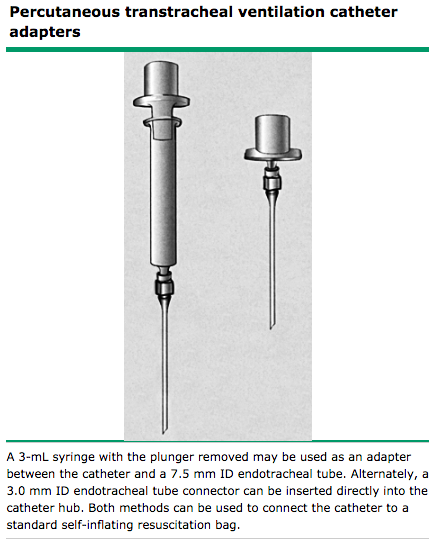
- 12 to 18 guage, 8.5 cm over-the-needle catheter (12 to 16 for adolescents, 16 to 18 for infants and smaller children) attached to 5 cc syringe filled with sterile saline
- 7 mm ETT + 3 cc plungerless syringe + bagger connected to 100% O2
- 3 mm ETT + O2 tubing with Y connector or 3-way stop cock (or cut hole in O2 tubing) + O2 source [15 LPM for adolescents (50 psi) or 10-12 LPM for smaller children (25 to 30 psi)]
Procedure:
- Supine position, neck in extension
- Chlorhexadine if time permits
- Local anesthesia if awake
- Stand on left side of patient (if RHD)
- Stabilize larynx with non-dominant hand, use index finger to palpate thyroid cartilage
- Move index finger down until palpate cricoid cartilage - in between is the cricothyroid membrane (in younger children and infants, start caudally palpating tracheal rings until palpate cricoid cartilage. Cricothyroid membrane is just above this even if not felt definitely). Needle can be inserted between tracheal rings if membrane cannot be found.
- Make small puncture to cricothyroid membrane with needle (aim for inferior portion to avoid blood vessels)
- Advance needle at 45 degree angle, directed caudally, until hear “pop”
- Draw back on attached syringe while advancing, looking for air bubbles indicating tracheal position
- Advance catheter on needle until hub flush with skin. Remove needle.
- Attach catheter to syringe and aspirate air to confirm placement. Remove syringe.
- Attach catheter to 3 mm ETT adaptor and attach this to O2 tubing
- Apply intermittent occlusion to end of Y-connector (or 3 way stop cock or hole in O2 tubing) in 1:4 second intervals
- ***in complete airway obstruction, this should be modified to prevent severe barotrauma and death. Use I:E ratior of 1:8 to 1:10, lower O2 pressures and flow rates, and as large a catheter as possible to allow for expiration
- Look for both chest rise and fall, diminished chest fall should prompt further reduction in respiratory rate, increased expiratory time, and emergent CXR looking for hyperinflation
- Listen for breath sounds
- Guard plastic cannula from kinking
- Prepare for more definitive airway
Fleisher’s 6th Ed Chapter 135 Procedures
Up To Date Needle cricothyroidotomy with percutaneous transtracheal ventilation