what are the two physical circulations in the lungs?
where do they & occur from?
what do they drain into?
- pulmonary circulation
- Arises from Right Ventricle.
- Receives 100% of right heart cardiac output.
- *2. bronchial circulation:** supplies blood to the tissues of the bronchi and bronchioles
- Arises from the aorta.
- Part of systemic circulation.
- Receives about 2% of left ventricular output
- right bronchial vein drains into azygous vein, left bronchial vein drains into the hemiazygous and accessory hemiazgous vein
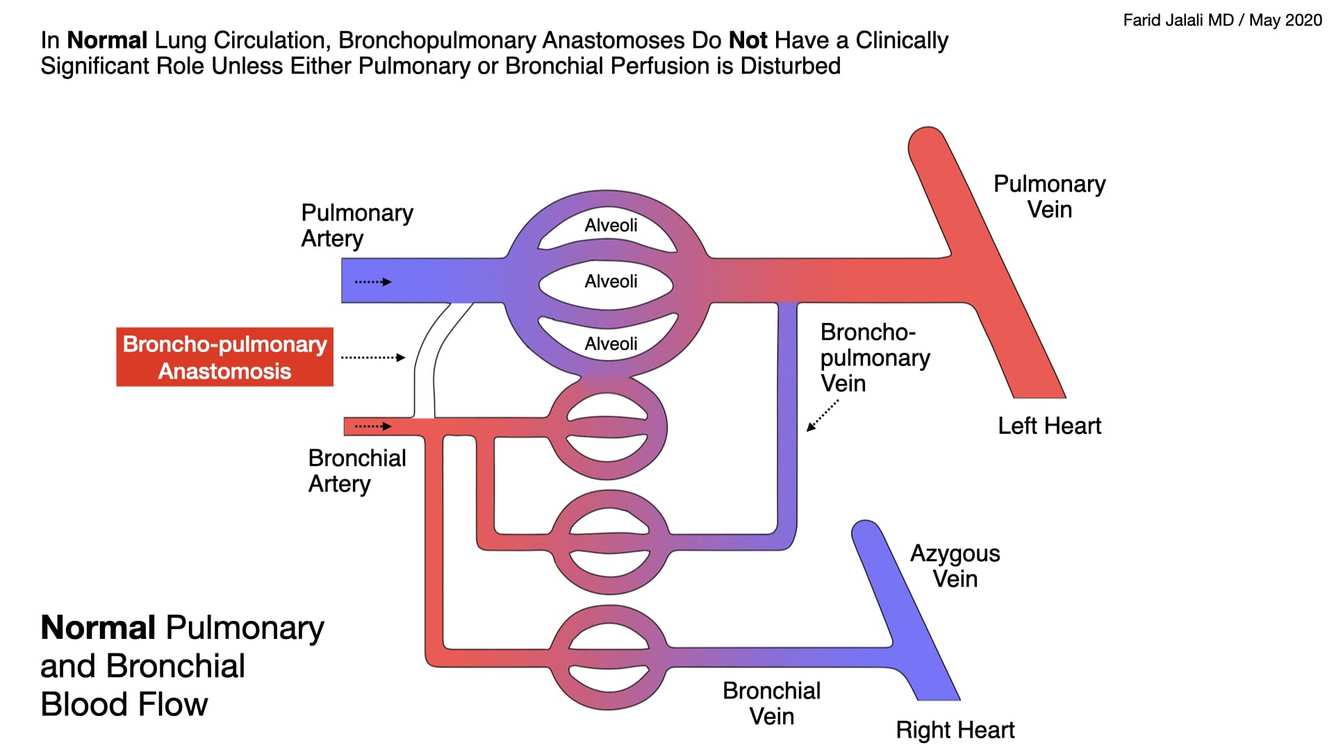
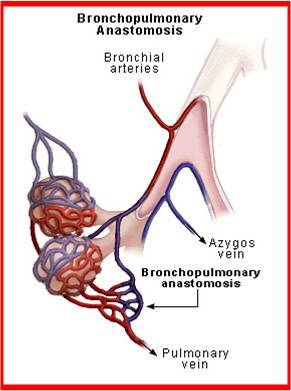
what exists between the pulmonary and bronchial circulation? why do they exist?
There are arterial and venous anastomoses (shunts) between the bronchial and pulmonary circulations. These are important ‘safety valves’ to prevent too high a pressure in the pulmonary circulation
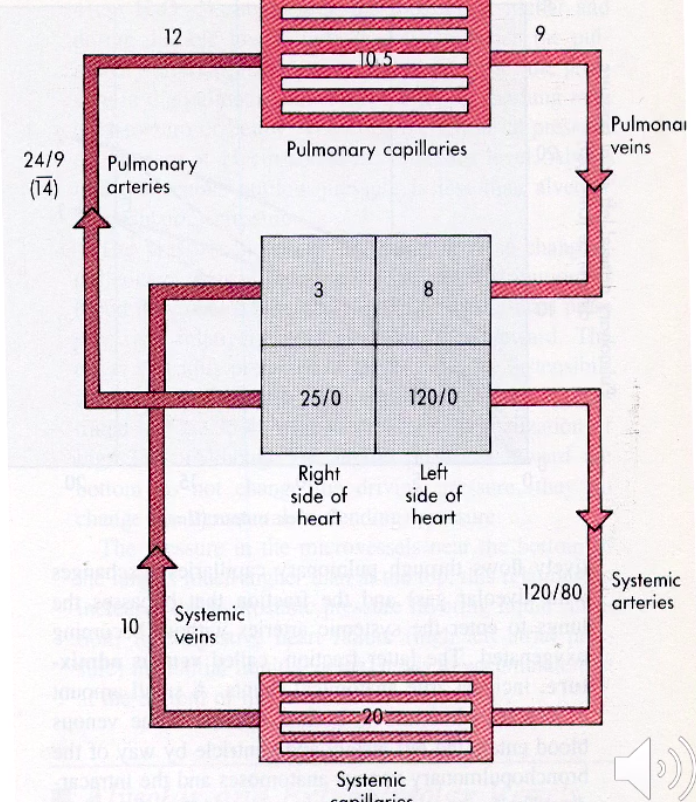
what is the difference in pressure between pulmonary and systemic circulation?
- Blood pressure much lower in pulmonary circulation c.f. systemic circ
systolic pressure much greater in systemic arteries and capillaires c.f. pulmonary; BUT mean venous pressure is similar for both
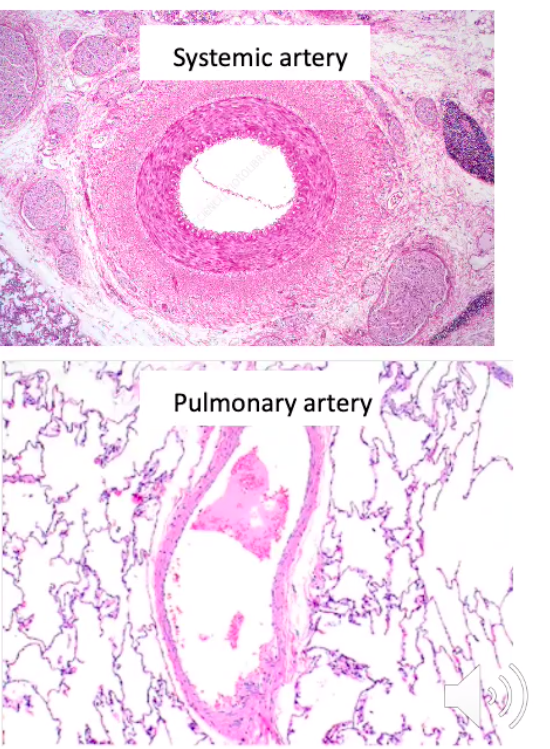
what ar special anatomic features of pulmonary circulation vessels? (4)
- Pulmonary arteries: thin walled. They have far less smooth muscle than systemtic arteries
- They have a larger diameter than systemic arteries
- Vessels are highly distensible and compressible
- Because of high compliance, pulmonary arteries stretch during systole. This allows the pulmonary arteries to maintain a low systolic pressure (
how does right cardiac output match the left cardiac output, but the pulmonary circulation has less pressure? :)
Then pulmonary vascular resistance R needs to be much lower than systemic vascular resistance for the cardiac output to be same on both sides of heart.
what condition do you get if pulmonary vascular pressure increases?
Pulmonary arterial hypertension (PAH): lifethreatening condition
(causes rise in back pressure in right ventricle, which has thinner walls, so dilates - cant pump = right heart failure)
what is the innervation like for lungs? basic role?
vertebral level?
- somatic innervation: provides pain and touch sensation from lungs (particularly in pleura) to spinal cord - T2-T6
- sympathetic innervation: innervates smooth muscle of bronchi and small pulmonary vessesls. T2-T4/6
- parasympathetic innervation:
i) vagal afferent fibres detect irritants in airways
ii) vagal efferent fibres produce bronchoconstriction and stimulate secretion of mucous.
explain the symapethic innervation to lung a bit more?
pathway?
innervate?
activation causes? how?
sympathetic innervation: T2-T4/6
- The postganglionic nerves from the paravertebral sympathetic ganglia pass into the lungs in plexi around pulmonary arteries and arterioles.
- The sympathetic fibres innervate: smooth muscle within the walls of bronchi and small pulmonary vessels –> form plexi around the BV
- Activation: bronchodilation via beta 2 receptors. Bronchial muscle relaxation due to sympathetic nerves is greatly augmented by circulating adrenaline
Bronchial muscle relaxation due to sympathetic nerves is greatly augmented by circulating what????
Bronchial muscle relaxation due to sympathetic nerves is greatly augmented by circulating adrenaline
what are J receptors?
where found?
stimulated by?
causes?
J receptors:
- location: alveolar walls
- stimulated by: enlargement of pulmonary capillaries / pulm. oedema
- causes: brachycardia, hypotension
parasympathetic vagal afferent & vagal efferent innervation causes what?
parasympathetic:
vagal afferent - triggers cough reflex (due to irritants)
vagal efferent innervation - narrowing of bronchi and mucous production
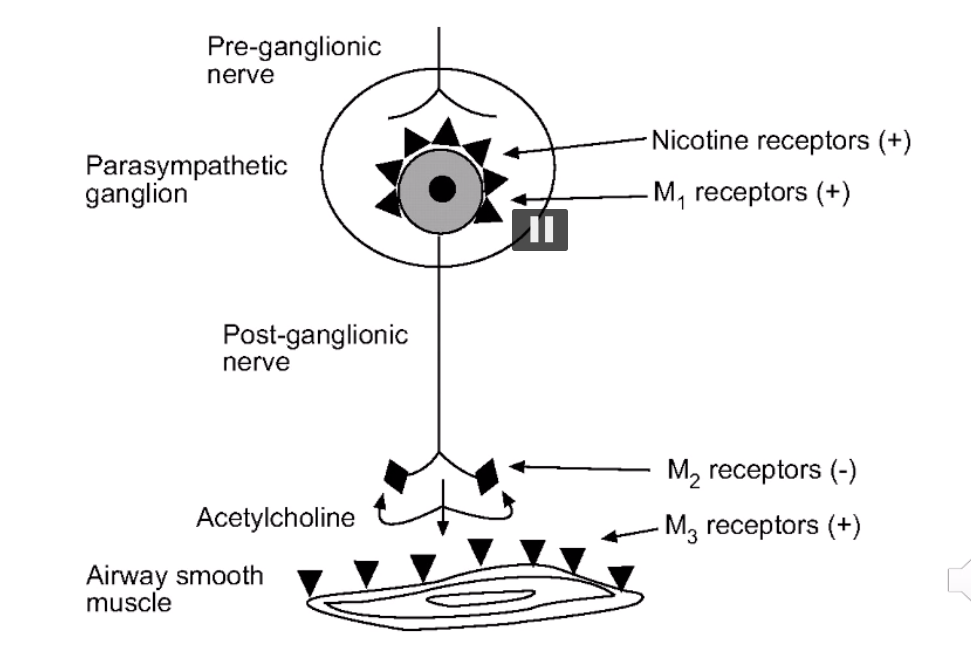
pre-ganglionic nerve fibres (both SNS & PNS): ? (NT and receptor)
parasympathetic post-ganglionic nerve fibres on airway smooth muscle and mucous glands: ? (NT and receptor)
pre-ganglionic nerve fibres (both SNS & PNS): Ach & Nicotinic receptors
parasympathetic post-ganglionic nerve fibres on airway smooth muscle and mucous glands: Ach & M3 (muscarinic receptors)
how does gravity influence pulmonary circulation?
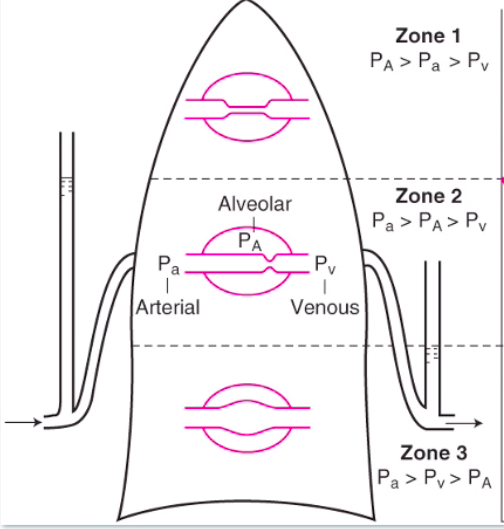
whats the 3 zone model?
pressure is much lower in apex c.f. base when standing:
- pulomonary artery: 15mmHg
- pulomonary base: 2 mmHg
- pulomonary apex: 25 mmHg
Creates a 3 zone model of the lung:
•The apices (zone 1) have intermittent flow; capillaries are squashed during expiration and diastole. flow occurs during systole (& inspiration)
•The centres (zone 2) have pulsatile flow; the pressure inside the capillay is greater for part of the resp. cycle: therefore is pulsatile. flow in this part of lung greater in systole than diastole; and inspiration c.f expiration
•The bases (zone 3) have continuous flow of blood; due to pulmonary A & V pressure > alveolar pressure
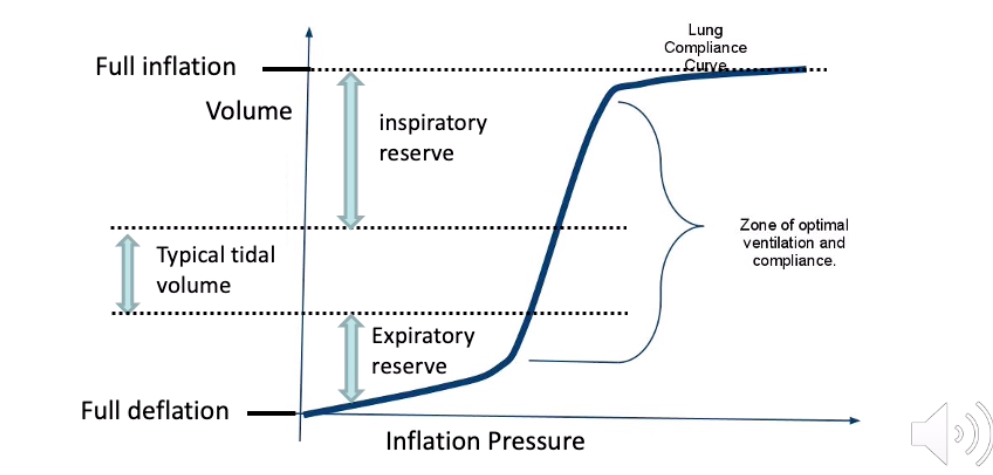
what is lung compliance?
(when is breathing least hard?)
why is low lung compliance bad? (caused by?)
why is high lung compliance bad?
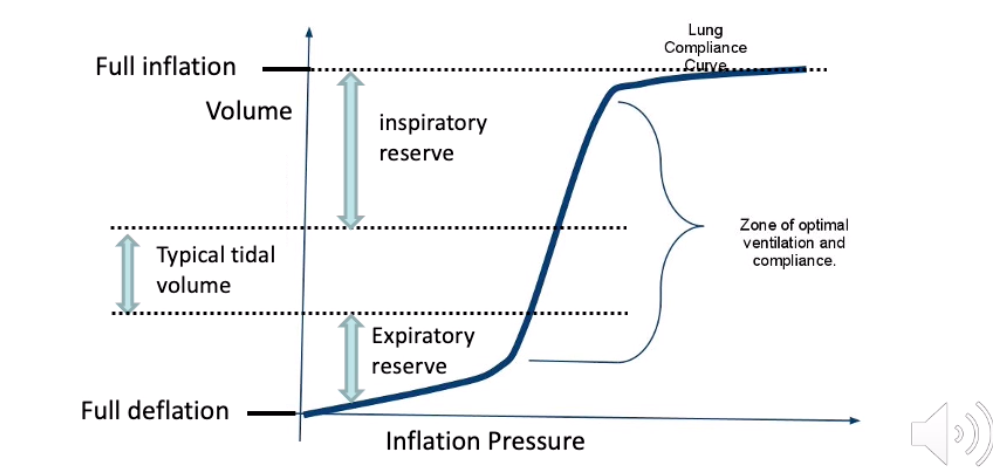
Lung compliance (C) is a measure of ‘stretchability’ or ‘distensibility’ of the lungs. It is the change in the volume per unit pressure change.
C = dV/Dp
breathing least hard when: given change in pressure gives large change in volume. (takes a lot of effort to get that v. last bit of breath in / out during inspiration / expiration - which is where it curves on the graph
Low compliance: requires more effort to inflate lungs - e.g. fibrosis
high lung compliance: if very high, then lungs have lost elastic recoil, so have to have extra effort to exhale. then can take extra effort to inhale again
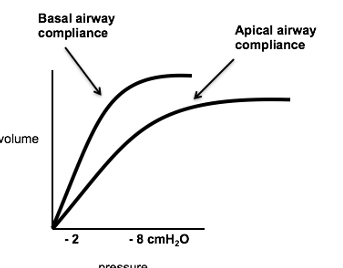
what is difference in compliance in base v apex of the lung? what does this mean for ventilation in apex and base?
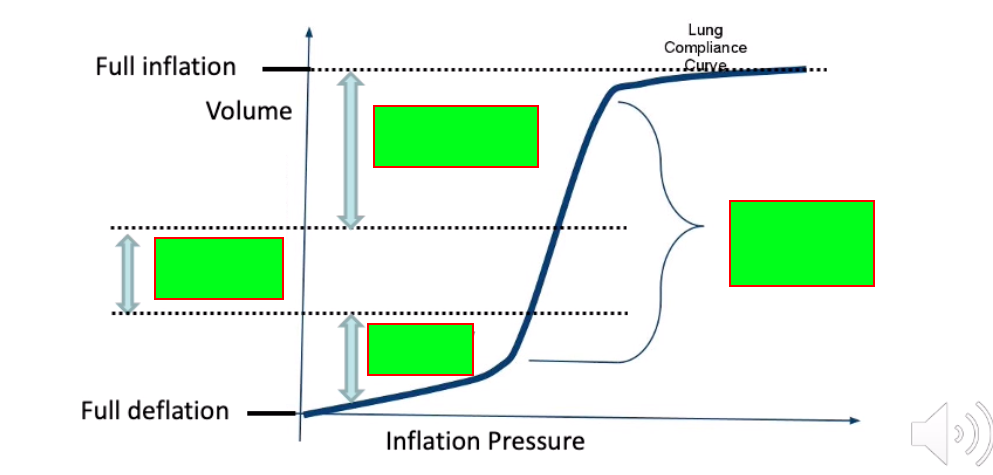
Compliance in base: higher - this means the base of the lungs are better ventilated (per unit lung volume) than apices.
Compliance in apex: lower
The basal alveoli are more ventilated than apical alveoli, as they have a higher compliance (as shown by a steeper sloping in the curve) and thus a bigger volume change per unit pressure change
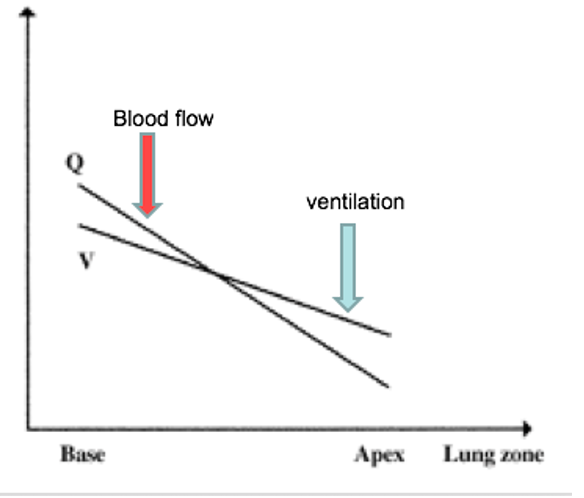
SO - what is ventilation AND blood flow (perfusion) like in base v apex?
which (ventilation or blood flow) shows a steeper decline with height of lung?
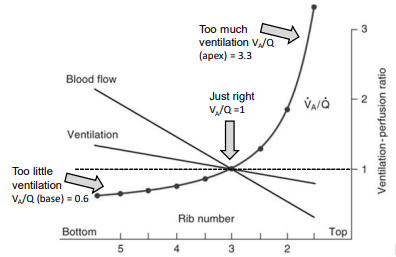
- blood flow and ventilation are higher at the base of the lungs c.f apex
- blood flow (Q on graph) shows a steeper decline with height than ventilation
At the base, blood flow is greater than ventilation yet at the apex, blood flow is worse than ventilation
what does ventilation / perfusion ratio graph show?
(what would ideal ratio be? - what is it at base and apex )
what does that mean regarding relationship of perfusion and ventilation in apex and base
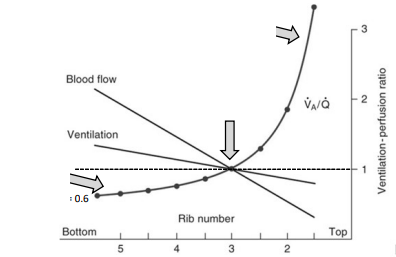
- ideal V/Q ratio: 1 for maximally efficient pulmonary function.
- the ratio is roughly 3.3 in the apex of the lung,*
- and only 0.63 in the base.*
@ the apex: ventilation exceeds perfusion - bad blood flow, good gas exchange
@ the base: perfusion exceeds ventilation - good blood flow, poor gas exchange
how do u work out ventilation / perfusion ratio?
= V/Q
what does it mean if V/Q is > 1 ?
what does it mean if V/Q is <1 ?
if V/Q is > 1: ventilation exceeds perfusion - bad blood flow, good gas exchange
if V/Q is <1: perfusion exceeds ventilation - good blood flow, poor gas exchange
:
In conditions of airway obstruction V/Q ratio is ?? than normal
In conditions of blood flow obstruction (eg from an embolus) V/Q ratio is ?? than normal.
In conditions of airway obstruction V/Q ratio is LOWER than normal
In conditions of blood flow obstruction (eg from an embolus) V/Q ratio is HIGHER than normal.
* important !! *
which, out of ventilation or perfusion, regulates the other? what does this mean, if have hypoxia?
e.g.
If ventilation is reduced in one alveolus, then the capillaries around it ??? , and blood is redirected to ?? ??? alveoli.
local ventilation regulates local perfusion
called: v/q matching
hypoxia: causes vasoconstriction of the local blood vessels
If ventilation is reduced in one alveolus, then the capillaries around it constrict, and blood is redirected to better ventilated alveoli.
what happens to pulmonary circulation during exercise?
- pulmonary arterial pressure: increases only slightly during exercise.
- pulmonary arterial resistance: greatly decreasing during exercise (by dilating)
what is the mechanism of pulmonary arterial vasodilation during exercise?
- in the apex of the lung?
- in the base of the lung?
in the apex of the lung:
- A small pressure increase in pulmonary arterial pressure produces a disproportionately large increase in blood flow.
- The pulmonary arterioles in zone 1 become distended (stretched) when the pressure in them rises: This stretching generates a reflex extra relaxation of the arterial smooth muscle and so the vessels enlarge , reducing the vascular resistance and increasing the flow through zone 1.
Blood flow through zone 1 can increase seven to eight fold during exercise
A similar reflex stretch induced relaxation occurs in zone 2 and 3, where blood flow can increase 2 to three times
- *in the base of the lung:**
- normal base alveoli in the lungs are relatively poorly ventilated during quiet breathing. Thus the associated capillaries are constricted.
- The increased ventilation that occurs at the start of exercise: increases PO2 in these alveoli.
- This dilates the associated capillaries and thus reduces total pulmonary vascular resistance

-
The Mediastinum27
-
CR Anatomy: Question Bank17
-
The Heart and Coronary Arteries34
-
Clinical Skills: CV1
-
The Conducting System of the Heart & ECG43
-
Anatomy: Practical 1 - Mediastinum43
-
Smooth and Cardiac Muscle32
-
CVS Histology48
-
Anatomy: Practical 2 - Thorax and the Lungs41
-
Heart as a Pump40
-
Haemodynamics35
-
Carriage of Oxygen in the Blood24
-
Review of the Sympathetic Nervous System34
-
Neural Control of Blood Pressure28
-
Renal Function 128
-
Renal Function 227
-
Blood volume & pressure control after Haemorrhage0
-
Microcirculation & Oedema35
-
Microanatomy - Histology of Hematopoietic System29
-
Peripheral Vasculature of the Limbs39
-
Drug Treatments for CVD24
-
Anatomy of the respiratory system27
-
Hormonal Control of BP32
-
Introduction to Respiratory System29
-
Anatomy of the upper airway41
-
Anatomy: Practical 2 - Thorax and the Lungs (Part 2)36
-
Pulmonary Circulation25
-
Chest X-rays28
-
Respiratory Physiology I17
-
Respiratory Physiology II25
-
:)51
-
Histology of Resp. System34
-
Pharmacology of the Airways14
-
Histology Qs7
-
Acid-Base Control of Respiration28
-
Gas Exchange and Lung Function Tests27
-
big boys29
-
::)53
-
:O50
-
:L54
-
:D13



