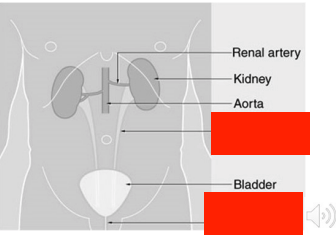
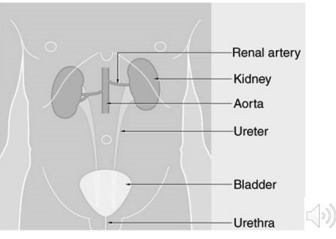
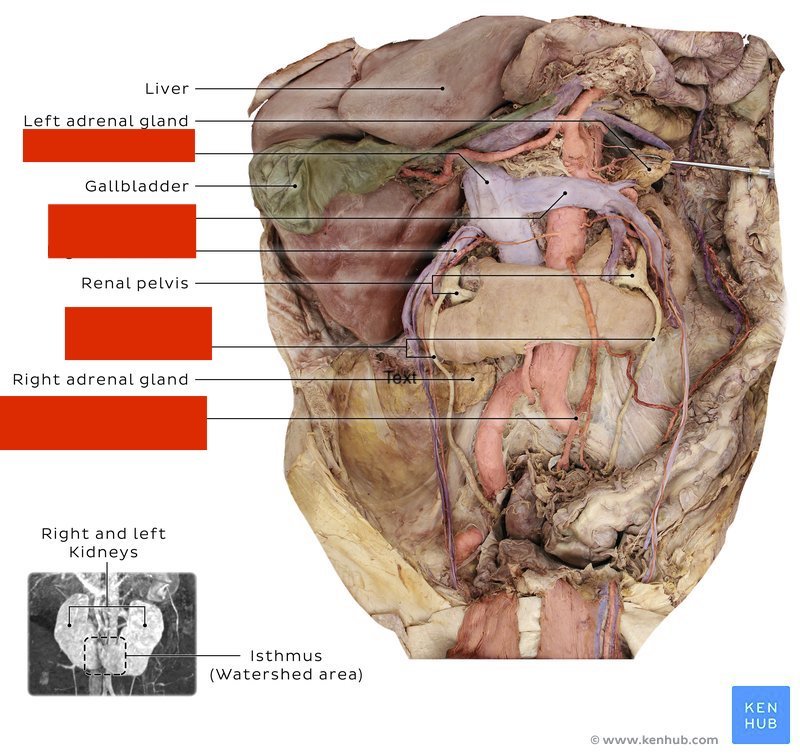
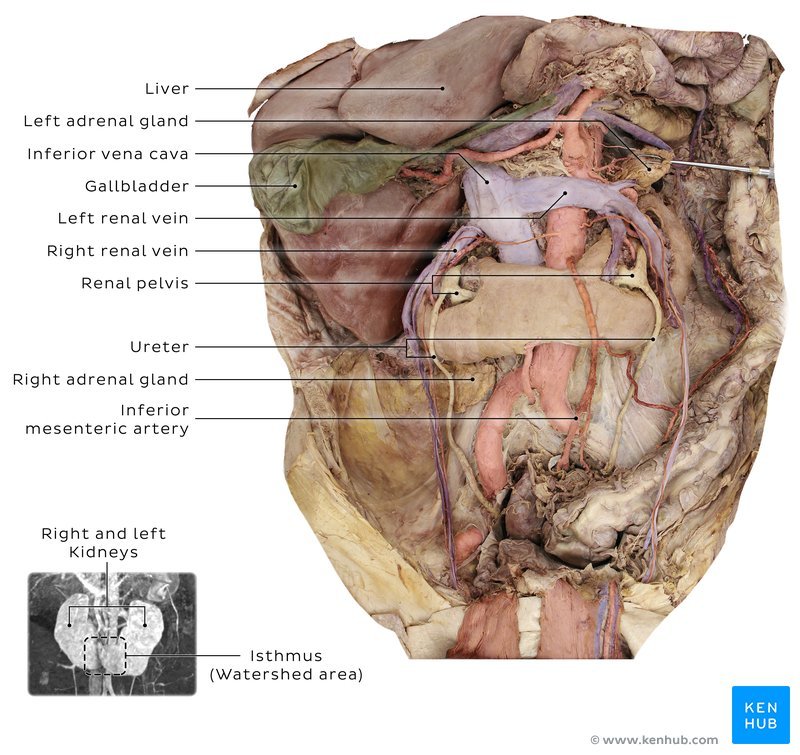
which arteries supply the kidneys?
from what origins?
what vertebral level found?
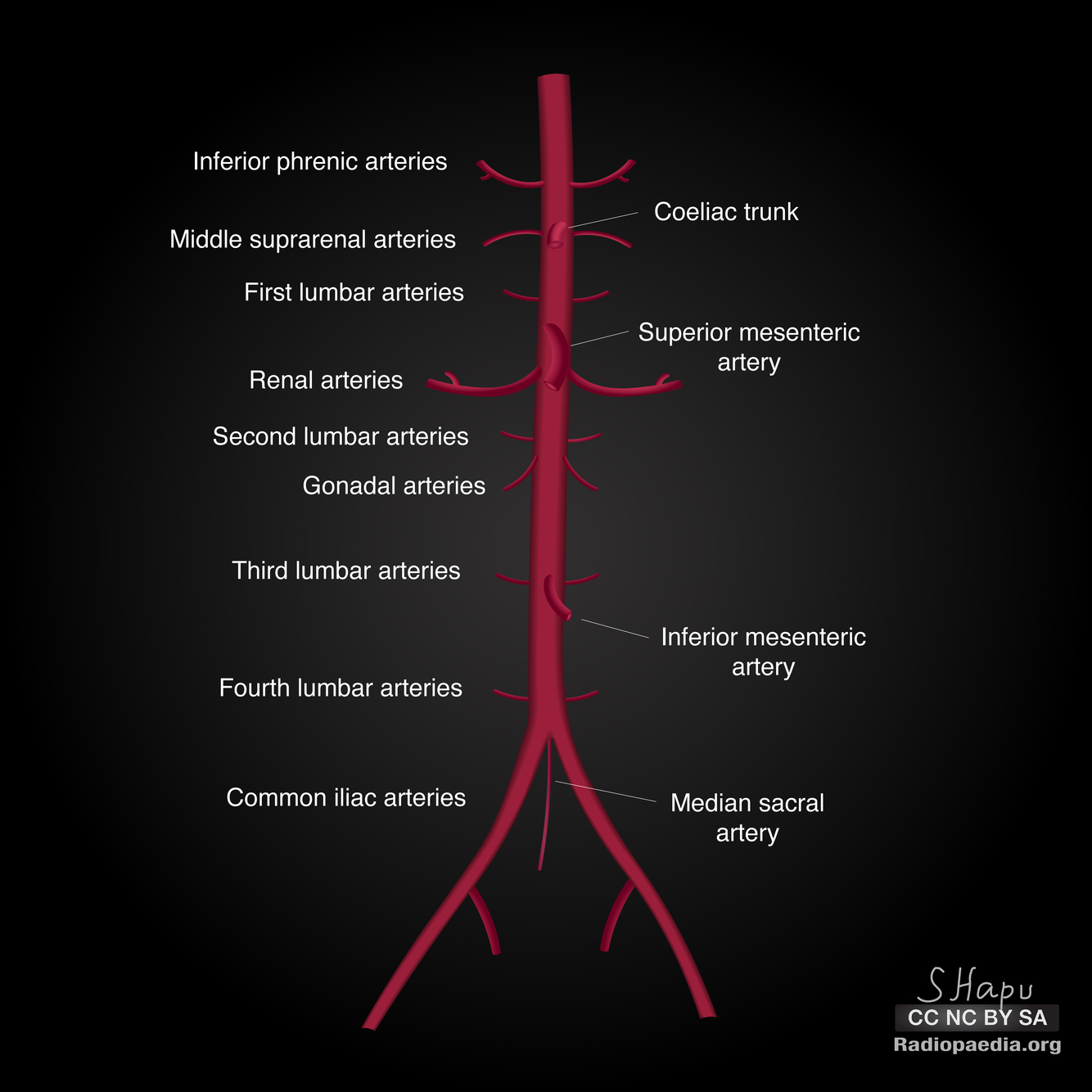
renal arteries
- L1-L2 level
- come from thoracic aorta
- lie inferior to superior mesenteric artery
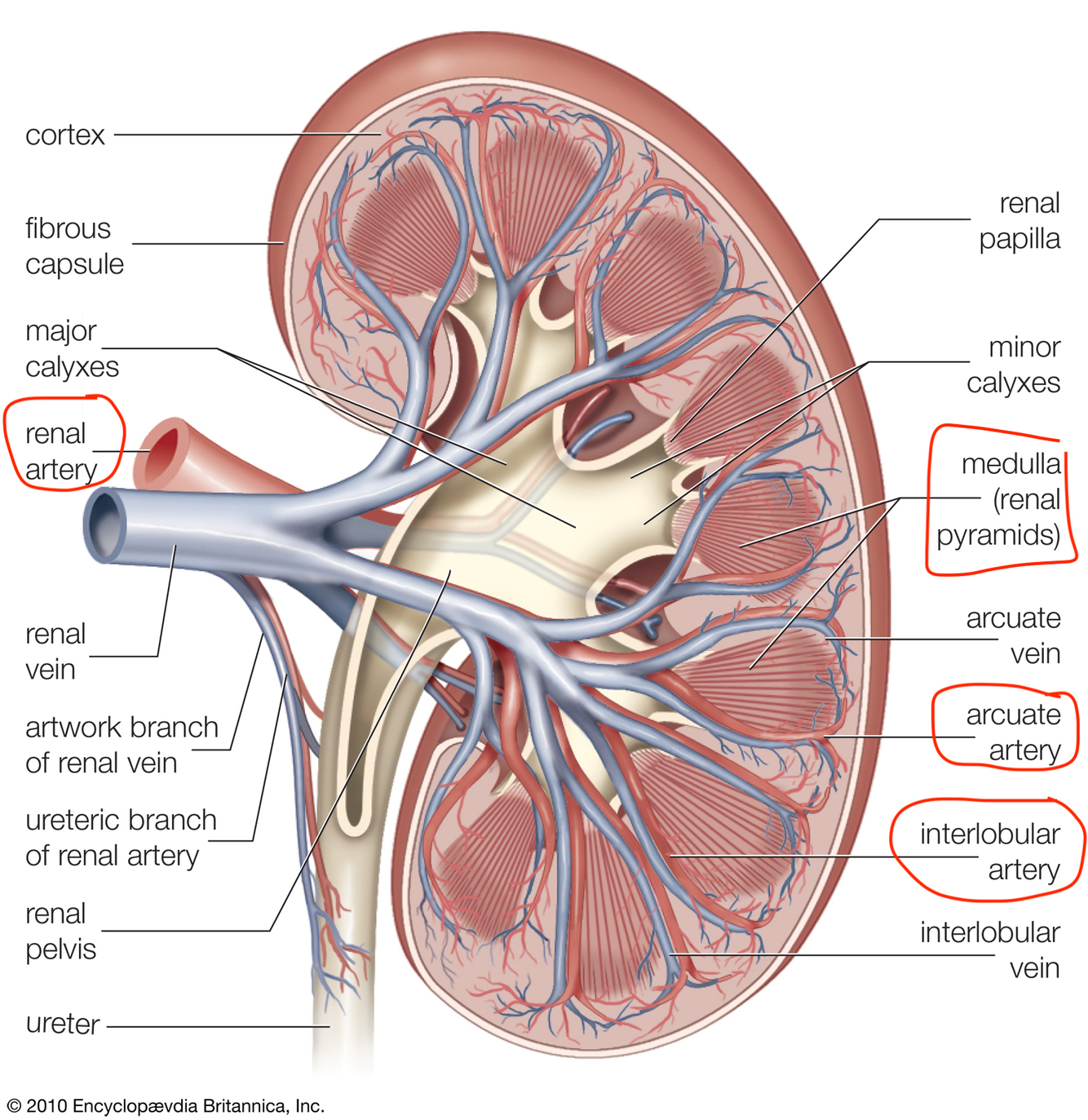
how does the main renal artery divides after entering the kidneys?
what is each glomerulus enclosed in?
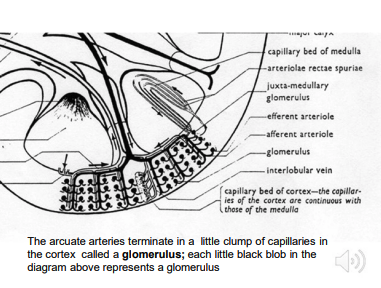
renal artery –> interlobar vessels –> arcuate arteries (in renal cortex) -> afferent arteriole , where terminates in the cortex called a glomerulus
each glom: enclosed in Bowman’s Capsule
:) look !
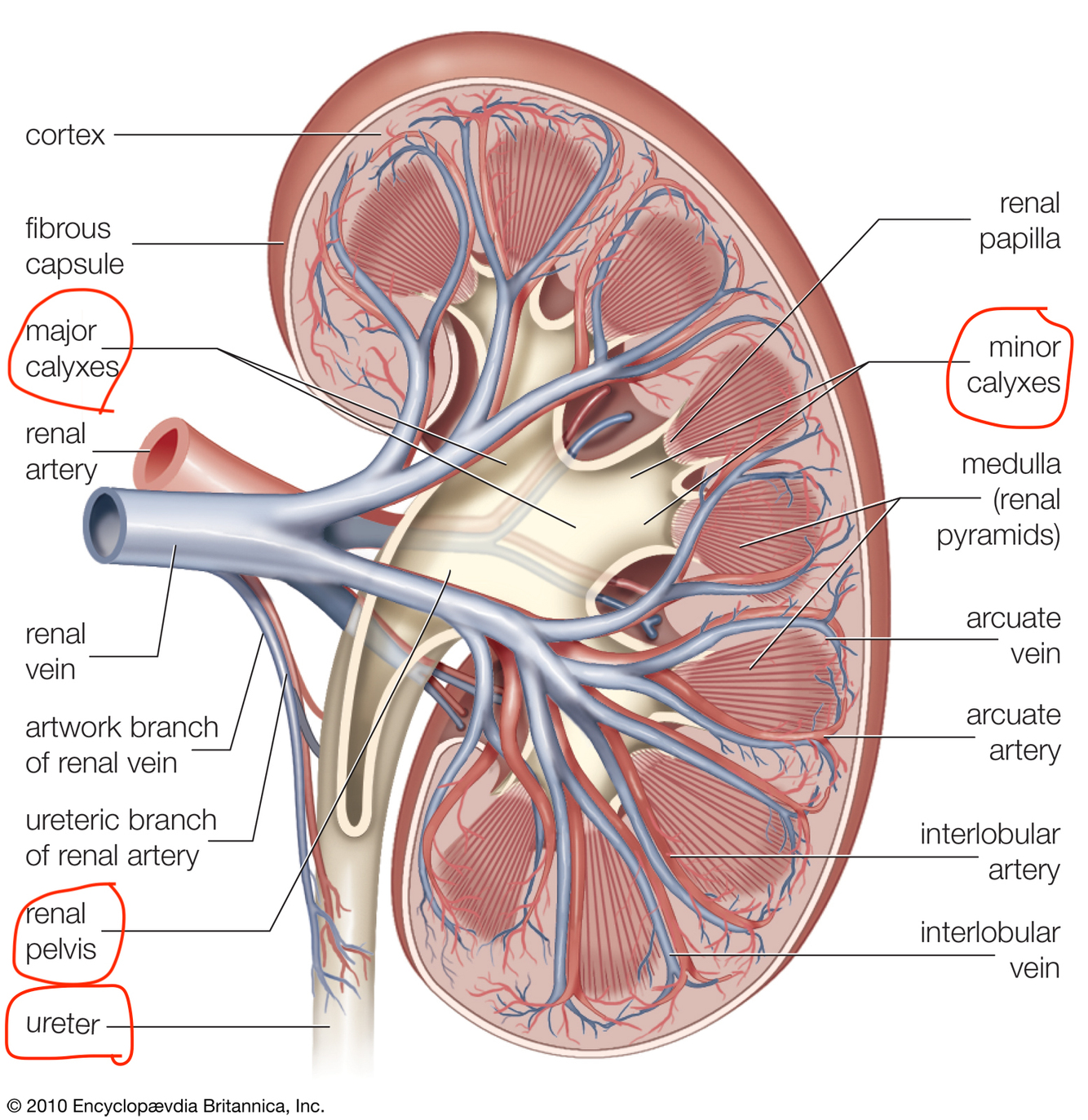
describe flow of urine into / out of kidney
- urine drains into the calyxes –> renal pelvis –> ureter
- blood enters glomerulus through afferent arteriole, which has a smaller
- 20% blood plasma filtered through glomerulus –> proximal tubule
describe the structure of capillaries found on glomerulus & how this achieves filtration
what is proteinura?
- fenestrated gaps
- have layer of podocytes: have slits between them
- the slits form the filtration mechanism (let ions through, but not proteins)
proteinura: increased levels of protein in the urine (whenn ^^ becomes inflammed & damaged)
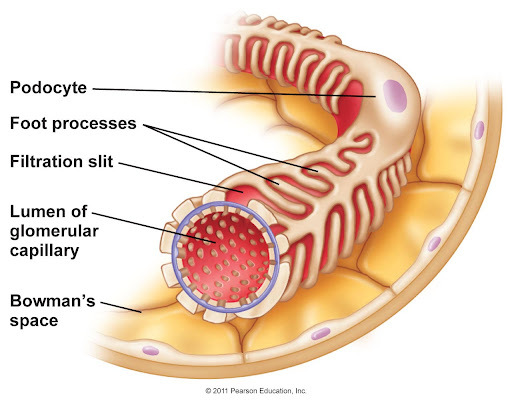
what controls the filtration of water into from glomerulus into the Bowmans capsule?
what is usual pressure of glomerular capillaries? what is normal pressure in Bowmans capsule?* how does pressure get to this BC?)
controlled by the constriction or relaxtion of afferent arteriole
normal pressure in capillaries: 55 mm Hg
normal pressure in Bowmans capsule: 10 mm Hg (a result of: glomerulus hydrostatic pressure (55 mm Hg) - blood colloid osmotic pressure (30 mm Hg) - capsular hydrostatic pressure (15 mm Hg) : 55-30-15 = 10 :)
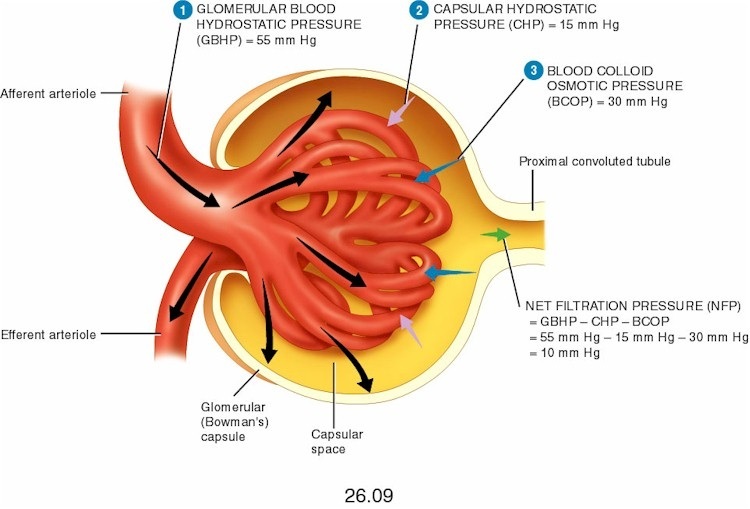
describe the anatomical pathway of kidney nephron
- Fluid passes from Bowman’s capsule into the proximal tubule
- Here, filtered materials can be reabsorbed into the peritubular capillaries
- Material can also be transported out of the capillaries and secreted into the tubular fluid
- The amount of a material (e.g. glucose) excreted is the amount filtered plus the amount secreted minus the amount reabsorbed
- Fluid passes out of the proximal convoluted tubule fluid and enters the ‘Loop of Henle’
- After the loop it enters the distal convoluted tubule
- The DCT returns to the junction where the afferent and efferent arterioles meet the glomerulus = juxtaglomerular apparatus.
- Finally the distal tubule enters the collecting duct.
- The collecting ducts drain into the ureter.
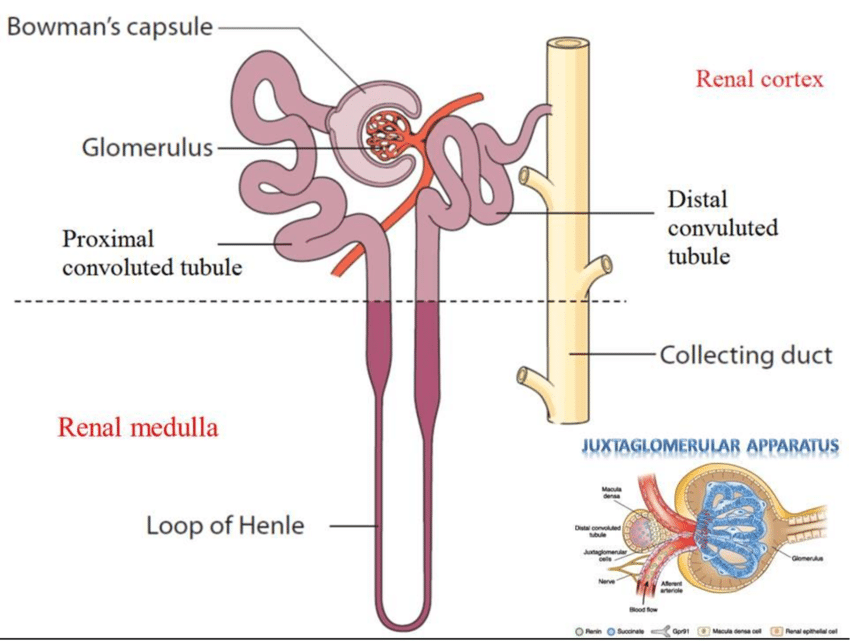
explain the mechanism of when is water reabsorbed back into the capillaries from the PCT?
(when water and solutes within the PCT are transported into the bloodstream)
- The proximal tubule is lined with epithelial cells
- The basal membranes of the cells (i.e. the layer not in contact with filtered fluid) contain sodium pumps which pump sodium into the interstitial fluid (1)
- Sodium channels exist in the luminal (inner) membrane of the cells and so sodium passes out of the lumen into the cells down its concentration gradient. (2).This sodium influx carries glucose with it.
- Water is reabsorbed down an osmotic gradient generated by the sodium pumps from the lumen into the cells and then out into the interstitial fluid
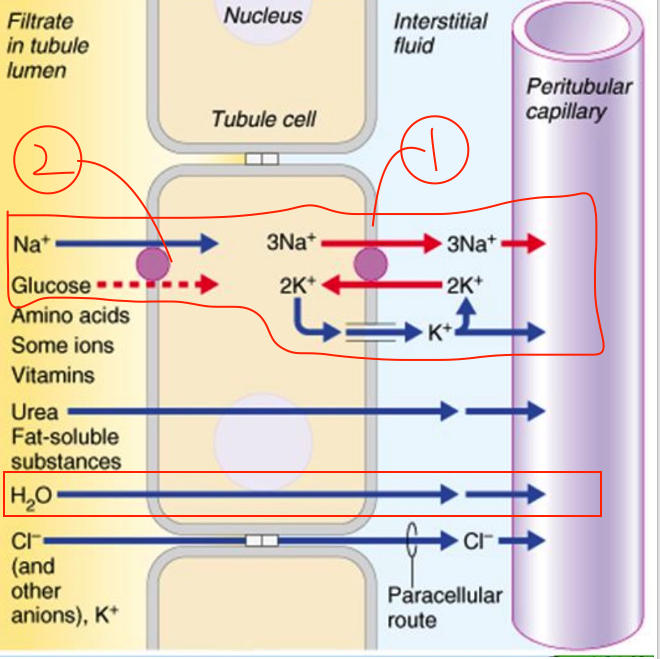
how much of water filtered in the glomerulus is reabsorbed in the PCT?
About 2/3 of all the water filtered in the glomerulus is reabsorbed in the proximal tubule
how much fluid is filtereted through all the glomeruli in both kidneys in fit adult? - what is this aka?
which system determines glomerular filtration rate / GFR?
what type of regulation is this? - what does this mean regarding differing BPs?
The total amount of fluid filtered through ALL the glomeruli in BOTH kidneys in a fit adult is about 120-125 ml/min. (depending on body size). This is the Glomerular Filtration Rate (GFR).
GFR is autoregulated by tubuloglomerular feedback
Autoregulation of GFR means that renal blood flow also does not change over a wide range of blood pressures.
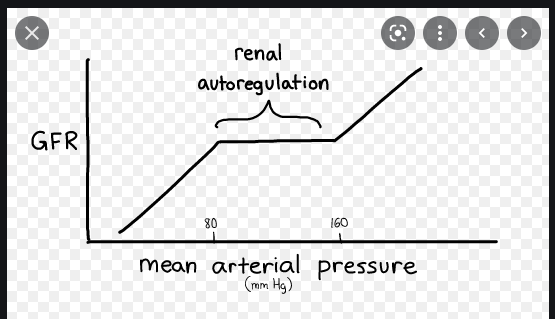
how does tubuloglomerular feedback regulate GFR
what happens to GFR if affererent arterioles constrict / relax?
- (for ur understanding / from youtube:
- blood enters afferent arterioles at around 100 mm Hg
- afferent arteriole has less constrictor tone, , which reduces the pressure to about 50 mm Hg(otherwise would damage the glom capillaries)
- yet after been in the glomerulus capillaires, need to up pressure again
- so efferent arteriole, increases resistance, so more pressure is applied to blood*
https://www.youtube.com/watch?v=ZDvWnezLdDU
Tubuloglomerular feedback regulates the GFR by regulating the degree of constriction in the smooth muscle of the afferent arteriole
- *so:**
- if afferent arterioles contrict: lowers filtration pressure & GFR
- if afferent arterioles relax: increases filtration pressure & GFR
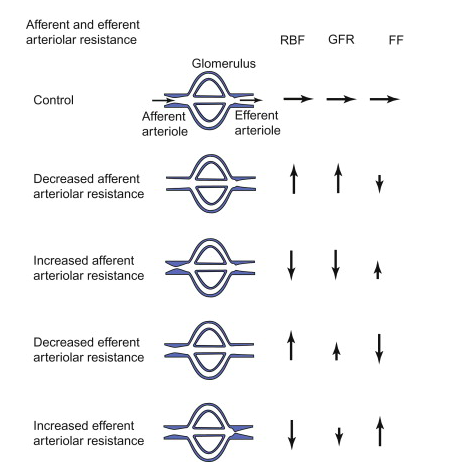
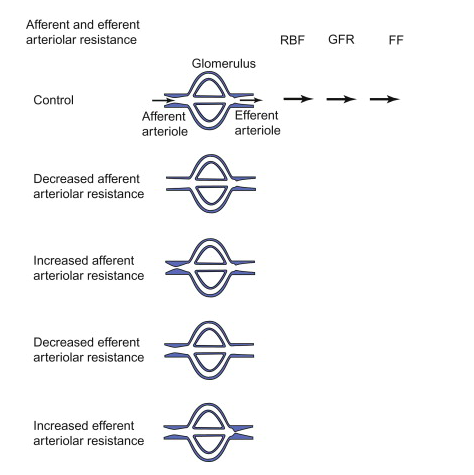
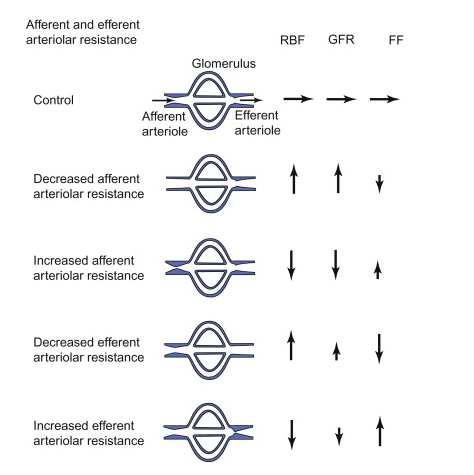
explain the mechanism that occurs if GFR is too low
and high :)
whole process = autoregulation
- *GFR too low**
- Cells in the macula densa of the JGA detect the concentration of sodium in the distal tubular fluid
- If Na+ levels are low, shows that GFR is too low
- The macula densa releases local chemical factors which relax the smooth muscle in the proximal tubule
- this increases the filtration pressure and GFR.
- *GFR too high**
- Cells in the macula densa of the JGA detect the concentration of sodium in the distal tubular fluid
- If Na+ levels are high, shows that GFR is too high
- The macula densa releases local chemical factors which constrict the smooth muscle in the proximal tubule
- decreases filtration pressure and GFR
what other function do macula dense cells do ? / what do they produce?
The macula densa cells also tonically produce prostaglandin PGE2
which acts on juxtaglomerular cells to stimulate renin release
low sodium levels = More prostaglandin = more renin
How do u measure GFR?
GFR is measured by the CLEARANCE of a selected material.
It is the effective volume of plasma completely ‘cleared’ of a substance per minute
Clearance is measured in units of litres/minute
e.g.
if 100% of a blood component is filtered through the glomerulus. This means that the material goes into the proximal tubule at exactly the same rate as the water in the plasma. if all of this filtered material appears in the urine (none is reabsorbed). Then the clearance of this substance will be the same as the glomerular filtration rate (125 ml/min).
OR
Suppose that 100% of a blood component is filtered through the glomerulus. And that all of this filtered material is reabsorbed. Then no blood will be ‘cleared’ of the material as it is all reabsorbed. The clearance of this substance will be ZERO
OR
if 100 % of the material is filtered and in addition all of the material in the efferent arteriolar blood is secreted into the urine.
The renal venous blood will have NO material in it. All the blood passing through the kidney will have been cleared of the material. The clearance will then equal the renal plasma flow. So the clearance of a material can be anything from zero to the renal plasma flow.
when does:
a) Clearance = zero?
b) Clearance = GFR?
c) Clearance = RPF (renal plasma flow)?
Substance in blood
1. Not removed at all by kidney: Clearance = zero
2. Removed at same rate as water passes through glomeruli: Clearance = GFR
3. Completely removed from blood passing through kidney: Clearance = RPF
why is some material still present in renal venous blood?
due to the proportion of the plasma which is not filtered (that which enters the efferent arteriole) will still contain the normal concentration of the material. Some material will be present in the renal venous blood.
what happens to GFR value if kidneys are damaged?
Generally GFR will decrease although RPF may be normal. Measurement of GFR is an essential test of kidney health.
how do u measure clearance of a substance?
what three steps do u need to do?
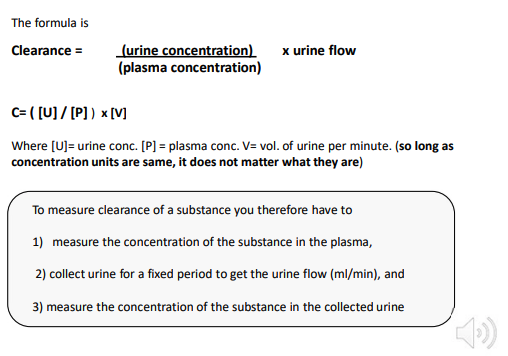
which substance do u measure GFR:
i) in specialised kidney research units
ii) clinical practice
i) specialised kidney research units
INULIN - BUT inulin does not occur naturally in plasma!
to measure inulin clearance you have to infuse inulin i.v. over a period of hours, to reach a steady plasma concentration
- *ii) clinical practise:**
- creatinine clearance is used to measure GFR
- freely filtered across the glom and neither reabsorbed nor metabolised
- creatinine clearance overestimates actual **GFR by 10-20%
- ** a 24 hour urine collection is undertaken, from empty-bladder one morning to the contents of the bladder the following morning, with a blood test for creatinine then taken
what happens to i) serum creatinine & ii) creatinine clearance when have:
- bilateral renal damage?
- one kidney damage?
bilateral renal damage:
- **serum creatinine goes up
- creatinine clearance goes down**
one kidney damage:
- serum creatinine & creatinine clearance stays normal


-
The Mediastinum27
-
CR Anatomy: Question Bank17
-
The Heart and Coronary Arteries34
-
Clinical Skills: CV1
-
The Conducting System of the Heart & ECG43
-
Anatomy: Practical 1 - Mediastinum43
-
Smooth and Cardiac Muscle32
-
CVS Histology48
-
Anatomy: Practical 2 - Thorax and the Lungs41
-
Heart as a Pump40
-
Haemodynamics35
-
Carriage of Oxygen in the Blood24
-
Review of the Sympathetic Nervous System34
-
Neural Control of Blood Pressure28
-
Renal Function 128
-
Renal Function 227
-
Blood volume & pressure control after Haemorrhage0
-
Microcirculation & Oedema35
-
Microanatomy - Histology of Hematopoietic System29
-
Peripheral Vasculature of the Limbs39
-
Drug Treatments for CVD24
-
Anatomy of the respiratory system27
-
Hormonal Control of BP32
-
Introduction to Respiratory System29
-
Anatomy of the upper airway41
-
Anatomy: Practical 2 - Thorax and the Lungs (Part 2)36
-
Pulmonary Circulation25
-
Chest X-rays28
-
Respiratory Physiology I17
-
Respiratory Physiology II25
-
:)51
-
Histology of Resp. System34
-
Pharmacology of the Airways14
-
Histology Qs7
-
Acid-Base Control of Respiration28
-
Gas Exchange and Lung Function Tests27
-
big boys29
-
::)53
-
:O50
-
:L54
-
:D13



