Skin/Burns Flashcards

Review the most important skin conditions and burns. (73 cards)

1
Q

What are petechiae and purpura?

A

Purple or red colored spots on the skin that occur when a small blood vessel bursts.

2
Q

What is ecchymosis?

A

Bruising of the skin.

3
Q

What is a spider angioma?

A

Small broken blood vessels on the surface of the skin.

They occur in the elderly and are not a concern. It also occurs with clients who have liver disease.

4
Q

What are Stevens-Johnson syndrome and Toxic epidermal necrolysis?

(Immediate complication)

A

Really bad adverse reactions of many meds that cause a severe rash all over the body.
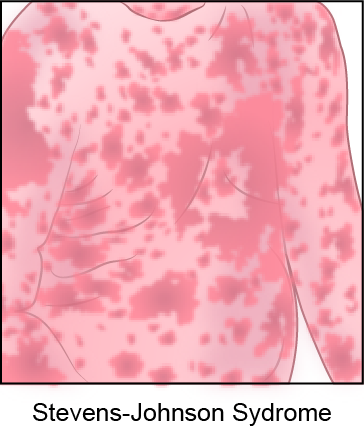
Always let the HCP know if you notice a rash, especially after the client starts a new med.

5
Q

What is the general teaching to prevent a skin disorder from getting worse?

A
  • not scratch the rash or damaged skin
  • keep nails short
  • not pick sores or lesions
  • wear loose clothing
6
Q

What is the client at risk for when there is an open wound or rash?

A

Infection, due to a break in the skin.

7
Q

How often are clients turned to prevent pressure ulcers?

A

At least every 2 hours.

8
Q

What is pruritus?

A

Itchy skin.

It is common for clients to receive diphenhydramine to decrease itching.

9
Q

What is serous wound drainage?

A

Clear or straw-colored.

It is a normal finding.

10
Q

What is purulent wound drainage?

A

Thick, yellow, green, brown or tan.

It indicates an infection.

11
Q

What is serosanguinous wound drainage?

A

Pale red and watery.

It is a normal finding after surgery or a recent skin injury that’s healing.

12
Q

What is sanguineous wound drainage?

A

Bright red.

It indicates active bleeding or may occur with wound cleaning.

13
Q

What are the 3 main layers of the skin?

A
  1. epidermis: top layer
  2. dermis: includes blood vessels, nerves, sweat glands
  3. hypodermis: subcutaneous fat
14
Q

What are the steps to getting a skin or wound culture?

A
  1. clean area first with normal saline going from close to the wound to away from the wound
  2. debride if needed
  3. use a sterile applicator or nasal swab to get a sample
  4. put in container
  5. send to lab
15
Q

When are antibiotics started: before or after collecting the culture?

A

AFTER the culture is collected.

16
Q

Describe:

Candida albicans

A

An infectious fungal disease of the skin.

It is also called a yeast infection, thrush, or oral candidiasis.

17
Q

Risk factors:

Candida albicans

A

Frequently due to a decreased immune system from:

  • chemotherapy
  • steroids
  • immunosuppressed
  • long term antibiotics
18
Q

On what areas of the body is candida albicans frequently found?

A

In warm, moist places where fungus likes to grow such as:

  • skin folds
  • mouth
  • vagina
  • under breasts
19
Q

Interventions:

Candida albicans

A
  • keep skin folds dry
  • antifungal such as fluconazole or nystatin powder or suspension
20
Q

Describe:

Cellulitis

A

An infection of the skin caused by Streptococcus or Staphylococcus. The area will be red and edematous.

The client is treated with antibiotics, and warm compresses.

21
Q

Interventions:

Cellulitis

A
  • private room due to possible cross-contamination
  • warm compresses
  • antibiotics
  • elevate extremity
22
Q

Describe:

Acne vulgaris

A

A chronic skin disorder that occurs more often in teenagers due to hormone changes.

23
Q

What are acne lesions called?

A
  • “zits”
  • blackheads (closed comedones)
  • whiteheads (open comedones)
24
Q

Medications:

Acne vulgaris

A
  • benzoyl peroxide or antibiotics may be prescribed
  • istretinoin for severe acne (highly toxic to fetus)
25
# Prevention and treatment: Acne vulgaris
* don't pick at face * gently wash the face using prescribed topical agents * wear sunscreen * keep hands off face
26
# Describe: Psoriasis
A chronic non-infectious inflammatory skin disorder that can lead to arthritis. ## Footnote The cause is not known.
27
# Risk Factors: Psoriasis
* stress * hormone imbalances * infections * skin trauma ## Footnote The cause is not known.
28
What do psoriasis **lesions** look like?
Silvery-white dry scales and redness. ## Footnote It normally affects the scalp, knees, elbows.
29
# Medications: Psoriasis
Focus on **decreasing the inflammation**. The most common meds and treatments are: * steroids/immunosuppresants * moisturizers * coal tar shampoo
30
# Describe: Eczema (atopic dermatitis)
An **allergic skin reaction that becomes inflamed, itchy, red and scaly**. ## Footnote The cause is unknown but there is a higher risk if other allergies are present such as asthma or allergic rhinitis.
31
# Teaching: Eczema
* use warm water to bathe, not hot water * avoid excessive bathing and washing of affected areas * avoid exposure to skin irritants such as soaps and detergents * use cool and wet compresses to soothe skin * keep nails short and clean * wear cotton gloves * use mild soap * apply unscented lotion at least twice a day
32
# Medications: Eczema
* topical steroids are applied to the rash * antihistamines for itching * antibiotics if a secondary infection occurs
33
Who is most at **risk** for skin cancer?
* older clients * light-skinned clients
34
How **often** should clients do a thorough skin cancer check?
Once a month.
35
What is a skin cancer **assessment**?
* **A:** asymmetry * **B:** border irregularity * **C:** color that is not uniform * **D:** diameter \> 1/4 inch (6mm) * **E:** evolving (changing) size, shape or color ## Footnote Notify HCP of these changes.
36
At what times during the day should a client **stay out of the sun**?
Between 10 a.m. and 4 p.m.
37
What **SPF factor** of sunscreen should be used?
At least **15 SPF** or higher. ## Footnote Apply 30 minutes before going outside.
38
# Describe: Melanoma
A highly metastatic skin cancer. ## Footnote It is typically a red, dark blue, black or even a white color.
39
# Describe: Basal cell carcinoma
A type of skin cancer that **rarely metastasizes.** ## Footnote It is described as having a "pearly papule, central crater and waxy border."
40
# Describe: Squamous cell carcinoma
A type of skin cancer that looks like a **firm, nodular lesion with a crust or central crater**. ## Footnote Larger tumors are associated with higher risk of metastasis.
41
How are skin cancers **diagnosed** and **treated**?
A **biopsy** is performed and then **surgery** to remove the tumor.
42
What is a **stage 1** pressure ulcer?
Skin is intact, red/erythema, non-blanching, warm and painful. ## Footnote Non-blanching means that when you press your finger on it, it stays red.
43
What is a **stage 2** pressure ulcer?
The first or second layer of skin has come off and it looks like a **shallow, pink wound or blister**.
44
What is a **stage 3** pressure ulcer?
There is full-thickness skin loss into the **dermis and subcutaneous tissue**.
45
What is a **stage 4** pressure ulcer?
There is **exposed bone, tendon or muscle**.
46
What is an **unstageable** pressure ulcer?
When the ulcer is **covered with slough or eschar.** * _Slough_ is **dead white blood cells** and skin debris. * _Eschar_ is **dead tissue and is black** in color.
47
On what **areas** are pressure ulcers more common?
On **bony and thin skin areas** such as: * back of head and ears * shoulder * elbows * hips * coccyx * heels
48
# Risk factors: Pressure ulcers
* moist skin * immobility * poor nutrition * skin being pulled on when moving up or down in bed - called "friction and shear"
49
How are pressure ulcers **prevented**?
* keep skin dry * don't massage bony areas - can cause capillary damage and necrosis * ​turn every 2 hours * apply skin lotion or cream * Keep HOB at 30 degrees or less
50
Why do burns have a high risk of **airway** problems? | (Immediate complication)
**Smoke inhalation**. ## Footnote Always assess airway first and give oxygen.
51
What is the best indicator of **fluid intake and output** in a burn client?
**Urine output**. ## Footnote It needs to be at least \>30 mL/hour for an adult.
52
What is the **Parkland formula**?
Used to calculate **how much fluids a burn client needs in 24 hours.** ## Footnote *Give Lactated Ringer's = **4 mL** X **kg** X **% of body burned*** *Example: 4 mL X 75 kg X 40% = 6000 mL*
53
How are the **fluids divided up** when calculating the 24-hour amount of fluids needed (using the Parkland formula)?
**Divide fluids up:** * give 1/2 of the amount in the first 8 hours * give the remaining amount in the next 16 hours ## Footnote Example: If 6000 mL is to be given total * give 3000 mL (375 mL/hr) for the first 8 hours * give 3000 mL more (or 187.5 mL/hr) for the next 16 hours
54
Why is there **↑ potassium** in a burn client?
The burn **destroys the cells** and the potassium is released into the vascular space increasing the amount in the blood.
55
Why is the **hematocrit ↑​** in a burn client?
There is **fluid loss**, causing the hematocrit to become **concentrated**.
56
What type of **room** does a burn client need to be placed in?
In a **private room** and placed on **protective isolation** (neutropenic precautions) to prevent them from getting an infection: * wear gown and gloves * sterile procedures
57
What type of injections should a burn client **_NOT_** get?
**Do not give IM or subcutaneous** injections in a burned client since the client will be unable to absorb the medicine.
58
How will the burn client receive **pain meds**?
Through **IV**.
59
What is the **room temperature** kept at for a burn client?
Keep the room **warm** since the client has heat loss due to skin loss.
60
What is the **"Rule of 9's"**?
Assesses the **percentage of the burned area** on a client.
61
What is a **stage 1** **burn**? ## Footnote It is also called a **superficial burn**.
When the **epidermis (first layer) is damaged**. ## Footnote It is red without blisters.
62
What is a **stage 2** **burn**? ## Footnote It is also called a **superficial partial-thickness burn.**
When the **epidermis and dermis are damaged**. ## Footnote There is edema with blisters that are yellow.
63
What is a **stage 3 burn**? ## Footnote It is also called a **deep partial-thickness burn.**
When **all the layers of the skin are damaged**. ## Footnote The area is stiff, red or white and dry.
64
What is a **stage 4 burn**? ## Footnote It is also called a **full-thickness burn.**
When the burn has gone through all the layers of the skin and **reached the muscle, tendon or bone**. ## Footnote It is a black color.
65
What **surgery** will be needed if the burn is not healing on its own?
Skin grafts.
66
How should the burned area be **positioned** in order for skin grafts to heal?
**Immobilize the area** to promote the adhering of the graft to the skin.
67
# Describe: Tinea corporis
A fungal infection on the skin. It is also known as ringworm.
68
# Medications: Tinea corporis
Antifungals ## Footnote Antifungals end in -azole.
69
# Describe: Herpes zoster (shingles)
A viral infection that causes a rash on the skin. In children it is known as chicken pox or varicella zoster.
70
What are the characteristic signs and symptoms of herpes zoster/shingles?
Painful and itchy rash along the nerves on back or face. The vesicles can be filled with fluid.
71
# Diagnostic test: Herpes zoster/shingles
* culture skin and send to lab or * direct fluorescent antibody test
72
# Interventions: Herpes zoster/shingles
* airborne and contact precautions * antiviral medications * prevent by getting vaccine starting at age 50
73
What are the 4 types of burns?
1. chemical 2. thermal 3. electrical 4. radiation