What is the importance of surface phenomena in pharmacy?
- Emulsion formation
- Dispersion of suspension
- Solubilisation
- Adsorption
- Penetration
For surface phenomena, define;
A) Interface
B) Interfacial phase
C) Surface/interfacial tension
A)
- the boundary between two immiscible phases. When one of the phases is gas or vapour, the term surface is often applied.
- E.g. L/L; L/S; L/V; S/V; S/S
B)
- It refers to molecules forming the interface. These molecules have different characteristics from those in the bulk.
C)
- the force per unit length acting parallel to the surface or interface so as to counterbalance the net inward attraction
- Expression: γL/V (dyne/cm or N/m); γL/L < γL/V if there is an interaction (eg H-bonding) between L/L.
What is the difference between surface and interfacial tension?
The main difference between these two is the places where it occurs.
Surface tension is defined to a single liquid surface, whereas the interfacial tension is defined to the interface of two immiscible liquids.
For the formation of surface or interfacial tension;
A) Describe the movement/attraction of molecules in the bulk of a liquid and the surface of the liquid
B) How are forces distributed in the surface of a liquid, what does this result in
C) Describe the meaning of higher free energy at the surface (surface free energy)
A)
- In the bulk of a liquid, molecules are subject to equal attraction in all directions
- At the surface or interface, molecules are subject to a net inward force of attraction
B)
- Unbalanced forces between molecules at surface mean they mover closer together –> contraction of surface
C)
- Molecules at surface have a higher free energy (Surface Free Energy)
- Work must be done to move a molecule from bulk to surface and increase the surface
Describe the principle of surface tension and surface free energy
Surface/interfacial tension: the force per unit length acting parallel to the surface or interface so as to counterbalance the net inward attraction
- Can also be defined as surface free energy change per unit area increase, directly related to the tendency of a liquid to decrease its surface area
- Minimum amount of work required to move the molecule from the bulk to the surface in order to expand the surface by unit of area
Surface free energy: the work required to increase the surface area, and is related to the surface tension
W = γ x ΔA –> γ = W/ΔA
> W: Surface Free Energy
> γ : Surface Tension
> ΔA: area increase
What are the two methods used to determine surface tension?
Surface tension = minimum amount of work required to move the molecule from the bulk to surface in order to expand surface by a unit of area
- Ring Method (using De Nouy tensiometer): measures the force to detach a platinum ring from a surface or an interface
F = 2 x ring circumference x γ x correction factor
F: detachment force
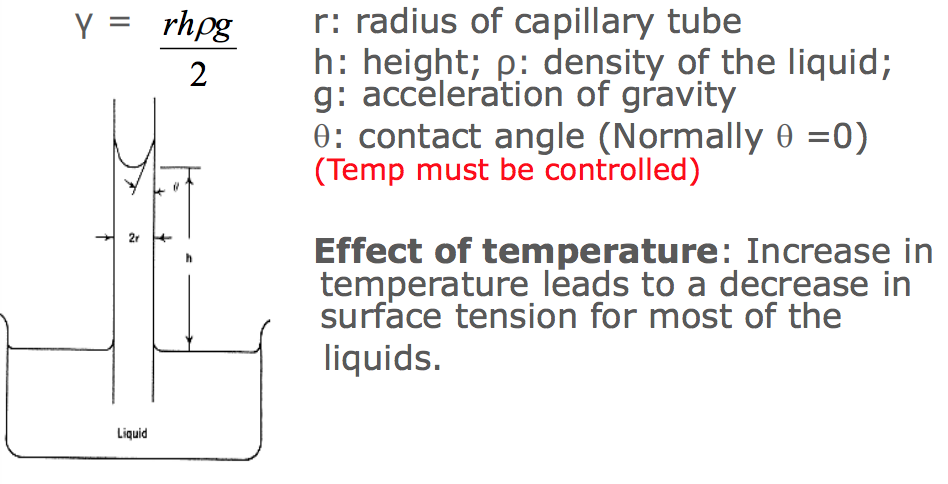
- Capillary rise methods (most accurate method): only for surface tension not interfacial tension
- Formula is in attached image
- Effect of temperture: Increase in temperature leads to decrease in surface tension for most liquid
- Capillary tube placed in liquid –> rises up the tube a certain distance –> measure the rise to determine surface tension of a liquid
Define adsoprtion, negative adsorption and adsorption
- Adsorption (surface effect): the accumulation of added molecules at interface or surface. It reduces surface free energy and surface tension.
- Negative adsorption: Added molecules migrate away from the surface to bulk - increase surface free energy and surface tension. (eg solution of sugars)
- Absorption: Penetration of one component throughout the body of a second. eg taking up water by a sponge
For adsoprtion in liquid/vapour and liquid/liquid systems;
A)What are monolayers
B) What are the types of monolayers
A)
An adsorption layer which is one molecule thick. They exist in different physical states: solid, liquid or gas.
B)
Soluble monolayer: Adsorbate (added molecule) is soluble in the liquid
Insoluble monolayers or films: Adsorbate is insoluble in the liquid but spreads on the surface of liquid to form a film
Give an example of a soluble monolayer, describe how they work
Surface-active agents (surfactants) are molecules or ions with affinity for both polar and non-polar solvents –amphiphilic - they contain both hydrophilic (polar) and lipophilic (non-polar) groups.
- These substaces will adsorb at interfaces –> orientate themselves to keep the lipophilic group away from the aqueuous environemnt to achieve a minimum free energy state
- For a surfactant to be adsorbed at interface, it must be balanced with proper amount of hydrophilic and lipophilic groups
- Their adsorption layer at the surface or interface is one molecule thick.
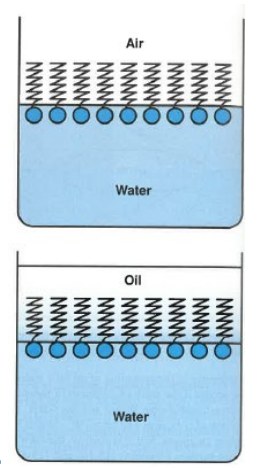
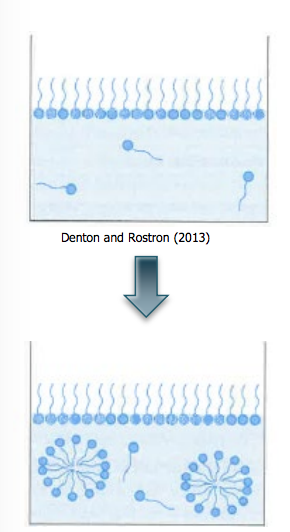
For the adsorption of soluble monolayers, describe why the following mechanisms occur;
A) Reduction of surface or interfacial tension
B) Micelle formation
A)
- Some of water molecules at the surface/interface are replaced by non-polar groups of surfactants and attraction forces between Water and nonpolar groups are less than those existing between two water molecules.
- This results in the reduction of surface or interfacial tension.
B)
- When the surface is saturated with surfactant molecules, additional surfactant molecules are forced into the bulk
- When the surface is saturated with surfactant molecules, additional surfactant molecules are forced into the bulk.
- To minimise free energy and protect lipophilic end from aqueous environment, the molecules cluster together to form micelles with lipophilic ends orientated to the inside of the micelle
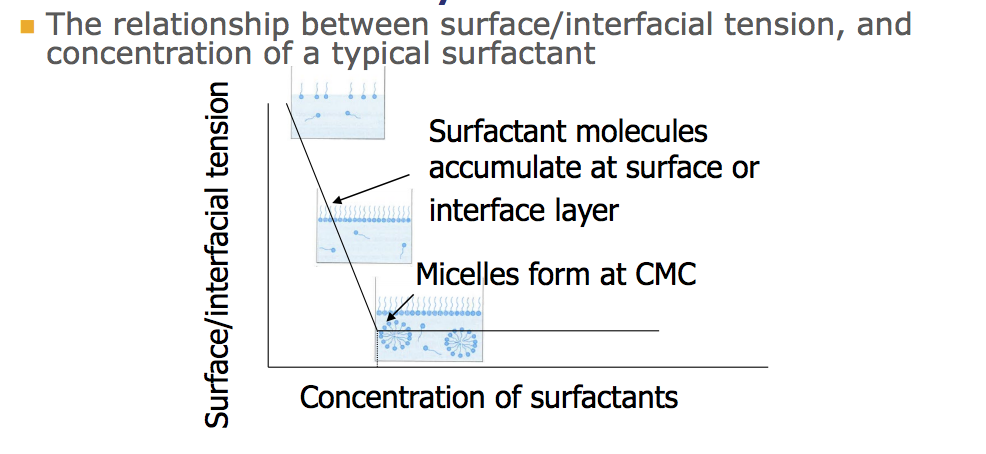
Describe the relationship between surface/interfacial tension, and concentration of a typical surfactant
Graph is in attached image
- Molecules in the monolayer are in equilibrium with those in the bulk
- Once the surface layer becomes saturated with surfactants, further increase in surfactant concentration will no longer change the surface tension.
- Surfactant molecules form micelles as an alternative way to shield non-polar groups in aqueous solution.
CMC = critical micelle concentration (conc of surfactant in a bulk phase, above or at which micelles form)
What is the surface concentration/surface excess? Provide the formula
- Surface excess or surface concentration Γ : it is the amount of surfactant per unit area of surface in excess of that in the bulk of the liquid
Before CMC is reached, surfactant molecules are closely packed at the surface, which allows the calculation of the surface area occupied by each molecule( A)
Provide the equation for A and some aplications of A
A=1/(NAΓ)
NA: Avogadro’s number (6x10²³)
Γ: surface excess
Application of A
- emulsion stability
- efficiency of wetting
- dimensions of molecules
What two classes of insoluble substances will form a stable monolayer? How are they formed?
- insoluble amphiphiles such as fatty acids
- polymeric materials such as proteins and synthetic polymers
Formation: Dissolve the substance in a suitable volatile solvent and carefully inject the solution on to the surface to form a film one molecule thick
> All the film-forming molecules remain on the surface and they are not in equilibrium with the bulk, hence, A (area occupied by each molecule) can be determined directly
How does the Lagumir Trough System work?
- Used for monolayer studies
- Shallow Teflon-coated trough with a movable barrier at the top of the trough. Filled with liquid and the surface impurities are swept off using the barrier. Tiny amount of film-forming material is injected onto surface.
- The movable barrier is squeezed towards to the floating barrier and the surface pressure (π) can be measured. It equates to the difference in surface tension between the pure liquid and the coated liquid.
What is the lagumir trough system used for
- studying the size and shape of molecules adsorbed at the surfaces
- revealing the physical state of the monolayer (eg solid, liquid or gaseous film)
- measuring the strength of the film
Draw the surface pressure vs area graphs for the three main types of monolayers
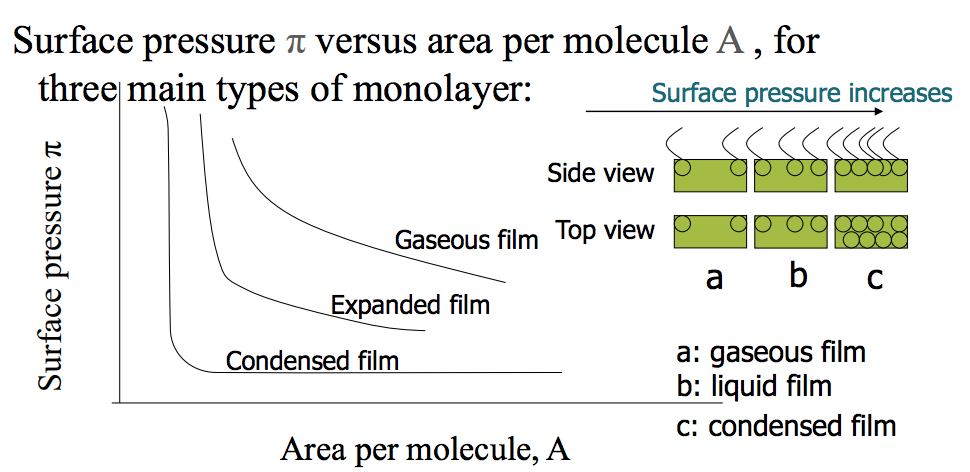
Monolayers are 2-D systems that can be classified in a similar way to 3-D solids, liquids and gases
3 mian types of monolayer: gaseous film, expanded film, condensed film
GRAPH IS ATTACHED
- Some molecules show transitions between one state and another as the film is cpompressed
- E.g β-oestradiol: lying along the surface – gaseous film; and change to stand upright - condensed film formed
Calculate the area per molecule in a insoluble monolayer of the example below;
Stearic acid Mw = 284.3
C = 8.5mg/100cm3
When 1 cm3 of the above solution is dissolved in a volatile solvent and placed on the surface of water in a Langmuir trough. After removing the solvent, an insoluble monomolecular film is formed. If the surface area occupied by the film is 400 cm2, calculate the area occupied by each molecule of stearic acid in the film.
- 1 cm3 of the solutions contains:
> 8.5 * 10-5 g (convert mg to g and divide by 100) / 284.3 = 2.99 * 10-7 mol
- 1 mol contains 6 * 1023 (Avogrado constant) molecules, 1 cm3 of the solution contains:
> 2.99x10-7 x 6 x 1023=1.79x10¹⁷ molecules.
- Therefore, the area per molecule, A, of stearic acid in the film is
- A = area / number of molecules
> 400 * 10-4 / 1.79 * 1017 = 2.23 * 10-19 m2 = 0.22 nm^2 = 22Å2
- Condensed film is formed
- Gaseous = A > 50 Å2
- Liquid film = 30-50 Å2
- Condensed film = A < 30 Å2
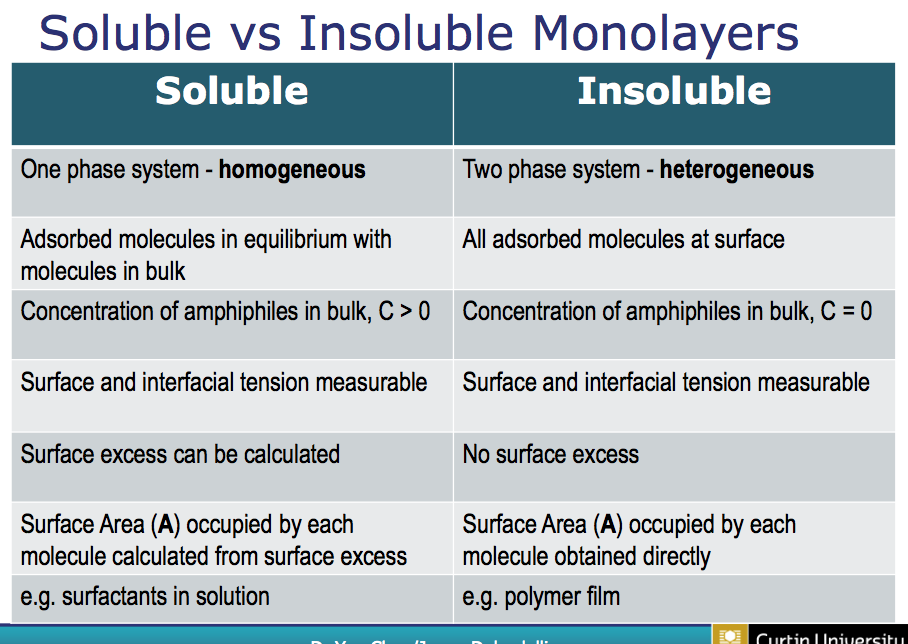
What are the differences between soluble and insoluble monolayers?
See attached image
What are some pharmecutical applications of monolayer and film studies
Study of polymers as packaging materials
- Adsorption of constituents by polymers from drug product.
- Permeability of polymer and the effect of incorporation of plasticiser
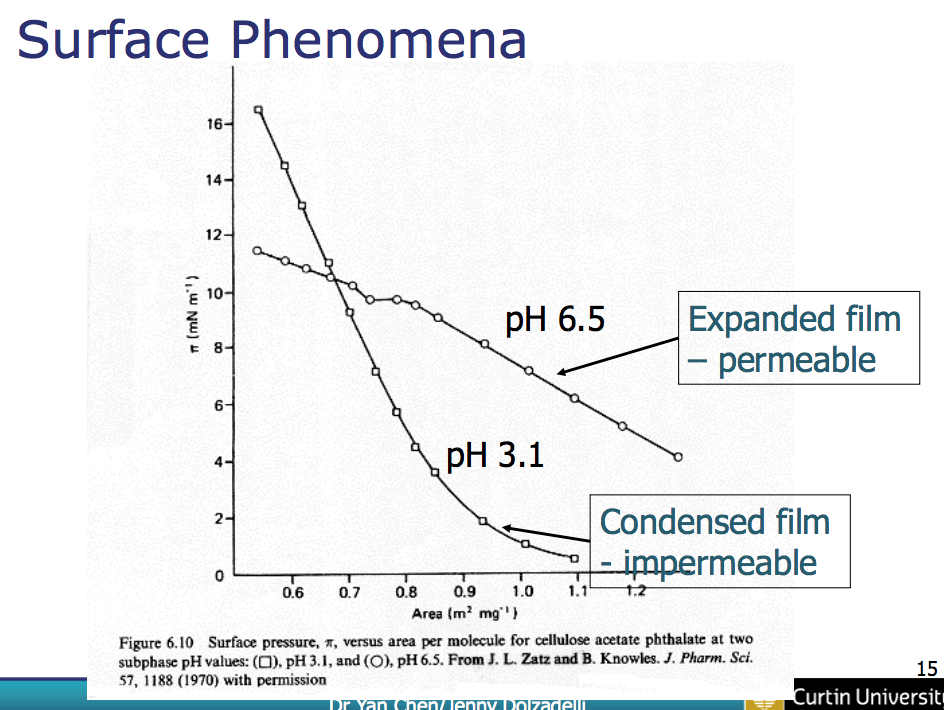
Study of suitability of polymers as enteric and film coatings for solid dosage forms
- CAB & CAS at pH3 & pH6 forms condensed film
- CAP tight film at pH3 and expanded film at pH 6
- CAB = cellulose acetate butyrate; CAP = cellulose acetate phthalate
- CAS = cellulose acetate stearate
What are the types of adsorption that occurs at the solid/liquid interface?
- Physical adsorption: weak Van der Waals’ forces
- Chemical adsorption (chemoisorption): strong valence forces such as ionic interaction
- Physical + chemical adsorption: eg adsorption of toxins by activated charcoal or attapulgite and kaolin
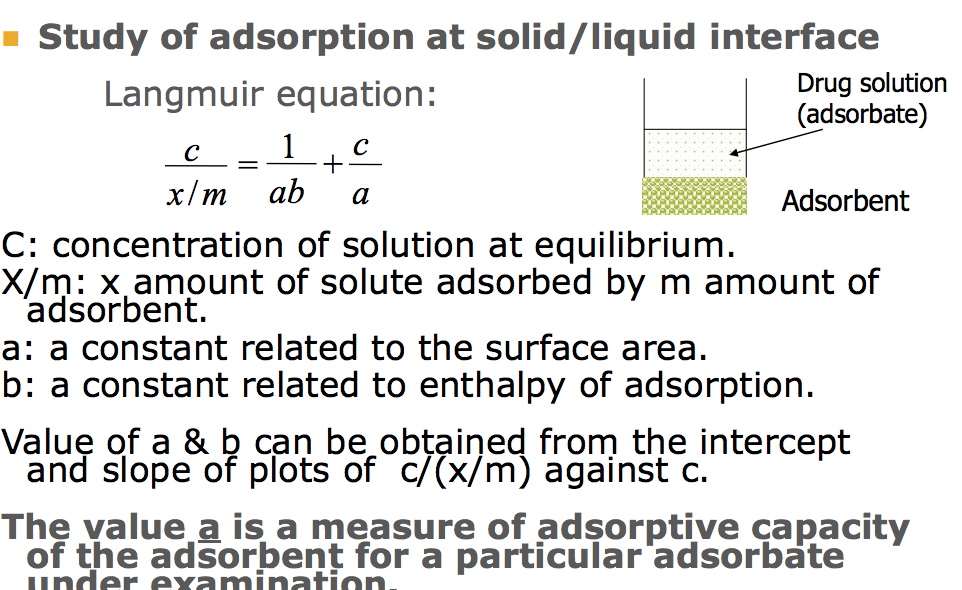
Provide the equation of the study of adsoprtion at solid/liquid interface
What are some factors affecting adsorption at solid/liquid interface?
- Solubility of adsorbate (effect is stronger than ionisation)
> Adsoprtion α 1/solubility
- Effect of pH on adsorbate
>Ionization : Adsorption is max when drug is completely unionized. > Amphoteric compound: a net charge zero –> maximum adsorption.
- Nature of adsorbent
> Most important property: Surface area
- Temperature
> Adsorption is generally an exothermic process
What are some pharmaceutical applications of adsorption?
- Separation ( eg HPLC, TLC analysis)
- Purification (water or protein purification)
- Removal of noxious substance (use of activated charcoal) –> SA important factor for its effectiveness
- Formulation of drug delivery systems
- Bioadhesive dosage form: wound healing, skin burn
- Adsorption of hydrophilic polymer at o/w interface- emulsifier

-
Ointments and Pastes part 19
-
Ointments and Pastes part 216
-
Ointment and Pastes Part 38
-
Self Assessment Questions for ointments7
-
Surface Phenomena part 1 + 226
-
Surface Phenomena part 318
-
Self Assessment questions for Surface Phenomena37
-
Surface Phenomena part 421
-
Colloids 116
-
Colloids 29
-
Self Assessment Questions for Colloids11



