Where does the Tricarboxylic Acid (TCA) Cycle occur?
In the mitochondrial matrix
The TCA cycle is a part of
Cellular respiration (aerobic process)
The TCA consists of a series of ______ reactions that results in ________ to ___________
REDOX, oxidation of acetyl-CoA, 2 molecules of CO2
4C (OA) + 2C (acetyl) –>
6C (citrate)
Isomer of citrate is “oxidatively decarboxylated” to give
5C compound (alpha-Ketoglutarate)
5C compound (alpha-Ketoglutarate) –>
4C (succinate) via oxidative decarboxylation
OA is regenerated from
succinate (the cycle repeats)
Label
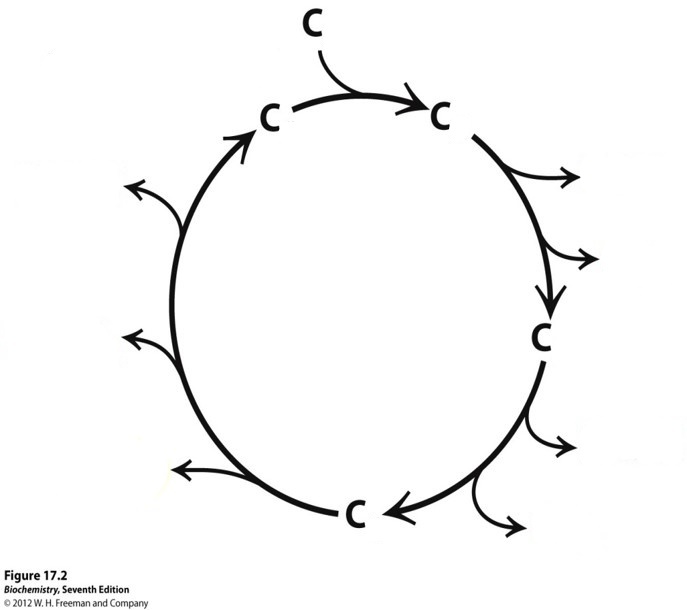
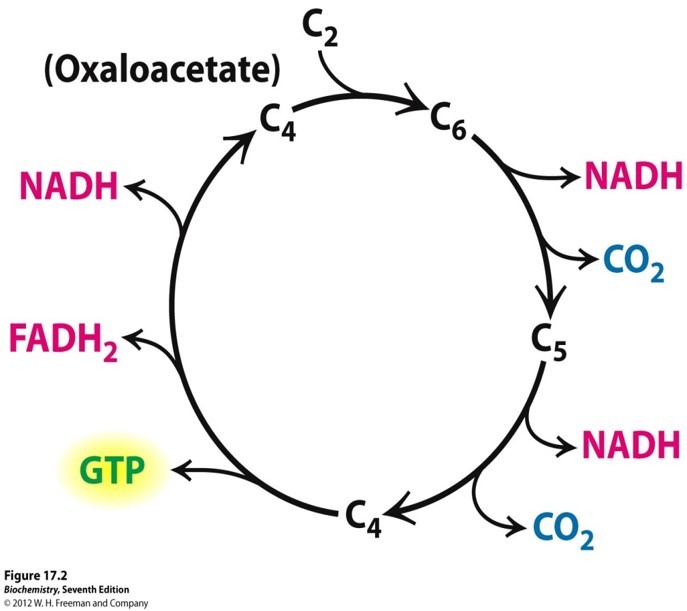
Properties of the TCA cycle:
- Aerobic
- Source of biosynthetic precursors
- Its activity depend of tissue type: Most active in brain, heart, kidney cortex, and liver
- Subcellular location: Enzymes within mitochondrial matrix except succinate dehydrogenase, which is located on the mitochondrial inner membrane.
- Compartmentalization - Inner mitochondrial membrane is impermeable to NADH, Acetyl CoA, Oxaloacetate; separate mitochondrial & cytosolic pools of each.
Enzymes of the TCA Cycle
- Citrate synthase
- Aconitase
- Isocitrate dehydrogenase
- Alpha-ketoglutarate dehydrogenase complex
- Succinyl-CoA synthetase
- Succinate dehydrogenase
- Fumarase
- Malate dehydrogenase
Pyruvate Dehydrogenase Complex (in mitochondrial matrix; not part of TCA cycle) consists of :
E1, pyruvate dehydrogenase (decarboxylation, TPP)
E2, dihydrolipoyl transacetylase (lipoamide, CoA)
E3, dihydrolipoyl dehydrogenase (FAD, NAD+)
Other components (regulatory): PDH kinase, protein phosphatase
Last 3 steps that constitute a common “metabolic motif”
Oxidation→hydration→oxidation
TCA Cycle is regulated:
- By energy charge: ATP, ADP
- By end product of the cycle: mitochondrial NADH
- At irreversible steps
Irreversible steps cataylized by
–citrate synthase
–isocitrate dehydrogenase (major)
–alpha-ketoglutarate dehydrogenase
Citrate synthase is allosterically regulated by
–NADH, succinyl-CoA, citrate, and ATP (inhibitors)
–ADP (activator)
Isocitrate dehydrogenase is allosterically regulated by
–ATP (inhibitor); calcium and ADP (activators)
Alpha-ketoglutarate dehydrogenase is regulated by
Succinyl-CoA and NADH (inhibitors) and calcium (activator)
Pyruvate Dehydrogenase is allosterically inhibited by:
- _________
- _________
- _________
and allosterically activated by:
- _________
- _________
- _________
Allosterically inhibited by:
- ATP
- Acetyl CoA
- NADH
Allosterically activated by:
- AMP
- CoASH
- NAD+
________ and ________stimulate PDH by promoting DEphosphorylation
Ca++, insulin
Pyruvate dehydrogenase (PDH) inhibited by reversible phosphorylation of __________:
- PDH kinase: allosterically activated by ________
- ______________
- serine residue on E1
- PHD kinases: allosterically activated by ATP
- Protein phosphatase
Intermediates are replenished through
anaplerosis
Anaplerotic enzymes:
- pyruvate carboxlase (major)
- PEPCK
- Malic enzyme
- PEP carboxylase (plants, bacteria)
A mutant form of IDH is present in ____________.
some cancers

-
Lecture 2: Acid/Bases28
-
Proteins I25
-
Proteins II33
-
Proteins III31
-
Proteins IV16
-
Hemoglobin22
-
Blood Coagulation49
-
Enzymes72
-
Biochemisty of Drugs as Enzyme Inactivators58
-
Lecture 1: Bioenergetics39
-
Glycolysis24
-
TCA Cycle24
-
The Electron Transport Chain, ATP Synthesis, and Mitochondrial Shuttles55
-
Gluconeogenesis49
-
Glycogen Metabolism75
-
Lipids60
-
Fatty Acid Catabolism88
-
Lipid Biosynthesis81
-
Lipids - Clinical Applications53
-
Peripheral Nerve29
-
Muscle Histology15
-
Abdominal Cavity12
-
Embryology29
-
Lipid Malabsorption Clinical Concepts56
-
Purine and Pyrimidine Synthesis39
-
Purine and Pyrimidine Breakdown and Heme52
-
Nitrogen Balance, Urea Cycle, and Amino Acid Metabolism19
-
Amino Acid Metabolism and associated diseases20
-
Nucleic Acid Structures81
-
Gene Expression and Regulation41
-
Protein Synthesis7
-
Molecular Medicine8
-
Overview of Cells and Structure29
-
Cytoskeleton44
-
Intro to Histology48
-
Membrane Structure and Function76
-
Mitochondria41
-
Nucleus40
-
Connective Tissue55
-
Cell Adhesion38
-
Biosynthesis and Cell Membranes30
-
Blood75
-
Lymphoid Organs25
-
Basic Components of the Immune System35
-
CD antigens14
-
Introduction to Viruses25
-
Somatosensory Receptor Physiology29
-
Physiology of Somatosensation24



