You are called to see a two year old colt that has been found showing signs of mild colic. The owner also reports that it appears to be dribbling saliva from its mouth.
What other information you would like from the owner?
- any previous hx of colic?
- any changes in diet recently?
- is he eating?
- any changes in routine recently?
- what is he fed/ how often?
- how long has this been going on?
- when were his teeth last checked?
- quantity of saliva?
- has it got any worse?
- are any other horses showing CS?
- any other CS
- when did he last eat/ drink?
- when did he last pass faeces?
- What signs of colic has it been displaying e.g. kicking at flank etc
- Any recent other medical history?
- How long has it been going on for?
- Does it live outside/inside?
- Has it travelled abroad recently?
- What other animals is it in contact with?
- when did he last defecate
- description
- anthelmintic hx
- has he got any. stereotypies (eg crib biting)
- when was he last seen to be normal
- any pain relief given yet
- new pasture?
Your clinical examination demonstrates the horse is dull and poorly responsive to stimuli. The heart rate is 84 beats per minute. There are no overt signs of abdominal discomfort. There is evidence of patchy sweating and muscle fasciculation. Mucous membranes are pale with a capillary refill time of <3 seconds. Rectal temperature is 38.6°C. There are no audible gut sounds. Per-rectum palpation yields dry faecal balls, with very firm ingesta palpable within the ventral colon. A nasogastric tube is passed with difficulty but yields 14 litres of reflux.
Write a problem list for the case?
- dull and poorly responsive to stimuli
- tachycardic
- patchy sweating
- muscle fasciculations
- CRT – unknown
- no gut sounds
- dry faecal balls and firm ingestion in ventral colon
- Signifies dehydrated matter, resultant from a small intestinal issue > SI obstruction (anything aboral > dry) as nothing to push faeces alone – colon absorbs all the water.
- (practical: firm faeces in anywhere beyond SI > indicates impaction in SI).
- lots of fluid in NG reflux (>2-5L is significant) – refer!
Your clinical examination demonstrates the horse dull and poorly responsive to stimuli. The heart rate is 84 beats per minute (tachycardia). There are no overt signs of abdominal discomfort. There is evidence of patchy sweating and muscle fasciculation. Mucous membranes are pale with a capillary refill time of <3 seconds. Rectal temperature is 38.6°C (slightly high). There are no audible gut sounds (BAD). Per-rectum palpation yields dry faecal balls, with very firm ingesta palpable within the ventral colon. A nasogastric tube is passed with difficulty but yields 14 litres of reflux.
Make a list of likely differential diagnoses?
- Proximal enteritis = large quantities of fluid
Strangulating lesions of the SI
- Pedunculate lipoma
- Hernia (less likely with age)
- Epipoic foramen entrapment
Impaction colic – non strangulating
- Idiopathic eosinophilic enteritis
Nephrosplenic entrapment
Spasmolytic colic
Equine grass sickness
Neoplasia – SI lymphoma
Colic related to parasite burden
- Non-abdominal causes of colic
- neurological disease (equine motor neurone disease, equine protozoal meningiencephalitis)
- Dental disease > maldigestion.
- Ileus
- Displacements
- Strangulations and torsion
- Impaction
- Idiopathic
- Spasmodic.
- Neoplasia
- Lymphosarcoma
- Adenocarcinoma
- Lipoma
- Leimioma
- FB, peritonitis
- Rare: lead toxicity, botiulism, tetanus.
Your clinical examination demonstrates the horse dull and poorly responsive to stimuli. The heart rate is 84 beats per minute (tachycardia). There are no overt signs of abdominal discomfort. There is evidence of patchy sweating and muscle fasciculation. Mucous membranes are pale with a capillary refill time of <3 seconds. Rectal temperature is 38.6°C (slightly high). There are no audible gut sounds (BAD). Per-rectum palpation yields dry faecal balls, with very firm ingesta palpable within the ventral colon. A nasogastric tube is passed with difficulty but yields 14 litres of reflux.
What is the most likely condition that this horse is likely to be suffering from? Why?
Grass sickness as there is salivation, muscle fasiculations and sweating. 2 year. At pasture.
EGS with a secondary impaction colic
Your clinical examination demonstrates the horse dull and poorly responsive to stimuli. The heart rate is 84 beats per minute (tachycardia). There are no overt signs of abdominal discomfort. There is evidence of patchy sweating and muscle fasciculation. Mucous membranes are pale with a capillary refill time of <3 seconds. Rectal temperature is 38.6°C (slightly high). There are no audible gut sounds (BAD). Per-rectum palpation yields dry faecal balls, with very firm ingesta palpable within the ventral colon. A nasogastric tube is passed with difficulty but yields 14 litres of reflux.
What should you do next?
Ileal biopsy via colonoscopy
Phenylephrine test
Rectal exam
Peritoneal tap
U/S
Bloods
Medical management – antispasmodic and meloxicam
Eyelash angle?? 22 degrees – positive result. 75% sensitivity and specificity
Urinalysis – some people think it could be of use but probably isn’t. Some show they might have concentrated urine (but mot colic horse will)
Barium swallow – but not easy in a horse especially when drooling etc. Risk of aspiration
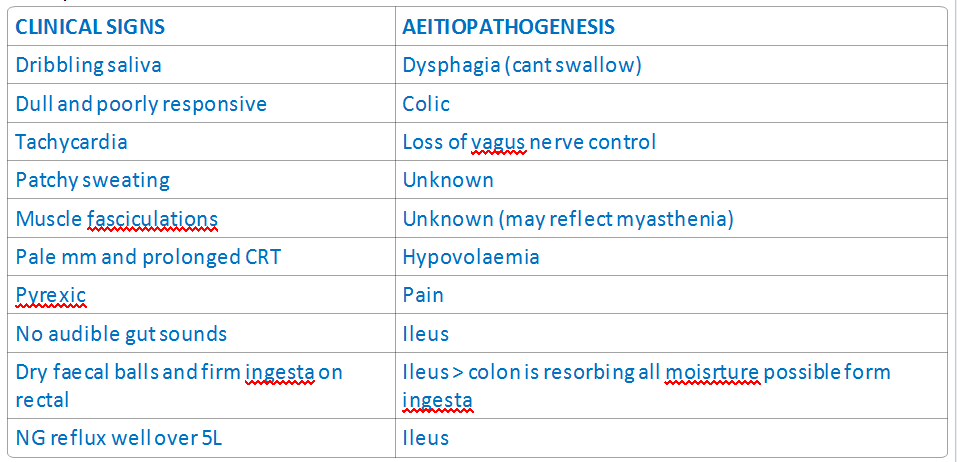
How do the clinical signs exhibited by this horse fit with the aetiopathogenesis of this disease?
- Dysautonomia = dysphagia = ileus = secondary impaction
- Dribbling an ptosis – lack of parasympathetic
- The true aetiology of grass sickness is unknown
- Tachycardia – pain (although probably enough to cause this), hypovolaemia, vagal nerve lack of function (controls the HR).
- Secondary impaction and dry faecal balls – neuro function slowing, fluid in the stomach not going any further = dehydration.
- Difficulty passing stomach tube –Don’t swallow properly, The tube goes up the nose first where there is rhinitis sicca (blocked up and dry).
Compile a comprehensive list of other clinical signs which might also be seen.
- Dull
Poorly responsive
Tachycardia
Patchy sweating
Muscle fasciculation
Pale MM
Long CRT
Pyrexia
No audible gut sounds – borborygmi
Dry faecal balls
Firm ingesta in ventral colon
14 litres of reflux via NG tube- difficulty passing the tube
- Anorexia
- Dehydration
- Ptosis
- Tucked up abdomen
- Reduced water consumption – dip the lips in the water but wont drink
- Rhinitis sicca showing up as crusty nose and snuffles
- Even greater tachycardia
- Spontaneous reflux
- Abdominal distension
- Oesophageal ulcers
- Narrow based stance – elephant on a ball
- Subacute = weight loss
- Paraphimosis in entire male
- If he passed any faeces – often very mucousy or dry
How would a definitive diagnosis be achieved?
- Ileal biopsy – can be done flank laparotomy or GI midline
- Joint of ileum and jejunum – consistent
- Histopathology – cranial cervical ganglia
- If there are no findings for clinical presentation ie (no serosal petechial of the primal intestine (as seen with proximal enteritis). Strangulating lesion – obvious. Look for incoordinated or absent peristalsis = EGS.
- May have to euthise on the table if you cant find anything and lean towards EGS.Under BEVA guidelines for humane destruction
- PM – microscope – cranial mesenteric and cranial cervical ganglia; vacuolation and chromatolysis, degenerative change. + a circumference of the ileum
What would your advice to the owner be in this situation for both this horse and the others that she owns?
Which bacteria is it linked to?
When will EGS be seen after exposure?
- Maintain good condtion – not overweight
- Use other stock e.g. sheep on high risk pasture
- Void diet change in high risk spring period
- Avoid sand or nitrogen soil
- Avoid overuse anthelmintic - worm burden may help neutralise toxin
- Pasture linked to Botulinum type C
- Avoid pastures known to be affected
- Avoid moving affected horses – change in management – risk
- Unusual or several to be affected in a field
- 7-10 days after a change of pasture EGs is seen
- Others don’t need to be too concerned – not contagious. Although a lin with soil type? Temporal and special clusters. Any change of pasture should be avoided for at risk animals within 10km for 2 weeks.
How do the clinical signs exhibited by this horse fit with the aetiopathogenesis of this disease?
How would a definitive diagnosis be achieved?
Ileal biopsy (or further biopsies on PM)
What would your advice to the owner be in this situation for both this horse and the others that she owns?
- euthanasia
- don’t put your other horses on the pasture where disease has been seen previously
- co-graze with ruminants
- manually poo pick (harrowing: bacteria live in the soil > churn up the bacteria and bring them to the surface > easier to be ingested, also spreads poo around the pasture).
- don’t cut grass to short > increases soil consumption
- supplement with forage
- Catch 22: want to move the horses off the field but don’t want to cause stress (both are risk factors for disease)see what age the animals are > (3-6 = most at risk. They are 2 yearlings and a 17 yo broodmare.
- move yearlings to a new pasture next year
- increase forage to avoid soil ingestion.
Risk factors for equine grass sickness?
- Continued grazing
- Grazing in areas where the disease has been seen before
- Dry cold weather
- Young animals
- Recent change in pasture
- Overuse of ivermectin’s > no competitive exclusion for C. Botulinum.
- Season
- April to June

-
Equine URT Disease Cases CR3
-
Equine upper respiratory tract surgery66
-
Nasal Discharge/Sinusitis65
-
Sinus Disease and Epistaxis56
-
Equine Viral Respiratory Disease40
-
AB selection for respiratory disease37
-
Approach to sampling32
-
Equine Lung Disease25
-
EIPH60
-
URT Disease16
-
Equine Asthma39
-
Cardiac assessment in equid28
-
Equine Cardiac Murmurs52
-
Pericardial and Vascular Disease52
-
LA Dysrhythmia43
-
Equine Poor Performance and Cardiac Disease14
-
Cardiac Histopathology22
-
Nasal Sinus Drainage and endoscopy PRACTICAL12
-
Airway sampling PRACTICAL7
-
Equine URT Radiography17
-
Clinical relevance EquineEthmoid haematoma9
-
EMS36
-
PPID35
-
Laminitis24
-
Hyperlipaemia30
-
Equine endocrine case decision10
-
Obese Equid8
-
Equine dermatology 148
-
Equine dermatology 228
-
Equine derm cases5
-
Practical: Equine GI anatomy16
-
Colic Case13
-
Equine Dentistry90
-
Microbiology Of Enteritis61
-
Equine dysautonomia8
-
Equine Colic Cases28
-
Colic - Causes and Clinical Signs41
-
Colic - Medical Management22
-
Colic - LI52
-
Gastric Disease in Horses50
-
Lipomas and SI surgical colic44
-
Diarrhoea in Horses66
-
Weight Loss in Horses48
-
Diseases Associated with Disorders of Fat Metabolism16
-
Liver Disease In The Horse77
-
Clinical Manifestations of Equine Parasites57
-
GI Disease in Foals68
-
Steeplechase...?16
-
Critically Ill Horse with GI Disease52
-
The critically ill horse with GI disease EXTRA12
-
Colic case planning28
-
Equine distal limb18
-
Nerve blocks11
-
LA bandaging6
-
Foot and Farriery46
-
Ultrasonography Of The Equine Distal Limb93
-
Local Anaesthesia Techniques47
-
Synoviocentesis7
-
Soft Tissue Trauma65
-
Equine Examination46
-
Soft Tissue Injuries43
-
Equine Back14
-
Equine Forelimb95
-
Equine Hind limb53
-
Equine Foot Radiography13
-
Equine Foot64
-
Equine Foot Cases8
-
LA Muscle Disease75
-
Radiography and Radiology47
-
Developmental Orthopaedic Disease 260
-
DOD 155
-
Equine Bone Healing45
-
Equine Tendon Healing46
-
Vascular Disease35
-
Neurology Infectious Diseases84
-
Equine Neurology116
-
Equine Opthalmology110
-
Corneal Ulcers58
-
Notifiable Neuro Viruses26
-
Large Animal Ophthalmology21
-
Eye and Disease30
-
Ocular Pharmacology81
-
Approach To The Sick Equine Neonate39
-
Caslick/Endometrial biopsy (practical)17
-
Mare Breeding Soundness Exam8
-
Diagnostic Methods and Cycle Manipulation in the Mare64
-
Parturition, Dystocia, Post-Partum Events and Reproductive Surgery53
-
Pregnancy Diagnosis in the Mare27
-
Endometritis in the mare53
-
Approach to scrotal swelling12
-
Pregnancy Loss Causes and Consequences50
-
Reproductive Problems in the Mare46
-
Clinical Equine Reproduction - Care of Sick Neonate36
-
Optimal Breeding Time in The Mare24
-
Common first opinion reproductive cases in equine practice22
-
Diagnostic methods in the stallion50
-
Common diseases and surgery of the stallion/gelding54
-
Complications of equine castration36
-
Anaesthesia for Colt Castration32
-
Rectal Tears30
-
Equine Urinary Disease64
-
Equine Urinary Tract9



