Define Endocrinopathic Laminitis?
Laminitis from hormonal influences rather than pro-inflammatory or intestinal conditions
What are the two main risk factors for endocrinopathic laminitis?
1. Glucocorticoid associated
- Iatrogenic corticosteroids administration (incase horse on long courses of corticosteroids that can cause laminitis)
- PPID
2. Insulin resistance associated
- EMS
Discuss Glucocorticoid-associated laminitis?
Maybe attributed to corticosteroid induced IR
IATROGENIC
Triamcinolone (used for treatment of inflam condition orthopaedic system)
- Hyperglycaemia for 3-6 days after 1 dose
Dexamethasone (3 weeks at 0.08mg/kg EOD)
- Increase 10x basal insulin and IR
Relationship between corticosteroids and laminitis is historical and difficult to conclusively demonstrate
PPID
Induces hyperadrenocorticism
Increased cortisol production resulting in IR
Horses with very high insulin are more likely to develop laminitis and survive <2 years than those with moderate elevations or normal insulin
What factors trigger endocrinopathic laminits?
Insulin
Endotoxaemia
What factors predispose to endocrinopathic laminitis?
Obesity
Breed
Insulin dysregulation
PPID
What factors exacerbate endocrinopathic laminitis?
Progression of obesity
Diet rich in starches and sugars
Progression of PPID
What is the evidence of the role of hyperinsulinaemia in endocrinopathic laminitis?
Hyperinsulinaemia raises the risk of pasture-associated laminitis in ponies
Laminitis has been experimentally induced by infusing insulin intravenously (hyperinsulinaemia)
Discuss what the consequences of hyperinsulinaemia are on vasodilation?
Increases perfusion to the lamellar tissue
Increase glucose delivery to hoof tissues
- Glucotoxicity
Advanced glycation end products
Important role in diabetic angiopathy in humans
Might affect lamellar blood vessels and result in laminitis
How does insulin effect vascular dynamics?
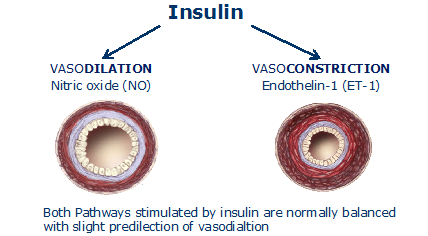
How are vascular dynamics effected by hyperinsulinaemia?
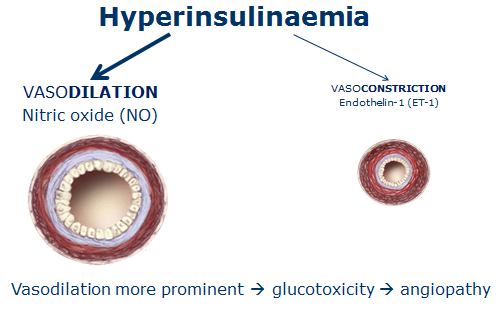
What happens to vascular dynamics with insulin resistance?
Slow vasodilation occurs in response to insulin through increased synthesis of nitric oxide (NO) by endothelial cells (Muniyappa et al. 2007). However, insulin also promotes vasoconstriction by stimulating endothelin-1 (ET-1) synthesis and activating the sympathetic nervous system. Under normal conditions, the opposing actions of NO (vasodilation) and ET-1 (vasoconstriction) are in balance because both arms of the insulin signalling cascade are active; activation of the insulin receptor therefore stimulates 2 different signalling pathways within the vascular endothelial cell. Nitric oxide is secreted when the phosphatidylinositol 3-kinase (PI3K) pathway is activated, whereas activation of the mitogen-activated protein kinase (MAPK) pathway leads to release of ET-1 (Muniyappa et al. 2008). Both the vasodilatory effects of insulin and insulin-dependent stimulation of glucose uptake are mediated by PI3K and this pathway becomes disrupted when IR develops. Consequently, vasoconstriction is promoted in insulin resistant animals because only the MAPK pathway remains fully functional
Also low adiponectin is associated with IR mediated inhibition of vasodilation
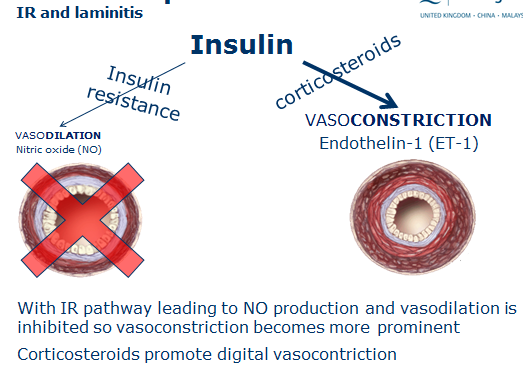
What does Adiponectin do?
regulates glucose metabolism and fatty acid oxidation and activity decreases with IR
What do the inflammatory mediaters released from adipose tissue do?
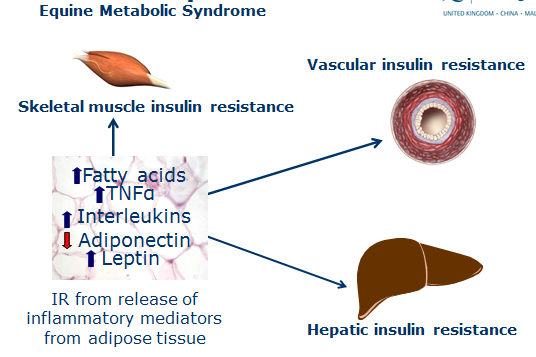
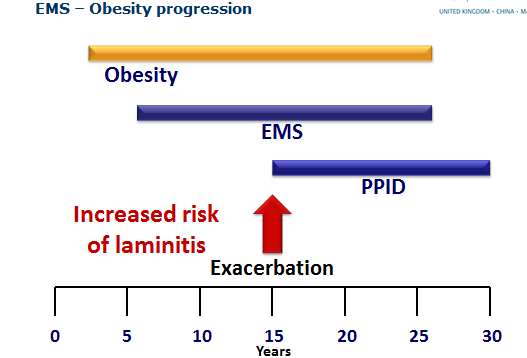
Describe the progression of obesity to hyperinsulinamia and endocrinopathic laminitis?
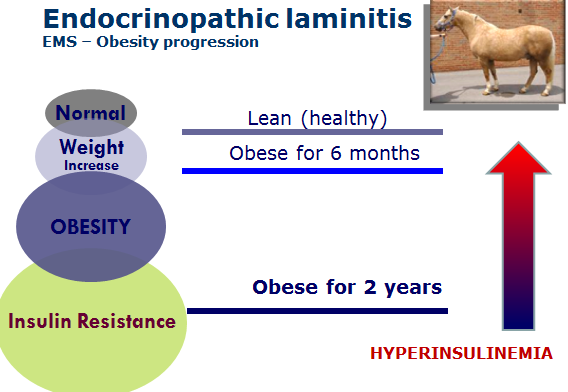
Describe obesity EMS progression?
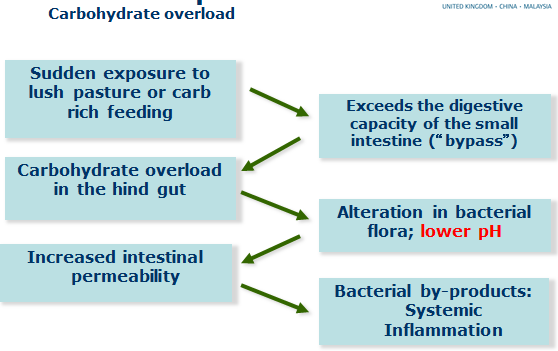
How does carbohydrate overload exacerbate endocrinopathic laminitis?
- Excessive, sudden carbohydrate consumption triggers a systemic inflammatory response
- Elevated plasma endotoxin concentrations in 85% of horses after carbohydrate overload to induce laminitis
- SIRS detected in horses after oligofructose administered to induce laminitis
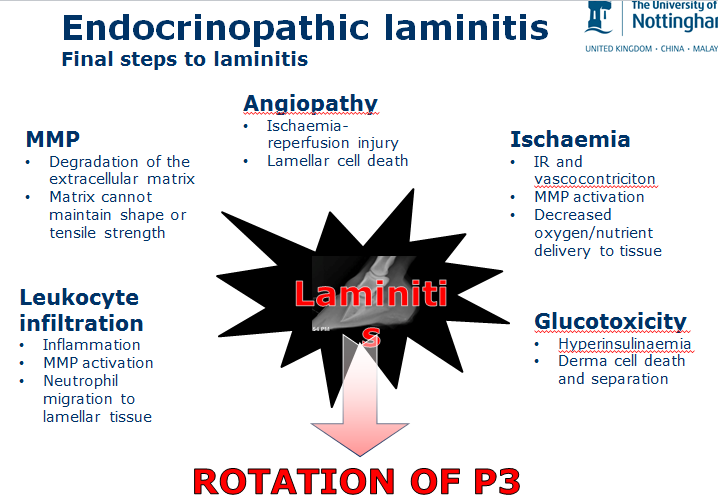
Matrix metalloproteinases (MMP) are involved in lamellar tissue physiological matrix turn-over. MMP activity is increased by?
- Endotoxaemia
- Hypoperfusion (vasoconstriction)
- Leukocyte activation/margination in laminar blood vessels
Greater amount of MMP in fore than hind feet why it happens more in front feet.
- Degradation of the extracellular matrix
- Matrix cannot maintain shape or tensile strength
- Laminae stretch and tear, causing separation at dermal/epidermal junction
Draw a flow diagram of endocrinopathic laminitis and it’s theorised causes?
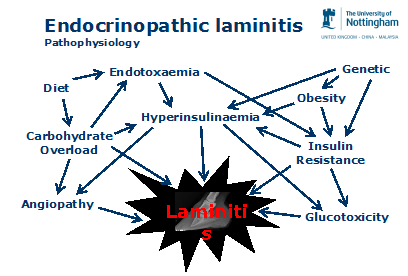
What are the final steps to laminitis?
How do you make a diagnosis of endocrinopathic laminitis?
1. History
Carbohydrate overload
PPID, EMS
2.Physical exam
PPID vs EMS
- Orthopaedic exam + Radiography
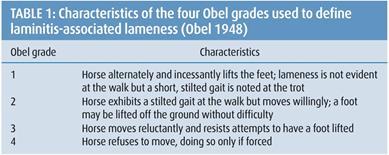
OBEL grading
4. Endocrine testing
PPID
IR
How can endocrinopathic laminitis be managed?
Predisposition
- Manage/treat obesity and insulin resistance
- Treat PPID
- Consistent farrier care
Exacerbation
- Regulate starch/sugar intake and total calories
- Monitor for PPID
Triggers
- Avoid sudden changes in feeding practices
- Gradual introduction to new pastures
- Treat endotoxemia and systemic inflammation
What should you do to treat a horse during acute laminitis?
- Treat underlying condition (PPID, EMS)
- Absolute box rest until sound and beyond
- Deep (1 foot), soft bedding
- NSAIDs
- Flunixin
- Phenylbutazone
- Cryotherapy
- Maintain limb temperature to 4°C (8°C acceptable) for 72h distally form carpus/knee
- Start as soon as possible, ideally before onset of endotoxaemia
- ACUTE LAMINITIS ONLY:
- Lowers metabolic rate of lamellar tissue
- Reduces impact of vasoconstriction
- Decreased cytokine production
- Reduce MMP activity (enzymes cant work at lower temp)
- Remedial farriery
- Every 6 weeks
- Consider farrier with extensive experience with laminitis
What is the long term management of endocrinopathic laminitis?
Goals
Manage obesity
Stop sugars in the grass from exacerbating hyperinsulinemia
Strategies
Short turnout (< 1 hour)
Grazing muzzles
Strip grazing (electric fence)

-
Equine URT Disease Cases CR3
-
Equine upper respiratory tract surgery66
-
Nasal Discharge/Sinusitis65
-
Sinus Disease and Epistaxis56
-
Equine Viral Respiratory Disease40
-
AB selection for respiratory disease37
-
Approach to sampling32
-
Equine Lung Disease25
-
EIPH60
-
URT Disease16
-
Equine Asthma39
-
Cardiac assessment in equid28
-
Equine Cardiac Murmurs52
-
Pericardial and Vascular Disease52
-
LA Dysrhythmia43
-
Equine Poor Performance and Cardiac Disease14
-
Cardiac Histopathology22
-
Nasal Sinus Drainage and endoscopy PRACTICAL12
-
Airway sampling PRACTICAL7
-
Equine URT Radiography17
-
Clinical relevance EquineEthmoid haematoma9
-
EMS36
-
PPID35
-
Laminitis24
-
Hyperlipaemia30
-
Equine endocrine case decision10
-
Obese Equid8
-
Equine dermatology 148
-
Equine dermatology 228
-
Equine derm cases5
-
Practical: Equine GI anatomy16
-
Colic Case13
-
Equine Dentistry90
-
Microbiology Of Enteritis61
-
Equine dysautonomia8
-
Equine Colic Cases28
-
Colic - Causes and Clinical Signs41
-
Colic - Medical Management22
-
Colic - LI52
-
Gastric Disease in Horses50
-
Lipomas and SI surgical colic44
-
Diarrhoea in Horses66
-
Weight Loss in Horses48
-
Diseases Associated with Disorders of Fat Metabolism16
-
Liver Disease In The Horse77
-
Clinical Manifestations of Equine Parasites57
-
GI Disease in Foals68
-
Steeplechase...?16
-
Critically Ill Horse with GI Disease52
-
The critically ill horse with GI disease EXTRA12
-
Colic case planning28
-
Equine distal limb18
-
Nerve blocks11
-
LA bandaging6
-
Foot and Farriery46
-
Ultrasonography Of The Equine Distal Limb93
-
Local Anaesthesia Techniques47
-
Synoviocentesis7
-
Soft Tissue Trauma65
-
Equine Examination46
-
Soft Tissue Injuries43
-
Equine Back14
-
Equine Forelimb95
-
Equine Hind limb53
-
Equine Foot Radiography13
-
Equine Foot64
-
Equine Foot Cases8
-
LA Muscle Disease75
-
Radiography and Radiology47
-
Developmental Orthopaedic Disease 260
-
DOD 155
-
Equine Bone Healing45
-
Equine Tendon Healing46
-
Vascular Disease35
-
Neurology Infectious Diseases84
-
Equine Neurology116
-
Equine Opthalmology110
-
Corneal Ulcers58
-
Notifiable Neuro Viruses26
-
Large Animal Ophthalmology21
-
Eye and Disease30
-
Ocular Pharmacology81
-
Approach To The Sick Equine Neonate39
-
Caslick/Endometrial biopsy (practical)17
-
Mare Breeding Soundness Exam8
-
Diagnostic Methods and Cycle Manipulation in the Mare64
-
Parturition, Dystocia, Post-Partum Events and Reproductive Surgery53
-
Pregnancy Diagnosis in the Mare27
-
Endometritis in the mare53
-
Approach to scrotal swelling12
-
Pregnancy Loss Causes and Consequences50
-
Reproductive Problems in the Mare46
-
Clinical Equine Reproduction - Care of Sick Neonate36
-
Optimal Breeding Time in The Mare24
-
Common first opinion reproductive cases in equine practice22
-
Diagnostic methods in the stallion50
-
Common diseases and surgery of the stallion/gelding54
-
Complications of equine castration36
-
Anaesthesia for Colt Castration32
-
Rectal Tears30
-
Equine Urinary Disease64
-
Equine Urinary Tract9



