Make a list of the risk factors for equine hyperlipaemia?
- Negative energy balance
- obesity
- insulin resistance
- stress, pregnancy
- PPID
- DM
Explain the pathophysiology of equine hyperlipaemia in this patient who is off their food:
Nine-year-old 280-kg Shetland pony mare with a body condition score 5/5?
- Negative energy balance because off feed
- Cortisol, epinephrine, and glucagon increase
- Insulin decreases
- Hormone-sensitive lipase stimulated
- Lipolysis results in increased NEFAs
- NEFAs used by liver for beta oxidation
- If excess, then converted back to TG
- TG exported from liver in VLDL
This patient has a plasma triglyceride (TG) concentration of 14.4 mmol/L, which is equivalent to 1,282 mg/dL (multiply mmol/L by 89 to convert to mg/dL). Does this patient suffer from equine hyperlipaemia? What cut-off values are used to define this disorder?
Yes, plasma TG concentration > 5.0 mmol/L and clinical signs
This patient has a plasma triglyceride (TG) concentration of 14.4 mmol/L, which is equivalent to 1,282 mg/dL (multiply mmol/L by 89 to convert to mg/dL). Does this patient suffer from equine hyperlipaemia? What cut-off values are used to define this disorder?
Yes, plasma TG concentration > 5.0 mmol/L and clinical signs
Task 5: Make an extensive treatment plan for this patient, assuming no financial limitations.?
- Intravenous dextose and insulin as a continuous rate infusion (CRI)
- Heparin
- Might place on partial parenteral nutrition (PPN)
If parenteral nutrition is not viable due to finances how might enteral nutrition be given for a pony suffering hyperlipaemia?
Option 1
- Select a complete pelleted feed for older horses and calculate the amount recommended for the patient if this was the primary source of calories.
- Begin with 25% of the required amount of feed for maintenance and increase to 50% over 3 days. Mix pellets with warm water and leave them until they have broken apart.
- Depending upon the size of the patient (relevant to stomach capacity), place a wide-bore nasogastric tube 1 to 4 times daily and pump the liquid feed into the stomach. Check for reflux before pumping additional feed into the stomach. Always clear the nasogastric tube with water and then air before withdrawing the tube.
Option 2
With this option, dextrose (glucose) and galactose is acquired in powdered form and mixed with warm water before being administered via nasogastric tube on a once daily basis.
Glucose administration: suggested regimen for a 200-kg pony
Day 1: 100 g dextrose orally + 30 IU insulin intramuscularly, twice daily
Day 2: 100 g galactose orally + 15 IU insulin intramuscularly, twice daily
Day 3: Repeat day 1
Day 4: Repeat day 2
Option 3
The lowest cost approach is to feed the horse or pony by mouth with a large syringe. Owners can be given dextrose (glucose) powder to dissolve in warm water. Treacle can be used in the same way and can be brought into solution with water by heating in a saucepan. Finally, applesauce can be thinned down with water and drawn into a syringe. All of these high-sugar solutions will provide calories and a dedicated owner can increase the caloric intake of the horse or pony by feeding it this way every 1-2 hours. The syringe should be placed in the corner of the mouth and the solution slowly administered. Owners must be discouraged from restraining the patient and forcefully administering the solution.
What are the potential complications of enteral feeding that must be considered before taking this approach?
- Nausea and vomiting
- Diarrhoea
- Constipation
- Malabsorption/maldigestion
- Mechanical complications (Tubes)
- Aspiration
- Tube malposition
- Tube clogging
What is refeeding syndrome?
During fasting the body switches its main fuel source from carbohydrates to fat tissue fatty acids and amino acids as the main energy sources. The spleen decreases its rate of red blood cell breakdown thus conserving red blood cells. Many intracellular minerals become severely depleted during this period, although serum levels remain normal. Importantly, insulin secretion is suppressed in this fasted state and glucagon secretion is increased.[1]
During refeeding, insulin secretion resumes in response to increased blood sugar, resulting in increased glycogen, fat and protein synthesis. This process requires phosphates, magnesium and potassiumwhich are already depleted and the stores rapidly become used up. Formation of phosphorylated carbohydrate compounds in the liver and skeletal muscle depletes intracellular ATP and 2,3-diphosphoglycerate in red blood cells, leading to cellular dysfunction and inadequate oxygen delivery to the body’s organs. Refeeding increases the basal metabolic rate. Intracellular movement of electrolytes occurs along with a fall in the serum electrolytes, including phosphorus and magnesium. Levels of serum glucose may rise and the B1 vitamin thiamine may fall. Cardiac arrhythmias are the most common cause of death from refeeding syndrome, with other significant risks including confusion, coma and convulsions and cardiac failure.[citation needed]
This syndrome can occur at the beginning of treatment for anorexia nervosa when patients have an increase in calorie intake and can be fatal.[3] It can also occur after the onset of a severe illness or major surgery. The shifting of electrolytes and fluid balance increases cardiac workload and heart rate. This can lead to acute heart failure. Oxygen consumption is also increased which strains the respiratory system and can make weaning from ventilation more difficult.
Recognise patients at risk of refeeding syndrome?
- Anorexia nervosa
- Classic kwashiorkor or marasmus
- Chronic malnutrition
- Chronic alcoholism
- Prolonged fasting
- Prolonged IV hydration
- Significant stress and depletion
Remeber to:
- Correct electrolyte abnormalities before starting nutritional support
- Administer volume and energy slowly
- Monitor pulse, I/O, electrolytes closely
- Provide appropriate vitamin supplementation
- Avoid overfeeding
PARENTERAL FEEDING
If the owner has sufficient finances, you could manage the patient presented in the previous SDL managed with lipid-free partial parenteral nutrition (PPN). Approximately 50% of daily caloric needs should be provided in the form of amino acids and glucose.
Calculate the digestible energy requirement for maintenance (DEm) for your patient. Provide only 50% of this requirement as PPN.
a. Using the National Research council (1989) formula:
DEm = 1.4 + (0.03 x bwt in kg) = Mcal required per day
1 Mcal (megacalorie) = 1000 kcal (kilocalorie) = 4.2 MJ (megajoules)
Add 20% in late pregnancy (9th, 10th, and 11th months of gestation)
Add 70% for lactation
b. Alternatively, Utrecht University guidelines
(Reference: Vet Quarterly 2001; 23:201-205)
Net energy (NE) = 348 kJ/(bwt in kg)0.75
Task 1: Perform these calculations for this 280-kg pony mare.
DEm = 1.4 + (0.03 x bwt in kg) = Mcal required per day
= 1.4 + (0.03 x 280)
DEm (NRC method) = 9.8 Mcal/d
= 9,800 kcal/d = 41.2 MJ/d
DEm (NRC method) = __9.8___ Mcal/d = _9,800_____ kcal/d = __41.2__ MJ/d
Need only 50% = 4,900 kcal/d (unless she is pregnant!)
To calculate the crude protein requirement of a 280kg pony with an Mcal/d of 9.8 you need to?
To calculate the amount of crude protein (CP) provided (in grams/day), multiply the calculated amount of digestible energy (in Mcal) by 40. Provide only 50% of daily CP requirement.
392 ÷ 2 = 192 g
You will provide this 280-kg pony mare with every 24 hours.
Daily amount of CP = __200______ g/day
Calculate the volume of amino acid solution that you will administer every 24 hours.
Task 3: If you have a 10% amino acid solution available, it contains 100 grams amino acids per litre.
This 280-kg pony mare therefore requires 2.0 litres/day.
When administering parenteral nutrition for a horse with hyperlipaemia how should it be monitored?
MONITORING
- Check blood glucose every 2-4 hours for first 12 hours of a new protocol
- Use a urine dipstick to check for glucose. Renal threshold is approximately 9 mmol/L (160 mg/dL) in horses.
- Monitor plasma triglyceride concentrations
- Consider performing blood gas analysis or measuring plasma bicarbonate concentrations to check for metabolic acidosis
DRUG THERAPY
- Insulin and heparin are two drugs that are used for the treatment of equine hyperlipemia.
Describe the pathophysiology of hyperlipaemia?
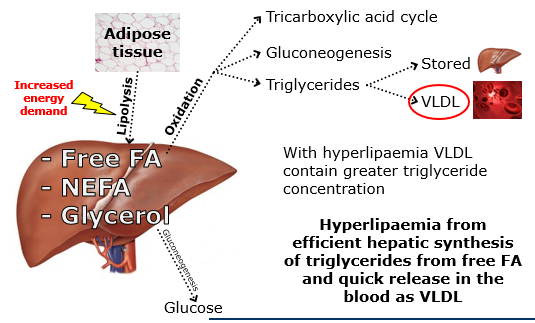
IN liver substances that result from lipolysis go on to enter different pathways. FFA go to the oxidation pathway and can become triglycerides which can be stored in liver or become VLDL.
With hyperlipaemia this process is very effective. Fast synthesis of VLDL from FFAs due to increased energy demand/negative energy balance.
What does lipoprotein lipase do?
Lipoprotein Lipase induces uptake of very low density lipoproteins (VLDL) by peripheral tissues including adipose
But remember the cause of hyperlipaemia IS OVERPRODUCTION OF VLDL RATHER THAN DECREASED CLEARANCE (increased production exceeding removal capacity of VLDls)
What are the roles of insulin?
- Inhibition of lipolysis, proteolysis
- Decreases liver glycogenolysis, gluconeogenesis and ketogenesis
- Stimulation of lipoprotein lipase
- VLDL available for rapid mobilisation if needed
If have insulin resistance start to have problems with all of the above.
How does stress effect insulin?
Stress (glucocorticoids, catecholamines, progesterone)
- Counteract insulin effects
- Contribute to insulin resistance
Create a diagram that shows the pathophysiology of hyperlipaemia?
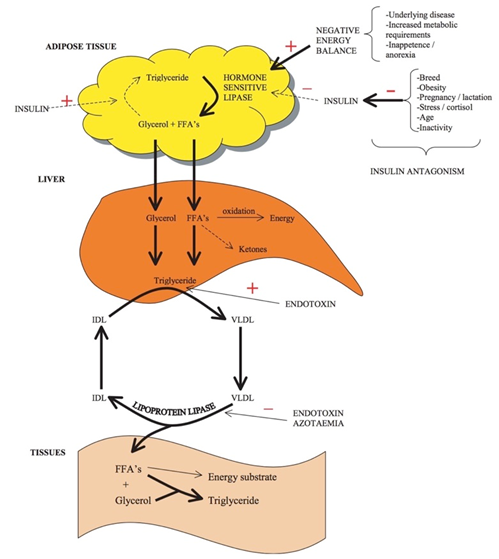
Endotoxin:
- Increases hepatic synthesis and secretions of VLDL from the liver
- Inhibition of LPL activity at high endotoxin concentration
Azotemia:
- Interference with LPL action
- Reduced metabolic pathways are indicated with dashed arrows, while increased metabolic pathways are indicated with bold arrows. - = inhibition, + = stimulation, FFAs = free fatty acids, VLDL = very low-density lipoprotein, IDL = intermediate density lipoprotein.
What are the clinical signs of hyperlipaemia?
- Suspected in ALL ponies, miniature or donkey that are inappetent even for a short period of time as they shift into NEB. Moment they stop eating they mobilise fats tissue and do it too efficiently and blood is full of VLDL.
- Generally simply quiet/dull demeanour
- More variable: icterus, anorexia, weakness, ataxia, diarrhoea, colic, fever, pendent oedema
- Masked by primary concurrent disease
- Infections, parasitism
- Primary colic (fasting may tips these breeds into NEB)
- PPID (glucocorticoid may trigger hyperlipaemia)
- Laminitis
- Physiological states of higher energy demand which may trigger hyperlipaemia
- Pregnancy (late gestation)
- Lactation
Is hepatic lipidosis common in horses?
Hepatic lipidosis and ketosis much less common in horses than other species
- Equine liver very efficient at synthesis of triglycerides and export of VLDL compared to ruminants for example
- Hepatic lipidosis only if FA mobilisation and synthesis exceed oxidation and VLDL excretion
- Severe lipidosis can affect hepatic function
- Hepatic failure
- Hepatic rupture
Diagnosis
- Increased serum triglyceride concentration
- Biochemical evidence of hepatic dysfunction
- US/Histopathological evidence of fatty infiltration of the liver
What are the risk factors for equine hyperlipaemia?
- Obesity
- Breed
- Shetland, Miniature
- Ponies
- Donkey
- Gender
- Female (Pregnancy/lactation)
- Stress, pain, disease
- Catabolic neuroendocrine response and secretion of ACTH, ADH, GH, catecholamines, glucocorticoids and glucagon and result in suppression of insulin and increased lipolysis
What are other risk factors that shift equines to negative energy balance?
- Anorexia
- Intestinal parasitism
- Enteritis / Colitis
- Gastric / Large colon impactions
- Dysphagia
- Lymphosarcoma
- Peritonitis
- Metritis
- Laminitis
- Dental disease
- etc.
Why are donkeys and pony breeds more prone to hyperlipaemia?
- Donkeys and pony breeds
- Relative insulin insensitivity to favor lipolysis (not as efficient as horses are with regards to Insulin sensitivity)
- Females at higher risk
- Donkey and miniature ponies females are more prone to hyperlipaemia than males even if not pregnant or lactating in some studies
- Reduced risk in horse breeds
- More likely to develop hypertriglyceridaemia than hyperliapemia (triglycerides are high don’t get as many VLDL and those that are there are not as compactly filled)
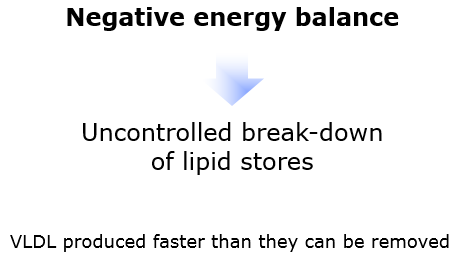
How does negative energy balance lead to hyperlipaemia?
If glucogen stores are depleted – in fatty animals there is excessive store for NEFA and free FA which are then mobilised to face energy demand – release of larger VLDL and lipoprotein lipase can not keep up with increase VLDL production and this results in hyperlipaemia
Name some causes of NEB?
Decreased energy intake
- Inability to eat
- Inability to chew
- Inability to swallow
- Inability to reach food source
- Severe lameness (eg. laminitis)
Increased energy demand
- Lactation
- Pregnancy
- Disease (e.g pyrexia will increase cellular metabolism)
- Endotoxaemia

-
Equine URT Disease Cases CR3
-
Equine upper respiratory tract surgery66
-
Nasal Discharge/Sinusitis65
-
Sinus Disease and Epistaxis56
-
Equine Viral Respiratory Disease40
-
AB selection for respiratory disease37
-
Approach to sampling32
-
Equine Lung Disease25
-
EIPH60
-
URT Disease16
-
Equine Asthma39
-
Cardiac assessment in equid28
-
Equine Cardiac Murmurs52
-
Pericardial and Vascular Disease52
-
LA Dysrhythmia43
-
Equine Poor Performance and Cardiac Disease14
-
Cardiac Histopathology22
-
Nasal Sinus Drainage and endoscopy PRACTICAL12
-
Airway sampling PRACTICAL7
-
Equine URT Radiography17
-
Clinical relevance EquineEthmoid haematoma9
-
EMS36
-
PPID35
-
Laminitis24
-
Hyperlipaemia30
-
Equine endocrine case decision10
-
Obese Equid8
-
Equine dermatology 148
-
Equine dermatology 228
-
Equine derm cases5
-
Practical: Equine GI anatomy16
-
Colic Case13
-
Equine Dentistry90
-
Microbiology Of Enteritis61
-
Equine dysautonomia8
-
Equine Colic Cases28
-
Colic - Causes and Clinical Signs41
-
Colic - Medical Management22
-
Colic - LI52
-
Gastric Disease in Horses50
-
Lipomas and SI surgical colic44
-
Diarrhoea in Horses66
-
Weight Loss in Horses48
-
Diseases Associated with Disorders of Fat Metabolism16
-
Liver Disease In The Horse77
-
Clinical Manifestations of Equine Parasites57
-
GI Disease in Foals68
-
Steeplechase...?16
-
Critically Ill Horse with GI Disease52
-
The critically ill horse with GI disease EXTRA12
-
Colic case planning28
-
Equine distal limb18
-
Nerve blocks11
-
LA bandaging6
-
Foot and Farriery46
-
Ultrasonography Of The Equine Distal Limb93
-
Local Anaesthesia Techniques47
-
Synoviocentesis7
-
Soft Tissue Trauma65
-
Equine Examination46
-
Soft Tissue Injuries43
-
Equine Back14
-
Equine Forelimb95
-
Equine Hind limb53
-
Equine Foot Radiography13
-
Equine Foot64
-
Equine Foot Cases8
-
LA Muscle Disease75
-
Radiography and Radiology47
-
Developmental Orthopaedic Disease 260
-
DOD 155
-
Equine Bone Healing45
-
Equine Tendon Healing46
-
Vascular Disease35
-
Neurology Infectious Diseases84
-
Equine Neurology116
-
Equine Opthalmology110
-
Corneal Ulcers58
-
Notifiable Neuro Viruses26
-
Large Animal Ophthalmology21
-
Eye and Disease30
-
Ocular Pharmacology81
-
Approach To The Sick Equine Neonate39
-
Caslick/Endometrial biopsy (practical)17
-
Mare Breeding Soundness Exam8
-
Diagnostic Methods and Cycle Manipulation in the Mare64
-
Parturition, Dystocia, Post-Partum Events and Reproductive Surgery53
-
Pregnancy Diagnosis in the Mare27
-
Endometritis in the mare53
-
Approach to scrotal swelling12
-
Pregnancy Loss Causes and Consequences50
-
Reproductive Problems in the Mare46
-
Clinical Equine Reproduction - Care of Sick Neonate36
-
Optimal Breeding Time in The Mare24
-
Common first opinion reproductive cases in equine practice22
-
Diagnostic methods in the stallion50
-
Common diseases and surgery of the stallion/gelding54
-
Complications of equine castration36
-
Anaesthesia for Colt Castration32
-
Rectal Tears30
-
Equine Urinary Disease64
-
Equine Urinary Tract9



