How do you diagnose COPD?
- Post-bronchodilator spirometry - FEV1/FVC < 70% i.e. obstruction
- CXR- hyperinflation, bullae, flat hemidiaphragm. Also important to exclude lung cancer
- FBC - exclude other causes like secondary polycythaemia
What is COPD?
FEV1 <80%; FEV1/FVC <0.7
A common, treatable (but not curable), largely preventable lung condition, characterised by persistent respiratory symptoms and airflow obstruction which is usually progressive and not fully reversible.
Encompasses both emphysema and chronic bronchitis
Define chronic bronchitis and emphysema.
Emphysema = defined histologically as enlarged air spaced distal to terminal bronchioles/destruction of alveolar walls
Chronic bronchitis = defined clinically as a cough for most days for 3 months for 2 successive years
What are the risk factors for COPD?
- Smoking (90% of cases) – inflammatory response, cilia dysfunction, oxidative injury. Includes non-tobacco smoking and passive smoking.
- Air pollution- mainly indoor from burning wood and coal
- Occupational exposure - coals, grains, silica and welding fumes, isocyanates, polycyclic hydrocarbons
- Genetic – alpha-1 antitrypsin deficiency at <45yrs
- Congenital - problems with lung development like maternal smoking
- Asthma - may be a risk
How common is COPD?
4th leading cause of death worldwide
increasing in women, used to be male>females
Describe briefly the pathophysiology of emphysema/bronchitis.
- Emphysema = “pink puffers” (difficulty breathing but well perfused)– inflammatory response → elastin breakdown → loss of alveolar integrity
- Bronchitis = “blue bloaters” (cyanosed) – inflammatory response → ciliary dysfunction and ↑goblet cell size and number → excessive mucus secretion
Why do you get pulmonary hypertension in smokers?
Progressive hypoxia (due to reduced SA and poor gas exchange, decreased compliance) → vascular smooth muscle thickening → pulmonary hypertension → poor prognosis
What is the histological difference between asthma and COPD?
Eosinophils play no role in COPD (except in acute exacerbation)
What are the symptoms of COPD?
- SOB (esp with exercise)
- Chronic/recurrent cough and regular sputum production
- Fatigue (secondary to nocturnal cough, persistent hypoxia and hypercapnia)
- Frequent LRTI
- Wheeze
Other:
- Weight loss, anorexia, fatigue - in severe COPD
- Waking at night with SOB
- Ankle swelling - ?cor pulmonale
- Reduced exercise tolerance
- Chest pain and haemoptysis is uncommon
What would you find on physical examination of a patient with COPD?
- Use of accessory muscles and intercostal retraction
- Barrel chest
- Cyanosis
- Clubbing
- Tachypnoea
- Pursed lip breathing
- Signs of right-sided heart failure - raised JVP, loud P2, hepatomegaly, hepatojugular reflux, lower extremity oedema
- Asterixis – CO2 retention
- Hyper-resonance on percussion
- Distant breath sounds, poor air movement on auscultation (on bullae)
- Wheezing, coarse crackles
What investigations would you do if you suspect COPD?
Spirometry - gold standard for diagnosis – reduced FVC causing post-bronchodilator (but not reversibility testing) FEV1/FVC <0.7. NB: in asthma FVC should not be affected.
Pulse oximetry – in patients with chronic disease, oxygen saturation of 88-90% is acceptable. If <92% you should order ABG.
ABG – hypercapnia, hypoxia and respiratory acidosis are signs of impending respiratory failure.
CXR – to rule out other pathologies.
Other investigations to consider: FBC, ECG, BNP, sputum culture, CT.
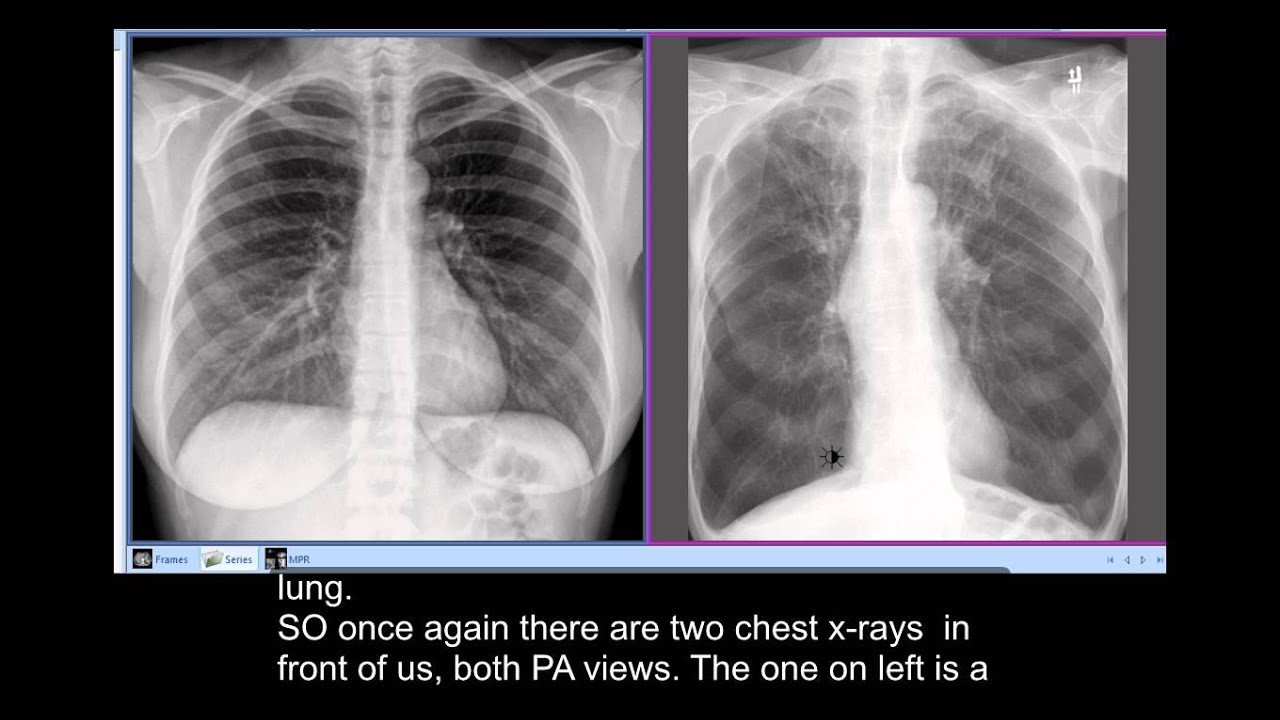
What would you see on a chest X-Ray of COPD?
A flattened diaphragm, hyperlucent lungs and hyperinflation. Increased anteroposterior ratio (barrel chest)
Describe the spirometry results of a person with COPD.
Reduced FER (FEV1/FVC)
Reduced FVC (although lungs are hyperinflated there is less movement of air due to air trapping
(In asthma the FVC is not affected)
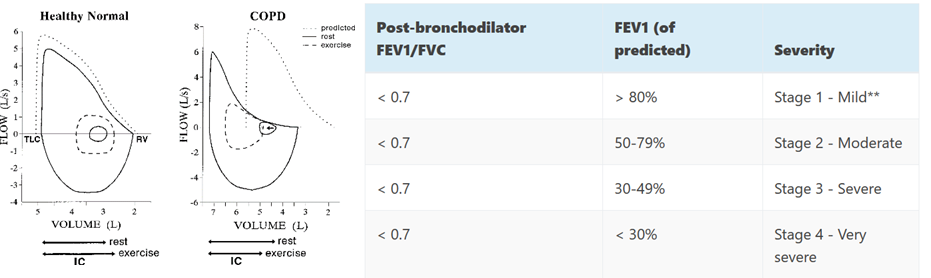
How do you divide COPD patients into management groups?
GOLD criteria
In patients with FEV1/FVC <0.70:
GOLD 1 - mild: FEV1 ≥80% predicted
GOLD 2 - moderate: FEV1 _>_50% predicted
GOLD 3 - severe: FEV1 _>_30% predicted
GOLD 4 - very severe: FEV1 <30% predicted.
Describe the chronic management of COPD patients.
Conservative:
- Smoking cessation, healthy diet, exercise
- Inhaled therapy – long or short acting B2 agonists and/or antimuscarinic to control symptoms and improve exercise tolerance. Inhaled corticosteroids also decrease exacerbation frequency in patients with FEV1<50% predicted.
- Pulmonary rehabilitation – MRC group 3 or above to reduce symptoms and improve quality of life. CI = MI, angina, immobility.
- Vaccination – flu and pneumococcal to prevent CAP and exacerbations.
- Dietician - if losing weight
Medical:
- Bronchodilators: only once conservative tried
- 1st SABA or SAMA
- 2nd LABA + LAMA/ICS (depends on steroid responsiveness signs)
- 3rd LABA + LAMA + ICS
- Add on treatments: oral theophylline, mucolytic, prophylactic antibiotics, PD-4 inhibitors
- Non invasive ventilation
- Long term oxygen (LTOT) - if sats _<_92%, FEV1 <50% of predicted, cyanosis, polycythaemia etc

How do you manage COPD exacerbations?
- Short acting bronchodilator – spacer or nebuliser can be considered for optimal delivery
- Systemic/inhaled corticosteroid e.g. prednisone, methylprednisone.
- Supplemental oxygen
- Antibiotic
- Invasive/non-invasive positive-pressure ventilation – improves gas exchange especially in patients with respiratory failure
Describe a difference in breathlessness between COPD and asthma.
In COPD breathlessness is persistent.
Which criteria are used in the classification of COPD?
In pulmonary function testing, a post-bronchodilator FEV1/FVC ratio of <0.70 is commonly considered diagnostic for COPD. The GOLD system puts airflow limitation into stages:
- GOLD 1 - mild: FEV1≥ 80% predicted
- GOLD 2 - moderate: 50% ≤ FEV1 < 80% predicted
- GOLD 3 - severe: 30% ≤ FEV1 < 50% predicted
- GOLD 4 - very severe: FEV1 <30% predicted.
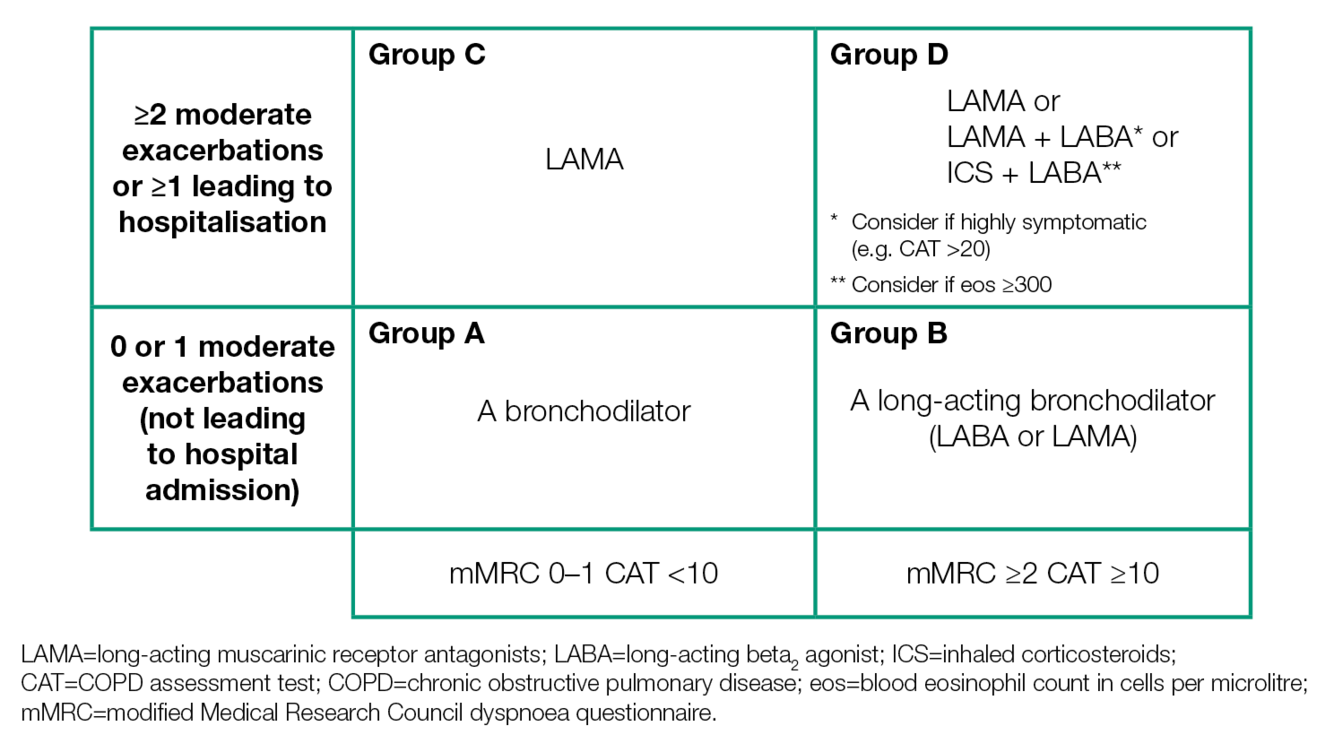
They can also be put into groups according to the number of exacerbations, according to CAT scale:
- Group A: low risk (0-1 exacerbation per year, not requiring hospitalisation) and fewer symptoms (mMRC 0-1 or CAT <10)
- Group B: low risk (0-1 exacerbation per year, not requiring hospitalisation) and more symptoms (mMRC≥ 2 or CAT≥ 10)
- Group C: high risk (≥2 exacerbations per year, or one or more requiring hospitalisation) and fewer symptoms (mMRC 0-1 or CAT <10)
- Group D: high risk (≥2 exacerbations per year, or one or more requiring hospitalisation) and more symptoms (mMRC≥ 2 or CAT≥ 10).
What are the guidelines for treating COPD? (GOLD)
What is LTOT?
Provision of oxygen therapy for continuous use at home for patients with chronic hypoxaemia (PaO2 at or below 7.3kPa)
- Likely to be lifelong and required to be used for at least 15hrs a day
- O2 flow rate must be sufficient to raise the waking oxygen tension above 8kPa (60mmHg)
- Prescribed for patinets with COPD, heart failure, secondary polycythaemia, bronchiectasis, chronic asthma.*
- Patient must not smoke.*
What is pulmonary rehabilitation?
Exercise training used to increase the low anaerobic threshold of patients with lung conditions such as COPD. Helps to rebuild muscle mass.
Also involves breathing exercises for clearing mucus.
But this still does not increase life expectancy or reduce the rate of decline of lung function.
What is NIV and when is it used?
Non-invasive ventilation (same as BiPAP)
Gives inspiratory positive inspiratory and expiratory airways pressure.
Why is there increased TLC in COPD?
Due to gas trapping
What are the parameters for mild, moderate and severe COPD?
Mild COPD: FEV1/FVC <0.7, FEV1 % predicted >80 %
Moderate COPD: FEV1/FVC <0.7, FEV1 % predicted 50–79 %
Severe COPD: FEV1/FVC <0.7, FEV1 % predicted 30–49 %
Very severe COPD: FEV1/FVC <0.7, FEV1 % predicted <30 %


-
Acute bronchitis11
-
Asthma21
-
Aspergillus lung disease30
-
ARDS11
-
Asbestos-related lung disease (incl. asbestosis and mesothelioma)24
-
Bronchiectasis18
-
COPD33
-
Extrinsic allergic alveoltis17
-
Idiopathic pulmonary fibrosis16
-
Lung Cancer43
-
Obstructive sleep apnoea19
-
Pleural Effusion16
-
Pneumoconiosis13
-
Pneumonia46
-
Pneumothorax26
-
Pulmonary Embolism22
-
Sarcoidosis15
-
MedEd - Chest pain38
-
Capsule Cases22
-
Procedures (chest drain)0
-
Smoking cessation4
-
Cavitating lung conditions2
-
X-rays6



