The most common cause of unilateral bloody breast discharge
Intraductal papilloma
The most common cause of unilateral serosanguinous breast discharge in the presence of a breast mass
Breast cancer
OCPs and breast cancer
OCPs do NOT increase risk for breast cancer. The dose of estrogen is not high enough. They are, in fact, probably protective since they shut down endogenous estrogen production.
HRT, on the other hand, is a risk factor for breast cancer.
Non-estrogen-related risk factors for breast cancer
- Hx of chest radiation (classically for lymphoma)
- Genes:
- BRCA1 and 2
- ATM (Ataxia telangiectasia)
- p53 mutation
- CHEK2 (checkpoint 2 kinase mutation)
- PTEN
- Cadherin 1
- STK11 (Serine-threonine kinase 11)
Should you recommend self breast exams?
NO. Because women will find something, and it will require workup but it will not be breast cancer.
Should you do regular breast exams for your patients (primary care, GYN)?
NO
Evidence has not borne this out to be helpful. Rather, in the same way as self exams, it just dramatically increases workup of benign lesions and leads to unnecessary expense, unnecessary stress, and iatrogenicity.
Breast exams are out, ___ is in
Breast exams are out, mammogram is in
Best current recommendation for breast cancer screening
Age 40, q2 yrs for mammograms
This is the recommendation to follow right now.
When do you use MRI over mammogram for breast cancer screening?
When risk is VERY high.
BRCA patients, BRCA-negative patients with strong family history, patients w/ history of chest irradiation
Breast cancer diagnosis
- 1st step: Mammogram
- May arrive at this __ ways:
- Screening mammogram > 30 years
- Diagnostic mammogram in the setting of suspected breast cancer outside of screening
- Breast mass (not cyst) on US < 30
- Bloody FNA on < 30 cyst by US
- Recurrence of cyst on < 30 by US
- May arrive at this __ ways:
- 2nd step: Core needle biopsy (OR excisional if you know it is cancer)
- Necessary for confirmation of diagnosis and for pathological diagnosis
Breast mass algorithm
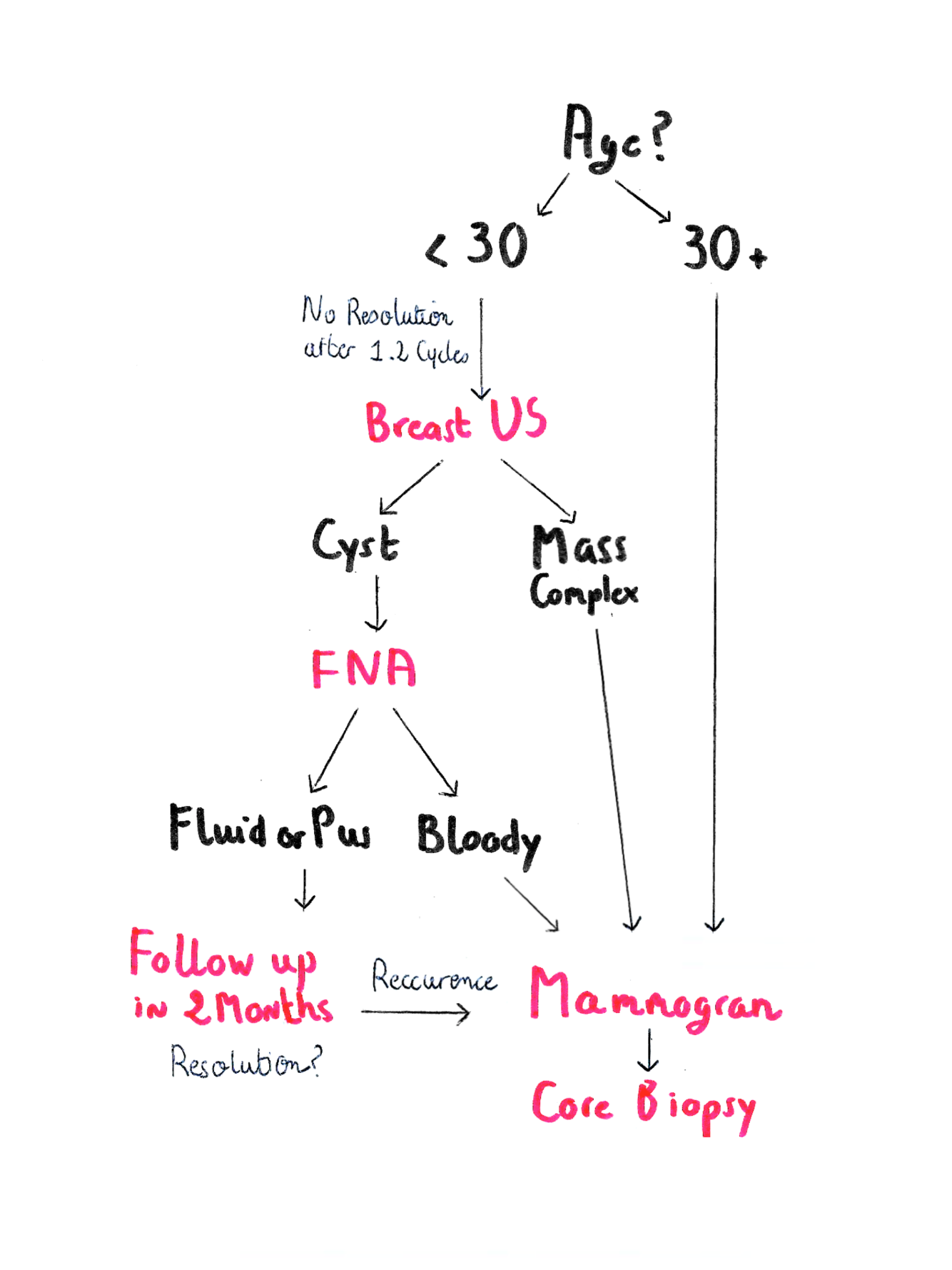
Importance of age to breast cancer screening
- Prior to age 30, breast tissue is too firm for mammogram to be useful. Ultrasound is a better test in these patients.
- BUT, we wait 1-2 cycles first to see if the mass goes away, since it is highly unlikely to have breast cancer in this population
- Wait 1-2 cycles, then ultrasound if < 30
Possible findings on breast ultrasound for a woman with a breast mass < 30
- Mass: Probably fibroadenoma, possibly breast cancer. Need core needle biopsy.
- Cyst:
- Blood: Probably breast cancer
- Pus: Probably an abscess
- Fluid: Probably a benign cyst
- Fibrocystic pattern: Fibrocystic change. Must repeat US on next early follicular phase (cycle day 3)
Standard breast cancer chemotherapy
- Doxarubicin
- Cyclophosphamide
- Paclitaxel
CHF caused by __ for breast cancer therapy is irreversible, while CHF caused by __ for breast cancer therapy is reversible.
CHF caused by anthracyclines for breast cancer therapy is irreversible, while CHF caused by trastuzumab for breast cancer therapy is reversible.
Prognostication for breast cancer receptors
- PR+: good prognosis
- ER+: good prognosis
- HER2/Neu+: poor prognosis
Targeting HER2/neu
Trastuzumab
Targeting ER/PR
If premenopausal: SERM
If postmenopausal: Aromatase inhibitor
BRCA prophylactic measures
- Prophylactic mastectomy and BLSO
- Otherwise, MRI and mammogram every year to screen
Adjuvant chemotherapy
Chemotherapy after surgical resection
Neoadjuvant chemotherapy
Chemotherapy first to reduce tumor size, then surgery
“Triple test” for breast cancer
- Clinical exam
- Imaging
- Pathology
- All three must be negative in order to rule breast cancer out
If imaging and clinical exam of a breast mass are concerning, but biopsy findings are benign. . .
. . . excisional biopsy is still warranted in order to avoid the possibility of sampling error
Prognostication for inflammatory breast cancer
Lymph node involvement is common
Most cases will require neoadjuvant therapy followed by surgery and radiation


-
Procedural Anatomy6
-
Vascular Supply and Lymphatic Drainage15
-
Peri-Operative Risk Assessment49
-
Hematopathology62
-
GYN Onc46
-
Perioperative Antiplatelet and Anticoagulant Management42
-
Anesthetic Pharmacology60
-
Myelodysplastic syndrome5
-
Transfusion Medicine5
-
Pre-procedural and diagnostic imaging12
-
Postoperative Issues88
-
Liver, Gallbladder, Pancreas103
-
Trauma and Wound Management140
-
Drug Reactions3
-
Electrolytes6
-
Intensive Care62
-
Esophagus, Stomach, Pharynx, Oral Cavity68
-
Abdominal Pain117
-
Nonconventional Dysplasia in IBD10
-
Chronic GI and GI Bleeds122
-
Vascular Disease and Vascular Surgery70
-
Drugs for Cancer and MDS3
-
Bites and Stings9
-
Toxic ingestion10
-
Surgical Management of Endocrinopathies94
-
Neurosurgery27
-
Useless things that they want us to know9
-
Burns, Hypothermia, Frostbite28
-
Orthopedics82
-
Hernias32
-
Head and Neck Surgery41
-
Anesthesia Curriculum71
-
Bladder, Kidney, Ureter, Urethra32
-
Ophthalmology13
-
Bariatric Surgery13
-
Lung Surgery60
-
Pediatric Surgery30
-
Urology77
-
Whipple33
-
Treating valve disease9
-
Emma Holiday Review66
-
Uworld Last Week5



