Parameters to follow in patients with septic shock (per the surviving sepsis campaign)
- Lactate
- target value < 1.0 mmol/L
- CVP (from central venous catheter)
- target value 8-12 mmHg
- MAP (from aterial catheter)
- target value >65 mmHg
- Urine output from Foley catheter
- target value >0.5 mL/kg/hr
Reasons serum lactate might be elevated
- Poor end-tissue oxygen delivery
- Inadequate renal clearance
- Metabolic changes (as in metformin-induced lactic acidosis)
In whom would you place a pulmonary artery catheter?
In someone who you want to measure left ventricular function (LVEDP), such as a patient in the ICU with known cardiac issues and cardiogenic shock on inotropic agents
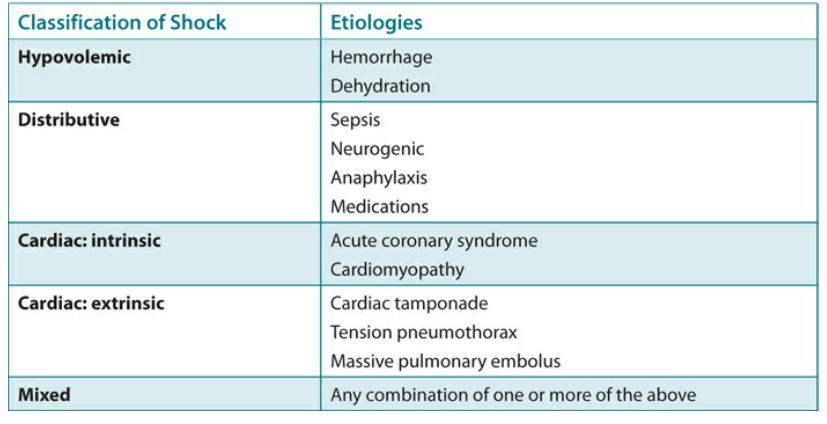
Classification of shock
Physiologic parameters of different etiologies of shock
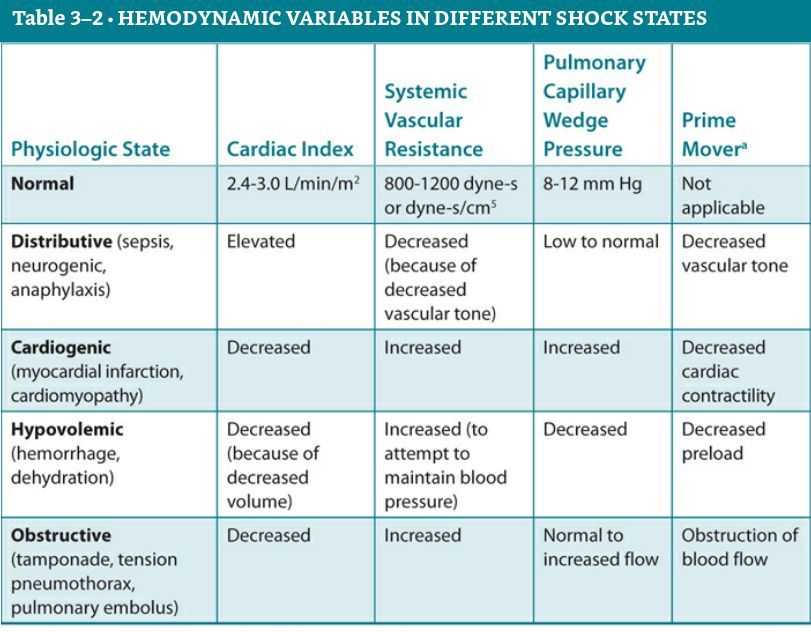
When there is clinical uncertainty about the etiology of hypotension, these tests are extremely helpful
- Central venous pressure measurement
- Echocardiography
Patient in shock responds to fluids initially, but then has a decrease in BP and becomes hypotensive again. What should you be thinking?
Ongoing bleeding
Effects of excessive administration of fluids and blood products
Excess crystalloid administration to a bleeding patient can cause dilution of clotting factors and thrombocytopenia, which can cause further bleeding and create a vicious cycle of worsening hypotension, coagulopathy, and hypothermia.
Patient in shock responds poorly to initial fluids and then has a continued slow drop in blood pressure. What should you be thinking?
Distributive shock.
Here the changes are due to microvascular leak syndrome or excess vasodilation
Appropriate therapy:
- Norepinephrine for septic shock
- Phenylephrine for neurogenic shock
- NOT continued fluid administration!!!
Sepsis spectrum
- Sepsis: Hyperdynamic and febrile response to infection
- Severe sepsis: Infection with septic host response and evidence of organ dysfunction in at least one organ system
- Septic shock: Sepsis with persistent hypotension despite fluid administration
Two major goals of treating sepsis
- Obtain source control
- Restore tissue perfusion
Hypotensive shock management algorithm (from pressure perspective)
- Fluids
- Norepinephrine OR Epinephrine (if alpha or beta effect is desired)
- Vasopressin
- Phenylephrine
- Dopamine
Physiologic effects of dobutamine
- Inotropy
- Modest peripheral vasodilation (decreased afterload)
What “source control” often means in sepsis
Abx alone are unlikely to be enough: drainage, debridement, necrotic tissue resection
Signs of an urgent airway
- Airway that is at risk of potential compromise
- Expanding hematoma
- Cutaneous emphysema
- Inhalation burn (ex, smoke from burning building)
- Not compromised yet, but may need to be intubated pretty soon.
Signs of an emergent airway
- “GCS < 8, intubate”
- Gurgling
- Gasping
Signs of emergent breathing
- Apnea
- Insufficient o2 sats
*
Ventilation problems are managed with ___. Oxygen exchange problems are managed with ___.
Ventilation problems are managed with intubation and mechanical ventilation. Oxygen exchange problems are managed with PEEP and FiO2.
__ indicates a problem with ventilation, while __ indicates a problem with oxygen exchange.
High pCO2 indicates a problem with ventilation, while low pO2 in the context of normal pCO2 indicates a problem with oxygen exchange.
Interpretation of end-tidal CO2
Should be 40 mmHg.
NOT a measurement of blood pCO2.
It is best utilized to determine if your endotracheal tube (both sides being adequately ventilated).
If there is something that prevents you from using an endotracheal tube in a patient with an emergent airway (mouth full of blood, face smashed up, etc) then you need to . . .
. . . perform cricothyrotomy
Can be done emergently at the bedside in the ER
When these patients get to the OR, they will have a nonemergent tracheostomy.
Tracheostomy is a ____ procedure. Cricothyrotomy is a ____ procedure.
Tracheostomy is a non-emergent procedure. Cricothyrotomy is an emergent procedure.
Three most important causes of obstructive shock
- Tension pneumothorax (obstructs flow to R ventricle)
- Pericardial tamponade (obstructs flow to R ventricle)
- Massive pulmonary embolism (obstructs flow to L ventricle)
Ventilator bundle
- Interventions to improve ventilator outcomes:
- Elevation of head of bed
- Stress ulcer ppx (with PPI)
- DVT prophylaxis (with LMWH)
- Daily sedation interruption
- Daily assessment of readiness for weaning/removal of ventilatory support


-
Procedural Anatomy6
-
Vascular Supply and Lymphatic Drainage15
-
Peri-Operative Risk Assessment49
-
Hematopathology62
-
GYN Onc46
-
Perioperative Antiplatelet and Anticoagulant Management42
-
Anesthetic Pharmacology60
-
Myelodysplastic syndrome5
-
Transfusion Medicine5
-
Pre-procedural and diagnostic imaging12
-
Postoperative Issues88
-
Liver, Gallbladder, Pancreas103
-
Trauma and Wound Management140
-
Drug Reactions3
-
Electrolytes6
-
Intensive Care62
-
Esophagus, Stomach, Pharynx, Oral Cavity68
-
Abdominal Pain117
-
Nonconventional Dysplasia in IBD10
-
Chronic GI and GI Bleeds122
-
Vascular Disease and Vascular Surgery70
-
Drugs for Cancer and MDS3
-
Bites and Stings9
-
Toxic ingestion10
-
Surgical Management of Endocrinopathies94
-
Neurosurgery27
-
Useless things that they want us to know9
-
Burns, Hypothermia, Frostbite28
-
Orthopedics82
-
Hernias32
-
Head and Neck Surgery41
-
Anesthesia Curriculum71
-
Bladder, Kidney, Ureter, Urethra32
-
Ophthalmology13
-
Bariatric Surgery13
-
Lung Surgery60
-
Pediatric Surgery30
-
Urology77
-
Whipple33
-
Treating valve disease9
-
Emma Holiday Review66
-
Uworld Last Week5



