Rate limiting step for bilirubin conjugation
2-3-UDP-glucoronyltransferase
Painless posthepatic jaundice is most often going to be . . .
. . . cancer or strictures
1000 foot interpretation of localization of process based on bilirubin
Unconjugated predominant: Prehepatic
Mixed: Intrahepatic
Conjugated predominant: Post-hepatic
Presentation of painless obstructive jaundice
- Indolent process that happens over long periods of time (stricture or cancer)
- Gall bladder and biliary tree have time to adjust: GB will become very large and thin walled, biliary tree will become huge.
- No inflammation, no leukocytosis, no Murphy’s sign
- Courvoisier’s sign: Palpable distended gallbladder
- Bilirubin levels will be way higher than in gallstone disease. Stools may be gray.
- Dx: RUQ-US, MRCP (best test), CT to detect cancer
- Tx: Endoscopic US w/ biopsy or ERCP w/ biopsy. Then stent for stricture, resect for cancer.
Classic presentation of malignant obstruction of the bile tree
- Indolent progression of jaundice, gray stools, weight loss
Distended gallbladder that is palpable, but non-painful
Some sort of obstructive jaundice (stricture, cancer)
What are you looking for on CT in a patient with obstructive jaundice?
- Pancreatic cancer
- Dx with endoscopic US + biopsy. Tx with Whipple procedure.
- Biliary cancer (likely cholangiocarcinoma, if pigmented melanona)
- Remember PSC is risk factor for cholangiocarcinoma
- Dx with ERCP + biopsy. Tx with resection.
- Unrevealing US
- Likely to indicate pathology at ampulla of Vater
- FOBT + and negative colonoscopy -> duodenal cancer
- Dx: ERCP + biopsy. Tx with resection.
Obstructive jaundice + migratory thrombophlebitis
Pancreatic cancer
Treatment for biliary tree strictures
Stenting
UNLESS, they have PSC. This is because these patients will eventually need transplant, and if you stent them it will be harder to do the transplant. In these cases, use ursodeoxcholic acid instead.
Sphincter of Odi dysfunction
- Presents following cholecystectomy
- Causes RUQ or epigastric pain, cholestasis, sometimes pancreatitis
- Dx and Tx with ERCP
- Post-ERCP complications: pancreatitis, cholangitis, cholicky pain, cholestasis due to post-operative swelling at the ampulla of Vater. Tx with supportive care.
Standard antibiotics prior to surgery for cholecystitis
- Ceftriaxone
- Flagyl
B-SAFE mnemonic for gallbladder surgery
- Landmarks to identify prior to beginning the procedure
- Bile duct
- Sulcus of Rouviere
- Left hepatic Artery pulsations
- Umbilical Fissure
- Duodenum (Enterics)
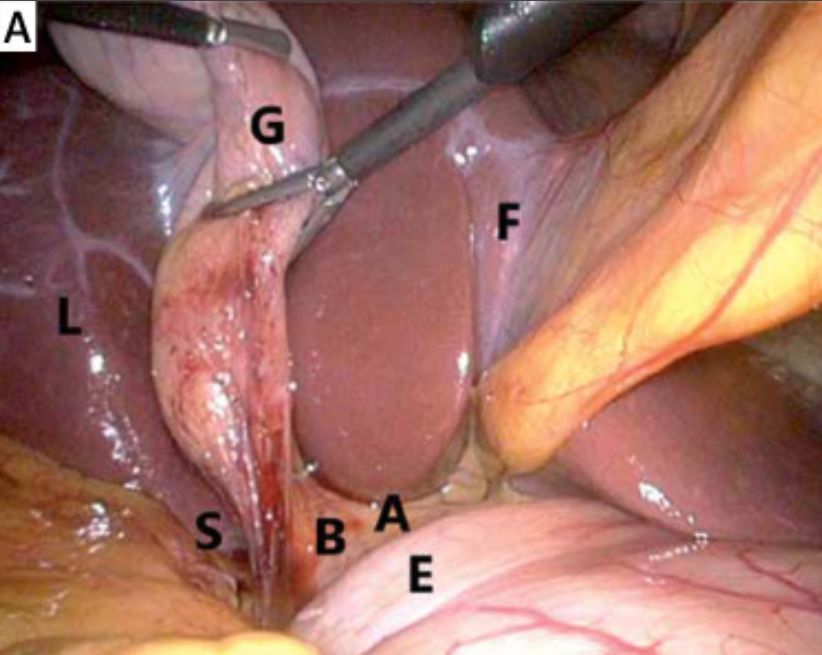
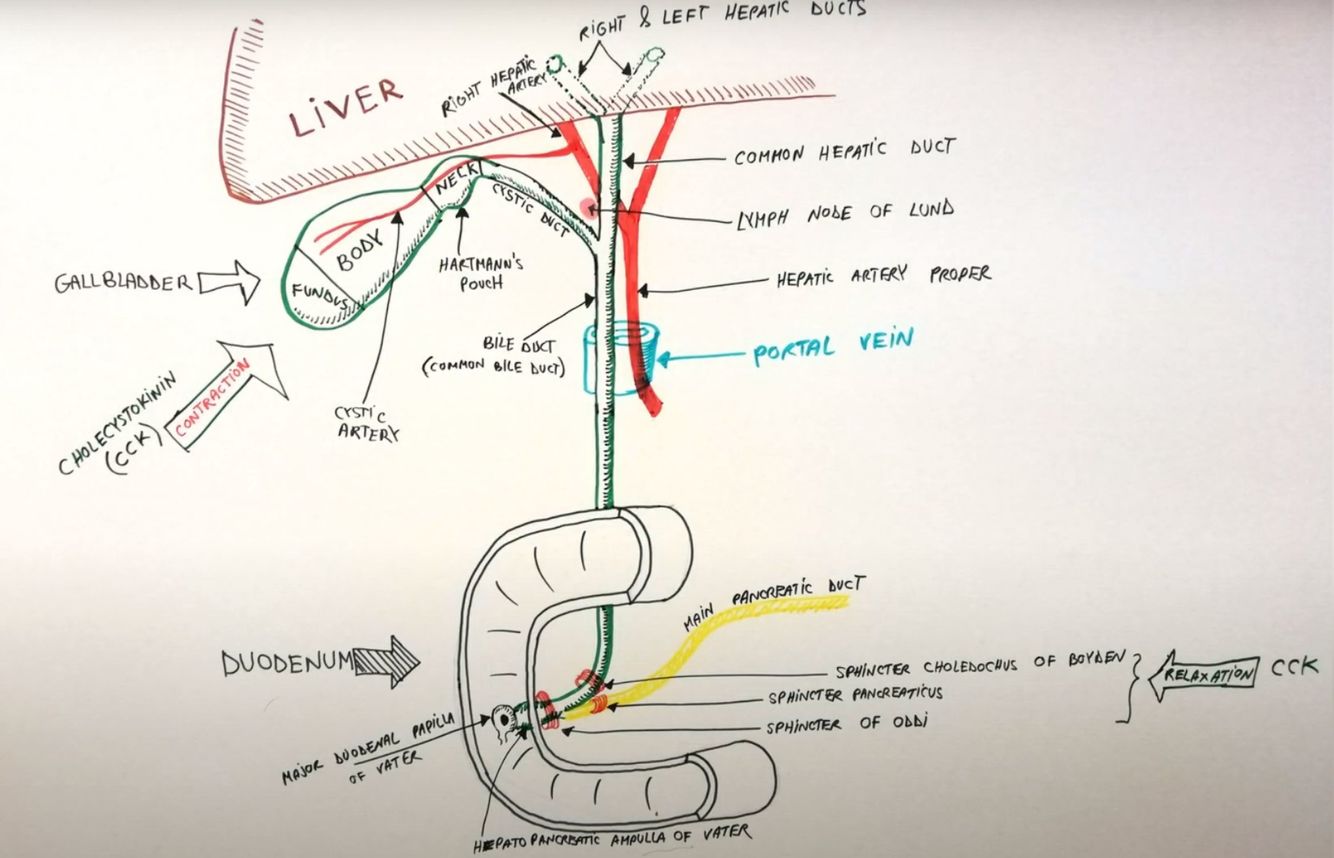
In-detail biliary tree anatomy
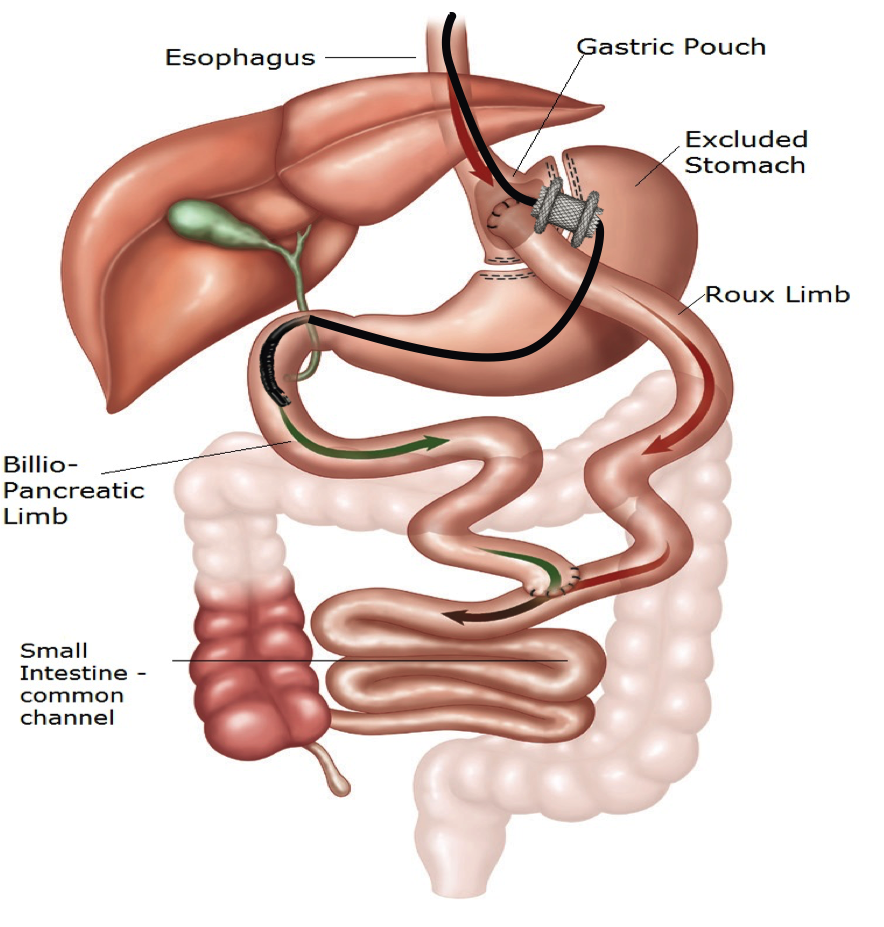
ERCP and EDGE
Done in patients with history of Roux en Y gastric bypass who develop gallstone disease
EDGE is done in two parts: Make a hole, then come back in 2 weeks to do ERCP
Five F’s of mixed cholesterol cholelithiasis
- Fat
- Female
- Forty
- Fertile
- First Americans (Native Americans)
Green bile stones vs black bile stones
Green: Mixed cholesterol, most common
Black: Bilirubin stones, from hemolysis
Treatment for uncomplicated cholelithiasis (w/o cholecystitis)
- Tx:
- Elective cholecystectomy for good surgical candidates
- Ursodeoxycholic acid for poor surgical candidates
In the context of gallstone disease, whenever you have an obstruction. . .
. . . everything proximal will be inflamed
Dx and Tx for cholecystitis
- Start w/ RUQ US. If positive, you are done, proceed w/ management.
- If above negative, do a HIDA scan. If positive, proceed w/ management.
- Note: HIDA scan in cholecystitis will fill the right and left hepatic ducts, but not the obstructed portion of the cystic duct or gall bladder.
- Tx: NPO, IV fluids, IV abx, urgent cholecystectomy (w/in 72-96 hours to prevent perforation)
- In a non-surgical candidate, percutaneous cholecystostomy.
Labs in choledocolithiasis
- Bile stasis markers: Bilirubin, GGT
- Hepatocellular injury markers: AST, ALT
- Pancreas injury markers: Lipase, pancreatic amylase
- Not all of them will always be present. Bilirubin and GGT will be elevated, but liver markers and pancreas markers may or may not be.
Dx and Tx for choledocolithiasis
- Start w/ RUQ US. If positive, you are done, proceed w/ management.
- If above negative, do an MRCP. If positive, proceed w/ management.
- Note: For cholecystitis, you do HIDA. For choledoco, you do MRCP.
- Tx: NPO, IV fluids, IV abx. Urgent ERCP is definitive therapy. But, you can also go straight to cholecystectomy. Either way, the eventually need a cholecystectomy.
- F/u: “Ball-Valve” effect. While working up, pain gets better, bilirubin goes down. But then the next day, pain is back and bilirubin is up again. This is the effect of the stone moving back and forth. It is possible to pass a stone spontaneously in real life, but you have to be careful not to be fooled by this. However, this will never be the case on the test.
Dx and Tx for cholangitis (aka ascending cholangitis)
- Etiology: Infection of static fluid in choledocolithiasis by gut flora
- Dx:
- Charcot’s triad (RUQ pain, jaundice, fever). Indicates choledocolithiasis.
- Reynold’s Pentad (RUQ pain, jaundice, fever, hypotension, AMS). Indicates cholangitis.
- RUQ US is the first and only test. If positive, diagnosis is done, proceed to surgery without further testing (no MRCP, no HIDA).
- Tx: NPO, IV fluids, Abx. Follow w/ EMERGENT ERCP. Then, urgent cholecystectomy.
- Note: Give abx on the way to the endo suite.
Abx in gallstone disease
- You want to cover gram negatives and anaerobes
- Cipro + metronidazole
- Amp + Gent + metronidazole
- Pip-Tazo will be on there, and it will be the wrong answer. You may see it done in the hospital. It is convenient. But, it is a poor choice for antibiotic stewardship, even though it technically covers what you want. It over-covers.
Differentiating pancreatic pseudocyst vs abscess on CT
Pseudocyst: Tender abdomen, smooth, round, cystic structure. Usually not febrile, but can produce febrile peritonitis and sepsis if it ruptures.
Abscess: Fever, tender abdomen, complex/multiloculated cavity.


-
Procedural Anatomy6
-
Vascular Supply and Lymphatic Drainage15
-
Peri-Operative Risk Assessment49
-
Hematopathology62
-
GYN Onc46
-
Perioperative Antiplatelet and Anticoagulant Management42
-
Anesthetic Pharmacology60
-
Myelodysplastic syndrome5
-
Transfusion Medicine5
-
Pre-procedural and diagnostic imaging12
-
Postoperative Issues88
-
Liver, Gallbladder, Pancreas103
-
Trauma and Wound Management140
-
Drug Reactions3
-
Electrolytes6
-
Intensive Care62
-
Esophagus, Stomach, Pharynx, Oral Cavity68
-
Abdominal Pain117
-
Nonconventional Dysplasia in IBD10
-
Chronic GI and GI Bleeds122
-
Vascular Disease and Vascular Surgery70
-
Drugs for Cancer and MDS3
-
Bites and Stings9
-
Toxic ingestion10
-
Surgical Management of Endocrinopathies94
-
Neurosurgery27
-
Useless things that they want us to know9
-
Burns, Hypothermia, Frostbite28
-
Orthopedics82
-
Hernias32
-
Head and Neck Surgery41
-
Anesthesia Curriculum71
-
Bladder, Kidney, Ureter, Urethra32
-
Ophthalmology13
-
Bariatric Surgery13
-
Lung Surgery60
-
Pediatric Surgery30
-
Urology77
-
Whipple33
-
Treating valve disease9
-
Emma Holiday Review66
-
Uworld Last Week5



