What is a mucoperiosteal flap?
This is when we raise the periosteum and the muocsa as one.
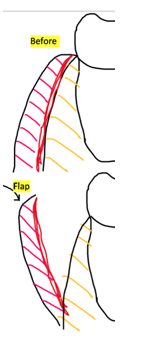
Discuss the width of the mucoperiosteal flap needed.
We need a wide flap as:
- This allows us to see better.
- It will heal just as quickly as a smaller flap.
- It allows the flap to maintain circulation and perfusion.
What are the important aspects of cutting a flap?
- Clean flap reflection -perfusion is reduced for small bits of tissue so it is more likely to necrose.
- The wound should not be closed on tension- this causes the wound to break down.
- Ensure the flaps and wounds lie on sound bone to provide support to the soft tissue- This allows healing and prevents tissue breakdown.
- Precise cuts should be used so that healing is by primary intention (reducing scaring)
Name this instrument and discuss it’s function
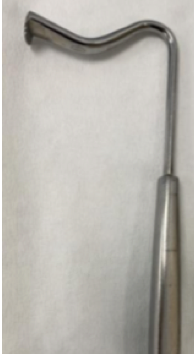
This is an outer henry rake retractor.
This is a broad instrument that reflects light in when you are removing bone.
Name this instrument and discuss it’s function.
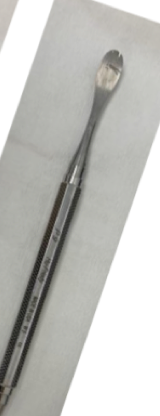
This is an ash periosteal elevator.
This pulls back the soft tissues to allow access
Name this instrument and discuss it’s function
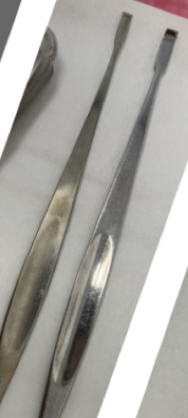
This is Howarth’s periosteal elevator.
This is used to lift the flap and protect the associated structures
What type of handpeice do we use for bone removal and why?
We use an electric straight handpeice with a saline or sterile water-cooled burr.
Because if we used an air handpeice (normally used in clinic ) it would drive air under the mucosa or skin-leading to emphysema .
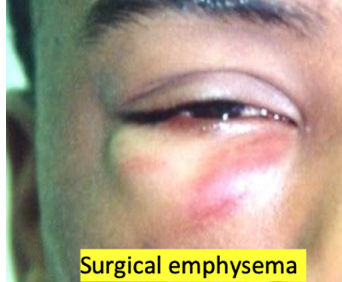
How can we debride the area after oral surgery.
Physcially-
Bone debris- using a bone file
Soft tissue debris- Mitchel’s trimmer or victoria curette.
Irrigation- (sterile saline into the socket & under the flap)
Suctioning-
Aspirate under the flap to remove debris
Check socket for retained apices.
Compare the two types of suture used for closing the flap.
Resorbable sutures-These hold tissue together temporarily but dissolve e.g. velosorb
Non-resorbable sutures- These are used when retention is required for extended periods of time & they have to be removed post-operatively e.g. mersilk
Compare monofilament and polyfilament Sutures
Monofilament sutures- made of one strand.
Polyfilament sutures- made of multiple strands but prone to wicking. (oral fluids and bacteria can move along the suture causing infection)
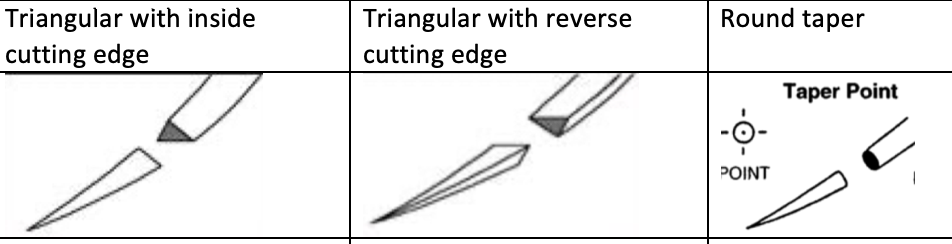
Compare the different suture needles- referring to their cross section.
Triangular cross section with inside cutting edge- Suture passes through without major trauama.
Triangular cross section with reverse cutting edge- prevents the needle tearing the suture when it is being tied
Round taper cutting edge- Cutting edge is on the point, this is more often used for friable tissue and is more dependent on tissue dilation.

-
Radiography79
-
OS- instrument quiz16
-
OS-general anaesthetic in children16
-
OS- Complications & post-op instructions31
-
OS- basic surgical techniques11
-
OS- Analgesia31
-
OS- post extraction complications25
-
Caries69
-
Endodontics164
-
H&N- Week 1 (exterior Skull and spine)45
-
H&N week 2- Triangles of neck.41
-
H&N week 3- The face26
-
H&N week 4- Cranial cavity31
-
H&N week 5- CN & floor & base of cranial cavity36
-
H&N- week 6 (Brain & nerves)36
-
H&N week 7- Mandibular nerve & muscles of mastication34
-
H&N week 8- Mouth & submandibular27
-
H&N week 9- maxillary nerve, nasal cavity.40
-
H&N week 10- Pharynx & Soft palate.48
-
H&N week 11- Ear and Eye47
-
Anatomy FC- specimens14
-
Perio- Classification62
-
Perio textbook105
-
Paeds-behaviour22
-
Paeds-TP9
-
Paeds- prevention46
-
Paeds-trauma125
-
*****Paeds- child protection18
-
Paeds- SND18
-
PMHP-Changing behaviour8
-
DMS- porcelain8
-
DMS- Acrylic resin6
-
DMS-wrought alloys14
-
DMS-ceramics10
-
DMS-Elastomers4
-
DMS-investment materials20
-
DMS-luting agents30
-
DMS-temporary materials5
-
SC-disability & impairment35
-
SC-bariatric11
-
SC- haematology17
-
SC- Cardiology10
-
SC- Liver disease11
-
SC- Elderly33
-
SC- medical conditions7
-
SC-oncology29
-
HUMANS- rheumatology27
-
HUMANS- Neuralgia28
-
HUMANS- Pregnancy9
-
HUMANS- vaccinations10
-
HUMANS- psychiatric diseases27
-
OPTEC- inlays/onlays/veneers18
-
OPTEC- Treatment planning13
-
OPTEC- periodontal considerations28
-
OPTEC- Occlusion31
-
OPTEC-provisional restorations9
-
OPTEC- Tooth whitening37
-
ORTHODONTICS163
-
Orthodontics- upper removable appliances46
-
Microbiology in practice22
-
PAEDS- oral medicine28
-
PROS- Complete Dentures77
-
MEDICAL EMERGENCIES52



