What is the most common complication of extraction?
PAIN.
So we warn the patient and advise regarding analgesia.
How do you know if the swelling is an inflammatory reaction to surgery or an post op infection?
If swelling occurs in first 48 hours- it is swelling due to the inflammatory reaction.
If swelling occurs in the next 3-7 days- it is swelling due to a post-op infection.
What is ecchymosis?
Bruising.
Compare limited mouth opening and trismus.
Limited Mouth Opening can have multiple causes :
- Muscle spasm- surgery or LA
- Damage to the muscle- odema / bleeding into the muscle/ haematomas/ clot fibrosing)
- Damage to the TMJ (oedema/joint effusion)
Trismus is limited mouth opening DUE TO MUSCLE SPASM.
How is trismus treated?
Monitoring- should go away after 1-2 weeks.
Teach patient to use:
Gentle mouth moving exercises (to get the patient to try and open slightly)
Trismus screw- to gradually screw open the jaw a bit every day. .
What is the likely cause of a bleed within 48 hours of extraction?
Reactionary or rebound bleed due to:
- The vessels opening up
- The LA vasoconstrictor wearing off
- Loose sutures
- Trauma (e.g. Food/ tongue)
What is the likely cause of secondary bleeding? (3-7 days after extraction)
Post operative infection
What is dry socket?
This is partial or complete loss of a blood clot. As a result the socket looks empty . It is common with 2-3% of all extractions resulting in a dry socket.
It is a slow healing socket.
What are the main symptoms of dry socket?
Intense Pain
Smell and bad taste
Discuss the expected timeframe of dry socket?
This starts 3-4 days after extraction
This takes 7-14 days for it to heal
How do we manage dry socket?
- Saline wash- LA block clean out the debris and food from the socket using a saline wash.
- Debridement and curettage- we scrape and clean out the socket to encourage a new clot forming.
- Antiseptic pack- you pack the socket and suture it to hold it in. This stops food and debris getting in.
- Alovygl- This is placed in the socket and will disintegrate over time.
- Teach the patient to wash out their own socket.
What is sequestrum?
A piece of dead bone tooth or restorative material that delays healing.
The patient returns with bleeding that looks spotted or speckled and pus discharge, what could it be?
An infected socket.
We want to check for remaining tooth/ root fragments/ bony sequestra or foreign bodies that could be causing it.
What does this radiograph show?
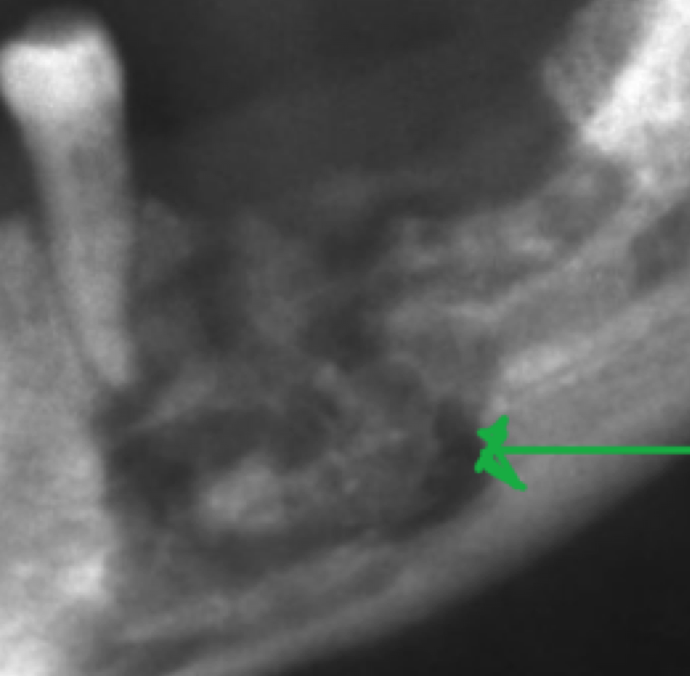
This shows osteomyelitis.
We can see the increased radiolucency (Uniform or patchy with a “moth-eaten appearance”)
What is osteomyelitis and how does it happen?
This is infection and inflammation of bone.
- invasion of Bacteria into the cancellous bone
- Resulting in soft tissue inflammation and oedema in the closed bony spaces.
- There is increased hydrostatic pressure
- Blood supply is compromised causing soft tissue necrosis.
- Bacteria proliferate because normal blood borne defences do not reach the tissues
What are the symptoms of osteomyelitis.
Feeling systemically unwell and Fever
tender area of extraction.
Altered sensation due to pressure on the IADN
Why is osteomyelitis more likely to occur in the mandible than the maxilla ?
The mandible has a poorer blood supply.
How do we treat osteomyelitis?
We refer the patient
This patient will then get a medical consultation then antibiotics and surgical treatment.
What is osteoradionecrosis ?
This is bone damage seen in patients who have recieved radiotherapy of the head and neck to treat cancer.
This results in:
- Bone within radiation beam becoming virtually non-vital.
- Reduced blood supply.
- Slow turnover of any remaining viable bone.
- Ineffective self repair of bone.
How do we routinely treat patients with osteradionecrosis?
Ensure mouth is clean prior to extraction (Scale and use chlorohexidine mouthwash)
Careful extraction technique
Consider antibiotics- if there is a secondary infection.
Use chlorohexidine (once the socket has healed)
What does this clinical image show?
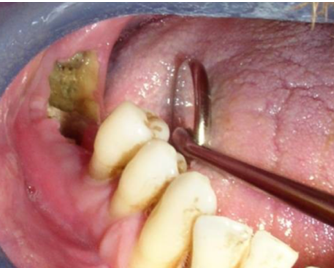
Medication related Osteonecrosis of the jaw OR osteoradionecrosis.
How do we know if a patient has osteoradionecrosis or MRONJ
You need to look at the patients medical history;
It is only osteoradionecrosis if the patient has had radiotherapy to treat head and neck cancer.
Otherwise it is Medication related osteonecrosis of the jaw. This can be caused by: Bisphosphonates, RANKL inhbitors e.g. Denosumab
and antiangiogenic e.g. Bevacizumab.
(So think patients with osteoporosis or cancer)
What is actinoymocosis and how do we treat it
This is a rare bacterial infection that erodes through tissues in areas of injury and susceptibility to produce thick lumpy pus.
We refer this for the patient to have an incision and pus drainage.
The patient is then prescribed antibiotics.
How do we grade MRONJ
0- jaw pain without clinically noticable cause.
1- asymptomatic exposed necrotic bone
2- symptomatic/ signs of infection.
3- Exposed bone extending out of the alveolar bone.

-
Radiography79
-
OS- instrument quiz16
-
OS-general anaesthetic in children16
-
OS- Complications & post-op instructions31
-
OS- basic surgical techniques11
-
OS- Analgesia31
-
OS- post extraction complications25
-
Caries69
-
Endodontics164
-
H&N- Week 1 (exterior Skull and spine)45
-
H&N week 2- Triangles of neck.41
-
H&N week 3- The face26
-
H&N week 4- Cranial cavity31
-
H&N week 5- CN & floor & base of cranial cavity36
-
H&N- week 6 (Brain & nerves)36
-
H&N week 7- Mandibular nerve & muscles of mastication34
-
H&N week 8- Mouth & submandibular27
-
H&N week 9- maxillary nerve, nasal cavity.40
-
H&N week 10- Pharynx & Soft palate.48
-
H&N week 11- Ear and Eye47
-
Anatomy FC- specimens14
-
Perio- Classification62
-
Perio textbook105
-
Paeds-behaviour22
-
Paeds-TP9
-
Paeds- prevention46
-
Paeds-trauma125
-
*****Paeds- child protection18
-
Paeds- SND18
-
PMHP-Changing behaviour8
-
DMS- porcelain8
-
DMS- Acrylic resin6
-
DMS-wrought alloys14
-
DMS-ceramics10
-
DMS-Elastomers4
-
DMS-investment materials20
-
DMS-luting agents30
-
DMS-temporary materials5
-
SC-disability & impairment35
-
SC-bariatric11
-
SC- haematology17
-
SC- Cardiology10
-
SC- Liver disease11
-
SC- Elderly33
-
SC- medical conditions7
-
SC-oncology29
-
HUMANS- rheumatology27
-
HUMANS- Neuralgia28
-
HUMANS- Pregnancy9
-
HUMANS- vaccinations10
-
HUMANS- psychiatric diseases27
-
OPTEC- inlays/onlays/veneers18
-
OPTEC- Treatment planning13
-
OPTEC- periodontal considerations28
-
OPTEC- Occlusion31
-
OPTEC-provisional restorations9
-
OPTEC- Tooth whitening37
-
ORTHODONTICS163
-
Orthodontics- upper removable appliances46
-
Microbiology in practice22
-
PAEDS- oral medicine28
-
PROS- Complete Dentures77
-
MEDICAL EMERGENCIES52



