A 40-year-old black female presents to the emergency room complaining of sudden onset of left sided periorbital pain and headache with the inability to open her left eye. Two weeks previously, she was seen in the emergency room complaining of severe diffuse headache and sent home with the diagnosis of tension headaches. On exam, she had no nuchal rigidity or photophobia. She was alert and oriented. She could not elevate her left eyelid or look medially. Her pupil was dilated and reacted minimally to light.
151 The MOST important first diagnostic study to perform would be:
A. serum angiotonase in converting enzyme level and sedimentation rate
B. Tensilon test
C. to obtain a history of diabetes or hypertension
D. CTscan
E. lumbar puncture
D. CTscan
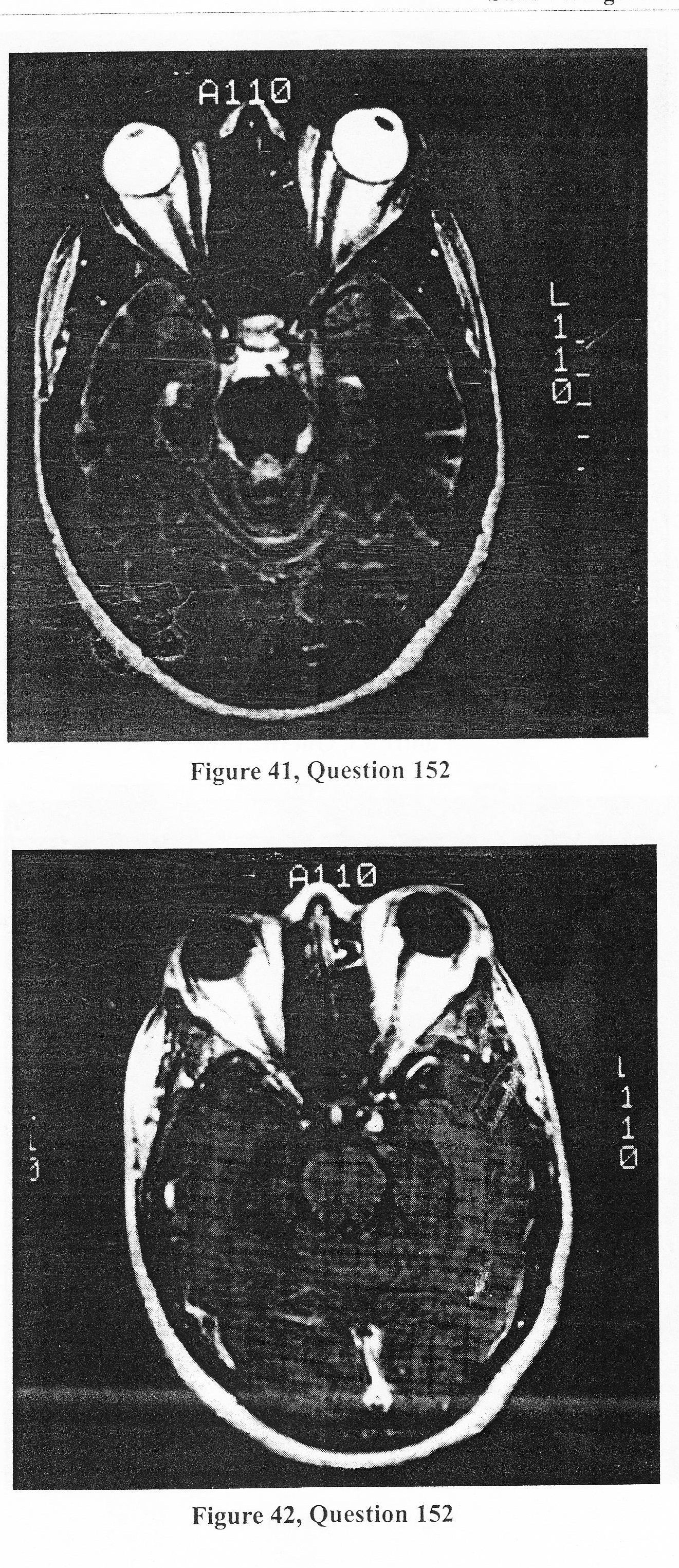
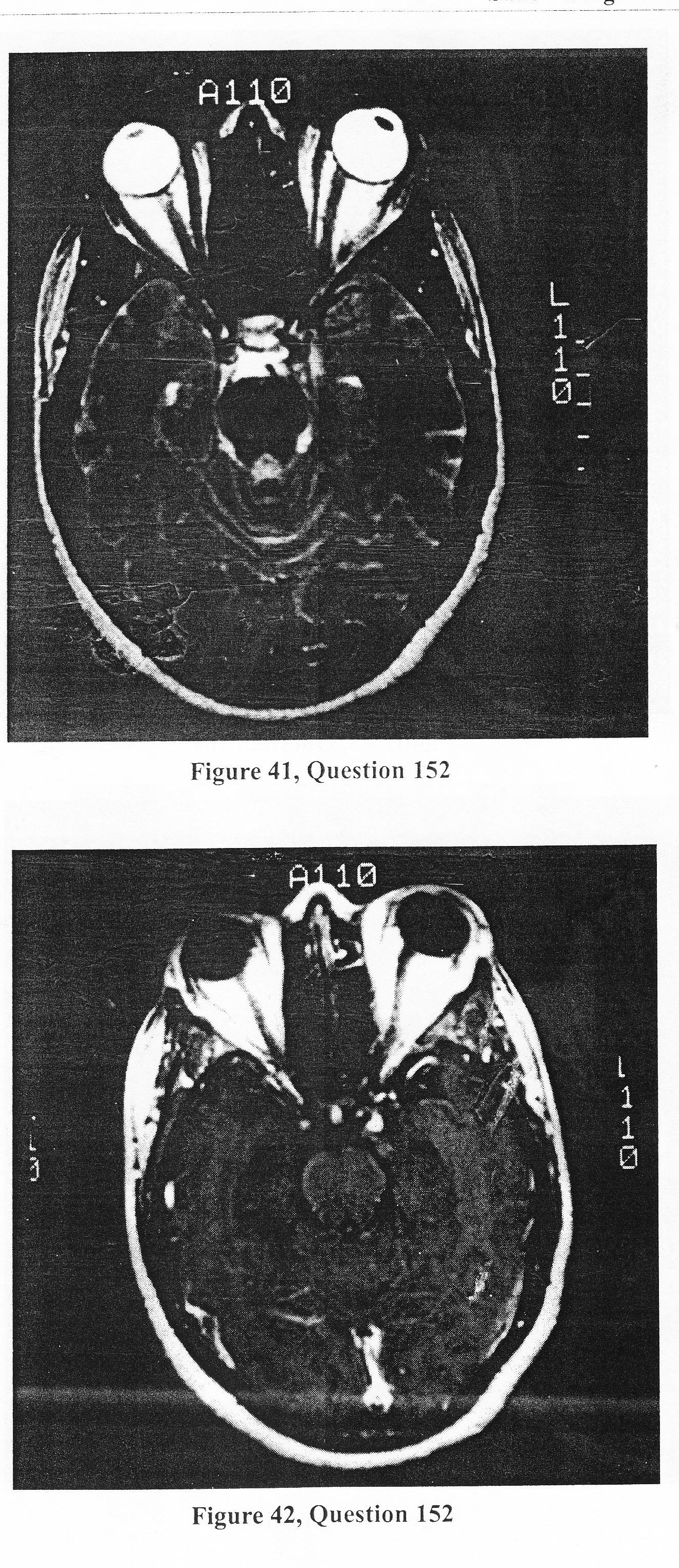
A 40-year-old black female presents to the emergency room complaining of sudden onset of left sided periorbital pain and headache with the inability to open her left eye. Two weeks previously, she was seen in the emergency room complaining of severe diffuse headache and sent home with the diagnosis of tension headaches. On exam, she had no nuchal rigidity or photophobia. She was alert and oriented. She could not elevate her left eyelid or look medially. Her pupil was dilated and reacted minimally to light.
- Figures 41 and 42 show MRIs of this patient. Based on this and the history, which is the BEST course of action?
A. Measure the patient’s blood pressure and perform a glucose tolerance test. Then reassure the patient that her neurologic deficit will most likely improve within one to three months.
B. Inform the patient she has a cavernous sinus mass that may lead to aberrant regeneration of the third cranial nerve.
C. The patient needs an angiogram to rule out a posterior communicating artery aneurysm
D. Absence of a structural lesion suggests no further evaluation is necessary at this point. .
C. The patient needs an angiogram to rule out a posterior communicating artery aneurysm.
A 10-year-old girl with myelodysplasia becomes hypotensive and difficult to ventilate during anesthesia for release of her tethered cord. Her mother had denied any allergy to medications. She is allergic to dust, pollen, and bee stings. Her lips and gums were swollen after a dental procedure last month.
- What is the MOST LIKELY cause of her hypotension?
A. anesthetic overdose
B. Latex allergy
C. antibiotic allergy
D. airway obstruction
E. myocardial infarction
B. Latex allergy
A 10-year-old girl with myelodysplasia becomes hypotensive and difficult to ventilate during anesthesia for release of her tethered cord. Her mother had denied any allergy to medications. She is allergic to dust, pollen, and bee stings. Her lips and gums were swollen after a dental procedure last month.
- Latex allergy is an IgE-mediated allergic reaction that can lead to intraoperative anaphylaxis. Which of the following DO NOT contain Latex?
A. surgery and examination gloves
B. multidose medication vial stoppers
C. intravenous tubing injection ports
D. clear disposable anesthesia masks and airway circuit tubing
E. Foley catheters
D. clear disposable anesthesia masks and airway circuit tubing
A 10-year-old girl with myelodysplasia becomes hypotensive and difficult to ventilate during anesthesia for release of her tethered cord. Her mother had denied any allergy to medications. She is allergic to dust, pollen, and bee stings. Her lips and gums were swollen after a dental procedure last month.
- Which of the following groups is NOT at high risk for Latex allergy?
A. patient with ventriculoperitoneal shunts for aqueductal stenosis
B. health care workers
C. patient with myelodysplasia
D. patient with congenital urinary tract abnormalities
A. patient with ventriculoperitoneal shunts for aqueductal stenosis
A 4-month-old baby boy presents to your office for an abnormally shaped head. The infant tends to hold his head turned to the right and has a flat occiput on the right. The right ear is anterior to the left in the axial plane and the right forehead is more prominent than the left, as is the malar eminence on the right.
- What is the CAUSE of this abnormality?
A.skull molding
B. sagittal suture stenosis
C. right lambdoid suture stenosis
D. left lambdoid suture stenosis
E. coronal suture stenosis
A.skull molding
A 4-month-old baby boy presents to your office for an abnormally shaped head. The infant tends to hold his head turned to the right and has a flat occiput on the right. The right ear is anterior to the left in the axial plane and the right forehead is more prominent than the left, as is the malar eminence on the right.
- What is the NEXT STEP in treating this abnormality?
A. surgery to correct the depressed area
B. three-dimensional CT scan to evaluate the sutures
C. no treatment, it will correct itself instruction to the parents about the cause of the problem and to keep the child off the flat area
C. no treatment, it will correct itself instruction to the parents about the cause of the problem and to keep the child off the flat area
- The incidence of open spina bifida, myelocele, and myelomeningocele has decreased over the past decade. Prior to the 1980s the incidence was 1-2 per 1,000 live births. What is the current incidence of spina bifida?
A. 8 per 10,000 live births
B. 6 per 10,000 live births
C. 3 per 10,000 live births
D. 1 per 10,000 live births
C. 3 per 10,000 live births
- Several new shunt valves have been released in the past several years. Which of the following is NOT a differential pressure valve?
A. Medusa programable valve
B. Cordis Orbis-Sigma valve
C. P/S Medical Delta valve
D. The Denver shunt
B. Cordis Orbis-Sigma valve
- Which of the following valves HAS a siphon control device integral to the valve?
A. Medusa programable valve
B. Cordis Orbis-Sigma valve
C. P/S Medical Delta valve
D. The Denver shunt
C. P/S Medical Delta valve
- The mother of one of your patients with a neural tube defect is six weeks pregnant. What advice can you give her, at this time, to DECREASE the risk of a neural tube defect in this child?
A. take large doses of folic acid
B. avoid hot tubs and fever
C. nothing; the defect occurs in the first month after conception
D. eat healthy
C. nothing; the defect occurs in the first month after conception
A 65-year-old male presents with the complaint of difficulty walking, especially long distances. His spouse thinks his memory is a little slower, but no worse than hers. He has to hurry to the bathroom, but has no incontinence. He has no pain. His strength is normal. His gait is shuffling. His reflexes are 2-3/4. There are no pathological reflexes.
- What work-up should be done for this man?
A. EMG and nerve conduction study of bilateral lower extremities
B. MRI brain and cervical spine
C. CT scan of the head and isotope cisternogram
D. MRI of the lumbar spine
B. MRI brain and cervical spine
A 65-year-old male presents with the complaint of difficulty walking, especially long distances. His spouse thinks his memory is a little slower, but no worse than hers. He has to hurry to the bathroom, but has no incontinence. He has no pain. His strength is normal. His gait is shuffling. His reflexes are 2-3/4. There are no pathological reflexes.
- Which factor is MOST accurate in determining success from shunting in a patient with ventriculomegaly and symptoms and signs of normal pressure hydrocephalus?
A. the clinical history
B. isotope cisternogram
C. MRI scan
D. lumbar puncture
A. the clinical history
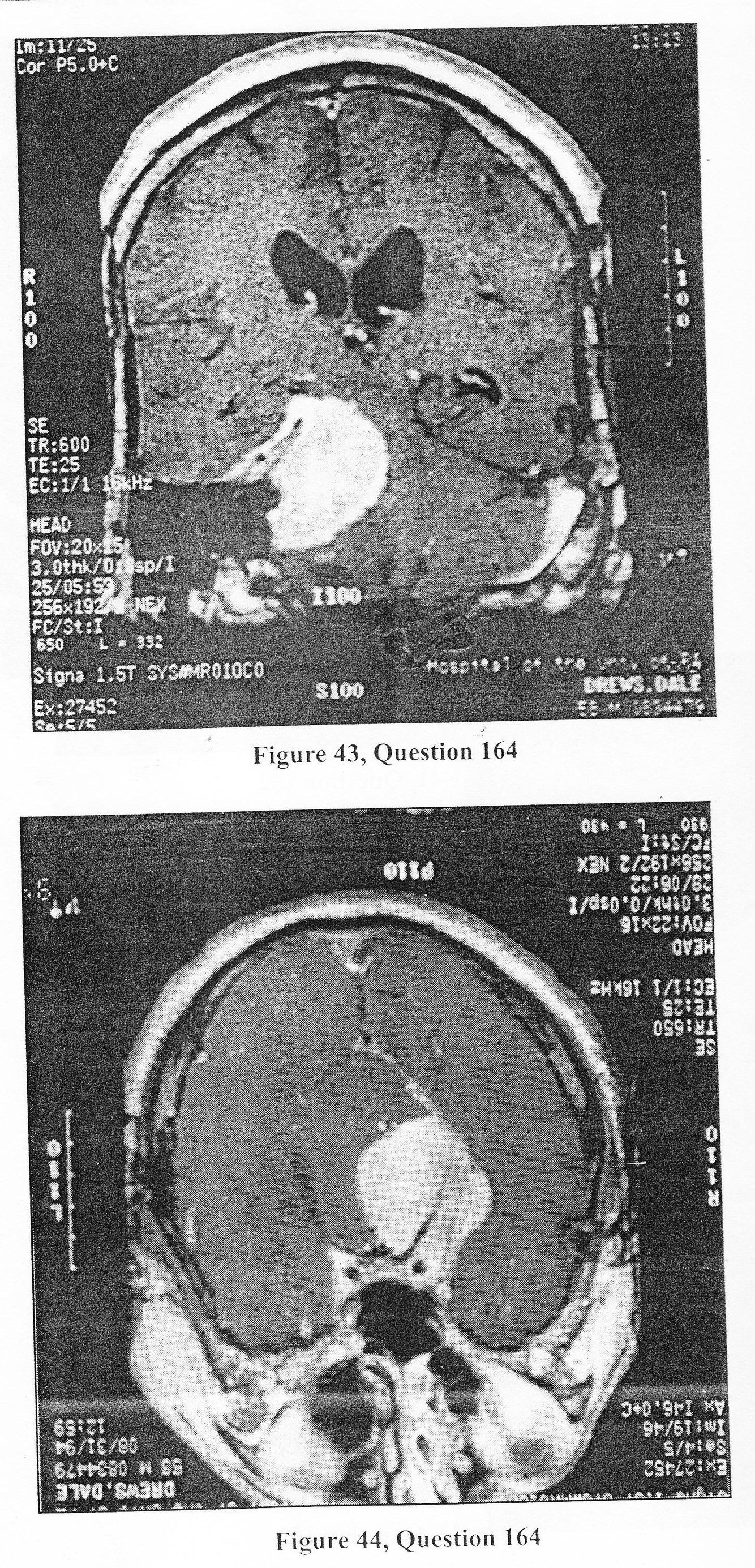
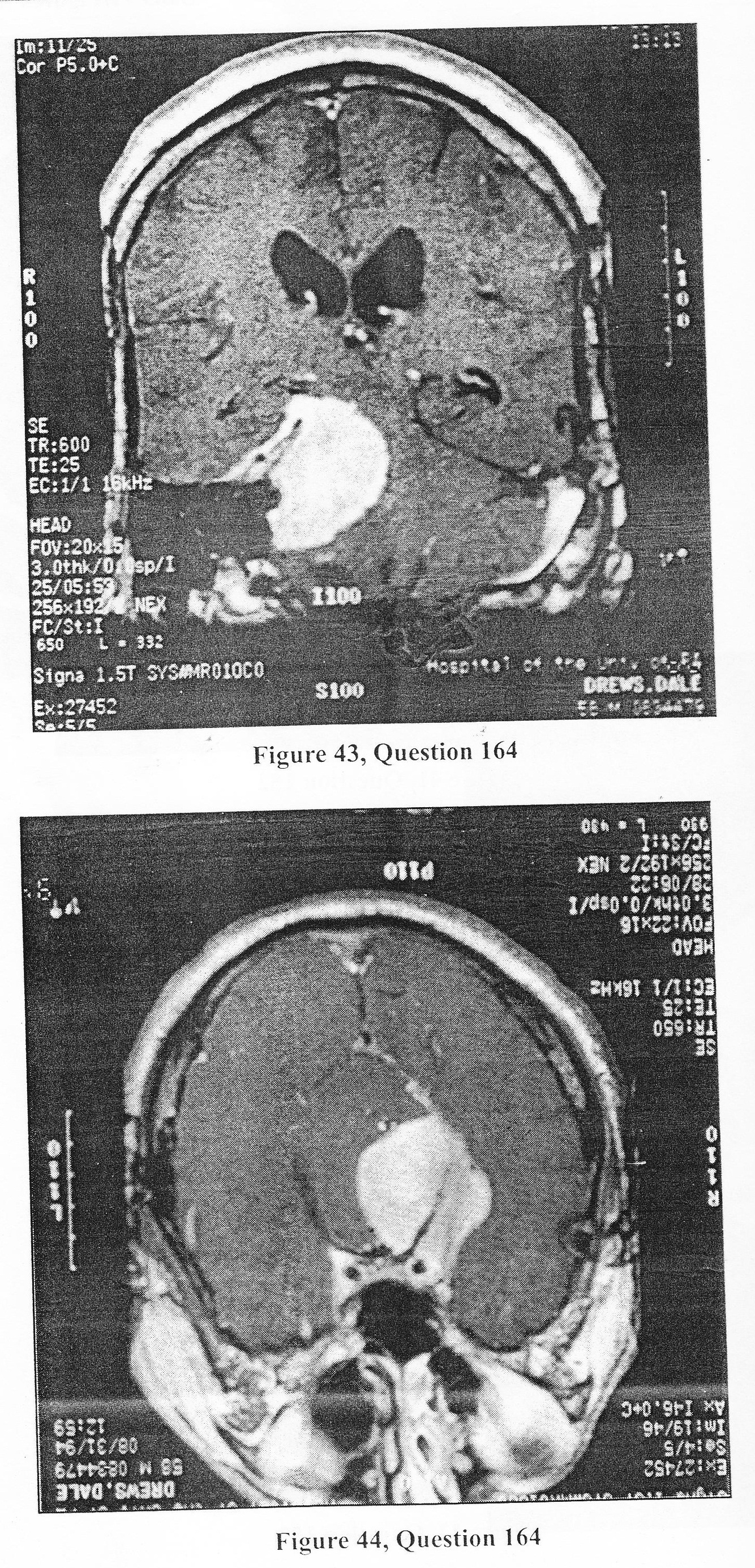
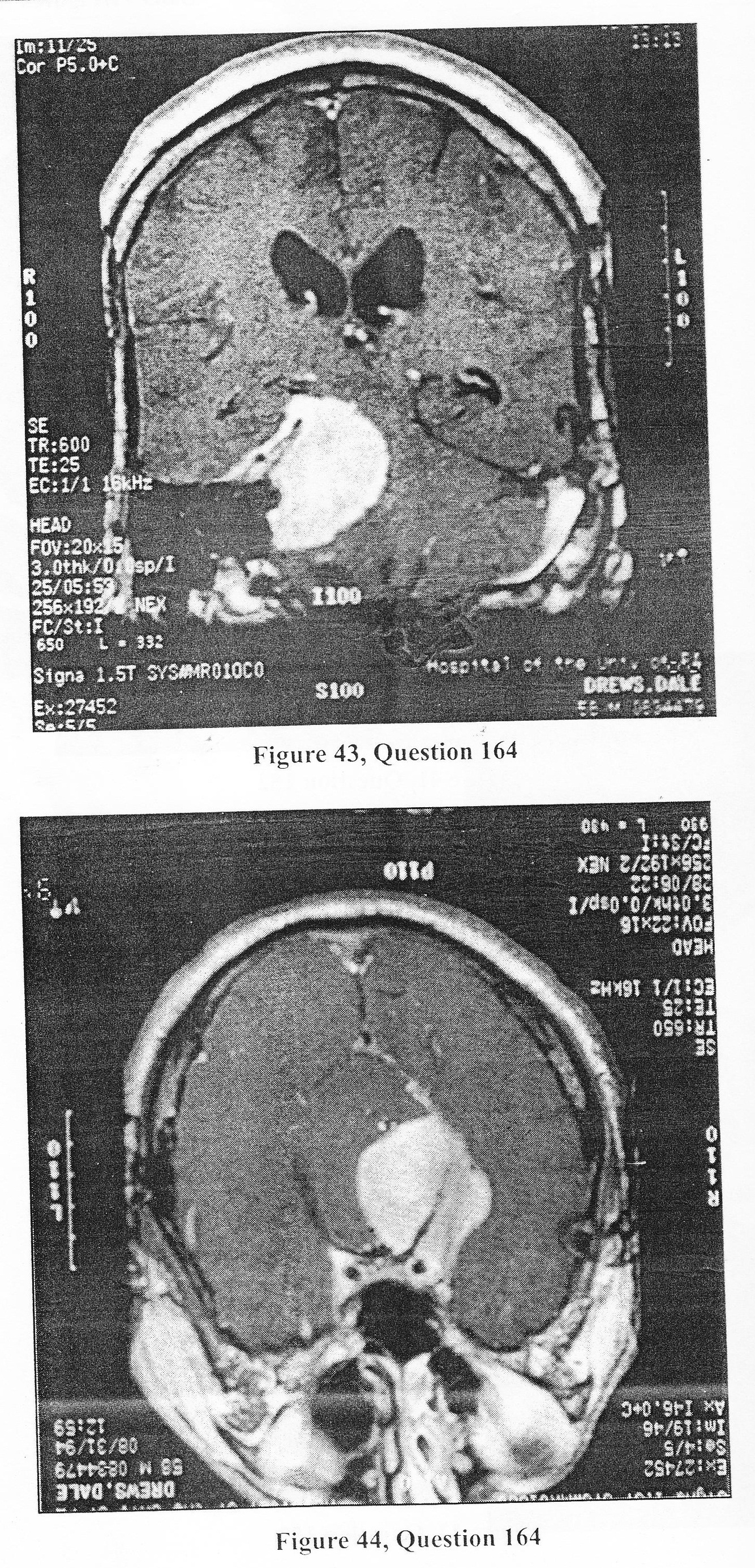
55-year-old man who was otherwise healthy presented with approximately 2-3 months of progressive diplopia, right-sided facial numbness, and ataxia. Neurologic examination was normal, with the exception of a right-sided sixth nerve palsy, decreased corneal reflex on the right, and an extensor Babinski response on the left side. His gait is ataxic. Figures 43 and 44 depict coronal and axial MRI examinations on this patient.
- The patient’s MRI findings are consistent with:
A. pontine glioma
B. petroclival meningioma
C. giant basilar aneurysm
D. clival chordoma
E. none of the above
B. petroclival meningioma
55-year-old man who was otherwise healthy presented with approximately 2-3 months of progressive diplopia, right-sided facial numbness, and ataxia. Neurologic examination was normal, with the exception of a right-sided sixth nerve palsy, decreased corneal reflex on the right, and an extensor Babinski response on the left side. His gait is ataxic. Figures 43 and 44 depict coronal and axial MRI examinations on this patient.
- Additional diagnostic tests which should be obtained include:
A. audiogram
B. CT scan of the temporal bone
C. cerebral angiography
D. all of the above
E. none of the above
D. all of the above
55-year-old man who was otherwise healthy presented with approximately 2-3 months of progressive diplopia, right-sided facial numbness, and ataxia. Neurologic examination was normal, with the exception of a right-sided sixth nerve palsy, decreased corneal reflex on the right, and an extensor Babinski response on the left side. His gait is ataxic. Figures 43 and 44 depict coronal and axial MRI examinations on this patient.
- The best surgical option for this patient at this time is:
A. extended subfrontal approach (bifrontal craniotomy by bilateral orbital osteotomy and transethmoidal/ transclival resection of tumor)
B. subtemporal/infratemporal fossa approach (frontotemporal craniotomy, zygomatic osteotomy, and transcavernous resection of tumor)
C. petrosal approach (combined supratentorial/subtemporal and infratentorial/presigmoid craniectomy and transtentorial resection of tumor)
D. extreme lateral transcondylar resection approach and resection of meningioma
C. petrosal approach (combined supratentorial/subtemporal and infratentorial/presigmoid craniectomy and transtentorial resection of tumor)
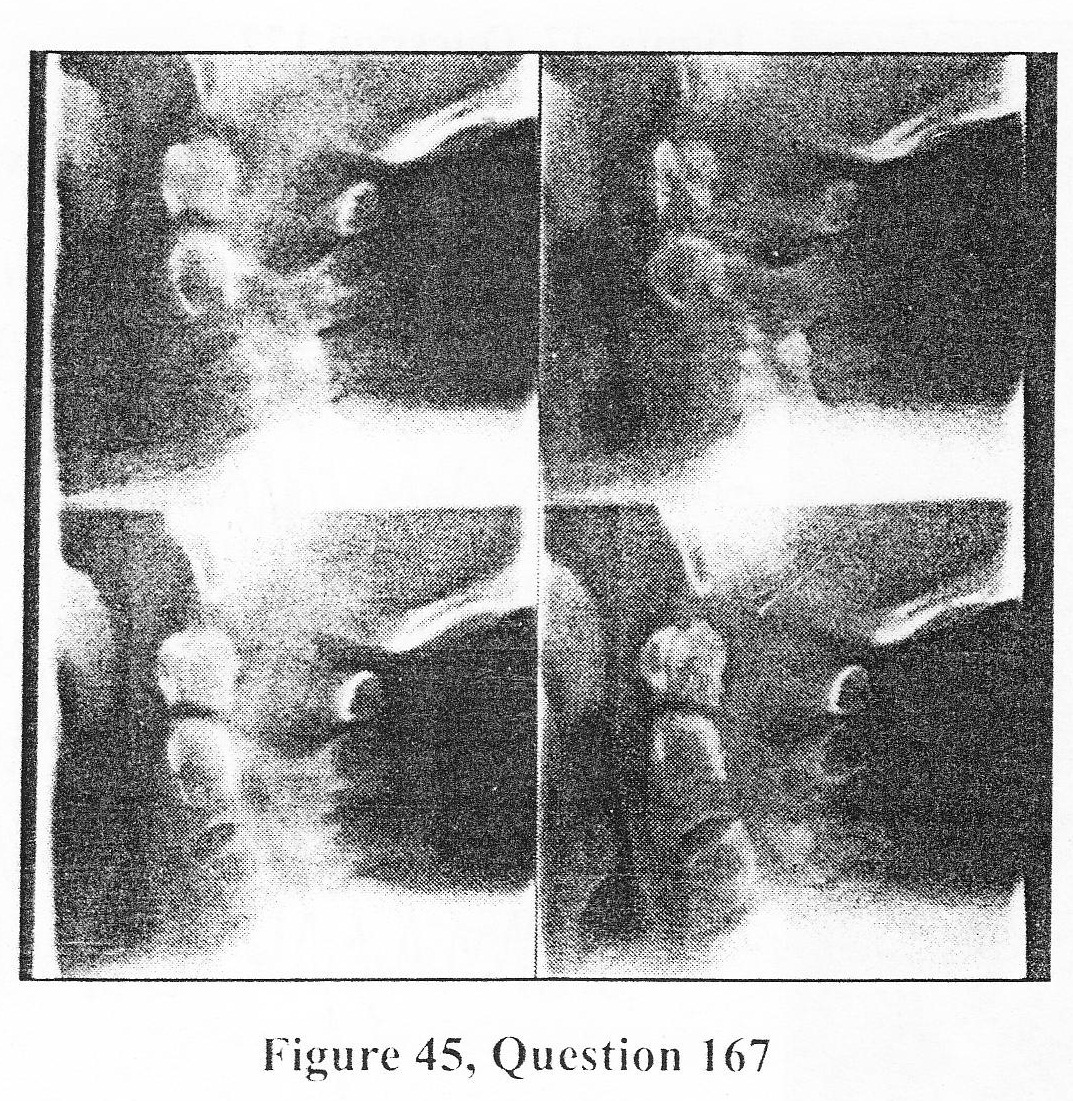
- While fishing, a 24-year-old male falls, striking his occiput. His neurological exam is normal. Tomograms of his cervical spine are shown in Figure 45. Regarding the abnormality demonstrated on the radiographs, which of the following statements is CORRECT?
A. There is a tear of the transverse ligament.
B. There is a high rate of non-union.
C. A chronic myelopathy is unlikely to develop.
D. There is a greater than 90% incidence of associated neurologic injury.
E. Surgery is mandatory in the management of this fracture injury.
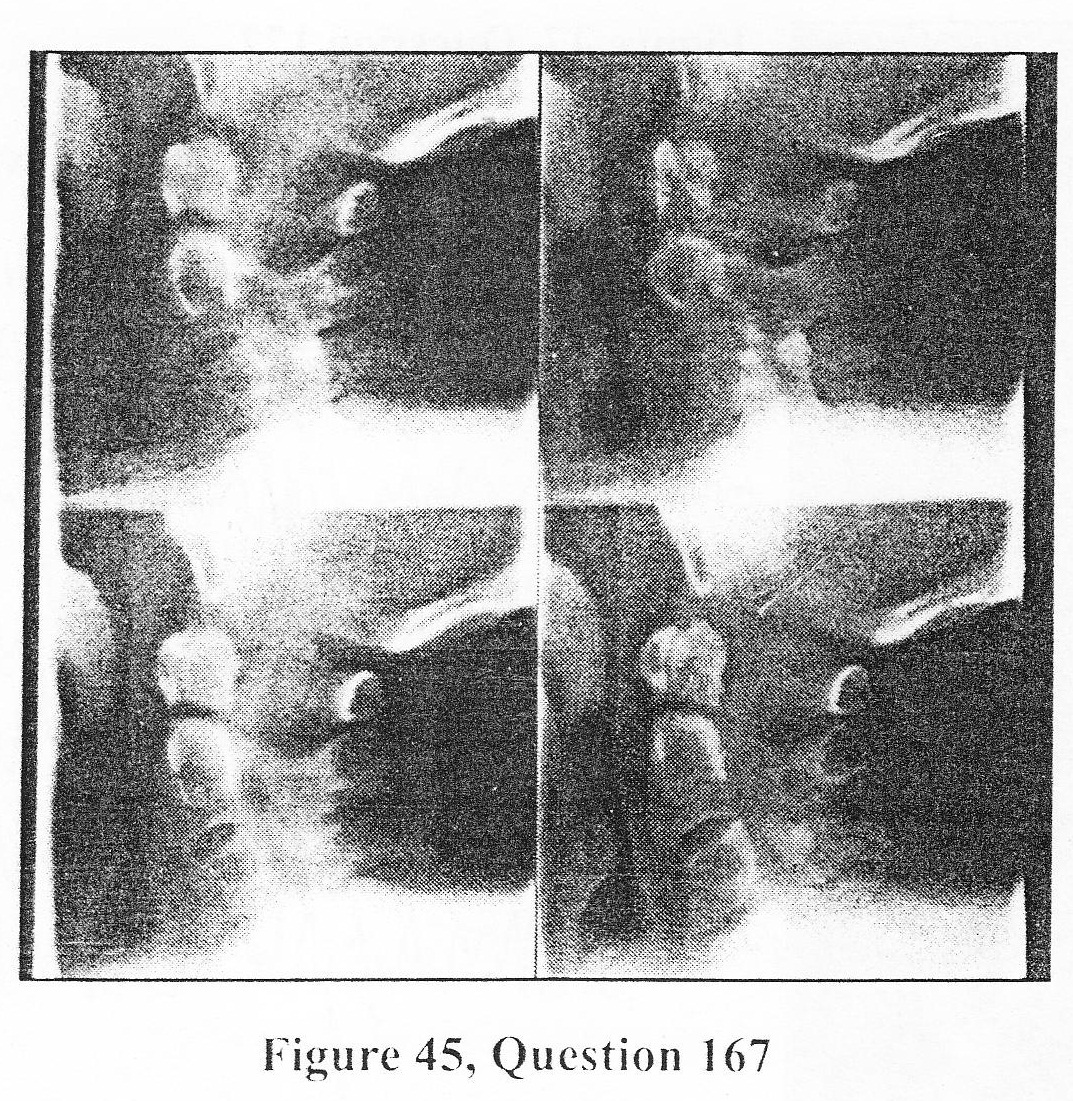
B. There is a high rate of non-union.
- Which of the following is NOT an appropriate treatment consideration?
A. halo ring-vest fixation
B. CI laminectomy
C. anterior screw fixation of the odontoid
D. posterior fusion of CI-2 with wire
E. posterior fusion of CI-2 with transarticular screws
B. CI laminectomy
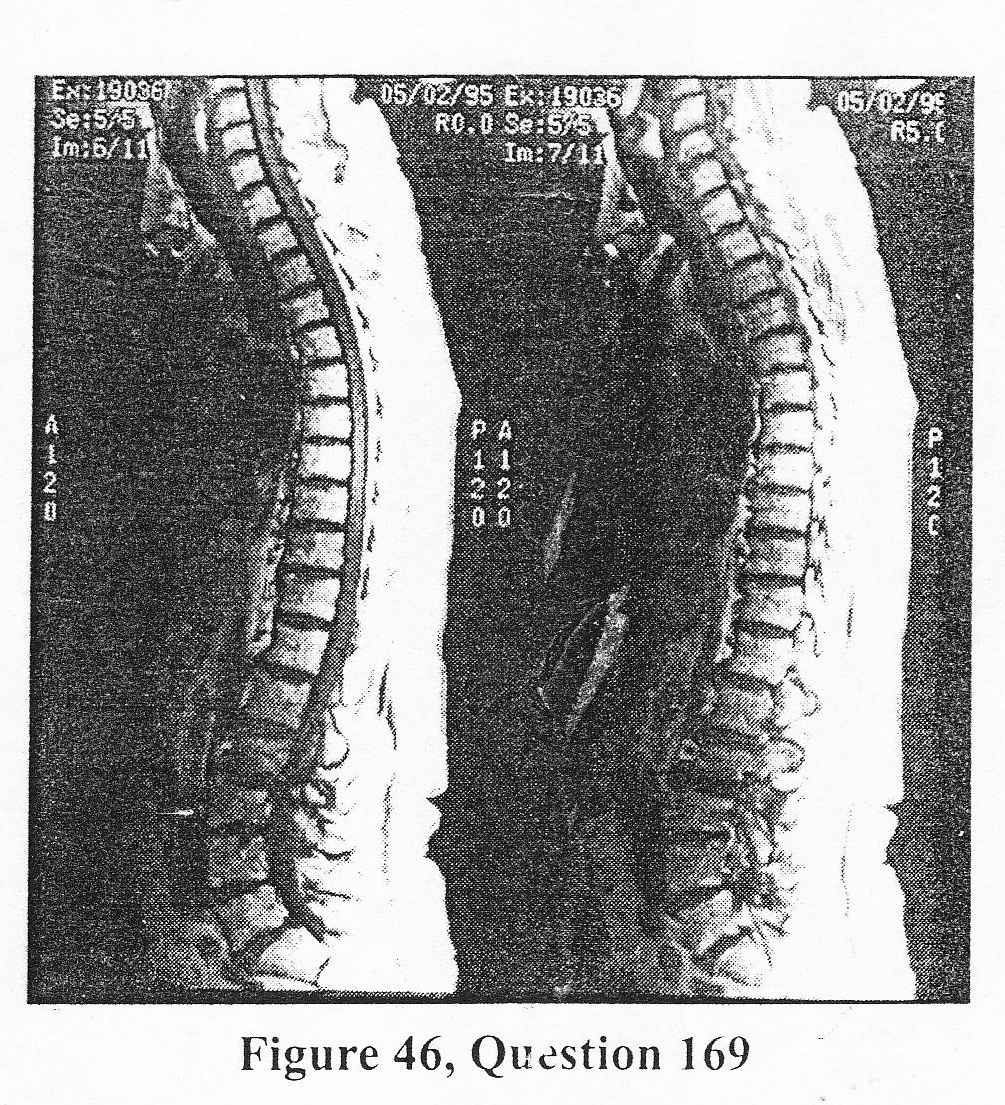
- A 75-year-old woman presents with progressive gait difficulties of one year duration. Her neurologic exam demonstrates lower extremity weakness, poor joint position sense in her feet, and upgoing toes. A head MRI study and CSF examination are normal. An MR of the thoracolumbar spine is depicted in Figure 46. The BEST possible diagnosis is:
A. spinal dural arteriovenous fistula
B. multiple sclerosis
C. thoracic disc disease
D. neurosyphilis
E. motor neuron disease
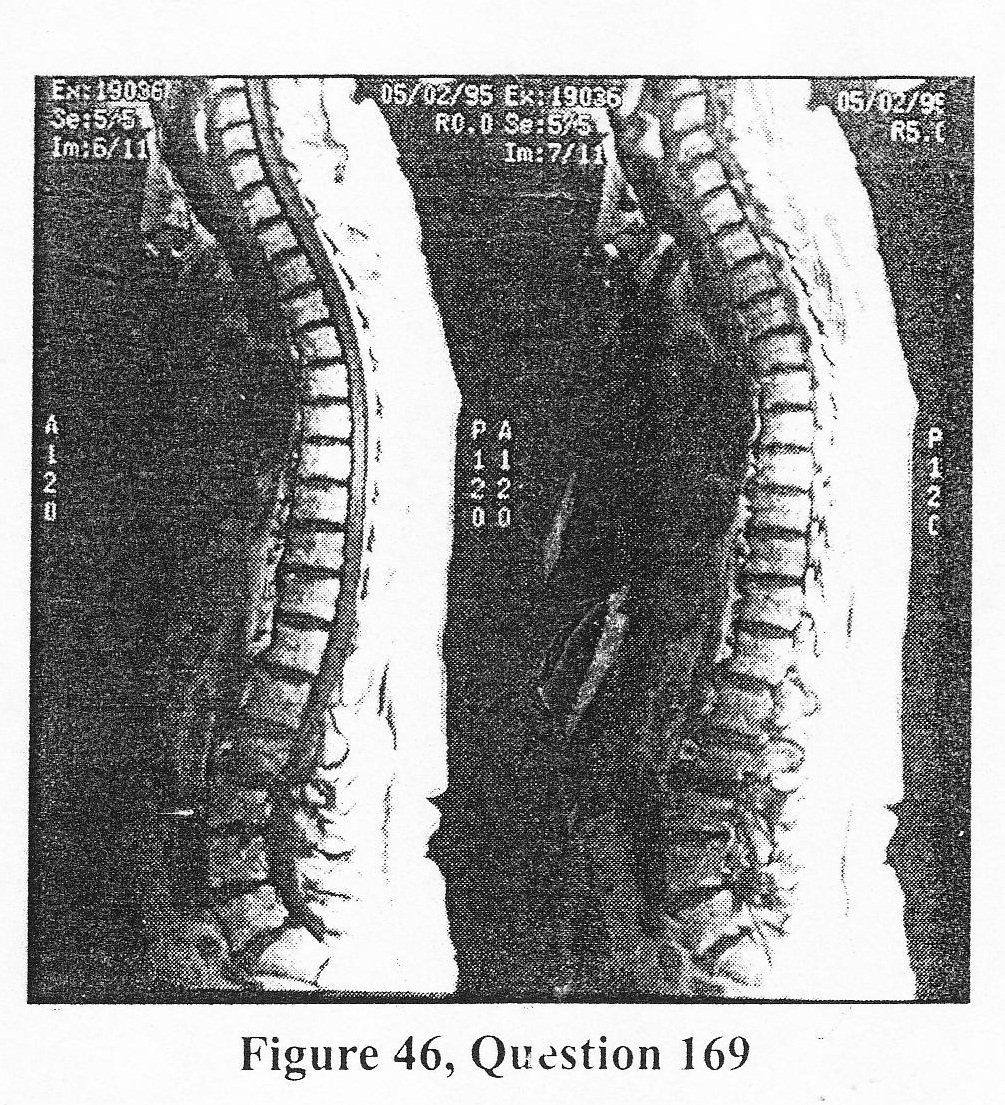
A. spinal dural arteriovenous fistula
- Which of the following studies is most LIKELY to be diagnostic?
A. spinal angiography
B. head MRI
C. electromyography
D. evoked potential studies
E. serum rapid plasmin reagin
A. spinal angiography
- Regarding the anatomy of the L4 pedicle, which of the following is NOT TRUE?
A. It is located at the same level as the L4 transverse process.
B. It is oriented roughly 20 degrees from the midline in the sagittal plane.
C. It is located closer to the L4/5 facet than the L3/4 facet.
D. Its diameter is larger in the superior-inferior dimension than in the medial-lateral dimension.
E. The L4 nerve root is closely opposed to its medial and inferior surfaces
C. It is located closer to the L4/5 facet than the L3/4 facet.
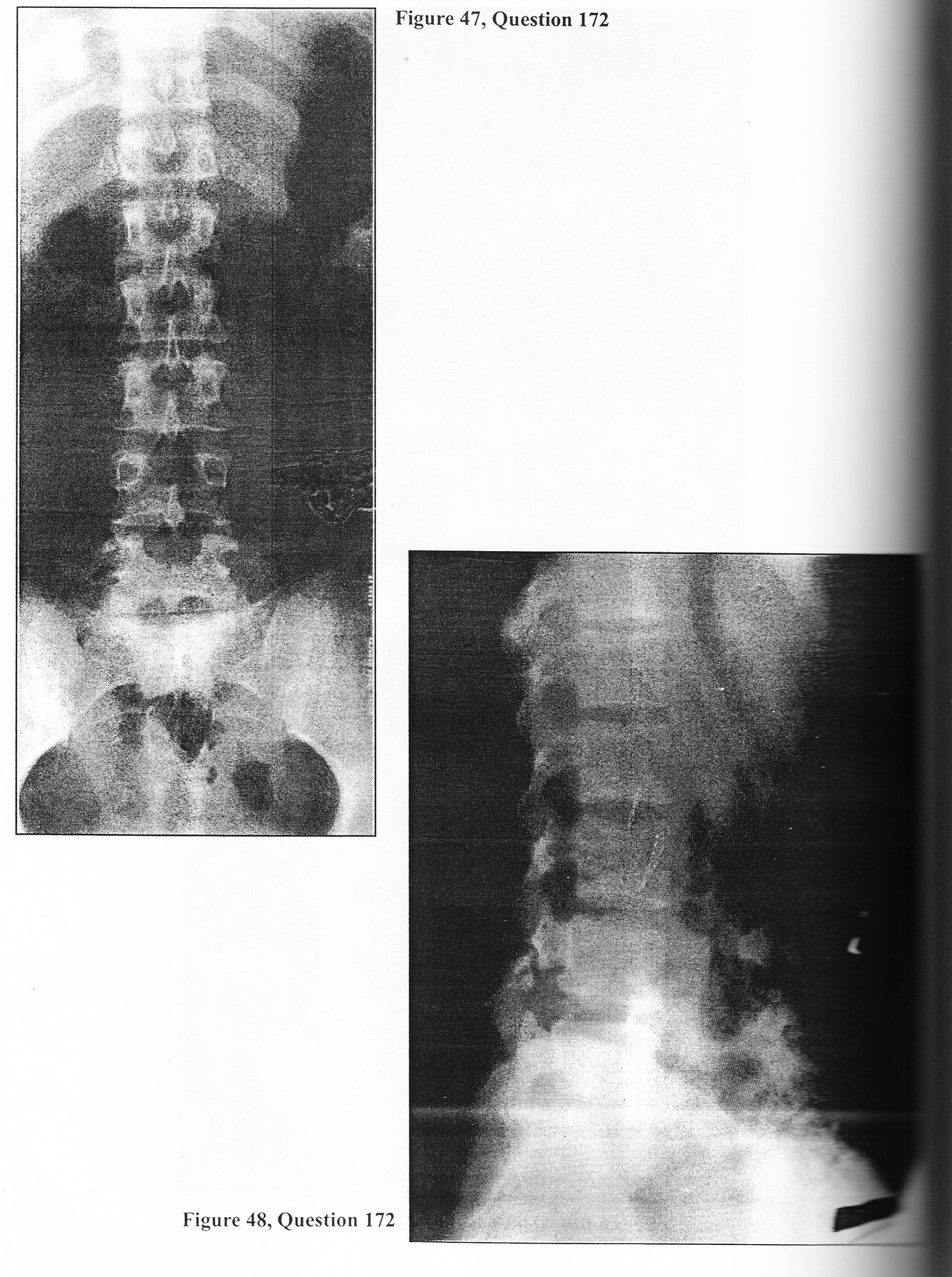
A 26-year-old male presents complaining of a two-year history of gradually progressive low back pain. It has been intermittent in nature, aggravated by physical activity, and relieved by rest. His most recent exacerbation occurred one month ago during a triathalon. The pain remains localized to the low back region with radiation into both buttocks but not the legs. He can no longer participate in his usual sports because of discomfort. Physical examination reveals the young man to be neurologically intact. Straight- leg raising and femoral stretch testing are normal. There is no clinical evidence of kyphoscoliosis. There is no joint tenderness. Range of motion of the lumbar region is normal. Plain x-rays accompany the patient (Figures 47 and 48). 172. At this point you WOULD:
A. prescribe anti-inflammatory and analgesic medications, reduced activity, and external bracing
B. obtain a lumbar MRI
C. place the patient on bed rest with bathroom privileges for three weeks
D. order a thoracolumbar spinal orthosis with a hip spica
E. all of the above
A. prescribe anti-inflammatory and analgesic medications, reduced activity, and external bracing
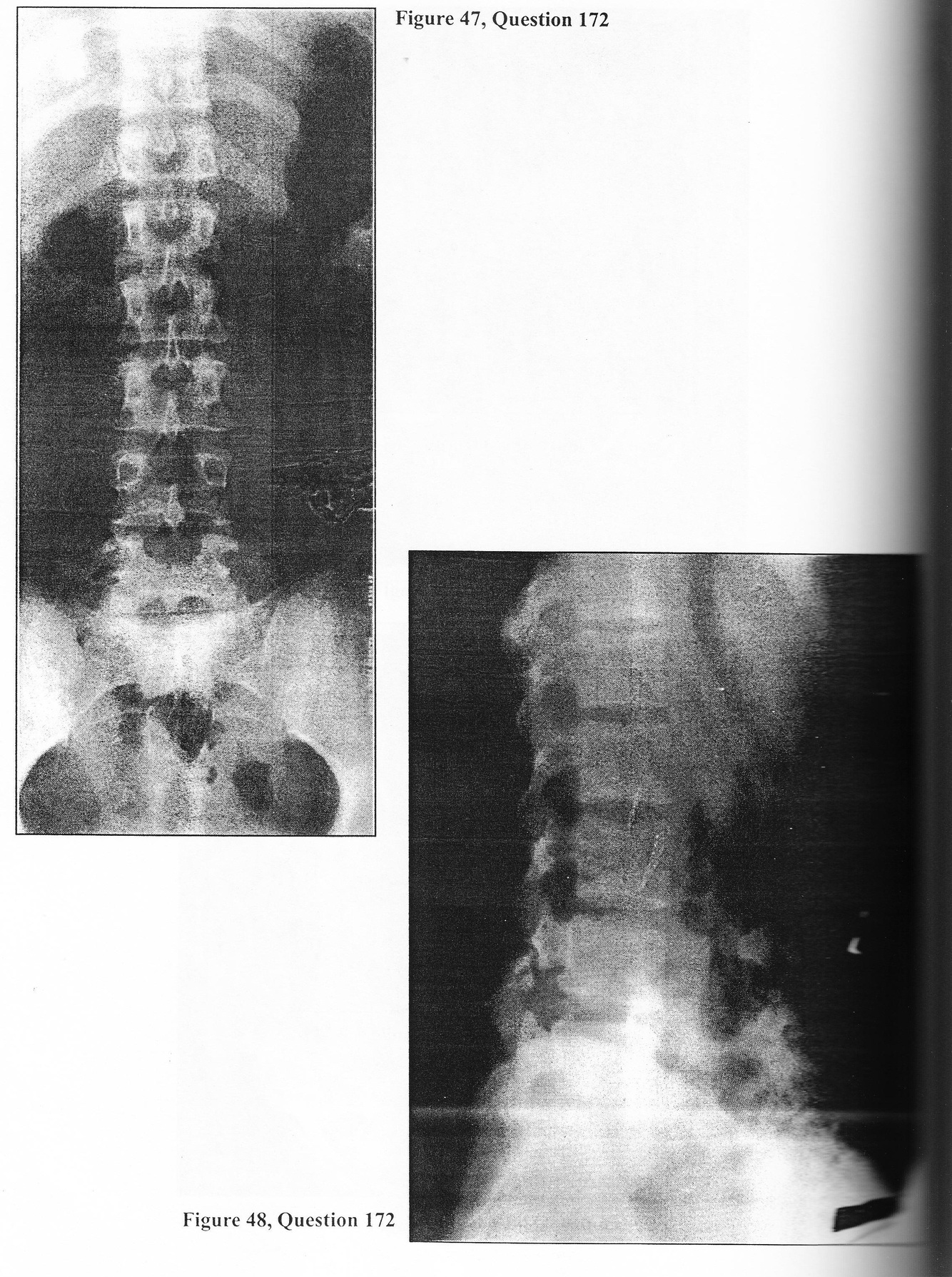
A 26-year-old male presents complaining of a two-year history of gradually progressive low back pain. It has been intermittent in nature, aggravated by physical activity, and relieved by rest. His most recent exacerbation occurred one month ago during a triathalon. The pain remains localized to the low back region with radiation into both buttocks but not the legs. He can no longer participate in his usual sports because of discomfort. Physical examination reveals the young man to be neurologically intact. Straight- leg raising and femoral stretch testing are normal. There is no clinical evidence of kyphoscoliosis. There is no joint tenderness. Range of motion of the lumbar region is normal. Plain x-rays accompany the patient (Figures 47 and 48).
- Four weeks later, the patient’s pain has improved, but the pain returned during a gradual return to a modified exercise program, but with radiation into both legs. Repeat physical examination reveals mild weakness in knee flexion bilaterally with diminished hamstring reflexes. Management at this time WOULD INCLUDE:
A. flexion and extension lateral lumbar radiographs
B. obtain tomograms of the lumbar spine
C. perform a bone scan
D. draw blood cultures and an erythrocyte sedimentation rate
E. lumbar puncture
A. flexion and extension lateral lumbar radiographs
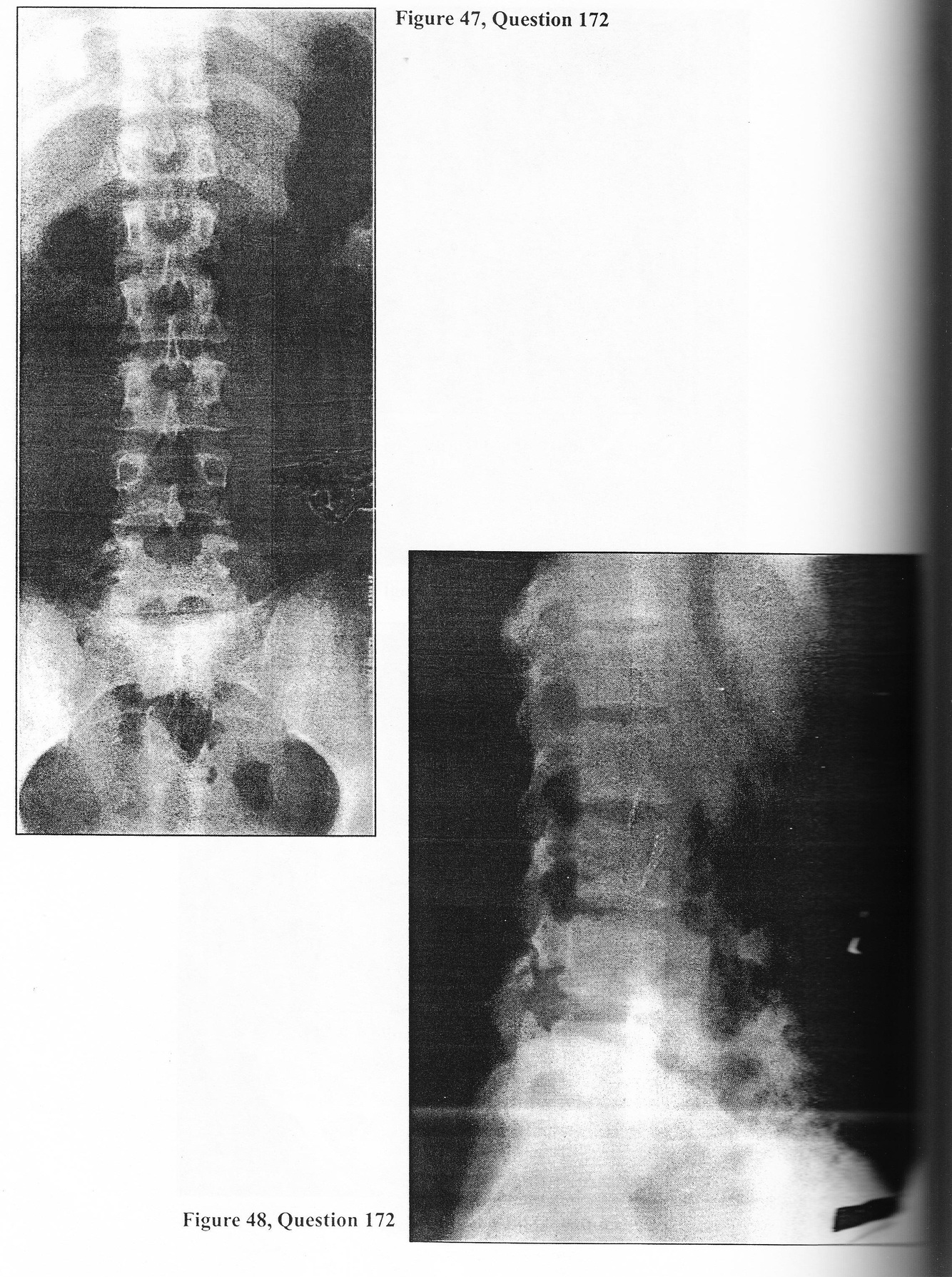
A 26-year-old male presents complaining of a two-year history of gradually progressive low back pain. It has been intermittent in nature, aggravated by physical activity, and relieved by rest. His most recent exacerbation occurred one month ago during a triathalon. The pain remains localized to the low back region with radiation into both buttocks but not the legs. He can no longer participate in his usual sports because of discomfort. Physical examination reveals the young man to be neurologically intact. Straight- leg raising and femoral stretch testing are normal. There is no clinical evidence of kyphoscoliosis. There is no joint tenderness. Range of motion of the lumbar region is normal. Plain x-rays accompany the patient (Figures 47 and 48).
- The MOST LIKELY cause(s) for this patient’s condition is (are):
A. hereditary
B. traumatic
C. degenerative
D. none of the above
E. all of the above
E. all of the above






