What are functional brain systems
Networks of neurons that work together & span wide areas of brain
– Limbic system
– Reticular formation
–Direct & Indirect pathways of the basal nuclei
describe the limbic system, what are the general functions?
- Structures from medial cerebral hemispheres & diencephalon
- Cerebral structures encircle (limbus=ring) superior brainstem
- General functions are:
- Establish emotional states
- Linking conscious, intellectual functions of cerebral cortex with unconscious & autonomic functions of brain stem
- Facilitating memory storage & retrieval
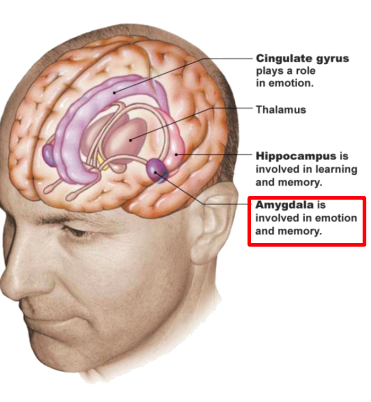
what is the amygdala
structure of limbic system
- Almond-shaped nucleus, anterior to tail of caudate & deep in medial temporal lobes
– Critical for responding to perceived threats
– Required for emotional memory
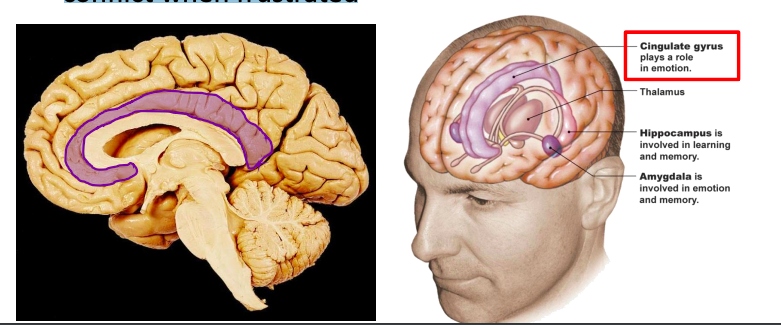
What is the cingulate gyrus
- part of limbic system
– Located along medial aspects of cerebral hemispheres next to corpus callosum
– role in responding to perceived threats, expressing emotions via gestures, & resolves mental conflict when frustrated
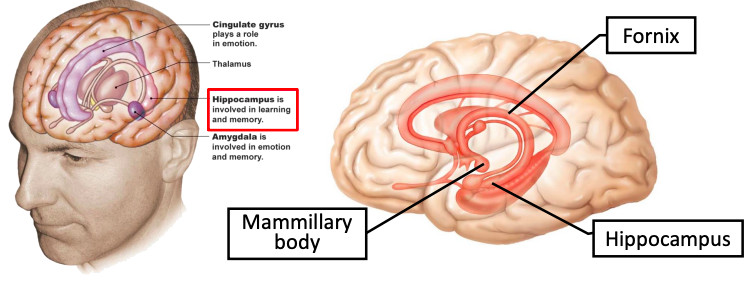
What is the hippocampus
part of limbic system
- located in medial temporal lobe
- Connected to mammillary bodies of hypothalamus via white matter (Fornix)
– Plays a role in learning, memory & emotion
how is the limbic system involved in emotion and cognition
Limbic system interacts with prefrontal lobes:
– Can react emotionally to things we consciously understand to be happening
– Are consciously aware of emotional richness in our lives
has:
- diencephalon structures, fiber tracts (white matter) and cerebral structures
Decribe reticular formation
- 3 braod columns along length of brain stem
- has far-flung aconal connections w/ hypothalamus, thalamus, cerebral cortx, cerebellum, spinal chord
Motor function: (some)
- regulate visceral motor functions (vasomotor, cardiac and respiratory centers)
- helps control coarse limb movements
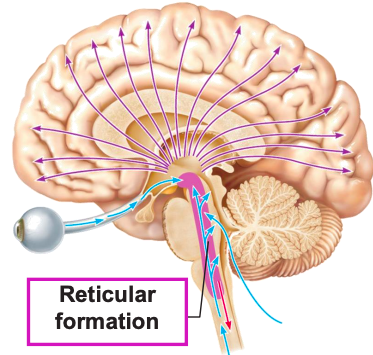
What is RAS
reticular activating system
*keeps your conscious
- sends impulses to cerebral cortex to keep conscious, alert and enhance excitabiltiy
- filters out repetitive & weak stimuli (99%)
- LSD interfers with sensory dampers, promoting and overwhelming sensory overload
- inhibited my sleep centers of hypothalamus and other neural regions
- Depressed by alcohol, sleep inducing drugs and tranquilizers
- aka cant keep cortex active
- Severe injurt results in premanent unconsciousness
Describe consciousness
- involves simultaneous activity of alrge areas of the cerebral cortex
- > conscious perception of sensation,
- > voluntary initiation and control of movement
- > capabilities associated with higher mental processing (memory, logic, judgement etc)
- defined on continum that grades behaviour in response to stimulse:
1. Alertness, 2. Drowsiness 3. Stupor (severely intoxicated) 4. Coma
What is sleep
- State of partial unconsciousness -> can be aroused by stimulation
- Alternating cycles of sleep & wakefulness reflect a natural circadian rhythm
- RAS activity is inhibited during sleep (however RAS also mediates dreaming)
*RAS not “turned off” bc still has a role
• Suprachiasmatic & preoptic nuclei of hypothalamus time sleep cycle
–> Releases peptide orexins which activate reticular formation (“wake-up” chemical)
*orexins accumulate as sleep goes on
what are the types of sleep
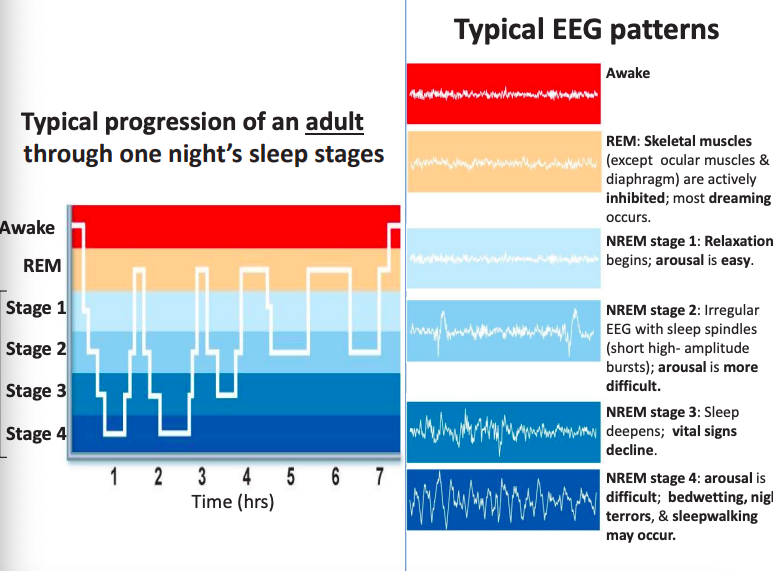
2 major types of sleep: nonrapid eye movement (NREM) and Rapid eye movement (REM)
- Typical sleep pattern alternates between REM & NREM sleep
Describe the importance of sleep
- Slow-wave sleep (NREM stages 3 & 4) presumed to be restorative stage
*Sleep deprived people spend more time in these stages •
People deprived of REM sleep become moody & depressed & exhibit various personality disorders
– >REM sleep may give brain the opportunity to work through emotional problems in dream imagery
- REM sleep may be a reverse learning process purge useless info
- Enhances immune system: Sleep inducing factors include Interlukin-1, interferon, serotonin & tumor necrosis factor
Describe memory
- storage and retrieval of info
- 2 stages of storage
1. Short term memory: temporary holding of info, limited to 7-8 pieces of info
2. Long term memroy: limitless capacity
How is info transfered from STM to LTM
Factors that affect transfer from STM to LTM
- Emotional state:best if alert, motivated, surprised, & aroused
- Rehearsal: repetition & practice
- Association: tying new information with old memories
- Automatic memory: subconscious information stored in LTM
Describe the molecular basis of memory
during learning:
- > alterned mRNA is synthesized and moved to axons and dendrites
- dendritic spines change shape
- extracellular protiens are deoposited at synapses involved in LTM
- number & size of presynaptic terminals may increase
- More neurotransmitter is released by presynaptic neurons
* memory goes backwards: Axons -> dendrities, strengthens circuits to make AP generation easier (like drawing over a shape over and over)
WHat are teh categories of memory
- declarative (explicit) and non declarative (implicit)
Declarative: semantic (facts), episodic (events), spatial (locations) memory
*aka I know this info
Nondeclarative (implicit): emotional, motor, proecdural (how to do things) memory
*aka more motore based, harder to put into words
What is declarative memory?
- Related to conscious thoughts & language ability
- Stored in LTM with context in which it was learned
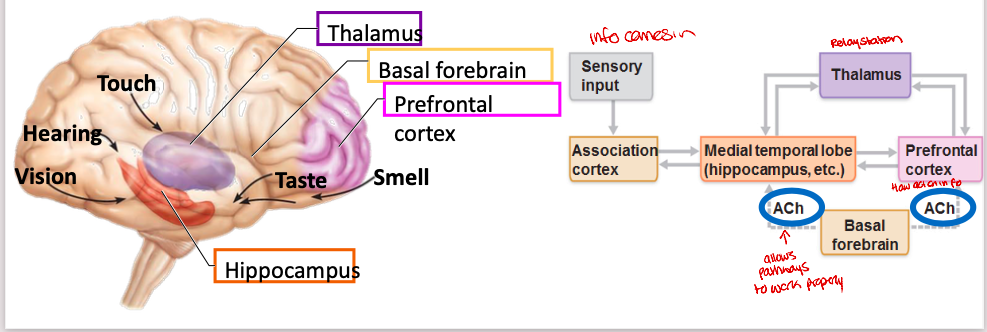
- Hippocampus & surrounding temporal lobes function in consolidation & access to memory
- ACh from basal forebrain is necessary for memory formation & retrieval
* Info comes in (sensory input) -> association cortex medial temporal lobe (hippocampus)
then can go to thalamus (relay station) OR prefrontal cortex (how to act on info)
*Ach is what allows pathways to work properly
What is nondeclarative memory?
*remember by doing, harder to undo
- Less consciour or unconscious
- aquired through experience and repetition (best remembered by doing; hard to unlearn)
- Emotional memory: amygdala
Motor memory: cerebellum
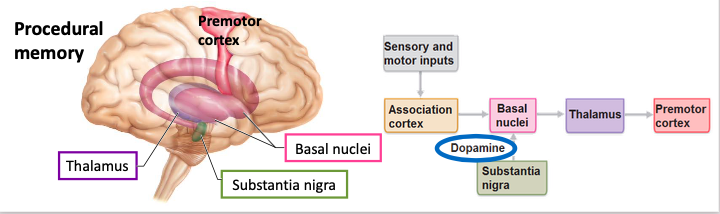
Procedural memory: basal nuclei relay sensory & motor inputs to thalamus and premotor cortex (allows to do things in patterns)
*Dopamine from substanta niagea is necessary
*sensory & motor inputs -> associaltion corex -> Basal nuclei -> thlamus -> premotor cortex
What do the direct and indirect circuits involve
- Cortex (Glu)
- Lentiform nuclei: putamen & globus pallidus (GABA)
* Note: GPi & GPe are tonically active -> default suppression of thalam
- Thalamus (Glu)
- Subthalamic nuclei (Glu)
- Substantia Nigra: Pars compacta (Dopamine)
- both circuits have same input that take diff pathways to get to same output
- direct circui _____ SNpc dopamine input while indirect is____ by SNpc dopamine
- direct circuit excited by SNpc dopamine input while indirect is inhibited by SNpc dopamine
When an excitatroy fires a lot, the postsynaptic neuron will fire ____
When excitatroy neuron fires a little the post synpatic neuron will fire _____
When an excitatroy fires a lot, the postsynaptic neuron will fire a lot
*somebody screaming at you go go go
When excitatroy neuron fires a little the post synpatic neuron will fire a little
* somebody says quietly go
When an inhibitory neuron fires a lot, the postsynaptic neuron will fire ____
when an inhibtroy neuron fires a little, the psot synaptic neuron will fire _____
When an inhibitory neuron fires a lot, the postsynaptic neuron will fire a little
* like yelling STOP
when an inhibtroy neuron fires a little, the psot synaptic neuron will fire a lot
*comparison to when have a lot of inhibition
pathway anatomy of the direct pathway
Cortex -> caudate/ putamen -> GPi -> Motor thalamus -> motor cortex


-
orientation30
-
3.1 Bone Marking terminology10
-
3.0 skeleton overview8
-
3.1 Skeleton: skull29
-
3.2 Skeletons: Vertebral Column & thoracic cage20
-
3.3 Skeletons: Appendicular Skeleton34
-
2.1 Cells42
-
2.2 parts of cells38
-
2.3 Tissues55
-
4.2 Muscles of the Head41
-
4.3 Muscles of back/ vertebral column22
-
4.4 Muscles of breathing/abdominal cavity33
-
4.5 Shoulder/Arms34
-
4.6 Muscles Crossing hip and knee joints33
-
4.7 Muscles of lower leg37
-
5.1 Nervous tissue43
-
5.2 Nervous tissue: Action potentials33
-
5.3 Neurotransmitters27
-
6.1 Central Nervous System37
-
6.2 Regions and organization of CNS42
-
6.3 Functional brain system37
-
6.4 Spinal chord29
-
7.1 Peripheral nervous system42
-
7.2 Cranial nerves24
-
7.3 Spinal nerves20
-
7.419
-
7.1 Autonomic Nervous System25
-
7.2 Neurotransmitters26
-
8.0 eye anatomy29
-
8.1 vision27
-
8.3 Taste and Smell28
-
8.4 Equilibrium and orientation12
-
9.0 Endocrine20
-
9.1 Amino Acid Hormones9
-
9.2 Release of hormones24
-
9.3 Endocrine38
-
10.0 Integument system52
-
11. Lymphatic system31
-
11.2 immunity22
-
12. Bones and skeletal tissues15
-
blood supply and cortex function3



