This case involves a beef suckler enterprise, comprising a herd of 80 South Devon cows and calves plus several stock bulls. They calve in autumn and spring, and calve indoors and out at grass depending on the time of year. When housed indoors the cows and calves are managed on a straw yard system. The farm is organic, and uses grass and small amounts of home-grown cereal. Calves are reared on a grass-based system and sent for slaughter at 24 months.
You are on call one evening in October, and asked to attend an 8-day old bull calf that has collapsed and is scouring. Most of the autumn block has calved now but a few cows remain that have not yet done so.
You arrive on the farm and while walking to the calf sheds you ask the farmer a couple of key questions to help you narrow down your differential diagnoses.
List the 4 most important questions you ask the farmer and justify your reason
- The calf: duration of clinical signs? Has the calf stood since birth? Did the calf suckle colostrum? Quality of colostrum?
- The other calves: Are other calves affected with scour (at the current time or earlier in the calving season)? How many? Severity of signs? Similar ages or older/younger? Any previous diagnosis made? Mortality in calves? Any records kept? Newborn calf management: procedure for navel disinfection, colostrum management (assisted suckling, using an oesophageal feeding tube)
- The cows: Any issues with cow health? E.g. calving problems (dystocia), milk fever, poor nutritional status (evident as thin cows/poor body condition score). Did he check the cow for mastitis? Any vaccinations? (Rota, Corona and E.coli/Clostridial vaccine to dam provides immunity to calf if it gets sufficient colostrum)
- General management: Management of the environment (e.g. bedding up frequency, scraping out frequency, stocking density if now housed) – problems are more often seen towards the end of the calving season due to build-up of pathogen load.
- The calf has been ill for 2 days, it appeared a bit weak after birth, the farmer thought this was due to the difficult calving the cow had. The calf was presented in posterior presention and needed assistance. The calf did suckle after birth, but they cow had been down a fair bit after calving, maybe due to sciatic nerve paralysis? It is a 3rd parity cow, previous calves she’s had were fine so the farmer would not see a reason why colostrum would not be OK; can you? He does not stomach tube any of the calves with colostrum, and only sometimes has to help the calf to suckle, predominantly with heifers.
- There are 5 similar age calves that are ‘runny’ but they’re still up and suckling. He always seems to have a couple go down near the end of the autumn calving block. He can’t remember any previous test being done, but one other calf died last week and he is now concerned about this one, as he is sure this would be a good stock bull.
- He’s got a medicine book where he keeps records of all treatments, and has treated 10 calves with antibiotics in the last week in the hope that would make a difference. He disinfects navels when the cows let him close to the calf to check, which is often not the case!
- All cows appear fine, the usual calving issues every now and then but nothing unusual. He vaccinates against IBR and BVD once a year. He calves in straw yards which are bedded up every other day and scraped out at the end of the calving period. The cows calve inside in autumn and stay in until spring, therefore the stocking density is currently quite high.
You decide to do one more thing, what would this be?
Check the Naval!!!!!
(in this case no pain or swelling present)
What are the differentials?
- Rotavirus
- Coronavirus
- Cryptosporidiosis
- Salmonellosis
- Nutritional causes, i.e. poor colostrum intake/management
- Mastitis: relates to mastitis in the dam, leading to insufficient good quality milk intake from calf
- The most likely differential diagnosis list for this presentation could include most of the options in the list above, but should not include:
- Omphalophlebitis (navel ill): you have checked the umbilical in the physical examination
- Coccidiosis (too young, signs very rarely this severe). Review coccidiosis epidemiology if needed, why don’t calves get ill before 3 weeks of age?
- Colibacillosis (E. coli scours) possible but less likely than other options, usually younger calves
- Trace elements are not a cause of scours in described case (potentially in older calves), trace elements deficiencies may be related to decreased immune function but it is seldom a direct cause of scours
You discuss the most likely differentials with the farmer; he’s not interested in what it ‘could be’, he wants to know what it is and asks you to take a sample and submit it for further analysis. Although you have some reservations, you take a fecal and blood sample from the calf and proceed with your treatment.
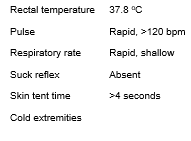
This calf is showing severe clinical signs associated with calf scour, including lack of a suck reflex, dehydration, reduced rectal temperature and cold extremities.
Provide a treatment plan suitable for this calf, be specific with regards to quantity, route, product, rate, method and ensure you cover the following areas: 1. Rehydration 2. Supportive therapy 3. Other medication
- Rehydration
- Oral versus IV fluid therapy: MUST be IV for this animal (severity of the case, poor absorption of oral fluids and gut pooling in an acidotic calf)
- Measuring base deficit on-farm is difficult: it would be common to assume acidosis is present in this case based on signalment (more common in beef calves) and clinical signs (e.g. lack of suck reflex)
- Sterile crystalloid solutions are expensive and home-made solutions can be made rapidly (normal saline (0.9%) can be made from 5 litres water and 45g of salt)
- 5 litres of normal saline can be given rapidly (80 ml/kg per hour for the first 2-3 litres) but then slowed down and a further 5-10 litres used over the following 24-48 hours at a maintenance rate.
- Bicarbonate solution is suggested to correct acid-base balance – can prepare a ‘spike’ (35g/400ml) and add to the normal saline drip (13 g NaHCO3/l). There is evidence however suggesting that acid base will correct itself once sufficient fluids are provided, so fluid therapy on its own is likely sufficient.
- Supportive therapy
- Consider safety when handling calf/dam, keep dam away from calf so she can’t cause injury while he’s recovering. He could consider keeping the dam in sight but out of the way using large straw bales.
- Nursing will be extremely important for this calf (e.g. shelter, warmth, dry soft bedding).
- Once on its feet, put the calf back on the dam and hope it feeds, provide additional oral fluids 3*/day to start off with, reducing dependent on hydration status, milk intake via dam and dam temperament.
- Feed fluid and milk separately, so milk can clot in abomasum. Once rehydration occurred, one needs to be aware that fluids don’t provide energy. Therefore milk is still needed.
- Other medication
- Medications that could be considered include broad-spectrum antibiotics (e.g. amoxicillin, ampicillin, oxytetracycline are all suitable avoid HP-CIA’s), NSAIDs (e.g. meloxicam, preference for product that is registered for use in calves), and anti-spasmolytics (e.g. ‘Buscopan’) but none of these are essential, although they are used in practice. Nursing/fluid therapy is essential, not the antibiotics or other medication. Use NOAH or the VMD product database for information on advised use with regards to duration, route and volume.
How can you IV catheter a calf?
To give the fluids, you can place a jugular catheter intravenously: transcutaneous cannulation (i.e. “normal” placement of a jugular catheter) however is often not possible in these dehydrated calves, and a surgical cut-down procedure can be used: Clip and prepare site as for surgery; use a scalpel to cut down through skin and expose jugular vein; Place catheter and tape/suture in situ.
How can you measure lactate?
There are cow side machines, which measure lactate (machine around £100, strips approx. £0.80). Lactate appears to be the most reliable quantitative assessment of volume deficit. However, lactate measures hypovolaemia (or hypoperfusion more accurately) and is not an indicator of acidosis (lactate might be produced as a part of the physiological compensation for metabolic acidosis). It only appears to detect moderate to severe hypovolaemia, and therefore its use with regards to fluid therapy decision making appears limited.
Practical recommendations for scouring calfs?
Provide practical recommendations you discuss with this farmer, considering 3 areas: colostrum/vaccination/environment
- Need to ensure colostrum intake is appropriate
- Separate ill calves from apparently non-affected
- Deep cleaning and disinfection with steam cleaning, hydrogen peroxide also effective
- Check other cows for mastitis in case of mastitis related scour
- Is possible reduce stocking density
- Consider rota and corona virus vaccination at drying off
- Halofuginone as a preventative treatment for Crypto
Discuss colostrum management further?
Colostrum management: Careful monitoring is important to make sure every calf has had an appropriate volume of colostrum. Consider assisted suckling for calves that don’t suckle the dam, or use of tube feeding with colostrum milked off the dam as a back-up. Consider storage of frozen colostrum for use when required. NB: milking colostrum from a beef cow is NOT easy! Can consider colostrum quality – measure using Brix refractometer (although poor colostrum quality is often more of a problem in high yielding dairy cows)
Discuss environmental management?
Environment: Provide an adequate calving/nursing environment: Bedding frequency/amount and stocking rate in the sheds – could this be improved to minimise pathogen load. Pasture hygiene/management may be important if problems during calving at grass.
Discuss vaccination management?
Vaccination: Cows can be vaccinated with a licensed vaccine containing rotavirus, coronavirus and E. coli to boost immunoglobulin levels in colostrum and milk.
- Vaccinate dam at the end of the drying off period, weaned ~7-10months, most weaned at 8 months
- Rotavec Corona is the name of the vaccine - administered 12-3 weeks before calving, IM
- Cost: £265/bottle, equates to 20 doses, so £13.25/dose (single dose vaccine)
A single injection should be given during each pregnancy between 12 and 3 weeks before calving is expected. Dose - 2 ml by intramuscular injection. The recommended site is the side of the neck. Good colostrum management is crucial to benefit from the effect of the vaccine. You don’t need to remember exact vaccination protocols, but do need a general understanding of how this vaccine can be most useful.

-
Acute Abdomen31
-
Disease and conditions of the avian digestive system44
-
Metabolic Disease With Neuro Signs33
-
Diseases and Conditions of the Avian Respiratory System47
-
Lungworm and Respiratory Disease in Ruminants11
-
Intro To Calf Pneumonia8
-
Sheep Respiratory Disease – Coughing Lambs24
-
Respiratory Disease In Adult Farmed Animals41
-
Sheep Resp Disease - Adults29
-
Large Animal Respiratory Parasites34
-
Respiratory Disease in Calves42
-
Respiratory Disease in Pigs72
-
Large Animal Respiratory Parasites31
-
Pneumonia Diagnosis15
-
Sheep Respiratory Disease - Pathology19
-
Respiratory disease in poultry58
-
AB selection for respiratory disease37
-
Hepatic lipidosis/ketosis/farm16
-
Herd level metabolic disease21
-
Hypocalcaemia practical14
-
Parasitic skin disease of farm animals19
-
Ectoparasites camelids6
-
Bovine teat surgery34
-
Avian dermatology21
-
Dehorning and disbudding21
-
Large Animal Anatomy Refresher17
-
Practical: Pig GI anatomy4
-
Practical: Ruminant GI anatomy27
-
Practical: Chicken GI anatomy16
-
Scouring in Calves32
-
Johne’s Disease33
-
Beef Calf With Scour10
-
Acute Abdomen COPY31
-
Oral Cavity Disease Ruminants29
-
Neonate Calf Diarrhoea8
-
Liver Disease in Farm Animals49
-
Diarrhoea in Adult Cattle34
-
Disease of The Rumen10
-
Ruminant GI Disease55
-
Abomasal Disease42
-
Pig Neonate Diarrhoea11
-
BVD47
-
GI Disease in Pigs56
-
Case Studies3
-
The Sick Cow12
-
Ruminant Parasite Case10
-
Scouring Lambs6
-
Antiparasitic agents and endoparasites44
-
Clostridial Disease in Ruminants29
-
Foot and Mouth Disease27
-
Revision Haemonchus & Ostertagia18
-
Revision Liver Trematodes25
-
Revision SI parasite ruminants19
-
Practical Parasite Control in Farmed Animals78
-
Revision practice of helminth control12
-
Revision Mechanisms of action18
-
Bacterial and Protozoal Intestinal Disease in Commercial Poultry75
-
Mineral workshop37
-
Microbiology Of Enteritis61
-
Bovine Distal limb11
-
Corrective Foot Trimming16
-
Joint Swelling In Neonate Calf5
-
Poultry42
-
Lameness in cattle40
-
CR Bovine Lameness11
-
Pig Lameness47
-
Other Causes of Lameness in Cattle68
-
Sheep and Goat Lameness5
-
Clostridial disease in cows25
-
Farm Assurance11
-
Cattle Lameness 272
-
Farm Assurance COPY51
-
Cattle Lameness 342
-
Pig Lameness COPY67
-
Sheep lameness31
-
Bovine Neurology51
-
Ovine Neurology62
-
Metabolic Disease With Neuro Signs COPY33
-
Porcine Neurology43
-
Non-Notifiable Viral Disease44
-
Notifiable Neuro Viruses26
-
Large Animal Ophthalmology21
-
Eye and Disease30
-
Pharmacological Control Of Pregnancy and Parturition25
-
Principle Causes of Infertility in the FEMALE56
-
Principles of Pregnancy Failure14
-
Pregnancy Loss Case11
-
Principles of Fertility and Breeding Time43
-
Intro to repro pathology137
-
Principles of Monitoring Fertility33
-
The Itinerant Bull SGTR case13
-
Principles of Cycle Manipulation32
-
Principles of managing dystocia45
-
Approach to Examining the Female Tract42
-
Principles of decision making and surgical management of dystocia24
-
Principles of Post Partum Conditions34
-
Principles of antibiotic treatment in reproduction cases and xertes39
-
Principles of Neonate Care and Disorders of the Neonate37
-
Principle causes of infertility in the male23
-
Approach to Examining the Male Reproductive Tract47
-
Principles of Semen Quality25
-
Porcine reproductive disease59
-
Reproductive Exam19
-
Fertility and The Dairy Vet26
-
Infertility in the Individual Cow14
-
Avian reproduction56
-
Milk Quality 1 & 220
-
Uterine Disease24
-
Reproductive Case Management15
-
Unwanted pregnancy TR12
-
Mastitis Diagnosis21
-
Small Ruminant Repro31
-
Camelids Repro9
-
Infectious Repro Disease21
-
Ewe Breeding6
-
Cases of Abortion in the Ewe8
-
Mastitis Teat Conditions22
-
Reproductive medicine use in practice19
-
Parturition & post partum disease in farm animals25
-
Mastitis control38
-
Abortion cases20
-
Milk Quality29
-
Down Cow6
-
Mastitis Treatment46
-
Bovine C-section & Dystocia (Practical)15
-
Infectious reproductive disease in cattle78
-
Heifer Dystocia16
-
Repro formative MCQ23
-
Large Animal Toxicity9
-
Cattle Urinary Disease23
-
Calculi in LA11



