What is the taxonomy of lepto in cattle and what is it commonly referred to as?
•Complicated taxonomy
–Leptospira borgpetersenii serovar hardjo-bovis
–Leptospira interrogans servovar hardjo-prajitno
•Commonly referred to as
Leptospira Hardjo
What is the prevalence of lepto in uk cattle?
Very common
–Compare and contrast with leptospirosis in dogs
–Lepto in cattle is completely different! Do not confused with ARF and liver disease in dogs and cats
What are the key infectious cattle diseases? (6)
–Lepto, BVD, IBR, Johnes, bTB, Neospora
What are the clinical signs of chornic/endemic lepto?
•Reproductive
–Late stage abortion
–Abort 12 weeks after infection
–Reduced “fertility”
•Lepto cow – less progesterone produced and less obvious oestrus
What are the clinical signs of acute lepto?
- Often sub-clinical- rare to see
- “Flabby bag”
–Sudden milk drop – udder which should be full of milk suddenly has none so is flabby!
–Pyrexia
- Abort after infection
- Acute cases are dropping off – rare to see in practice
What are the risk factors for lepto? (4)
- Open herds
- Shared bulls - venereal
- Sheep
- •Shared watercourses (less important; some people think you can find in river and streams) possible if they drink here when cow further up
Where is lepto found in the cow?
Where is it shed?
Where is it absorbed?
- Found in kidneys
- Shed in urine
- Absorbed across mucous membranes
When does lepto increase?
•Increases at grazing
–See AB go up
–During the spring/summer
Due to the change in the urine
How do we diagnose lepto? (2)
–ELISA
- Use for monitoring – greater persistence
- Bulk milk ELISA available
–Give you an idea if the herd has been exposed!
–Can sense increase
•Wide inconclusive value – often end up testing twice
–Microscopic agglutination test (MAT)
•Use for suspected acute cases
Can we vaccinate against lepto?
–Limit shedding *VPH consideration*. ZOONOTIC! People at the parlour are most at risk
–Improve fertility at herd level and minimise the amount of disease we see
–If they aren’t vaccinating – advise this!
How can we treat lepto?
–Supportive and antibiotics (P&S, oxytet) in acute case
•Unlikely to see acute cases
–Traditionally high doses of streptomycin to eliminate from urinary tract
- E.g. Ab positive bull
- Too higher value to cull them you could do this
How can you revent againt lepto?
–Biosecurity – don’t buy it in if you haven’t got it, don’t but in bulls without testing
–Reduce risk factors – e.g. showing, open herd
–Vaccinate
What are these urine samples showing?
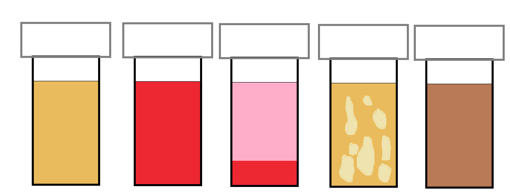
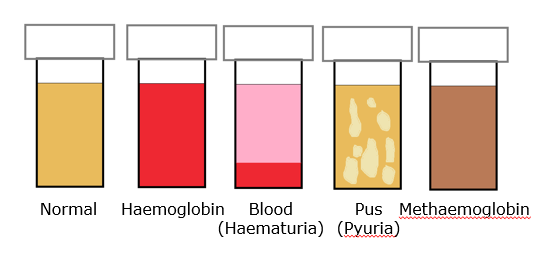
- A 2nd parity beef suckler cow, 6 months in calf, from an extensive grazing herd on Bodmin Moor in Cornwall
- Farmer calls to say urine looks like red wine
- Differential diagnoses?
Split into haemoglobinuria (5) an haematuria (5)
•Haemoglobinuria
–Babesiosis
–Bacilliary haemoglobinuria (Clostridia)
–Periparturient haemoglobinuria
–Copper toxicity
–Kale poisoning
•Haematuria
–Acute bracken poisoning
–Enzootic haematuria/Bladder tumour (Bracken poisoning)
–Pyelonephritis
–Urinary calculi
–Other tumours
What diagnostics do we start with when a cow presents with urinary complaints?
History
Clinical exam
Uine analysis
- A 2nd parity beef suckler cow, 6 months in calf, from an extensive grazing herd on Bodmin Moor in Cornwall
- Farmer calls to say urine looks like red wine
What is most likely and what do we do next?
- Likely Babesiosis (take blood sample)
- Assess anaemia (Clinical signs/PCV)
–Imidocarb (care re: withdrawl)
–Blood transfusion if necessary
- A 5th lactation dairy cow, calved 42 days presented at the end of a routine fertility visit because she is “unwell”
- The cow urinates before your examination and there is pus present in the urine
- Differential diagnoses? (4)
- Endometritis
- Vaginitis
- Cystitis
- Pyelonephritis
How do we differentiate between pus from urinary vs repro tract?
–Vaginal examination
–Catheterisation
–Ultrasonography
How do we differentiate between a problem renally vs bladder? (4)
–Clinical exam
–Rectal examination
–Ultrasonography
–Biochemistry
•Creatinine NOT urea in ruminants
- Pyrexia, painful, swollen left kidney on rectal examination
- Vaginal examination normal
- Pus on catheterised urine sample
What is most likely and what do we do next?
- Likely pyelonephritis
- Treatment with antibiotics
–Penicillin (long duration – 10 days?)
- 6th lactation dairy cow, chronic lameness and two cases of mastitis this lactation. Losing weight, no diarrhoea, clinical exam NAD
- +++ protein in urine
What Urinary disease is most likely? What would your thoughts be if this cow also had D++?
- Diarrhoea – think Johnes!. Johnes loose weight as it a PLE. Loos protein and lean BW.
- So similar to PLE but in urinary – PLN. Kidney disease can cause protein loss. Rare in cattle but would completely miss this.
- Chronic sick cows – protein in urine would mean you wouldn’t miss this!!
•Glomerulonephritis
–Protein losing nephropathy
– more likely from history as lots of chronic infections. Lots of AB-AG complexes that can precipitate out of the kidney! Not v common, But you would find on dipstick.
Complete this table
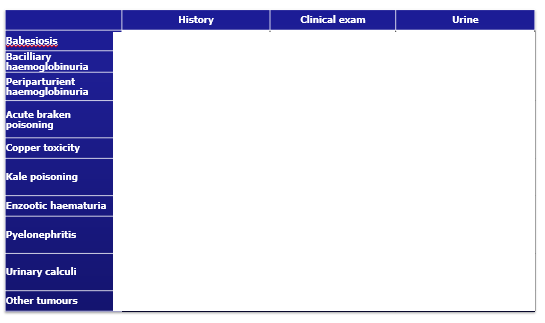
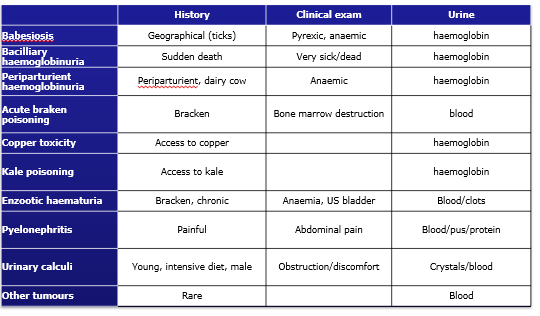

-
Acute Abdomen31
-
Disease and conditions of the avian digestive system44
-
Metabolic Disease With Neuro Signs33
-
Diseases and Conditions of the Avian Respiratory System47
-
Lungworm and Respiratory Disease in Ruminants11
-
Intro To Calf Pneumonia8
-
Sheep Respiratory Disease – Coughing Lambs24
-
Respiratory Disease In Adult Farmed Animals41
-
Sheep Resp Disease - Adults29
-
Large Animal Respiratory Parasites34
-
Respiratory Disease in Calves42
-
Respiratory Disease in Pigs72
-
Large Animal Respiratory Parasites31
-
Pneumonia Diagnosis15
-
Sheep Respiratory Disease - Pathology19
-
Respiratory disease in poultry58
-
AB selection for respiratory disease37
-
Hepatic lipidosis/ketosis/farm16
-
Herd level metabolic disease21
-
Hypocalcaemia practical14
-
Parasitic skin disease of farm animals19
-
Ectoparasites camelids6
-
Bovine teat surgery34
-
Avian dermatology21
-
Dehorning and disbudding21
-
Large Animal Anatomy Refresher17
-
Practical: Pig GI anatomy4
-
Practical: Ruminant GI anatomy27
-
Practical: Chicken GI anatomy16
-
Scouring in Calves32
-
Johne’s Disease33
-
Beef Calf With Scour10
-
Acute Abdomen COPY31
-
Oral Cavity Disease Ruminants29
-
Neonate Calf Diarrhoea8
-
Liver Disease in Farm Animals49
-
Diarrhoea in Adult Cattle34
-
Disease of The Rumen10
-
Ruminant GI Disease55
-
Abomasal Disease42
-
Pig Neonate Diarrhoea11
-
BVD47
-
GI Disease in Pigs56
-
Case Studies3
-
The Sick Cow12
-
Ruminant Parasite Case10
-
Scouring Lambs6
-
Antiparasitic agents and endoparasites44
-
Clostridial Disease in Ruminants29
-
Foot and Mouth Disease27
-
Revision Haemonchus & Ostertagia18
-
Revision Liver Trematodes25
-
Revision SI parasite ruminants19
-
Practical Parasite Control in Farmed Animals78
-
Revision practice of helminth control12
-
Revision Mechanisms of action18
-
Bacterial and Protozoal Intestinal Disease in Commercial Poultry75
-
Mineral workshop37
-
Microbiology Of Enteritis61
-
Bovine Distal limb11
-
Corrective Foot Trimming16
-
Joint Swelling In Neonate Calf5
-
Poultry42
-
Lameness in cattle40
-
CR Bovine Lameness11
-
Pig Lameness47
-
Other Causes of Lameness in Cattle68
-
Sheep and Goat Lameness5
-
Clostridial disease in cows25
-
Farm Assurance11
-
Cattle Lameness 272
-
Farm Assurance COPY51
-
Cattle Lameness 342
-
Pig Lameness COPY67
-
Sheep lameness31
-
Bovine Neurology51
-
Ovine Neurology62
-
Metabolic Disease With Neuro Signs COPY33
-
Porcine Neurology43
-
Non-Notifiable Viral Disease44
-
Notifiable Neuro Viruses26
-
Large Animal Ophthalmology21
-
Eye and Disease30
-
Pharmacological Control Of Pregnancy and Parturition25
-
Principle Causes of Infertility in the FEMALE56
-
Principles of Pregnancy Failure14
-
Pregnancy Loss Case11
-
Principles of Fertility and Breeding Time43
-
Intro to repro pathology137
-
Principles of Monitoring Fertility33
-
The Itinerant Bull SGTR case13
-
Principles of Cycle Manipulation32
-
Principles of managing dystocia45
-
Approach to Examining the Female Tract42
-
Principles of decision making and surgical management of dystocia24
-
Principles of Post Partum Conditions34
-
Principles of antibiotic treatment in reproduction cases and xertes39
-
Principles of Neonate Care and Disorders of the Neonate37
-
Principle causes of infertility in the male23
-
Approach to Examining the Male Reproductive Tract47
-
Principles of Semen Quality25
-
Porcine reproductive disease59
-
Reproductive Exam19
-
Fertility and The Dairy Vet26
-
Infertility in the Individual Cow14
-
Avian reproduction56
-
Milk Quality 1 & 220
-
Uterine Disease24
-
Reproductive Case Management15
-
Unwanted pregnancy TR12
-
Mastitis Diagnosis21
-
Small Ruminant Repro31
-
Camelids Repro9
-
Infectious Repro Disease21
-
Ewe Breeding6
-
Cases of Abortion in the Ewe8
-
Mastitis Teat Conditions22
-
Reproductive medicine use in practice19
-
Parturition & post partum disease in farm animals25
-
Mastitis control38
-
Abortion cases20
-
Milk Quality29
-
Down Cow6
-
Mastitis Treatment46
-
Bovine C-section & Dystocia (Practical)15
-
Infectious reproductive disease in cattle78
-
Heifer Dystocia16
-
Repro formative MCQ23
-
Large Animal Toxicity9
-
Cattle Urinary Disease23
-
Calculi in LA11



