How is milk fever commonly prevented?
Milk fever (or hypocalcaemia) is prevented by correct feeding during the late dry (“transition”) period. Forages (e.g. grass silage) on a farm are commonly analysed for macromineral content to aid farmers, vets and nutritionists in this.
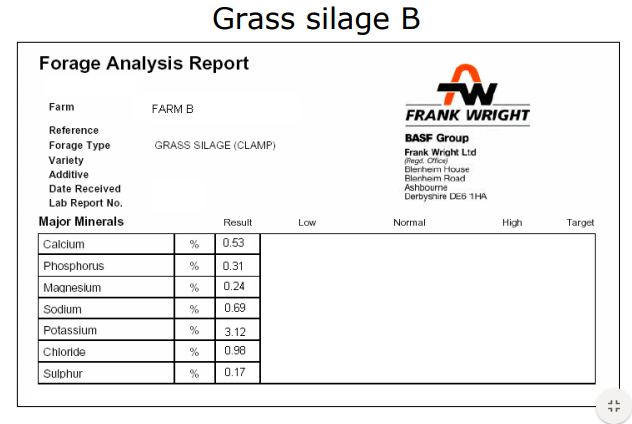
The results of the analysis for a particular grass silage are provided.
What do you think are the potential risks of feeding this silage in terms of preventing milk fever?
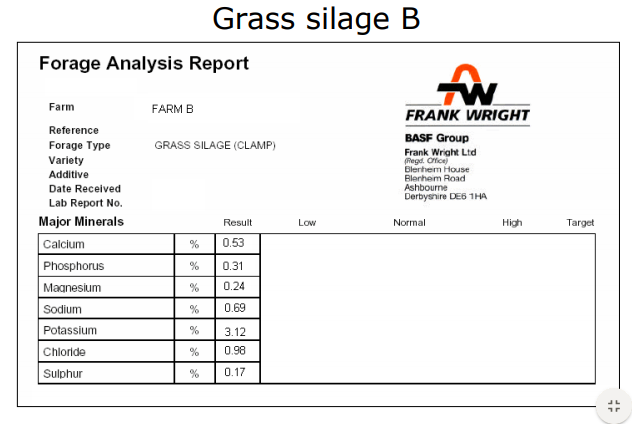
Grass silage has a high DCAB – high in calcium – not going to be good for reducing calcium intake
DCAB – don’t want it to be too positive
DCBA is +390 for grass silage (in practice article) – which is high
Want low calcium before calving to prime PTH response.
Another way to do it is the DCAB approach – make them go into metabolically acidosis, which can make them uptake calcium from uptake better and can metabolise it from bone more quickly, and more efficient vitamin D3 activation
DCAB rather than calcium restriction is the preferred choice! Both work well, but DCAB is more practically easier and cheaper to implement. Calcium restriction is hard to do as there is not many feed stuffs with low enough calcium, so would need to feed calcium binders, which are expensive. DCAB can be cheap by mixing several ingredients
Both is a bit overkill
With DCAB diet, just need baseline calcium – they are more efficient at mobilising it. Just want them to be efficient as it as possible for first few days
Full DCAB – adding salts, making it negative -100, might need to measure urine pH
Partial – aiming to get it to low +s, involves manipulating feeds you choose and potentially bit of salt
REALLY high DCBA – calculated as 715
Want DCAB for transition cow diet – 0-100, grass silage is way out!!
If a farmer needs to use this grass silage in the transition cow diet (e.g. this is the only grass silage that he has available), what could you advise them to do to minimise the risk?
12kg is good DMI for a dry cow
Supplement feed with low DCAB – dilute high DCAB grass silage out à wheat and barely. Wheat looks about 0, need about 10kg of wheat, but this isn’t great as they don’t have enough fibre – which ruminants need! Wheat is very energy dense. Need concentrate with lower DCAB and not as much energy? Still would need a huge amount. SO if you are trying to manipulate ingredients, could add straw in or maize silage – depends what he grows and what he can buy. Want a mixture of different things that make the DCAB between 0-100.
Add salts that have negative ions that will lower DCAB enough à most straight forward approach, need at least 0.75kg of salt per cow per day to get to right level – going to get very expensive!!! (£3-4 a cow PER DAY) And a lot to expect the cow to eat, they wont eat it – not very palatable. Don’t want to reduce intake! Need effective mixing or else they won’t eat the salts – can selective feed if not mixed well enough
Just adding 100-200g a day would not be enough as you want to DCAB much lower.
Alternative – Wheat and barley which have DCAB of 0. 2kg of grass silage and 10kg of wheat would be needed for a good DCAB. You haven’t got enough fibre – will be a disaster. Concentration with lower DCAB and grains still need huge amounts of grain. Straw and maize silage we wouldn’t worry so much about the rumen? Straw – buy in and mix. Maize silage – good if they grow it.
Probably need to manipulate and get a bit of both. Straw and maize silage we wouldn’t worry so much about the rumen? Straw – buy in and mix. Maize silage – good if they grow it.
Have to mix properly especially with salts – prevent selective feeding. Chop the straw up
Calcium binders – if you can’t manipulate DCBA or cannot get away from feeding the silage he has, as it has high calcium. This is expensive. If they want grass silage to be the main component this is the best bet.
Calcium restriction where possible
Prophylactic treatment if cant get farmer to change or use calcium binders
If on grass – keep them on tight grass, usually have access to other things in feeders such as straw for example. How to control in a field – Last resort giving a bolus (but this is hard as you need great handling). Could feed them calcium binding concentrate – have to assume they are getting the right amount per cow. Keep them tight on the grass. Have access to straw etc.
Have to mix properly especially with salts – prevent selective feeding. Chop the straw up
Cant get any of the above to work – bolus is third line defence (prophylaxis). You can do things to reduce potassium in the grass too.
Is there anything the farmer can do to avoid this problem in the future?
Can grow grass with lower potassium, so lower DCAB and lower risk
Discuss the factors that you think might affect DMI – which do you think are the most important? The expected DMI of a lactating cow can be estimated using the formula DMI = 2.5% of bodyweight + 10% milk yield
- palatability (tasty, spoiled, dry, moist etc.),
- access to feed (is there enough feeding space per cow and for heifer and cow mixed, want everyone to be able to eat at the same time, about 75-80cm for a high yielding cow, transition cow might want a bit more room as very pregnant so about 90cm-1m, even though they don’t eat as much, eating together will encourage them to eat more),
- Housing
- nice open passage ways to access feed,
- stress levels (group changes for example, moving into new groups will cause drop in intake),
- heat stress,
- water access,
- design of feed barrier (is it easy to clean out – don’t want build-up of mould etc., will reduce palatability),
- Neck rail – stops the cow getting too much into the the feed (Walking in it)
- right height neck rail – don’t want it to cause rubbing or any uncomfortableness.
- Higher the rail, more comfortable to have the head under the barrier
- Don’t want them to be pushing food away if there is no barrier – won’t be able to reach. Might have to go along with a tractor and push it all back in.
- Positive of using a trough means that food isn’t pushed away
- Individual stalls – gets around taking up too much space, means every cow has an area to go to eat, less bullying and pushing in. Keeps neck rail out of the way of the cow. If they are too small, worse than having a straight rail
- Vertical dividers into stalls
- Too small – cows will only fill every other one
- Can’t monitor each cow this way
- Eating off a smooth surface e.g. kitchen worktop – can increase intake, much easier to keep clean
- BCS – fat cows don’t eat as much
- Lots of group changes around calving – will reduce intake due to stress. Try keeping them all in the same building and as close as possible usually helps. In bigger herds, can do all in all out
- Often move: Dry off – transition – individual pen – milking pen/fresh calvers
- Keeping a gate between cows that have been moved may reduce stress.
- Try to batch move e.g. a week at a time
- Robot feeding system – cows respond and come over to eat the fresh food – many cows respond to fresh delivery.
- Cows are stimulated to investigate feed by their food being altered.
What acts to increase blood calcium?
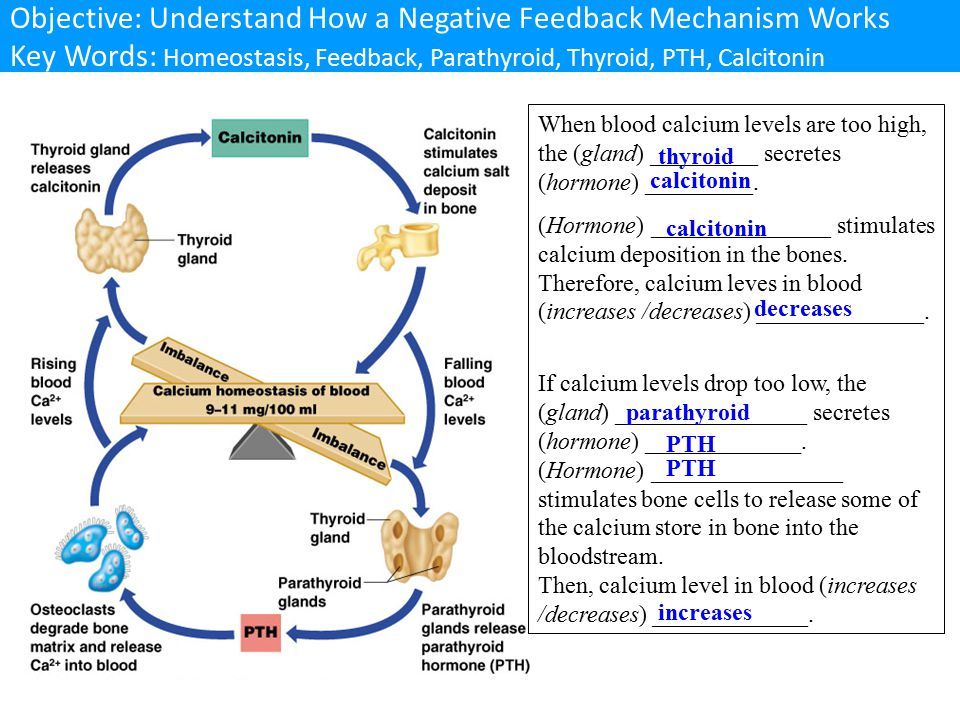
PTH & activated VitD
Understand how negative feedback mechanisms of caclium homeostasis work?
What kind of cow is most at risk from milk fever?
- 4th parity cow
- Heifers don’t commonly suffer from milk fever as cows get older calcium stores depleted and less responsive to PTH
- A disease that occurs at calving or 12 hours before or 24hrs after. Initial shock after colostrum starts being made.
- Around calving: ca demand increases rapidly endocrine control takes a few days to adjust
- Age of cow: Older cows have reduced calcium reserves, milk fever increases with parity
What do each of these clinical signs most indicate?
Thrashing limbs, hyperaesthesia
Constipation, rumenal bloat
Sunken eyes, diarrhoea
Unable to weight-bear on one leg
Thrashing limbs, hyperaesthesia (Hypomagnesia/grass fever/staggers)
Constipation, rumenal bloat (hypoCa)
Sunken eyes, diarrhoea (Hypovolamia, sepsis/toxic mastitis/e.coli)
Unable to weight-bear on one leg (fracture, nerve damage, secondary to MF)
Clinical signs relation to poor muscle contraction due to hypocalcaemia?
Skeletal muscle
- Weakness
- S-bend neck
Smooth muscle
- GI stasis
- Poor uterine involution
Cardiac Muscle
- Poor contractility
- Slight increased HR (c.f “toxic cow”)
What are the differential diagnoses for clinical signs below?
Three down cows, mixed stages of lactation
Weakness and recumbency
Tongue protruding from mouth
Farm spreads broiler waste on pasture
Three down cows, mixed stages of lactation (milk fever unlikely as in diff stages)
Weakness and recumbency (looks like milk fever but in diff stages of lactation)
Tongue protruding from mouth (not furious licking so not ketosis)
Farm spreads broiler waste on pasture (Apparently it’s botulism)
The cows have ingest botulism toxin causing paralysis that is seen in the tongue. Can only treat with supportive care and euthanasia. Should notify FSA and APHA.
What will your treatment be for this cow?
4th lactation dairy cow
Calved overnight
Found down in the morning
Sternal recumbency, S-bend neck
Attempting to, but unable to stand when encouraged
HR90 (high), T 37.6C (subnormal), rumen static, rectum bulging with dry faeces
- 400ml 40% calcium borogluconate slowly IV (1 bottle in the vein)
- Monitor heart rate and rhythm as injected as it can cause fatal dysrhythmias
- Consider blood sample in case no response
- Outcome of treatment:
- Eructation, defecation, standing
- If no response, consider alternatives and complications (e.g. “downer cow”)
Describe two methods of decreasing the likelihood of milk fever?
Approach A
- Reduce dietary calcium during late dry period
- Up regulates PTH production
- Increase GI uptake of CA as activating vit d
- Must increase dietary ca at calving
- Difficult to keep calcium low enough
- -can use ca binder
Appraoch B
- Decrease Na and K, increase Cl and S
- Slight acidosis increases binding of PTH and other effects (increase mobilisation of calcium)
- Must provide adequate Ca as increased mobilisation
- Partial or full DCAB approach (partial less complications but more instance of MF full DCAB more complications)
- Anionic salts can reduce palatability (drop in DMI and therefore increase in ketosis)
- Grass can be high in K making it diff to give DCAB at pasture
Summarise briefly the pathophysiology of milk fever?
The cows calcium demand rockets up at calving, PTH activated to mobilise more ca, problem with high producing dairy cows is their demand goes up so quickly the homeostasis mechanisms (PTH) cannot keep up.
Caused by sudden increase in Ca demand and slow endocrine response

-
Acute Abdomen31
-
Disease and conditions of the avian digestive system44
-
Metabolic Disease With Neuro Signs33
-
Diseases and Conditions of the Avian Respiratory System47
-
Lungworm and Respiratory Disease in Ruminants11
-
Intro To Calf Pneumonia8
-
Sheep Respiratory Disease – Coughing Lambs24
-
Respiratory Disease In Adult Farmed Animals41
-
Sheep Resp Disease - Adults29
-
Large Animal Respiratory Parasites34
-
Respiratory Disease in Calves42
-
Respiratory Disease in Pigs72
-
Large Animal Respiratory Parasites31
-
Pneumonia Diagnosis15
-
Sheep Respiratory Disease - Pathology19
-
Respiratory disease in poultry58
-
AB selection for respiratory disease37
-
Hepatic lipidosis/ketosis/farm16
-
Herd level metabolic disease21
-
Hypocalcaemia practical14
-
Parasitic skin disease of farm animals19
-
Ectoparasites camelids6
-
Bovine teat surgery34
-
Avian dermatology21
-
Dehorning and disbudding21
-
Large Animal Anatomy Refresher17
-
Practical: Pig GI anatomy4
-
Practical: Ruminant GI anatomy27
-
Practical: Chicken GI anatomy16
-
Scouring in Calves32
-
Johne’s Disease33
-
Beef Calf With Scour10
-
Acute Abdomen COPY31
-
Oral Cavity Disease Ruminants29
-
Neonate Calf Diarrhoea8
-
Liver Disease in Farm Animals49
-
Diarrhoea in Adult Cattle34
-
Disease of The Rumen10
-
Ruminant GI Disease55
-
Abomasal Disease42
-
Pig Neonate Diarrhoea11
-
BVD47
-
GI Disease in Pigs56
-
Case Studies3
-
The Sick Cow12
-
Ruminant Parasite Case10
-
Scouring Lambs6
-
Antiparasitic agents and endoparasites44
-
Clostridial Disease in Ruminants29
-
Foot and Mouth Disease27
-
Revision Haemonchus & Ostertagia18
-
Revision Liver Trematodes25
-
Revision SI parasite ruminants19
-
Practical Parasite Control in Farmed Animals78
-
Revision practice of helminth control12
-
Revision Mechanisms of action18
-
Bacterial and Protozoal Intestinal Disease in Commercial Poultry75
-
Mineral workshop37
-
Microbiology Of Enteritis61
-
Bovine Distal limb11
-
Corrective Foot Trimming16
-
Joint Swelling In Neonate Calf5
-
Poultry42
-
Lameness in cattle40
-
CR Bovine Lameness11
-
Pig Lameness47
-
Other Causes of Lameness in Cattle68
-
Sheep and Goat Lameness5
-
Clostridial disease in cows25
-
Farm Assurance11
-
Cattle Lameness 272
-
Farm Assurance COPY51
-
Cattle Lameness 342
-
Pig Lameness COPY67
-
Sheep lameness31
-
Bovine Neurology51
-
Ovine Neurology62
-
Metabolic Disease With Neuro Signs COPY33
-
Porcine Neurology43
-
Non-Notifiable Viral Disease44
-
Notifiable Neuro Viruses26
-
Large Animal Ophthalmology21
-
Eye and Disease30
-
Pharmacological Control Of Pregnancy and Parturition25
-
Principle Causes of Infertility in the FEMALE56
-
Principles of Pregnancy Failure14
-
Pregnancy Loss Case11
-
Principles of Fertility and Breeding Time43
-
Intro to repro pathology137
-
Principles of Monitoring Fertility33
-
The Itinerant Bull SGTR case13
-
Principles of Cycle Manipulation32
-
Principles of managing dystocia45
-
Approach to Examining the Female Tract42
-
Principles of decision making and surgical management of dystocia24
-
Principles of Post Partum Conditions34
-
Principles of antibiotic treatment in reproduction cases and xertes39
-
Principles of Neonate Care and Disorders of the Neonate37
-
Principle causes of infertility in the male23
-
Approach to Examining the Male Reproductive Tract47
-
Principles of Semen Quality25
-
Porcine reproductive disease59
-
Reproductive Exam19
-
Fertility and The Dairy Vet26
-
Infertility in the Individual Cow14
-
Avian reproduction56
-
Milk Quality 1 & 220
-
Uterine Disease24
-
Reproductive Case Management15
-
Unwanted pregnancy TR12
-
Mastitis Diagnosis21
-
Small Ruminant Repro31
-
Camelids Repro9
-
Infectious Repro Disease21
-
Ewe Breeding6
-
Cases of Abortion in the Ewe8
-
Mastitis Teat Conditions22
-
Reproductive medicine use in practice19
-
Parturition & post partum disease in farm animals25
-
Mastitis control38
-
Abortion cases20
-
Milk Quality29
-
Down Cow6
-
Mastitis Treatment46
-
Bovine C-section & Dystocia (Practical)15
-
Infectious reproductive disease in cattle78
-
Heifer Dystocia16
-
Repro formative MCQ23
-
Large Animal Toxicity9
-
Cattle Urinary Disease23
-
Calculi in LA11



