In a rushed conversation with the receptionist at your veterinary practice, a dairy farm client has asked for a vet to attend a fourth lactation Holstein-Friesian milking cow that is ‘down’ (recumbent) two hours after calving.
Discuss and list the questions and history you would like to obtain from the farmer?
- How long has she been “down”?
- Is she low/high yielding cow?
- What do you feed the herd/your nutrition plan for the herd?
- Has this happened to any the cows in the herd?
- Has she had this before?
- How is the calf?
Arriving on the farm
Having arrived at the farm, you are shown to this cow.
Clinical exam
- The cow is depressed and makes no attempt to rise. She is grinding her teeth (bruxism). There are no signs of a traumatic calving (e.g genitals appear normal)
- Rectal temperature - 37.6ºC
- Heart rate - 112 bpm
- Respiratory rate - 44 bpm
- Eyelid Skin Tent Time - 5s, sunken eyes
- The right-hind quarter of the udder is very hot and hard to the touch, and you can strip out a secretion that is watery and pale yellow in colour
What are your top 3 differentials and which is most likely?
- Hypocalcaemia
o For milk fever the cow may be slightly dull or still quite bright, but not as depressed or dehydrated as with toxic mastitis, will have dry mucous membranes, hard faeces (why is this?), possibly a ‘swan’ neck position (see photo - but not reliable !), and may keep trying to stand. She’ll have a weak tachycardic heart rate, have a dry muzzle and cold extremities (ears). Smooth muscle paralysis can cause bloat.
- Toxic mastitis
o ‘Toxic’ mastitis is characterised by clinical signs of toxaemia e.g. dehydration (eyelid STT, sunken eye),injected mucous membranes, increased respiratory rate and heart rate, loose faeces (often called a ‘toxic scour’). In addition, the udder will nearly always have a hot, swollen, hard quarter with a watery (often grey/yellow) secretion, present unless very early in the course of disease
- Calving injury (secondary to injury)
o Dystocia cases are usually bright (unless in severe pain or have concurrent disease) but are unable to stand or may try to stand and fail. They can have an increased heart and respiratory rate (due to pain) but there may be few other obvious clinical signs. Diagnosis is generally from the history and signs of a difficult calving (e.g.bruising/lacerations of vulva/vagina). Calving injury is often neurological (obturator or sciatic nerve paralysis), but can be skeletal (fracture) or muscular (rupture), and are often associated with forced extractions
Define per acute
• Per-acute means very acute and often violent with respect to disease, often very severe
What are the 4 treatment options for a toxic masitits. Discuss what would be given. Include the order you would give it. (4)
- Fluid therapy
• Give IV as per OS would be too slow especially in such a sick animal
Hypertonic saline (7.2%) is commonly used ‘in the field’ as you only require 3-5 litres for an adult cow – if unsure about the use of hypertonic saline, check out this In Practice article (Sargison N, Scott P Supportive therapy of generalised endotoxaemia in cattle using hypertonic saline. In Practice 1996;18:18-19) for the mechanism of action and make sure you understand the importance of drawing fluid into the circulation from the intracellular fluid to the intravascular space. The effect is temporary and therefore you must provide water for these cows to drink - they will drink 30-40 litres of warm water after rapid administration of hypertonic saline.
Isotonic fluid therapy requires large volumes of saline (40-50 litres) administered over a longer period, which may be impractical in many instances.
- NSAIDs
• You MUST administer non-steroidal anti-inflammatory drugs (NSAIDs) to these cows. Hopefully, you are now familiar with why these drugs are invaluable in these sort of cases – but this paper (Vangroenweghe, F. et al., Effect of carprofen treatment following experimentally induced Escherichia coli mastitis in primiparous cows) gives you an idea of the role that NSAIDs play in ‘toxic’ mastitis cases. It is unlikely that a particular NSAID is any ‘better’ than another – the important thing is that they are given quickly, and probably that they are administered intravenously.
- Supportive care
- Calcium
- We need to be very clear about the need for excellent nursing with these cows and this means the farmer or a member of the farm staff that is prepared to ensure these cows are warm (i.e. they have shelter and plenty of bedding), and that they are comfortable (i.e. have access to water and good quality feed)
- In addition it is important that the affected quarter is manually ‘stripped out’ – i.e. that this affected quarter is milked out to remove as much infection as possible. Oxytocin is licensed (VMD Product Database, NOAH Compendium) for this purpose and may assist with this procedure (recall the mechanism of action of oxytocin) although there is no good evidence this necessarily works!
- Antibiotics
• The role of antibiotic treatment needs to be discussed. If you have put antibiotic treatment first then this is incorrect! We need to think about the pros and cons of antibiotics –Are these cows bacteraemic? What is causing the clinical signs – endotoxamia or bacteraemia? Are we expecting to remove coliforms from the udder? Are we administering antibiotic to cover potential secondary infection in a very sick cow? This remains a very controversial area of bovine medicine but the evidence does NOT support the role of antibiotic to improve the chance of recovery in these cows – have a look at the BestBET (Bestbets for vets: Enrofloxacin in dairy cattle with E.coli mastitis ) that the Centre for Evidence Based Medicine has published on the use of enrofloxacin in the treatment of ‘toxic’ mastitis in dairy cattle
The farmer had more cases of toxic mastitis previously so you now consider preventive measures for the herd.
‘Toxic’ mastitis in dairy herds can be considered as a combination of ENVIRONMENTAL INFECTION PRESSURE and ADEQUATE IMMUNE FUNCTION.
Have a look at the photograph of this group of high-yielding Holstein-Friesian cows that are about 2 weeks off calving. This loose housed type of accommodation is typical for this stage of the cow’s lactation cycle, as deep straw is the best environment for the cow when she calves.
What aspects of this environment could pre-dispose these cows to ‘toxic’ mastitis?
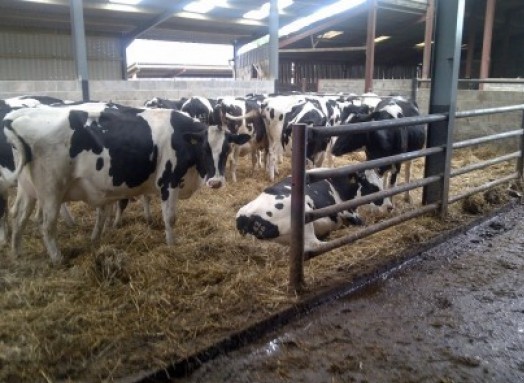
- Environmental hygiene is critical in the trasition and calving period.
- Predisposing factors to a large ‘burden’ of environmental infection:
o Stocking density
o Poor building ventilation
o Poor bedding quality
o Lack of adequate feed/water space allowances
• The AHDB Dairy Mastitis Control Plan research suggests these cows require at least 1.25m2 per 1000 litres milk – so if these are cows giving 10,000 litres in a lactation they require a lot of room
What measures must be discussed with the farmer to ensurec cows all have a good immunity against toxic mastitis.
- Ensure good immune function – transition cow nutrition is the most important to prevent negative energy balance and hypocalcaemia and this means at least 0.8m feed space per cow and feeding these cows every day to ensure good intakes of feed. See the photo of much better dry cow management below! The best dry cow rations will be fortified with additional vitamin E and selenium which support immune function. Other measures include avoiding concurrent disease (like lameness), and to minimise group changes.
- We can also consider vaccination for a short period whilst environmental improvements are put in place. Have a look at the product called ‘Startvac’ online – here is the research paper that was done in the UK and some detail is provided in the technical note provided by Prof Andrew Bradley here. Do you think the potential benefits outweigh the cost to the farmer from buying this vaccine from you?
- Finally, there is a product called ‘Imrestor’. As yet there is little evidence that its use is cost effective to prevent mastitis (apart from this paper in Mexico – but no peer-reviewed data in the UK yet!) but it represents a new type of medicine that may become useful in future. Have a look at the 3-minute video to learn about its mode of action.

-
Acute Abdomen31
-
Disease and conditions of the avian digestive system44
-
Metabolic Disease With Neuro Signs33
-
Diseases and Conditions of the Avian Respiratory System47
-
Lungworm and Respiratory Disease in Ruminants11
-
Intro To Calf Pneumonia8
-
Sheep Respiratory Disease – Coughing Lambs24
-
Respiratory Disease In Adult Farmed Animals41
-
Sheep Resp Disease - Adults29
-
Large Animal Respiratory Parasites34
-
Respiratory Disease in Calves42
-
Respiratory Disease in Pigs72
-
Large Animal Respiratory Parasites31
-
Pneumonia Diagnosis15
-
Sheep Respiratory Disease - Pathology19
-
Respiratory disease in poultry58
-
AB selection for respiratory disease37
-
Hepatic lipidosis/ketosis/farm16
-
Herd level metabolic disease21
-
Hypocalcaemia practical14
-
Parasitic skin disease of farm animals19
-
Ectoparasites camelids6
-
Bovine teat surgery34
-
Avian dermatology21
-
Dehorning and disbudding21
-
Large Animal Anatomy Refresher17
-
Practical: Pig GI anatomy4
-
Practical: Ruminant GI anatomy27
-
Practical: Chicken GI anatomy16
-
Scouring in Calves32
-
Johne’s Disease33
-
Beef Calf With Scour10
-
Acute Abdomen COPY31
-
Oral Cavity Disease Ruminants29
-
Neonate Calf Diarrhoea8
-
Liver Disease in Farm Animals49
-
Diarrhoea in Adult Cattle34
-
Disease of The Rumen10
-
Ruminant GI Disease55
-
Abomasal Disease42
-
Pig Neonate Diarrhoea11
-
BVD47
-
GI Disease in Pigs56
-
Case Studies3
-
The Sick Cow12
-
Ruminant Parasite Case10
-
Scouring Lambs6
-
Antiparasitic agents and endoparasites44
-
Clostridial Disease in Ruminants29
-
Foot and Mouth Disease27
-
Revision Haemonchus & Ostertagia18
-
Revision Liver Trematodes25
-
Revision SI parasite ruminants19
-
Practical Parasite Control in Farmed Animals78
-
Revision practice of helminth control12
-
Revision Mechanisms of action18
-
Bacterial and Protozoal Intestinal Disease in Commercial Poultry75
-
Mineral workshop37
-
Microbiology Of Enteritis61
-
Bovine Distal limb11
-
Corrective Foot Trimming16
-
Joint Swelling In Neonate Calf5
-
Poultry42
-
Lameness in cattle40
-
CR Bovine Lameness11
-
Pig Lameness47
-
Other Causes of Lameness in Cattle68
-
Sheep and Goat Lameness5
-
Clostridial disease in cows25
-
Farm Assurance11
-
Cattle Lameness 272
-
Farm Assurance COPY51
-
Cattle Lameness 342
-
Pig Lameness COPY67
-
Sheep lameness31
-
Bovine Neurology51
-
Ovine Neurology62
-
Metabolic Disease With Neuro Signs COPY33
-
Porcine Neurology43
-
Non-Notifiable Viral Disease44
-
Notifiable Neuro Viruses26
-
Large Animal Ophthalmology21
-
Eye and Disease30
-
Pharmacological Control Of Pregnancy and Parturition25
-
Principle Causes of Infertility in the FEMALE56
-
Principles of Pregnancy Failure14
-
Pregnancy Loss Case11
-
Principles of Fertility and Breeding Time43
-
Intro to repro pathology137
-
Principles of Monitoring Fertility33
-
The Itinerant Bull SGTR case13
-
Principles of Cycle Manipulation32
-
Principles of managing dystocia45
-
Approach to Examining the Female Tract42
-
Principles of decision making and surgical management of dystocia24
-
Principles of Post Partum Conditions34
-
Principles of antibiotic treatment in reproduction cases and xertes39
-
Principles of Neonate Care and Disorders of the Neonate37
-
Principle causes of infertility in the male23
-
Approach to Examining the Male Reproductive Tract47
-
Principles of Semen Quality25
-
Porcine reproductive disease59
-
Reproductive Exam19
-
Fertility and The Dairy Vet26
-
Infertility in the Individual Cow14
-
Avian reproduction56
-
Milk Quality 1 & 220
-
Uterine Disease24
-
Reproductive Case Management15
-
Unwanted pregnancy TR12
-
Mastitis Diagnosis21
-
Small Ruminant Repro31
-
Camelids Repro9
-
Infectious Repro Disease21
-
Ewe Breeding6
-
Cases of Abortion in the Ewe8
-
Mastitis Teat Conditions22
-
Reproductive medicine use in practice19
-
Parturition & post partum disease in farm animals25
-
Mastitis control38
-
Abortion cases20
-
Milk Quality29
-
Down Cow6
-
Mastitis Treatment46
-
Bovine C-section & Dystocia (Practical)15
-
Infectious reproductive disease in cattle78
-
Heifer Dystocia16
-
Repro formative MCQ23
-
Large Animal Toxicity9
-
Cattle Urinary Disease23
-
Calculi in LA11



