What are the 2 ways to reduce disease prevalence?
- Treat exsiting disease
- Prevent new disease
How can we reduce sole ulcers and haemhorrage by “Walking and standing for long periods on hard surfaces (e.g. concrete), especially in the post calving period”?(4)
–Promoting lying
»Cubicle comfort – make the bed really comfy so they want to be in them
–Post calving period
»Cubicle training for heifers
»Fresh cow groups
–Limiting standing time
»Collecting yard – make the standing groups smaller to prevent standing
–Rubber matting
What 5 issues are common with cattle cubicles?
- Many too small – Sheds designed for British Friesians which are a bit smaller!
- Many worn out – Sharp/rough edges. Makes the cow reluctant to sit
- Step >10”
- Slip off step
- When standing half in and half out, pressure on legs & flexor tendons
- Bigger the step – force weight onto back feet
- Insufficient bedding Þ Uncomfortable + hock and hip abrasions and ulceration Þ lameness
- Ideally 5-10% more cubicle than cows –
–Ensure free choice
–Avoids bullying
–Choice of the bed they use
What type of cubicle bedding has the greatest amount of lying down time?
Cow cushion
What type of cubicle bedding has the least amount of lying down time?
Bare concrete
What is the end result of a cow spending less time lying down? (3)
The alternative is to stand on concrete in slurry
- Softens feet
- Increases pressure abnormally
- Increased levels of lameness
Why do we have dividers between cubicles?
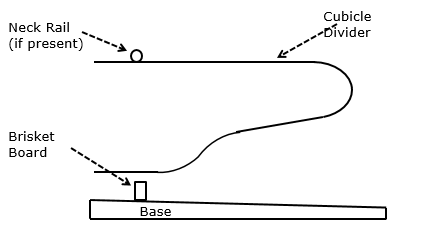
We want them to go in forwards so all muck goes in passageway not on bed
What size lunge zone do you want in the ideal cubicle?
What size bob zone?
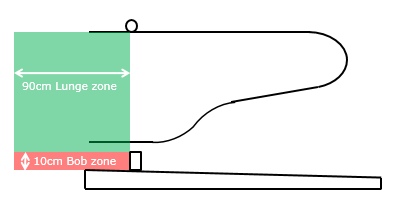
90cm lunge
10cm bob
What is the difference here and what does that mean?
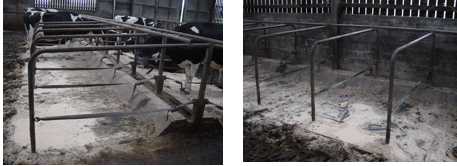
Left: “Head to Head” cubicles. Lunge space can be shared forward
Right: “Head to Wall” cubicles. Lunge space must be provided forward
What are th signs of problems with cubicles? (3)
- Cow half in/half out lying
- Cow half in/half out standing
- Standing not lying (especially near cubicle)
What would the cow in an ideal cubicle look like?
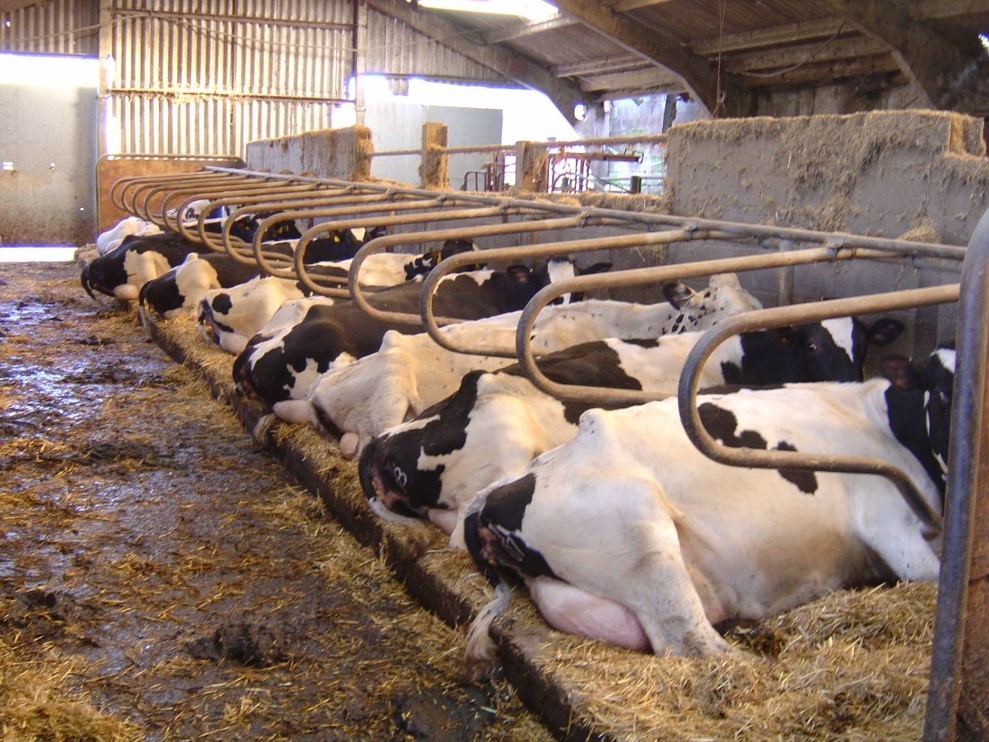
What are the 3 cow cubicle comfort tests and how are these done?
- Knuckle test – first into bed and twist. Tests to see how abrasive the bed is. (if your knuckles hurt – bad)
- Knee drop test – drop onto your knees on the bed. Should be willing to do it without the worry of it hurting. We are lighter than cows so I we are unwilling it is not good enough
- Lying test – just lie in cubicle. Not so great as we aren’t 700kg.
What 2 things should we do for heifers about to use cubicles prior to calving?
–Cubicle training during rearing
•Provide at least one month in cubicles before they calve
–When cows out at grass?
–Expose to concrete before they calve
•Allows the foot to adapt to the post calving environment
What cubicles should a fresh cow group have?
–Provide “best” cubicles at a low stocking rate or very clean straw yard for 4-6 weeks after calving
- Reduces pressure on feet during risk period
- Reduces stress during the post calving period
How can we limit waiting time in a collecting yard? (2) What is the issue of this
•Split cows into more groups
–Disliked by farmers as increases complexity
•Increase parlour size
–Expensive
What is a benefit and negative of using rubber matting through a unit or where cows stand for periods of time?
Benefit - comfort
Negative - cost
How can we prevent foot overgrowth?
Routine foot trimming
Who can do foot trimming?
–Farm staff (Must have appropriate training)
–Foot Trimmers
•Must be trained, ideally fully qualified/NACFT
When do we foot trim? (4)
- All feet of all cows are examined and trimmed at drying off
- A number of cows with obviously overgrown feet are selected on a routine basis (therefore not all cows are examined)
- All cows are trimmed in batches (often by a lay foot trimmer)
- The whole herd is trimmed annually by a lay foot trimmer
How can we reduce periparturient increase in the movement of the pedal bone?
–Provide periparturient animals with the best accommodation to minimise risk during this key period
How can you lose of fat from the digital cushion and new bone formation on P3 (2)
–Minimise body condition score loss to peak yield. (Current recommendation are adequate targets for this purpose)
–Identify and treat animals early to limit the impacts of disease
What are the 3 reasons we need to manage diet (especially high yielding cows)?
–Avoid subacute rumenal acidosis (SARA)
–Providing a source of high quality long fibre
–Minimise body condition score loss to peak yield
What four things can be done to help poor underfoot conditions?
–Improve cow tracks
–Repair damaged yards
–Gateways and water troughs
–“Forcing” / pressurising cows forward
What are the objectives of cow tracks? (6)
–Encourage rapid cow flow
–Comfortable and easy travel. Wide enough.
–Minimise damage and risk of lameness
–Keep cows clean – don’t want it too muddy (we use these for milking)
–Reduce loss of pasture due to poaching
–Support some vehicle use if absolutely necessary

-
Acute Abdomen31
-
Disease and conditions of the avian digestive system44
-
Metabolic Disease With Neuro Signs33
-
Diseases and Conditions of the Avian Respiratory System47
-
Lungworm and Respiratory Disease in Ruminants11
-
Intro To Calf Pneumonia8
-
Sheep Respiratory Disease – Coughing Lambs24
-
Respiratory Disease In Adult Farmed Animals41
-
Sheep Resp Disease - Adults29
-
Large Animal Respiratory Parasites34
-
Respiratory Disease in Calves42
-
Respiratory Disease in Pigs72
-
Large Animal Respiratory Parasites31
-
Pneumonia Diagnosis15
-
Sheep Respiratory Disease - Pathology19
-
Respiratory disease in poultry58
-
AB selection for respiratory disease37
-
Hepatic lipidosis/ketosis/farm16
-
Herd level metabolic disease21
-
Hypocalcaemia practical14
-
Parasitic skin disease of farm animals19
-
Ectoparasites camelids6
-
Bovine teat surgery34
-
Avian dermatology21
-
Dehorning and disbudding21
-
Large Animal Anatomy Refresher17
-
Practical: Pig GI anatomy4
-
Practical: Ruminant GI anatomy27
-
Practical: Chicken GI anatomy16
-
Scouring in Calves32
-
Johne’s Disease33
-
Beef Calf With Scour10
-
Acute Abdomen COPY31
-
Oral Cavity Disease Ruminants29
-
Neonate Calf Diarrhoea8
-
Liver Disease in Farm Animals49
-
Diarrhoea in Adult Cattle34
-
Disease of The Rumen10
-
Ruminant GI Disease55
-
Abomasal Disease42
-
Pig Neonate Diarrhoea11
-
BVD47
-
GI Disease in Pigs56
-
Case Studies3
-
The Sick Cow12
-
Ruminant Parasite Case10
-
Scouring Lambs6
-
Antiparasitic agents and endoparasites44
-
Clostridial Disease in Ruminants29
-
Foot and Mouth Disease27
-
Revision Haemonchus & Ostertagia18
-
Revision Liver Trematodes25
-
Revision SI parasite ruminants19
-
Practical Parasite Control in Farmed Animals78
-
Revision practice of helminth control12
-
Revision Mechanisms of action18
-
Bacterial and Protozoal Intestinal Disease in Commercial Poultry75
-
Mineral workshop37
-
Microbiology Of Enteritis61
-
Bovine Distal limb11
-
Corrective Foot Trimming16
-
Joint Swelling In Neonate Calf5
-
Poultry42
-
Lameness in cattle40
-
CR Bovine Lameness11
-
Pig Lameness47
-
Other Causes of Lameness in Cattle68
-
Sheep and Goat Lameness5
-
Clostridial disease in cows25
-
Farm Assurance11
-
Cattle Lameness 272
-
Farm Assurance COPY51
-
Cattle Lameness 342
-
Pig Lameness COPY67
-
Sheep lameness31
-
Bovine Neurology51
-
Ovine Neurology62
-
Metabolic Disease With Neuro Signs COPY33
-
Porcine Neurology43
-
Non-Notifiable Viral Disease44
-
Notifiable Neuro Viruses26
-
Large Animal Ophthalmology21
-
Eye and Disease30
-
Pharmacological Control Of Pregnancy and Parturition25
-
Principle Causes of Infertility in the FEMALE56
-
Principles of Pregnancy Failure14
-
Pregnancy Loss Case11
-
Principles of Fertility and Breeding Time43
-
Intro to repro pathology137
-
Principles of Monitoring Fertility33
-
The Itinerant Bull SGTR case13
-
Principles of Cycle Manipulation32
-
Principles of managing dystocia45
-
Approach to Examining the Female Tract42
-
Principles of decision making and surgical management of dystocia24
-
Principles of Post Partum Conditions34
-
Principles of antibiotic treatment in reproduction cases and xertes39
-
Principles of Neonate Care and Disorders of the Neonate37
-
Principle causes of infertility in the male23
-
Approach to Examining the Male Reproductive Tract47
-
Principles of Semen Quality25
-
Porcine reproductive disease59
-
Reproductive Exam19
-
Fertility and The Dairy Vet26
-
Infertility in the Individual Cow14
-
Avian reproduction56
-
Milk Quality 1 & 220
-
Uterine Disease24
-
Reproductive Case Management15
-
Unwanted pregnancy TR12
-
Mastitis Diagnosis21
-
Small Ruminant Repro31
-
Camelids Repro9
-
Infectious Repro Disease21
-
Ewe Breeding6
-
Cases of Abortion in the Ewe8
-
Mastitis Teat Conditions22
-
Reproductive medicine use in practice19
-
Parturition & post partum disease in farm animals25
-
Mastitis control38
-
Abortion cases20
-
Milk Quality29
-
Down Cow6
-
Mastitis Treatment46
-
Bovine C-section & Dystocia (Practical)15
-
Infectious reproductive disease in cattle78
-
Heifer Dystocia16
-
Repro formative MCQ23
-
Large Animal Toxicity9
-
Cattle Urinary Disease23
-
Calculi in LA11



