Stroke Mimics (10)
- Structural
- ICH - subdural or Extra-dural
- Brian tumour
- Brain abscess
- Vascular
- Aortic dissection
- Carotid/vertebral artery dissection
- Migraine - Vestibular
- Giant cell arteritis
- Polyarteritis nodosa
- Lupus / vasculitis
- Cerebral Venous sinus thrombosis
- AGE
- Infectious
- Bell’s Palsy
- Labrynthitis
- Vestibular neuronitis
- Demyelination/Peripheral Neuropathy
- Peripheral nerve palsy
- Demyelinating disease - MS
- Meniere’s disease
- Metabolic
- Hypoglycaemia
- Hyponatraemia
- Wernicke’s encephalopathy
- Todd’s paresis
- Toxicological
- Intoxicated states
- Methanol → blindness
Seizure differential
ALWAYS CONSIDER PRE-ECLAMPSIA IN FEMALE!
- Drugs - abuse / accidental / acquired / TOX / intoxication or withdrawal
- Infection - Febrile rigors
- Metabolic - Hypoxia, BSL, Electrolytes, Encephalopathy, Uraemia, TSH
- Environmental - heat stroke, dysbarism,
- Structural - Epilepsy, SOL, SAH, ICH
- Other - pre-eclampsia, syncope, pseudoseizure
HINTS EXAM
PERIPHERAL
- Head impulse abnormal
- Nystagmus unidirectional
- No veritcal skew
- No new hearing loss
CENTRAL
- Head impulse normal
- Nystagmus bidirectional
- Veritcal skew
- May have new hearing loss
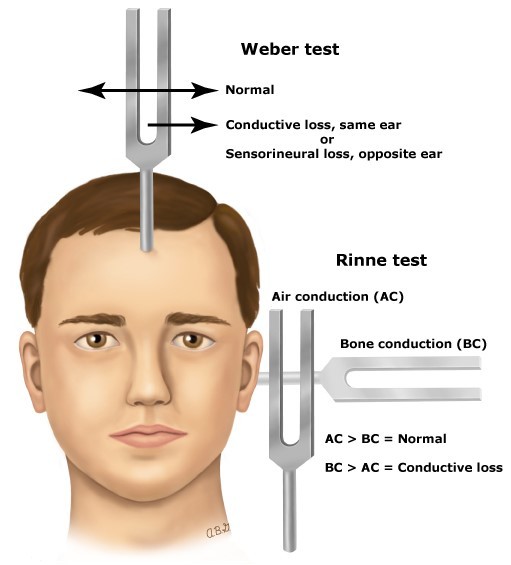
Rinne vs Weber
- Weber test: Place the base of a struck tuning fork on the bridge of the forehead, nose, or teeth. In a normal test, there is no lateralization of sound. With unilateral conductive loss, sound lateralizes toward affected ear. With unilateral sensorineural loss, sound lateralizes to the normal or better-hearing side.
- Rinne test: Place the base of a struck tuning fork on the mastoid bone behind the ear. Have the patient indicate when sound is no longer heard. Move fork (held at base) beside ear and ask if now audible. In a normal test, AC > BC; patient can hear fork at ear. With conductive loss, BC > AC; patient will not hear fork at ear.
Bulbar Palsy (7)
LMN lesion - IX, X, XII
- MND
- Syringobulbia
- GBS
- Polio
- Subacute meningitis
- Neurosyphilis
- Brainstem CVA
Pseudobulbar Palsy (5)
UMN lesion - IX, X, XII
- Bilateral Internal Capsul CVA
- MS
- MND
- High brainstem tumour
- Head injury
Bulbar vs Pseudobulbar Palsy
Compare and contrast (14)

BP Targets for CVA
- AIS / TIA <220/120
- AIS with tPA <185/110
- ICH <180/90
- SAH <160/90
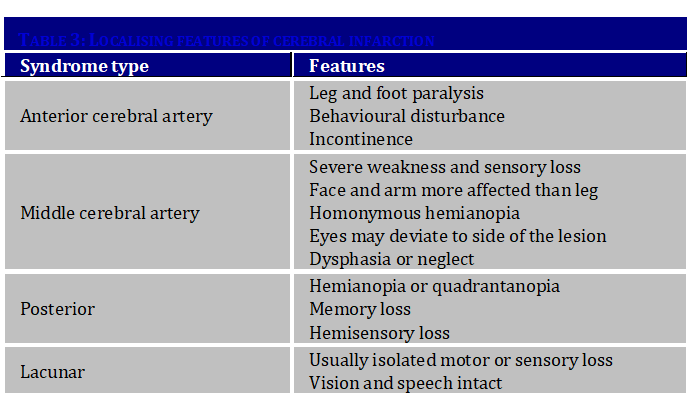
Stroke Syndromes
Complete Cord Transection
Total loss of sensory, autnomic and motor function below level of spinal cord injury
Acute or subacute process
Trauma, infarction, haemorrhage and extrinsic compression
Flaccid paralyis
Loss of sensation with sensory level - NO sacral sparing - no perianal sensation, rectal pshincter tone or gt toe movement)
Autonomic dyfsunction
Reflexes can still occur as they are mediated by spinal levels
DTRs - may be lost, present or AbN
Autonomic dysfunction - neurogenic shock, priapism
Urinary retention
Bradycardia, hypotension, hypothermia, ileus
Multiple Sclerosis
Auto-immune demyelinating disorder of brain and spinal cord (CNS)
Relatively sparing of axons
25-30yrs, F:M 2:1, latitude
Very variable clinical presentation
- CN - optic/trigeminal neuraliga
- Spinal cord - transverse myelitis
- Paraesthesia/weakness of limbs
- Bladder urgency, constipation
- Sexual difficulties
- Cerebellar
- Cerebral
- Hemiplegia
- Seizures
- Neuropsych
Dx
- 2 or more discrete episodes evolving over days to weeks
- CSF - Oligoclonal bands (IgG)
- MRI - demyleinating lesions
- Nerve conduction studies
Rx
- Acute exacerbation - IV methylpred 1g daily for optic neuritis / paraplegia / brainstem lesions
- Inhibit progression
- Immunosuppression - methotrexate, azathioprine, mitozantrone
- Immunomodulators - B-interferons, glatiramer, natalizumab
- Rx complications
- Depression / bladder dysfunction, spasticity, tremors
Raised ICP
Normal 5-15mmHg
Raised >20mmHg
CPP = MAP - ICP
When ICP > MAP - brain doesnt get O2
Causes
- Trauma - HI, NAI (kids and elderly)
- Haemorrhage
- Tumours
- Infections
- Extra CSF - ICH
- CVA
Signs/Sx
- GCS < 9
- Fixed dilated pupils
- Cushing’s reflex - SNS activation
- HTN / ↑ widened pulse pressure
- ↓ HR - bradycardia
- ↓ RR
Mx
- Osmotherapy
- Mannitiol 0.5-1g/kg - target 300-320mOsmol/kg
- Hypertonic saline - target 145-155mmol/L
- Surgical
- EVD
- Evacuation of haematoma
- Supportive
- Head up 30 degrees
- Avoid hypoxia, hypercarbia, HTN
- Target PaCO2 35-45mmHg
- Target MAP approx 80
- CPP = MAP - ICP
- Aim CPP > 60mmHg
- Avoid raising ICP - prevent coughing, vomiting
- Decrease cerebral metabolic rate
- Sedation, paralysis
- Treat seizures
- Consider hypothermia
Motor Weakness

Motor Weakness Additional findings

Neuropathy vs myopathy vs NMJ weakness

Bedside Pulmonary Function Tests - GBS and MG
25% with motor weakness due to GBS or MG will need intubation
Consider 20/30/40 rule
FVC < 20mls/kg
MIP < 30cm H2O
MEP < 40cm H2O
Only FVC useful
- likely to need ETT when FVC < 10-15mls/kg
Rule out other causes of respiratory failure
Do NOT chase autonomic dysfunction
Myaesthenia Gravis
Post-synaptic autoimmune disorder
Younger females and older men (bimodal)
Sx
Descending motor power loss
Bulbar symptoms, Ptosis
Sensation, reflexes and pupillary reflexes should be spared
Fatigable and fluctuate
DDx
Lambert-Eaton Syndrome
- pre-synaptic Ca channels
- Improves with activity
Botulism
- Impaired pupillary responses
Ix
Ice test - ice pack over eye for 3 minutes improves ptosis and upward gaze
Tensilon test - IV edrophonium + monitor for improving ptosis and diplopia
Tips
Avoid sux - unpredictable response
Lower doses of roc (0.5mg.kg) due to impaired receptor response
Rx
Physostigmine
Immunosuppression
IVIG
Plasmaphoresis
Treat underlying cause
Electrolyte replacement
MG - drugs to avoid
Aminoglycosides
Fluoroquinolones
BB
MgSO4
SAH - World Federation Neurosurgeons Scale
Most important porgnosticating factors are level of consciousness + level of hemiparesis
Grade I (45%) = GCS 15 + NO motor deficit
Grade II (22%) = GCS 14-13 + NO motor deficit
Grade III (3%) = GCS 14-13 + motor deficit
Grade IV (17%) = GCS 12-7 +/- motor deficit
Grade V (14%) = GCS 6-3 +/- motor deficit
SAH - Hunt and Hess classification

SAH - Fisher Scale
Radiological
Risk of vasospasm

SAH Risk Factors and Complications
Risk Factors
HTN
Smoking
F>M
Previous SAH / Known Aneurysm
CT disorders - PKD, Marfan’s, Ehler’s Danlos
Complications
Immediate
* Neurological deficit
* MI
* APO
Delayed
* Rebleeding
* Vasospasm
* Prevented with nimodipine 60mg q4-6hr PO/NG 1/52
* Hydrocephalus
* Usually communicating
* Hyponatraemia
* Seizures
SAH sites

Seizure + fever differentials
Epilepsy
CNS - meningitis, encephalitis, cerebral abscess
Raised ICP - SOL, cerebral oedema, blocked VP shunt
Febrile seizure
Toxic ingestion


-
Resuscitation42
-
Cardiology102
-
Respiratory19
-
GI32
-
Neurology47
-
Endocrine25
-
Renal12
-
Toxicology82
-
Haem/Onc39
-
Administration29
-
Environment31
-
Paediatrics3
-
ENT26
-
Decision Rules10
-
Data Interpretation8
-
Radiology31
-
Trauma21
-
Differentials / Common Presentations1
-
Rheumatology18
-
ID44
-
O+G35
-
Eyes23
-
Calculations6
-
Signs/Symptoms7
-
Orthopaedics42
-
Max/Facs15
-
Difficult/Special Situations11
-
Renal / Urology5
-
STATs0
-
Psychiatry10
-
ACEM policies and procedures0
-
Drugs/Pharm10
-
Dermatology17
-
Metabolic13



