Post Resuscitation Care (11)
- O2 Sats 94-98%
- TTM
- ECG
- ABG
- ETT check / Lung protective ventilation
- Inotropes for hypotension
- Sedation
- Complications of CPR
- Fractures
- Aspiration
- PTx
- Need for CT head
Goals:
Maintain normal vital signs
Prevent further organ dysfunction
Organise any interventions
Treat/Mx complications of CPR
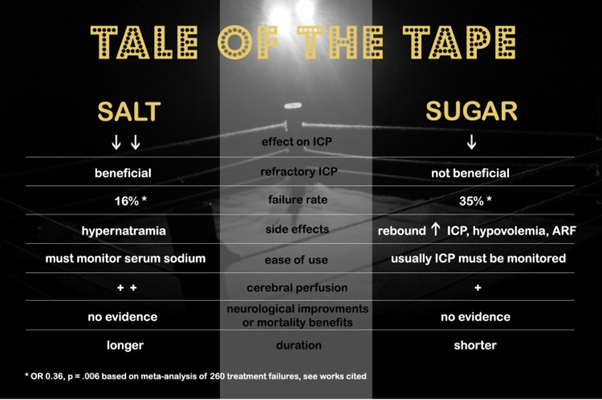
Hypertonic Saline
Indications
- Raised ICP
- Hyponatraemia (Na<120)
- Hypotension - small volume needed
- Sputum expectoration
Preparations
- 3% 150ml, 7.5% 75ml, 23.4% 30ml
Aims
- Keep BP >90
- ICP <20mmHg
- Osmolality 300-320 mOsm/L
- Na 145-155 mmHg
+ve EFFECTs
- rapid effect (peak @ 10 min, lasts 1 hour)
- VBG to monitor Na
- Less hypovolaemia cf mannitol
- Rapid restoration of intravascular volume, BP and decreases ICP
- May have a better effect on CBF for a given reduction in ICP
- May prevent cerebral oedema
- cheap, available
- Easy to transport (small volume)
- Anti-inflammatory effect may decrease incidence of MODS
-ve EFFECTS
- Hypernatraemia / hypokalaemia
- Hyperchloraemic acidaemia
- Renal failure
- CVC required
- Phlebitis, tissue necrosis if extravasates
- Central pontine myelinosis if Na+ corrected too quickly in hyponatraemia
- Increase in circulating volume -> risk of CHF (theoretical – not recorded)
- Coagulopathy: can affect APTT, INR and platelet aggregation (no evidence for changes in outcome)
- Rapid changes in Na+ may result in seizures and encephalopathy
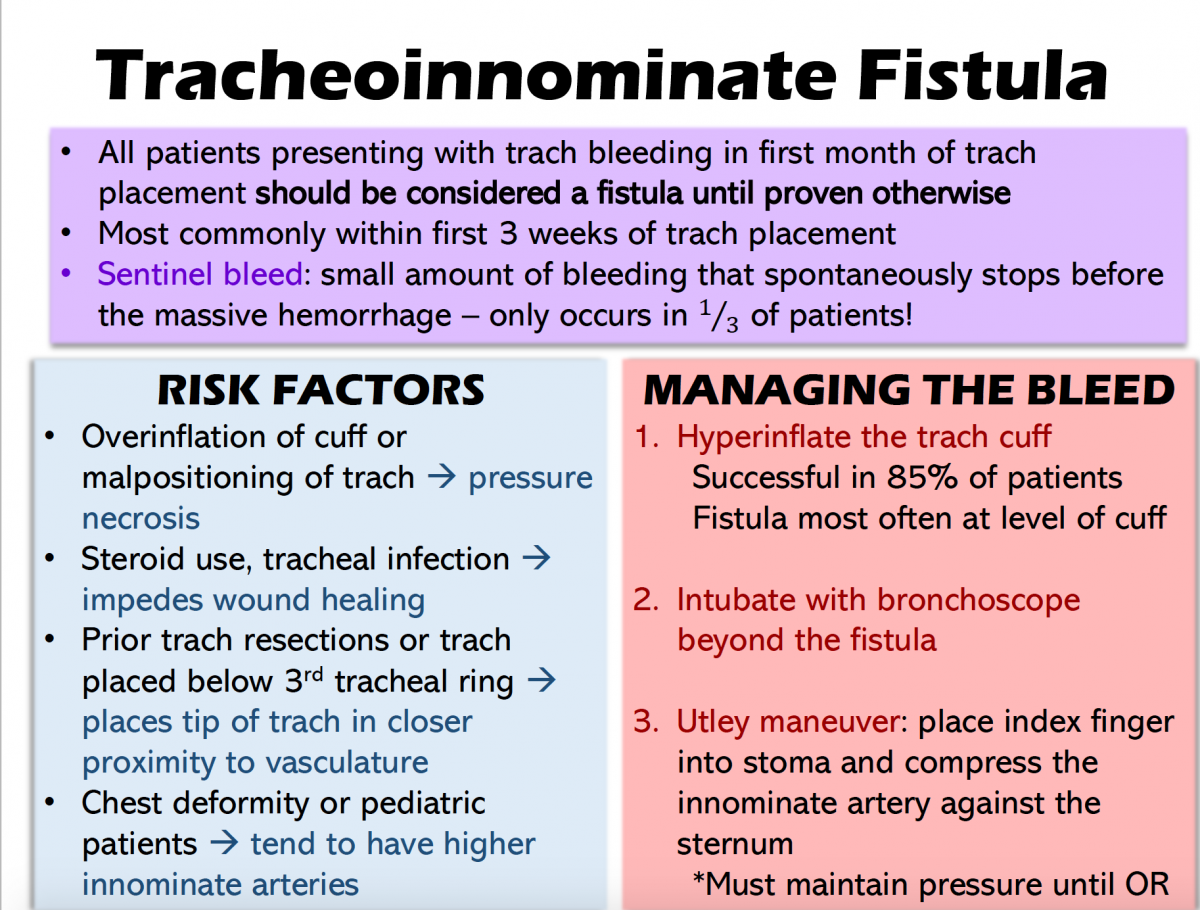
Tracheoinnominate fistula
Capnography
Noninvasive measurement of the concentration (partial pressure) of expired carbon dioxide over time
Clinical Uses
- Rapid assessment critically ill / severely ill pt
- Assess Response to treatment for acute respiratory distress
- Monitoring during procedural sedation
- Rapid assessment of ubtunded or unconscious pt
- Sedated patients (Opioid Abuse, EtOH intoxication, procedural sedation, etc.)
- Monitoring Airway Ventilation
- Unlike pulse-oximetry, not prone to motion artifact
- Earlier recognition of respiratory depression when compared to pulse-oximetry (Deitch 2010)
- Median time to difference in detection = 60 seconds
- May also detect other adverse effects, such as bronchospasm, laryngospasm, or upper airway obstruction
- Metabolic Acidosis (Taghizadieh 2016)
- Metabolic acidosis → decreased HCO3 → compensatory hyperventilation → increased minute ventilation and decreased ETCO2
- Obstructive Lung Disease
- Upsloping of alveolar plateau due to alveolar leak of CO2
- Pattern also seen in leaks in breathing system (endotracheal tube leaks)
- Ventilated Patients/Apneic Patients
- ET Tube Placement - GOld Standard
- CPR Effectiveness/ROSC
- Quantitative measure of chest compression effectiveness
- Prognostic factor of ROSC if <10 mmHg at 20 min of CPR (Levin 1997)
- An early indicator of reperfusion from ROSC is sudden rise in EtCO2 and thereby may help to decrease deleterious pauses in chest compressions for pulse checks
Resuscitative Thoracotomy
Indications
- Traumatic cardiac arrest <15 mins PLUS
- Penetrating injury
- Blunt injury + cardiac tamponade
- Bleeding from ICC >1.5L or 200mls/hr for 3 hrs
Goals
- Relieve cardiac tamponade
- Perform open cardiac massage
- Occlude aorta to increase blood flow to heart and brain
- Control life threatening thoracic bleeding
- Control bronchovenous air embolism
https://www.aci.health.nsw.gov.au/networks/eci/clinical/procedures/procedures/554100
Capnography in CPR
Normal 35-45mmHg
During cardiac arrest:
- Gradual fall in ETCO2 suggests compressionist fatigue during CPR
- Abrupt increase in ETCO2 suggests ROSC during CPR (detectable before pulse check)
- ETCO2 at 20 minutes of CPR is prognostically useful
Prognosis
- >20 mmHg at 20 minutes CPR -> higher chance of ROSC
- <10 mmHg at 20 minutes CPR -> almost no chance of ROSC
FFP / ELP
vs
Cryoprecipitate
Prep time for both approx 30 mins
FFP
- All clotting factors
- Fibrinogen 700-800mg
- 250-300ml
Cryo
- Factors VIII, XIII and vWF
- Fibrinogen 150-252mg
- 10-20ml
Hypothermic Arrest
Correct electrolyte abnormalities
- May see relative hypokalaemia - fluid shift resolves with rewarming
Defib
- Try up to 3 times
- No success - no further attempts until T >30C
- Pacing not successful
Int+Vent
- Low risk ppte VF
- Aim normocapnoea
Drugs
- <30C - withold
- 30-35 - twice time interval i.e every 8-10mins
Rewarming
- Passive - remove wet clothes, warm blanket, warm drinks
- Active
- Ex - bare hugger, immersion hot watert
- Int - warm air, IVF, lavage, haemofiltration, ECMO or CPB
Arterial line uses
- Persistent or recurrent hemodynamic instability
- Monitoring of conditions or treatments that result in large fluid or blood pressure shifts
- Frequent arterial blood sampling
- Expected inaccuracies in noninvasive blood pressure management (e.g. because of obesity or dysrhythmias)
Pulse Oximetry
Measures arterial hemoglobin that is in the oxyhemoglobin state
Pulse oximetry is limited by:
- Artifact
- Low perfusion states
- Increased ambient light
- Deep skin pigmentation
- Nail polish
- Methylene blue
- CarboxyHb
- MetHb
ETCO2 uses
Considerations for resuscitation
- Pt wishes
- Presence or absence of advanced care directive
- Presence of enduring guardianship
- Duty of care - identify and treat reversible pathology
- Pre-morbid QOL
- Co-morbidities
- Limits of Mx, Rx goals and disposition destination
- Other stake holders i.e. NOK, ED nurses, ICU
- Personal biases
Organ donation
ECMO criteria
Acute, severe REVERSIBLE respiratory or cardiac failure with a high risk of death that is refractory to conventional management
- poor gas exchange
- compliance < 0.5mL/cmH2O/kg
- P:F ratio < 100
- shunt fraction > 30%
ECMO complications
- Clot formation
- Haemolysis
- Air embolism
- Bleeding
- Pump failure
- Decannulation
- Circuit rupture
- Cardiac arrest
- Oxygenator failure
- VA: left ventricular overdistension -> APO, cardiac damage, pulmonary haemorrhage, pulmonary infarction, aortic thrombosis, cardiac or cerebral hypoxia, CVA 15%
- VV: cardiac arrest -> perform CPR
ECMO contraindications
Absolute
* progressive non-recoverable cardiac or respiratory disease
* Severe PHTN
* Advanced malignancy
* GVHD
* >120kg
* Unwitnessed cardiac arrest
Relative
* age > 75
* multi-trauma with multiple bleeding sites
* CPR > 60 minutes
* multiple organ failure
* CNS injury
Intubation of Obese
- Cardiovascular
- HTN
- LV dysfunction
- Respiratory
- O2 consumption increased
- CO2 production increased
- Reduced FRC - abN elevated diaphragm, dec chest wall compliance
- Airway
- Difficult in all aspects i.e BVM, SGA, ETT, surgical
- Time to desaturation decreased due to resp factors
- Ramping, Head-up
- Pre-oxygenation and Apnoeic oxygenation
- Drugs
- LBW for hypnotics
- TBW for NMB
- Ventilation
NEEDS FINISHING
Clamshell vs anterolateral ED thoracotomy
Clamshell
ADV - Better access to heart and lower mediastinum
ADV - Access to both pleural cavities
ADV - Better performance for non-surgeons
CONS - Difficult wound closure
CONS - Post-op pain
AL approach
ADV - Direct / fast access to heart /pericardium
ADV - Easy to close
ADV - less morbidity assoc
CON - Limited access
CON - Limited interventions due to space restriction
CON - If bleeding source on right - unable to reach
High pressure alarm - Ventilator

Low pressure alarm - Ventilator
Think Air Leak
Ventilator can’t generate the peak or plateau pressure necessary to oxygenate or ventilate the patient.
Most likely disconnection of circuit or patient from ventilator
ETT Position Too High:
- Check ETT depth
- Dislodged during transport
ETT Cuff Leak:
- Cuff pressure - inc or replace
- Leak at ETT/ventilator interface
- Check tubing
Check ICC - may be a leak through ICC
NIV Complications
- Inc WOB
- w/ asynchrony
- Improperly set triggers
- Increase in intrathoracic pressure
- Resp alkalsosis
- Decreased venous return
- Dec CO
- Dec renal blood flow and GFR → inc fluid retention
- Inc ventilation/perfusion ratio
- Air trapping
- Intrinsic positive end-expiratory
pressure, - Barotrauma
- Nosocomial infections of the
lungs and sinuses
Analgesics - adverse rxns
- Fentanyl - chest wall rigidity
- Oxycodone - serotonin syndrome
- Hydromorphone - inactive metabolites
Sedative adverse rxns
- Etomidate - myoclonus
- Ketamine - laryngospasm
- Propofol - venous irritation
- Pentobarbitol - 30min sedation duration
Local Anaesthesia Toxicity Treatment


-
Resuscitation42
-
Cardiology102
-
Respiratory19
-
GI32
-
Neurology47
-
Endocrine25
-
Renal12
-
Toxicology82
-
Haem/Onc39
-
Administration29
-
Environment31
-
Paediatrics3
-
ENT26
-
Decision Rules10
-
Data Interpretation8
-
Radiology31
-
Trauma21
-
Differentials / Common Presentations1
-
Rheumatology18
-
ID44
-
O+G35
-
Eyes23
-
Calculations6
-
Signs/Symptoms7
-
Orthopaedics42
-
Max/Facs15
-
Difficult/Special Situations11
-
Renal / Urology5
-
STATs0
-
Psychiatry10
-
ACEM policies and procedures0
-
Drugs/Pharm10
-
Dermatology17
-
Metabolic13



