Given that it is very difficult to detect hypoadrenalism in the operative and postoperative situation, patients on exogenous steroids who cannot continue their oral medication are given intravenous steroids to ‘cover’ the intra and postoperative phases. A common regimen is?
25 mg of hydrocortisone IV 4/day
- A post-op patient presenting with shortness of breath: 3. A post-op patient with poor urine output 4. post-op patient who is confused 5. post-op patient with a problem relating to their wound 6. A post-op patient with constipation or diarrhoea 7. post-op patient with nausea and vomiting dentify which patients are at high risk of post-operative nausea and vomiting and formulate a plan to prevent and/or treat this
pain can cause confusion 2. Atelectesis, PE or DVT Pneumonia, Blood transfusion Complication of surgery 3. Dehydration, Urinary retention, Urinary obstruction, Complication of surgery, Anaesthetic/medication 4. Hypoxia Infection Drug induced Constipation Dehydration Endocrine abnormalities 5. Surgical site infection Wound dehiscence Keloids 6. Post op ileus, Diet, Iatrogenic (codeine), Functional Pathological 7. Patient factors • Female • Age • Incidence declines throughout adult life • Previous PONV or motion sickness • Use of opioid analgesics • Non-smoker Surgical factors • Intra-abdominal laparoscopic surgery • Intracranial or middle ear surgery • Squint surgery (highest incidence of PONV in children) • Gynaecological surgery, especially ovarian • Prolonged operative times • Poor pain control post-op Anaesthetic Factors • Opiate analgesia or spinal anaesthesia • Inhalational agents (e.g. Isoflurane, nitrous oxide • Prolonged anaesthetic time • Intraoperative dehydration or bleeding • Overuse of bag and mask ventilation (due to gastric dilatation)
When should blood be transfused, and how quickly? Definition of massive blood transfusion is…. What are the components of FFP and cryoprecipitate? In which these two blood products might be used. Complications of blood trans How long does it take for iron tablets to work nicotine replacement+counselling
<80 transfusion+sym <60 trans Acute inc in pressure 1unit/2hrs >1 blood volume (24 hours) >50% of blood volume in 4 hours FFP = liquid portion of whole blood -> low blood clotting factors/low levels of other blood proteins Cryoprecipitate = made from blood plasma -> used for low clotting factors Early 1. Acute haemolytic reaction 2. overload 3. acute lung injury Late Infection Graft vs Host disease Iron overload 3wks
- How do you present a Chest X-ray:
- Name, age, date 2. RIP ABCDE (r- rotation, I-inspiration, p - projection/type of radiograph/penetration-quality) A is for Airway • trachea, right and left main stem bronchi and right intermediate bronchi B is for Breathing • Look to see if the lungs uniformly expanded and compare the lung fields • Look around the edges of each lung • Look at the 4 silhouettes C is for Circulation • Look at the cardiac size • Look at the great vessels (pulmonary vessels and aorta) • Look at the mediastinum and hila D is for Disability/dem bones • Look for a fracture, especially of the ribs and shoulder girdle E is for Everything else • Look for air under the diaphragm • Look at the edges for surgical emphysema • Look for the breast shadows • Look for foreign bodies 6. Give a short Summary at the end.
Indications for a plain abdominal X-ray are as follows: For most other clinical situations, an abdominal X-ray is not recommended as there is a more appropriate alternative test. Common examples include:
- Suspected bowel obstruction - To look for dilated loops of small or large bowel or a dilated stomach. Suspected perforation - To look for evidence of pneumoperitoneum. An erect chest X-ray should always be requested at the same time to look for free gas under the diaphragm. Moderate-to-severe undifferentiated abdominal pain - May be useful if the provisional diagnosis includes any of the following: toxic megacolon, bowel obstruction and perforation. Suspected foreign body - To look for the presence of radiopaque foreign bodies. Renal tract calculi follow-up - To look for the presence or movement of known renal tract calculi. • Abdominal trauma: A CT scan of the abdomen and pelvis with intravenous contrast is much more sensitive and specific at looking for evidence of solid organ, bowel or bony injury and may identify the site of significant active bleeding. • Right upper quadrant abdominal pain: An ultrasound scan of the abdomen is recommended to look for evidence of gallstones, inflamed gallbladder or an obstructed common bile duct. • Suspected intra-abdominal collection: A CT scan of the abdomen and pelvis is recommended to look for a source of infection (collection of pus or fluid). • Acute upper gastrointestinal bleeding: Endoscopy is indicated and enables diagnosis in most cases and can be used to deliver haemostatic therapy. If initial endoscopy is negative, then angiography or CT angiography may be useful to identify the source of the bleeding. • Suspected intra-abdominal malignancy: A CT scan of the abdomen and pelvis is recommended to look for a malignancy and can be used to help stage the malignancy if found. • Constipation: This is usually a clinical diagnosis without the need for any imaging tests. There is no evidence correlating abdominal X-ray findings with constipation. The only exception is in elderly patients where an abdominal X-ray may be useful to show the extent of faecal impaction, but does not diagnose constipation.
benzodiazepines to tailor of?
alcohol addictions 1L of % = 1 unit thus 5% of 1L =5 units CAGE question: to detect addicts - guilt, eye opener, Heroin Naltrexone?
Abdominal X-ray:
name age date taken type/penetration-quality A is for Air in the wrong place • pneumoperitoneum & pneumoretroperitoneum • gas in the biliary tree and portal vein B is for Bowel • dilated small and large bowel • volvulus • distended stomach • hernia • bowel wall thickening C is for Calcification • calcified gallstones, renal calculus, nephrocalcinosis, pancreatic calcification and an AAA • foetus (females) • Look for clinically insignificant calcified structures such as costal cartilage calcification, phleboliths, mesenteric lymph nodes, calcified fibroids, prostate calcification and vascular calcification D is for Disability (bones and solid organs) • Look at the bony skeleton for fractures and sclerotic/lytic bone lesions • Look at the spine for vertebral body height, alignment, pedicles and a ‘bamboo spine’ • Look for solid organ enlargement E is for Everything else • evidence of previous surgery and other medical devices • foreign bodies • lung bases
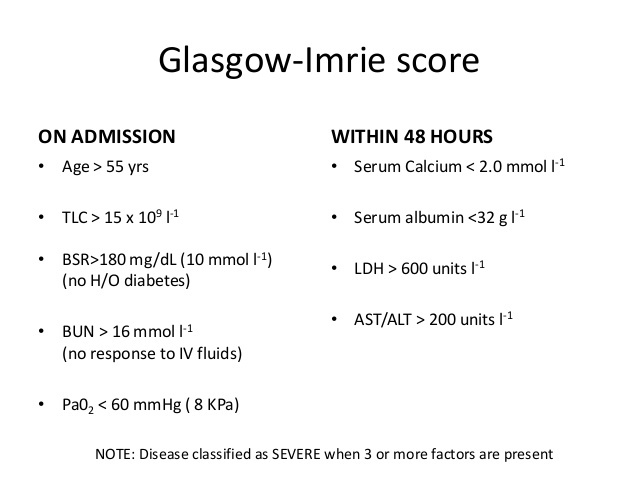
Glasgow-Imrie criteria
mild attack Rx
Severe attacks
complications
- fluid resuscitation and analgesia
no dietary restriction
Later management is aimed at treating predisposing factors. Gallstones should be sought by ultrasonography; if present, cholecystectomy is the definitive treatment and is ideally performed on the same admission or at worst 2–4 weeks after recovery. Ductal stones should be removed endoscopically before discharge from hospital. Alcohol abuse must be discouraged.
- 48 hours
sepsis
shock and multiple organ dysfunction syndrome (MODS)
ARDS develops rapidly with little warning but a deteriorating arterial P O 2 may herald its onset. This is an indication for urgent ventilatory support
- oxygen supplementation
- intravenous fluid resuscitation
- nasogastric tube is passed to aspirate the stomach only if gastroparesis causes troublesome vomiting.
- Enteral nasogastric or nasojejunal feeding has been reported to significantly decrease morbidity. If enteral feeding is not tolerated because of ileus, then total parenteral nutrition may be necessary.
- Gross fluid and electrolyte disturbances as well as hypocalcaemia are also likely to occur. Fluid balance in the shocked patient is complicated by massive losses of protein-rich fluid into the peritoneal cavity and interstitially (‘third space’). This sequestration of fluid needs to be countered by large amounts of intravenous fluids, carefully monitored by measuring central venous pressure and hourly urine output.
- • Haemoglobin estimation and white cell count
- Arterial blood gas estimations (?sepsis)
- Blood sugar (hyper dec insulin)
- Plasma electrolytes, creatinine and urea
- ‘Liver function tests’ (i.e. bilirubin, alkaline phosphatase, lactate dehydrogenase (LDH), transaminases, plasma proteins) (? biliary obstruction)
- Plasma calcium (hypo) and phosphate
- C-reactive protein (complications if high)
suspected/proven to have a gallstone aetiology should undergo urgent therapeutic ERCP, which should take place within 72 hours of the onset of pain. This applies whether severe pancreatitis is predicted or confirmed. All of these patients require sphincterotomy of the sphincter of Oddi whether or not stones are found in the common bile duct. If stones are seen or if cholangitis or jaundice is present, biliary stenting is usually required.
There is no role for surgery during the acute attack but in patients with stones, laparoscopic cholecystectomy with operative cholangiography should be performed before discharge from hospital. This is because deferring cholecystectomy until months later increases the risk of another attack. In the small group of critically ill patients with infected necrotic tissue and infected peripancreatic fluid collections, surgical debridement with or without continuous peritoneal irrigation is unavoidable, but mortality remains high.
complications:
pancreatic and peripancreatic necrosis
During the initial attack, acute peripancreatic fluid collections may develop. Most resolve spontaneously, but for those that do not, CT-guided percutaneous drainage is valuable. Fluid collections persisting for longer than 6 weeks are termed pancreatic pseudocysts (see below). Late in the course of the disease, a pancreatic abscess may appear. This is a well-localised collection of pus within the gland, and contrasts with infected necrotising pancreatitis which appears earlier and is not localised.
Discuss with your consultant about the different types of prosthetic material available for repair & list them below
Polypropylene (PP) is the most frequently used type of mesh
Polyethylene terephthalate (PET) is also used
Grey Turner’s sign
- Acute pancreatitis, whereby methemalbumin formed from digested blood tracks subcutaneously around the abdomen from the inflamed pancreas.
- Pancreatic hemorrhage[1]
- Retroperitoneal hemorrhage[1]
- Blunt abdominal trauma
- Ruptured / hemorrhagic ectopic pregnancy.
- Spontaneous bleeding secondary to coagulopathy (congenital or acquired)
- Aortic rupture, from ruptured abdominal aortic aneurysm or other causes.
Cullen’s sign is superficial edema and bruising in the subcutaneous fatty tissue around the umbilicus.
Causes
- acute pancreatitis, where methemalbumin formed from digested blood tracks around the abdomen from the inflamed pancreas
- bleeding from blunt abdominal trauma
- bleeding from aortic rupture
- bleeding from ruptured ectopic pregnancy
Bloating?
This is a characteristic feature of IBS.
inflammatory bowel disease.
- What factors increase the risk of developing the condition? Suggest up to four.
- What are the indications for surgery in inflammatory bowel disease?
1.
- Smoking - Crohn’s
- Family history - UC and Crohn’s
- White European descent Recent appendicectomy
2.
- Failed medical management
- Severe complications (strictures/fistulas)
- Growth impairment in younger patients
- Toxic megacolon
- Bowel perforation
Differential diagnosis for rectal bleeding
Angiodysplasia is the most common vascular lesion of the gastrointestinal tract, and this condition may be asymptomatic, or it may cause gastrointestinal (GI) bleeding. [1] The vessel walls are thin, with little or no smooth muscle, and the vessels are ectatic and thin (see image below).
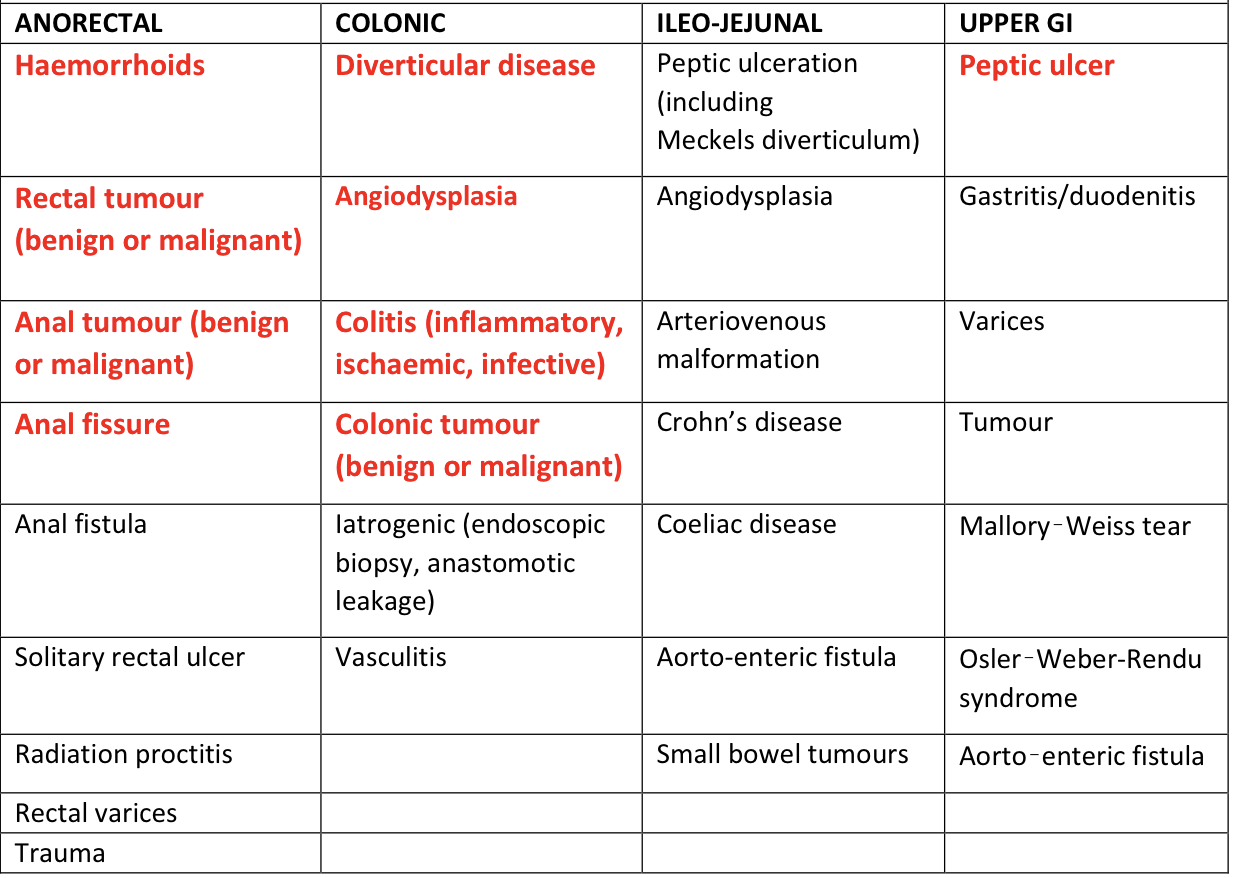
What is the relationship of blood with stool? This is the key question with regard to potentially localizing the source of bleeding. There are four scenarios:
Blood is mixed with the stool: this suggests that the lesion is proximal to the sigmoid colon. Stool in the proximal colon is soft (thus facilitating mixing with blood) and there is sufficient transit time to enable mixing
Blood streaked on stool: suggests a sigmoid or anorectal source of bleeding.
Blood is separate from the stool: if the blood is passed immediately after stool, the
likelihood is that this is an anal condition such as haemorrhoids. If, however, blood is passed on its own, this implies that there has been sufficient bleeding to dilate the rectum and produce a defecation stimulus. Such bleeding is most likely to occur with diverticular disease, angiodysplasia, inflammatory bowel disease, or sometimes a rapidly bleeding cancer (upper GI haemorrhage is another small-print cause).
Blood is only seen on the toilet paper: this implies relatively minor bleeding from the anal canal, most likely due to haemorrhoids or an anal fissure.
Is there any pain or prolapse when opening the bowels?
Is there any tenesmus (sensation of incomplete evacuation)?
Has there been any change of bowel habit?
Most of the conditions resulting in rectal bleeding are non-painful. The most notable exception is an anal fissure, which produces intense/tearing pain during defecation and perhaps lasting for several hours post-defecation; such patients may also complain of an itch or perianal irritation. Colitis may be associated with abdominal
cramping, and lower anal cancers may present with pain. Haemorrhoids are not typically associated with pain unless they have thrombosed, but patients may have noticed prolapse.
This question is most specific for rectal cancer, where a luminal mass in the rectum can cause the feeling of incomplete bowel evacuation after defecation. It can also be a symptom of colitis.
passage of blood per rectum may be associated with diarrhoea (such as with colitis) or mucus (think of colitis, proctitis, rectal cancer, and villous adenomas of the rectum). Extensive haemorrhoids may also be associated with the passage of mucus per rectum.

-
Orthopaedics - Clinical conditions49
-
Drugs57
-
Pain management1
-
DVT assessment & management15
-
Care of the diabetic surgical patient and the surgical patient on steroids.38
-
peri operative42
-
peri op (general)18
-
Period Cardioresp8
-
General surgery43
-
GP day cases55
-
Medicine day case23
-
Hepato pancreatic biliary surgery7
-
contraception10
-
Rheumatology56
-
Paediatrics35
-
geri27
-
Urology10
-
Vascular surgery17
-
ID19
-
Renal workbook21
-
surgery workbook16



