Cerebellar
Movement Functions
- Starting movement
- Timing and fine tuning of movements
- Stopping at the right time
- Postural adjustments
- Motor planning (via outputs to premotor circuits)
- Motor adaptation/learning (via outputs to motor circuits)
Cerebellum
Anatomy
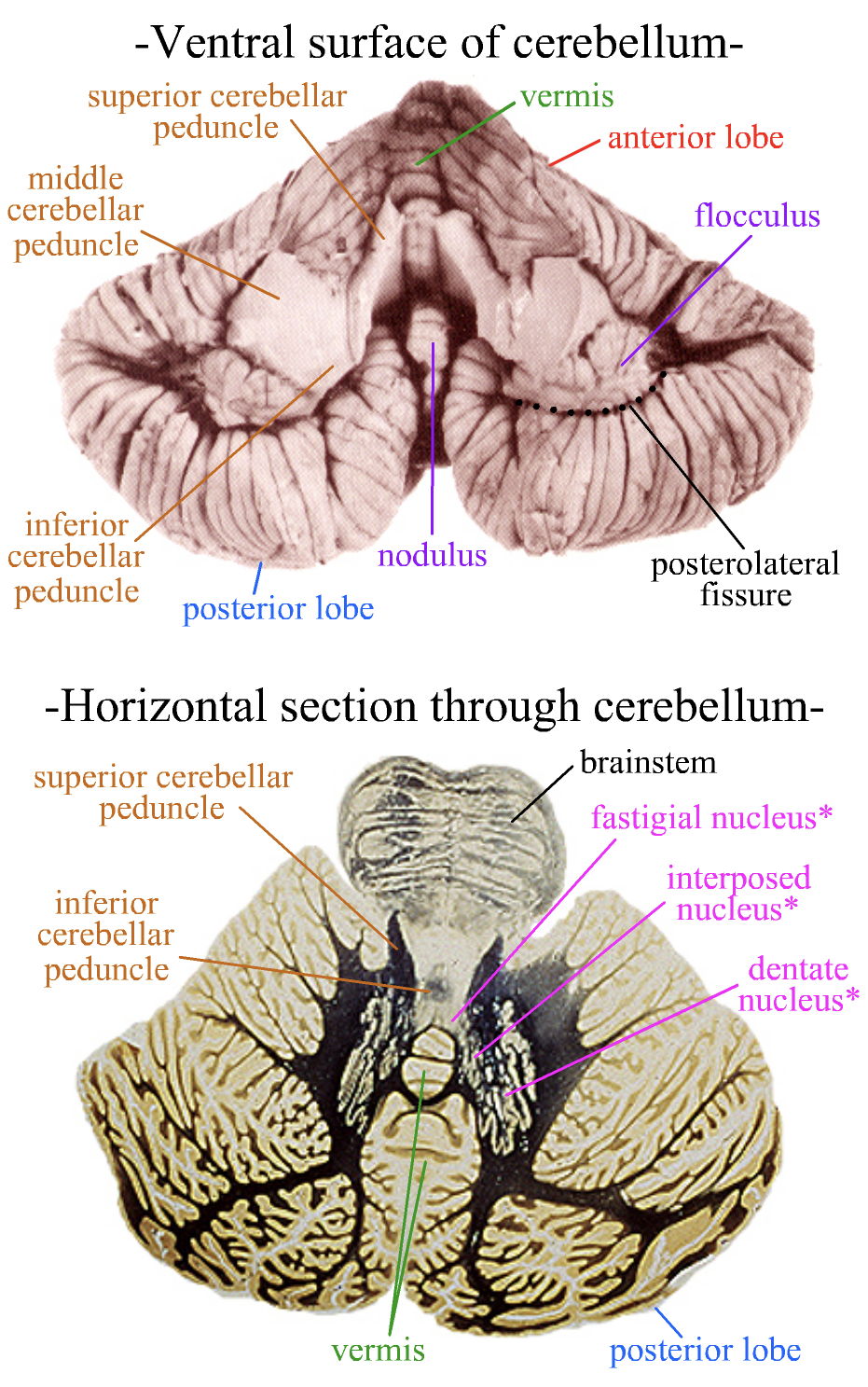
- Develops from alar plates of metencephalon
- Covers posterior surface of brainstem
- Forms roof of 4th ventricle
- Folia → transverse surface folds
- Medial to lateral: vermis → paravermis → lateral cerebellar hemisphere
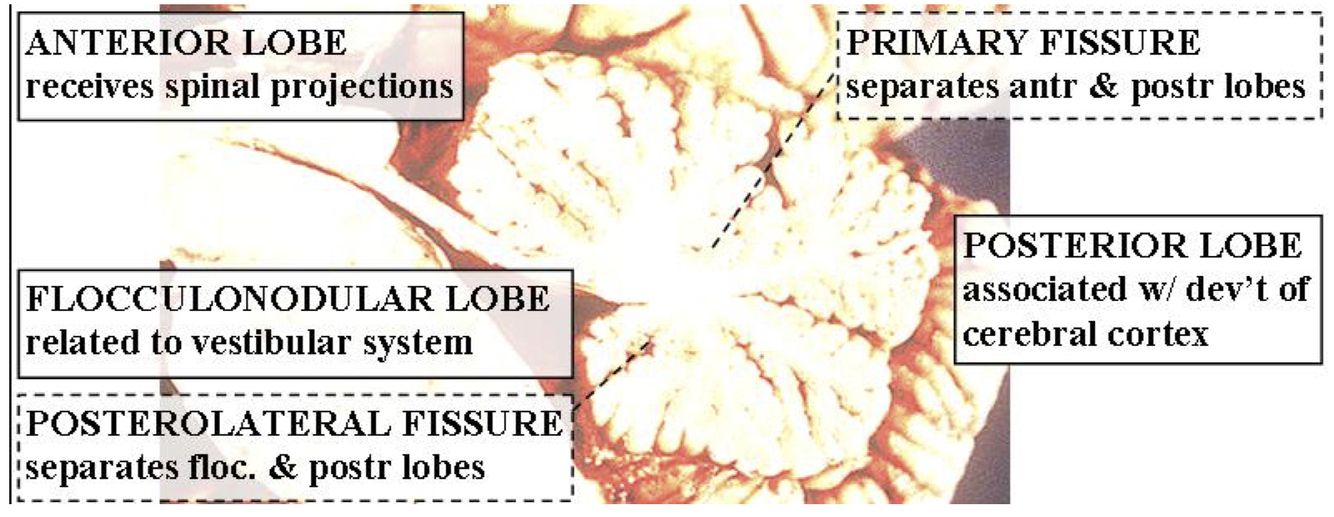
- Primary fissure → seperates anterior from posterior lobes
- Posterolateral fissure → seperates posterior from flocculonodular lobes
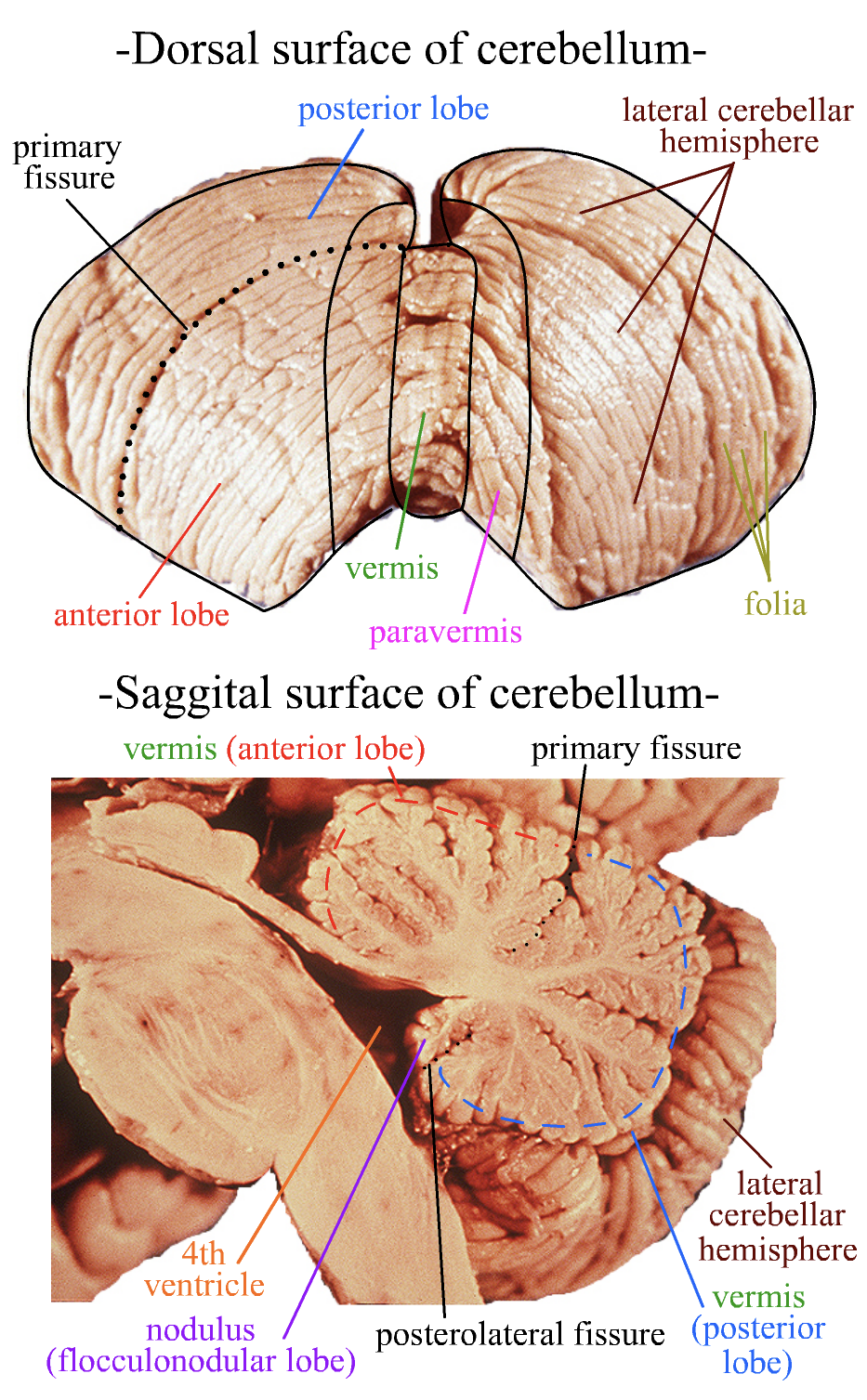
Transverse Divisions
Based on phylogenetic trends.
Longitudinal Divisions
Based on function.
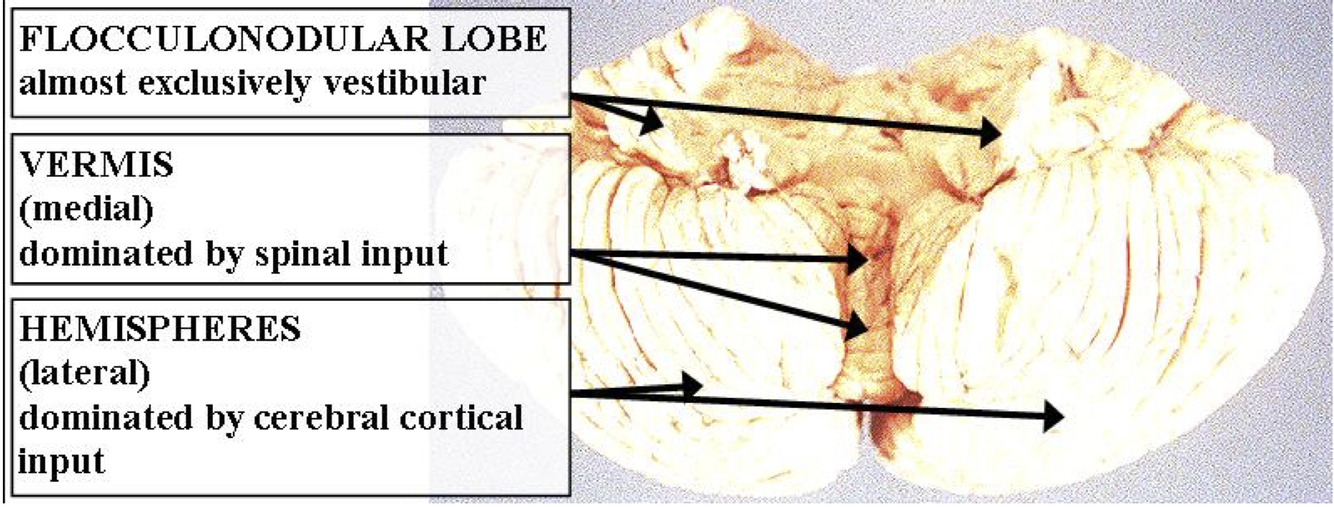
Flocculonodular Lobe
Includes nodulus and 2 flocculi.
Involved in control of balance and eye movements.
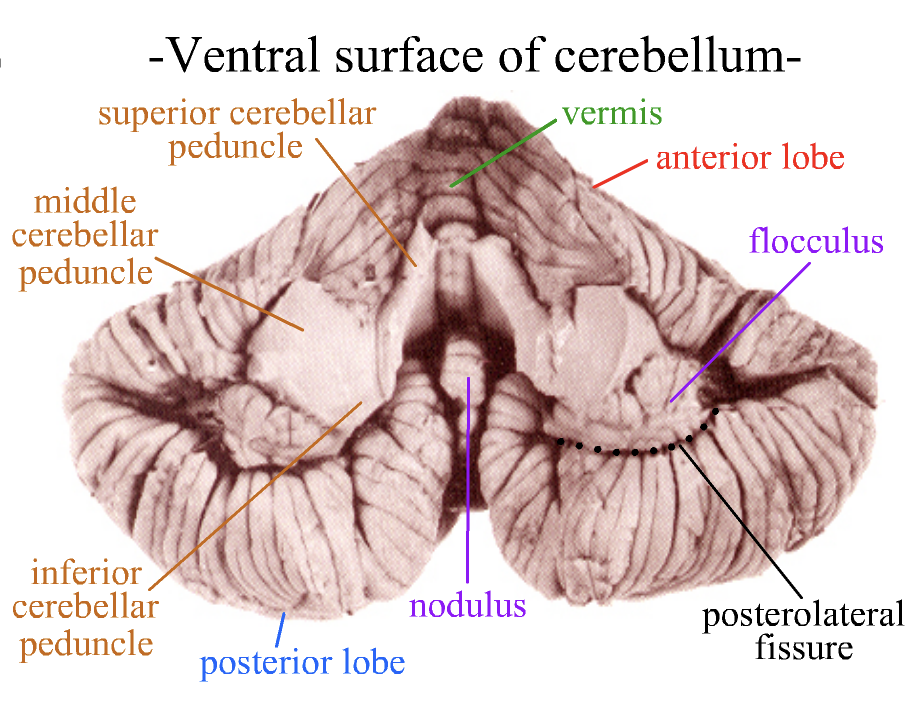
Brainstem Connections
Cerebellum connected to brainstem via 3 cerebellar peduncles:
ICP ↔ Medulla
MCP ↔ Pons
SCP ↔ Midbrain
Blood Supply
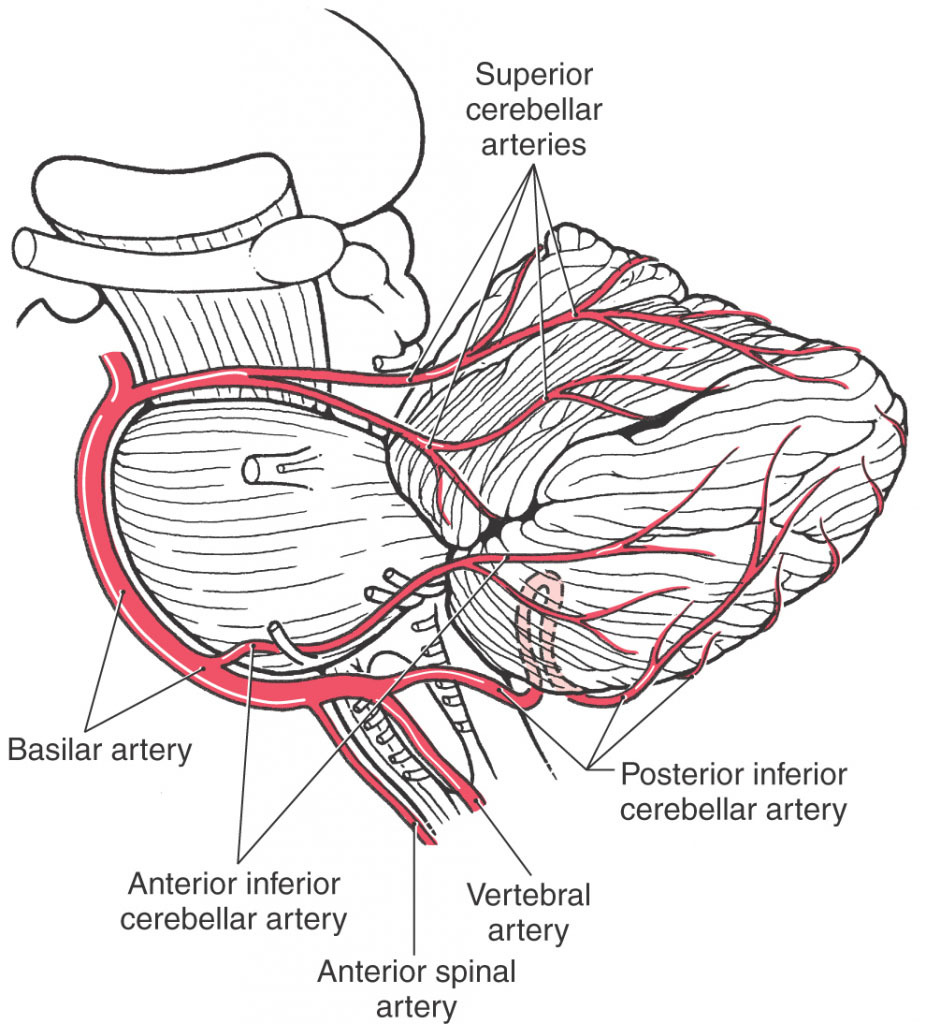
PICA
inferior half of cerebellum
inferior vermis
inferior cerebellar peduncle
AICA
middle cerebellar peduncle
strip of ventral cerebellum
flocculi
SCA
superior half of cerebellar cortex
deep cerebellar nuclei
superior vermis
superior cerebellar peduncle
Internal Anatomy
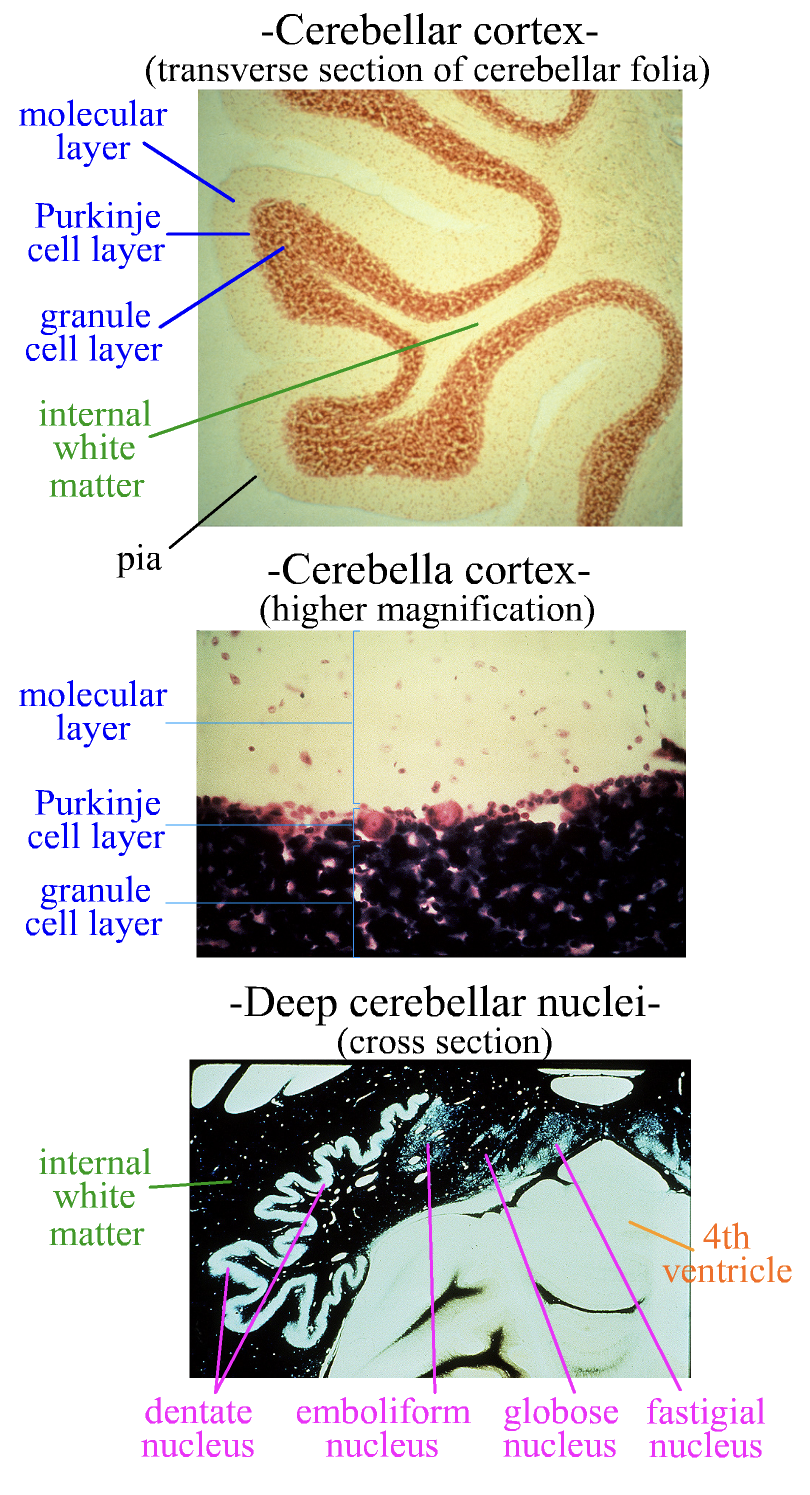
- Cerebellar cortex
3 layers:- granule cell layer
- Purkinje cell layer
- molecular layer
- Internal white matter
- afferent axons: mossy and climbing fibers
- efferent axons: from Purkinje cells
- Three pairs of deep nuclei:
- fastigial nucleus
- interposed nucleus
- globose n.
- emboliform n.
- dentate nucleus
Cerebeller Connections
Overview
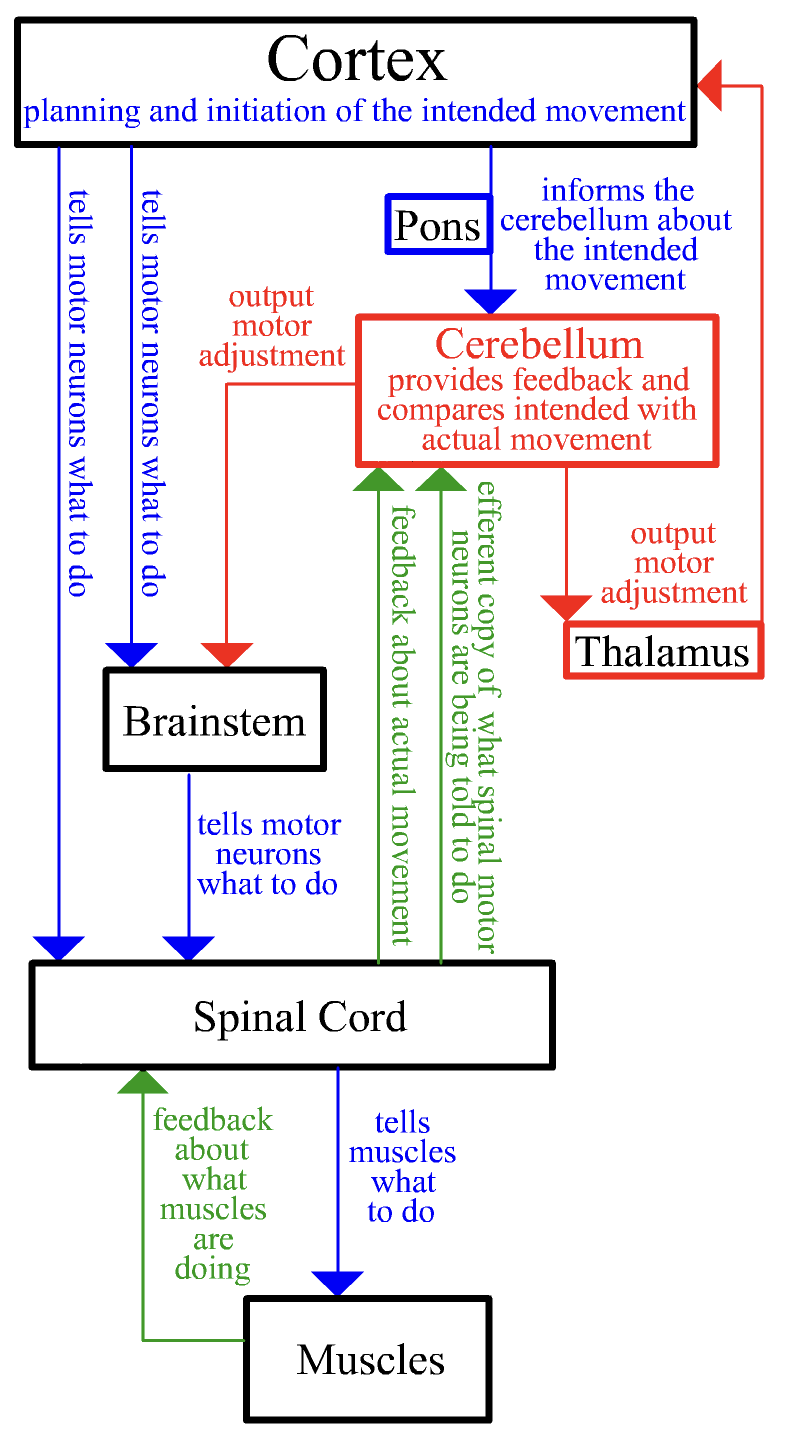
- Influence over motor neurons indirect
- cerebellum → thalamus → motor cortex → spinal cord
- cerebellum → UMNs of extra-pyramidal system in brainstem → spinal cord
- Cerebral cortex informs cerebellum of command for movement
- mainly motor systems → pontine nuclei → cerebellum ⟾ cortico-ponto-cerebellar pathway
- Influenced by all sensory systems (unconsciously)
- direct projections
- DSCT ⟾ peripheral movements
- VSCT ⟾ motor commands to spinal LMNs
- polysynaptic pathways
- afferents from inferior olive = climbing fibers
- all other afferents = mossy fibers
- afferent bundles fan out in cerebellar white matter → folia
- afferent fibers send collaterals to deep cerebellar nuclei before terminating in cerebellar cortex
- direct projections
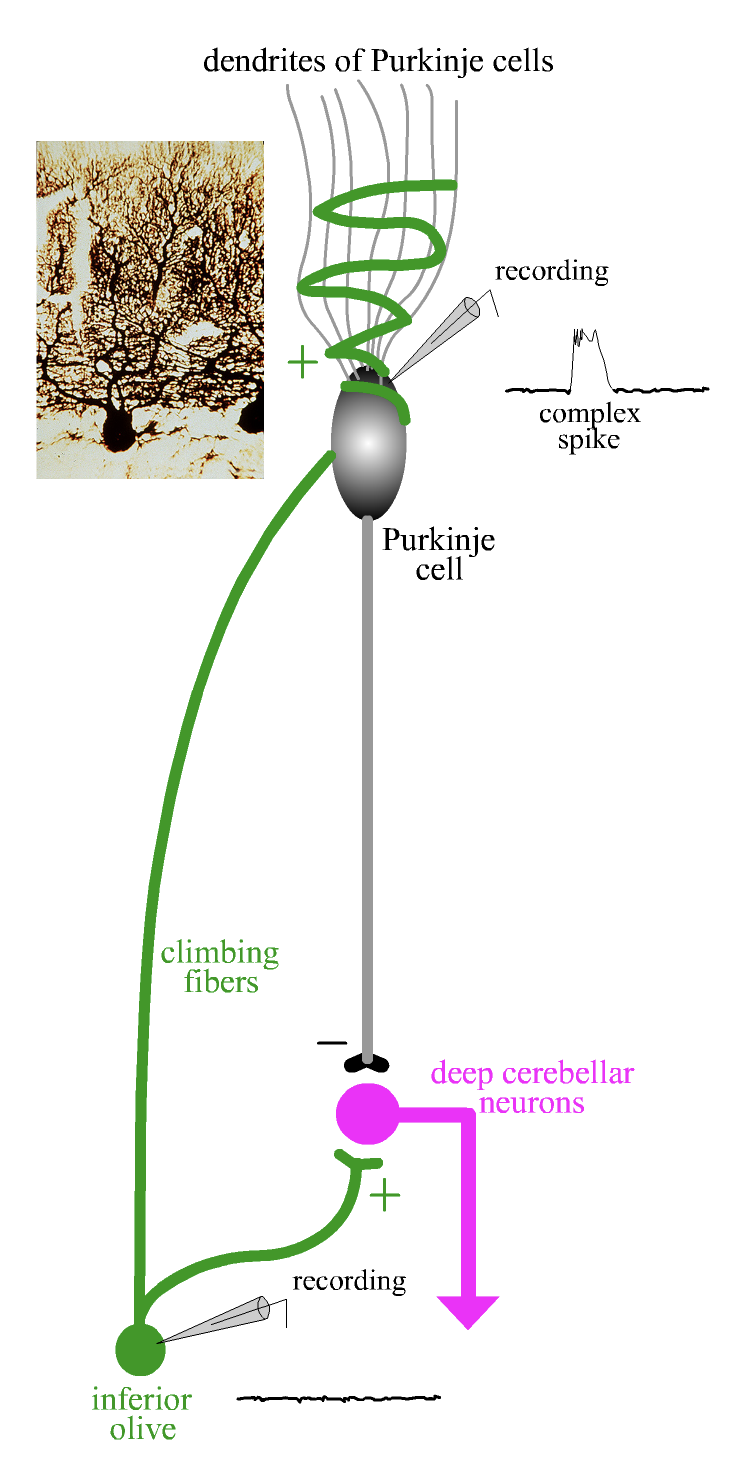
Climbing Fibers
Inferior olive → ICP → climbing fibers → contralateral cerebellum.
- Excitatory synapses with:
- deep cerebellar neurons
- dendrites of Purkinje neurons
- Each CF gives off 1-10 collaterals
- each collateral innervates only 1 Purkinje cell
- Each action potential in CF produces a complex spike in Purkinje cell
- Crucial for motor adaptation and motor learning
Mossy Fibers
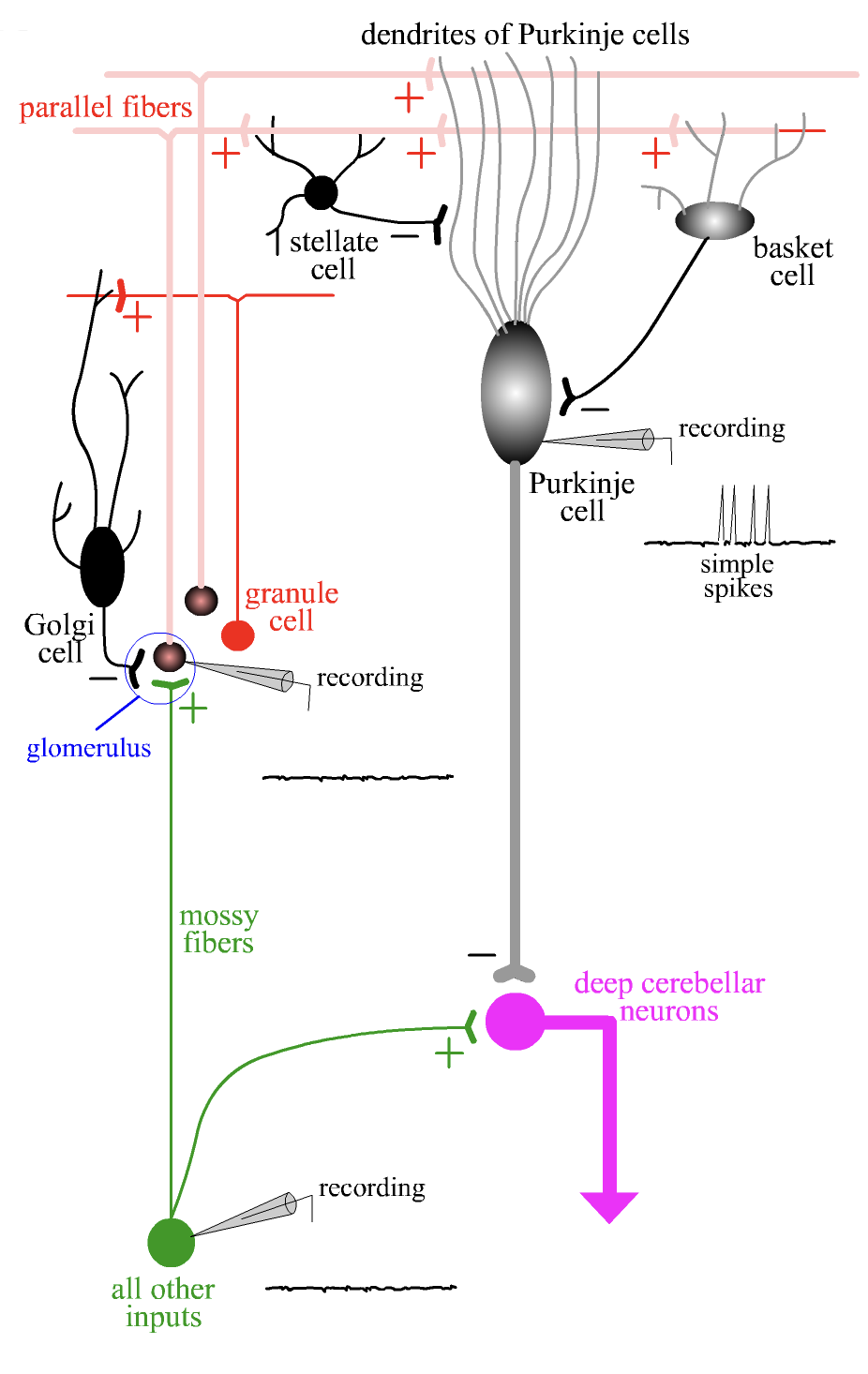
- Mossy fibers arise from nuclei in spinal cord and brainstem
- sensory info from periphery
- commands from cerebral cortex
- Excitatory to:
- deep cerebellar neurons
- granule cells → parallel fibers → Purkinje neurons
- produces simple spikes
- Direct (MF) and indirect (granule cell) activation of Purkinje cell → steady stream of simple spikes
- encodes moment to moment input info
- Path supplies info about planned and ongoing movements.
Cerebellar Circuits
Summary
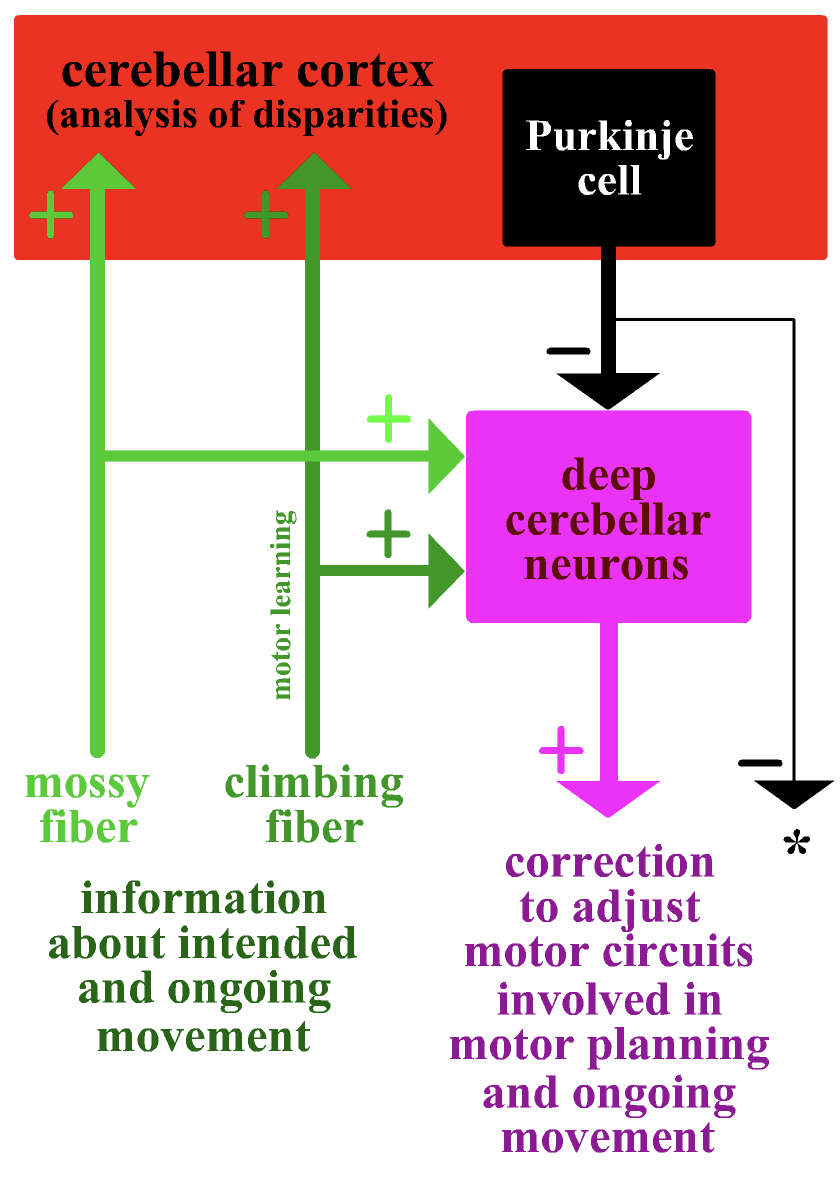
- Info about intended and ongoing movement → mossy and climbing fibers → cerebellum
- Projects to both cerebellar cortex and deep cerebellar neurons
- In cerebellar cortex circuits, differences between planned movements, stored info, and actual ongoing movements analyzed
- Correction signal from Purkinje neurons adjusts output firing of deep cerebellar neurons
- Purkinje cells in flocculonodular lobe and vermis can directly control vestibular nuclei
- Alters movement as needed to complete task
Cerebellar
Internal Projections
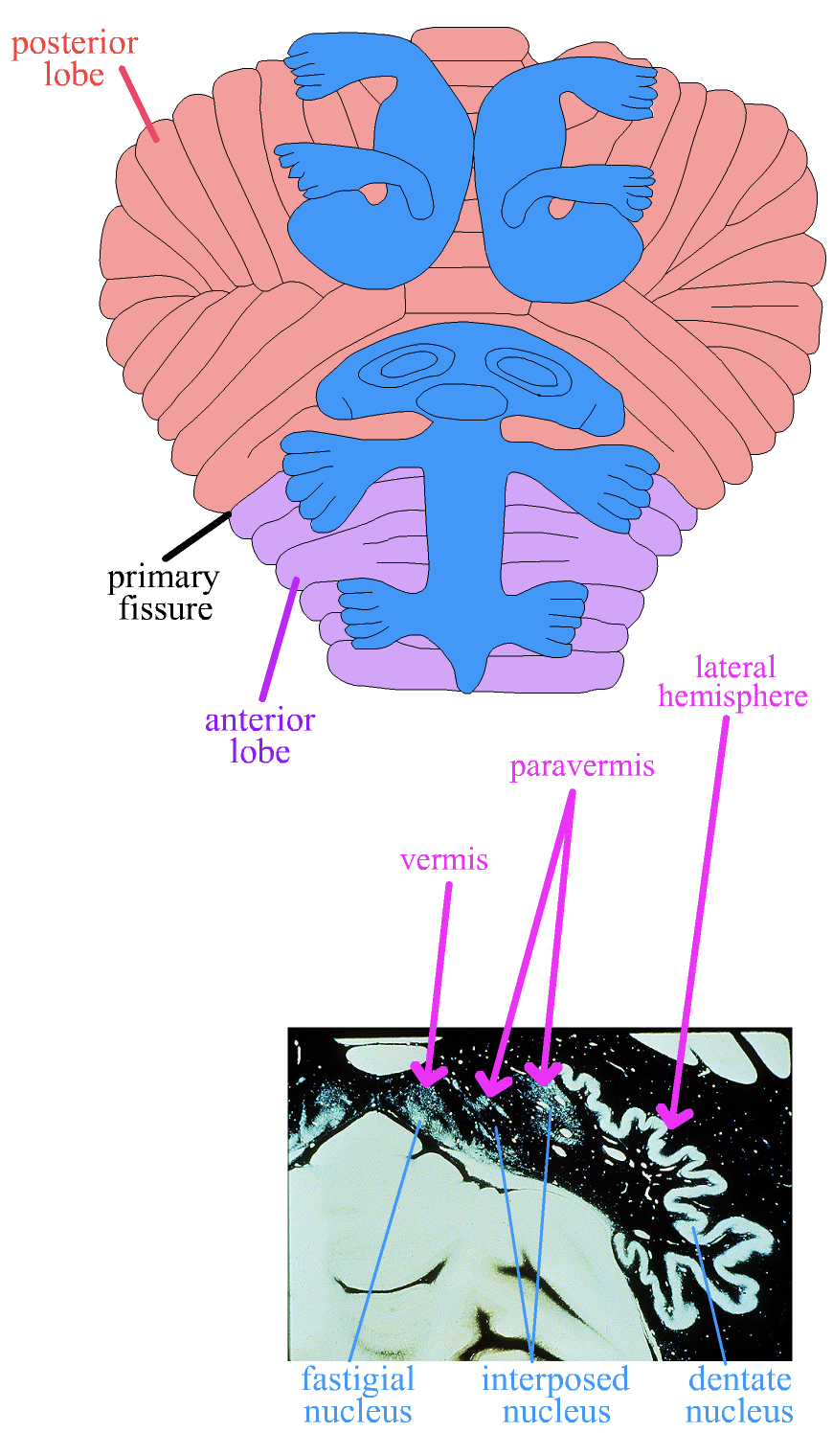
Deep cerebellar n. also somatotopically organized.
Medial to lateral organization.
Trunk info:
vermis → fastigial n.
Limb info:
paravermis → interposed n.
lateral hemisphere → dentate n.

Cerebellar
Somatotopy
- Head, neck, and trunk → vermis
- auditory input
- cortico-ponto-cerebellar relays
- visual and auditory projections
- frontal eye field projections
- somatosensory info from face
- trigeminal projection doubled → two head areas located midline
- Limbs → paravermis & cerebellar hemispheres
- Anterior lobe: legs rostral, arms caudal
- Posterior lobe: legs caudal, arms rostral
- More concerned with where than what
- projections from cerebral cortex projects disynaptically to cerebellar cortex
- body representation more coarse
- shows divergence at cerebellar cortex
- Vestibular system (medial and inferior vestibular n.) → flocculonodular lobe > ant. and post. vermis
- Olivo-cerebellar system → entire cerebellar cortex
- timing of movement
- inferior olive w/ input from cortical and spinal projections
- sends info to cerebellum that is already integrated
Direct vs. Indirect
Inputs
- Direct sensory input
- DSCT/VSCT
- Cuneocerebellar tract
- Disynaptic sensory input
- spino-olivo-cerebellar
- spino-reticulo-cerebellar
Functional Organization
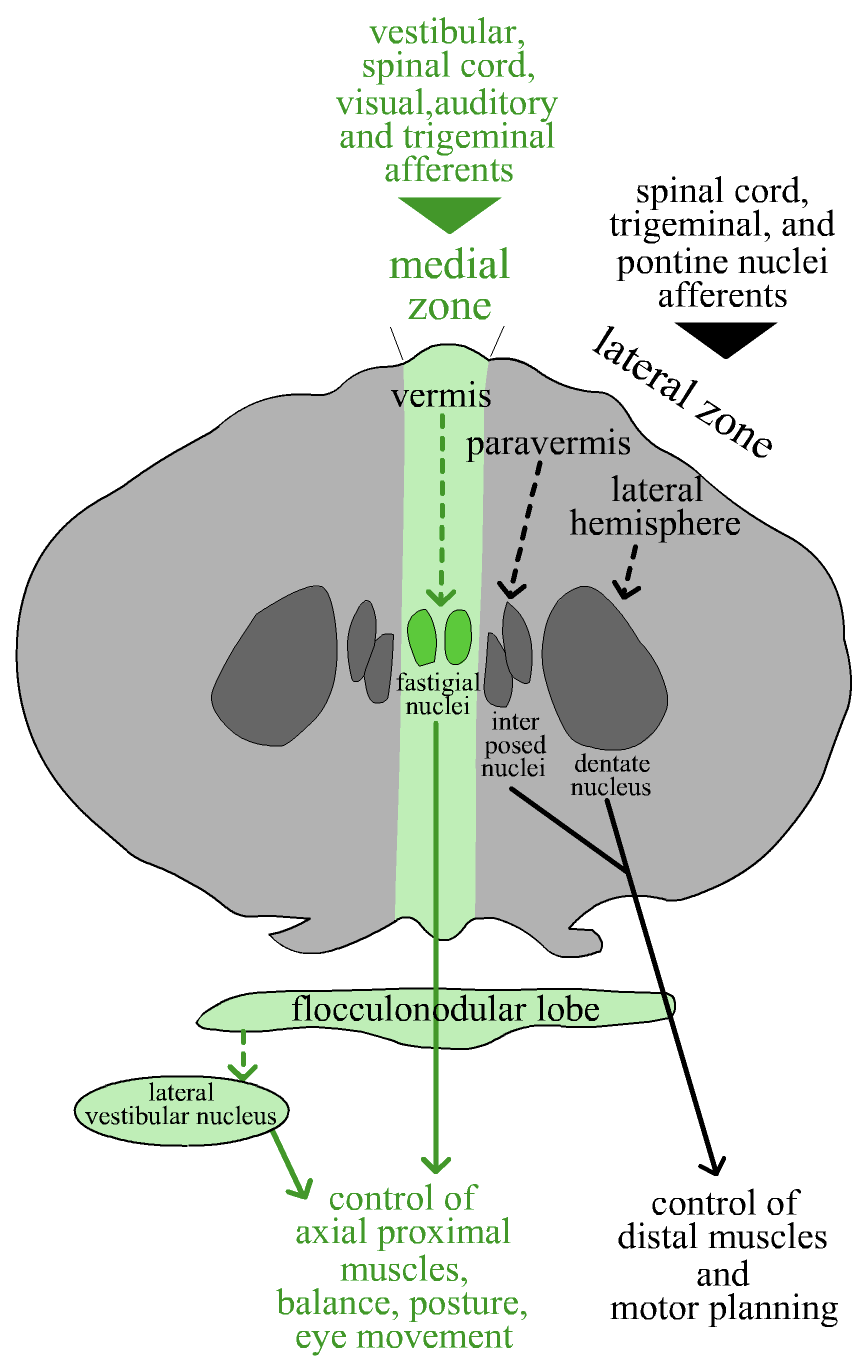
Cerebellum divided into 2 distinct zones:
- Medial zone ⟾ flocculonodular lobe and vermis
- spinal cord, vestibular, trigeminal, visual, and auditory inputs
- regulate output of fastigial n. and lateral vestibular n.
- involved in moment to moment control of
- balance
- eye movement
- posture
- locomotion
- trunk muscles
- Lateral zone ⟾ paravermis and cerebellar hemispheres
- input from spinal cord & trigeminal and cerebral cortex inputs via pontine n.
- regulate output of interposed n. (globose + emboliform) and dentate n.
- involved in moment to moment control of distal muscles & motor planning
Medial Zone
Inputs
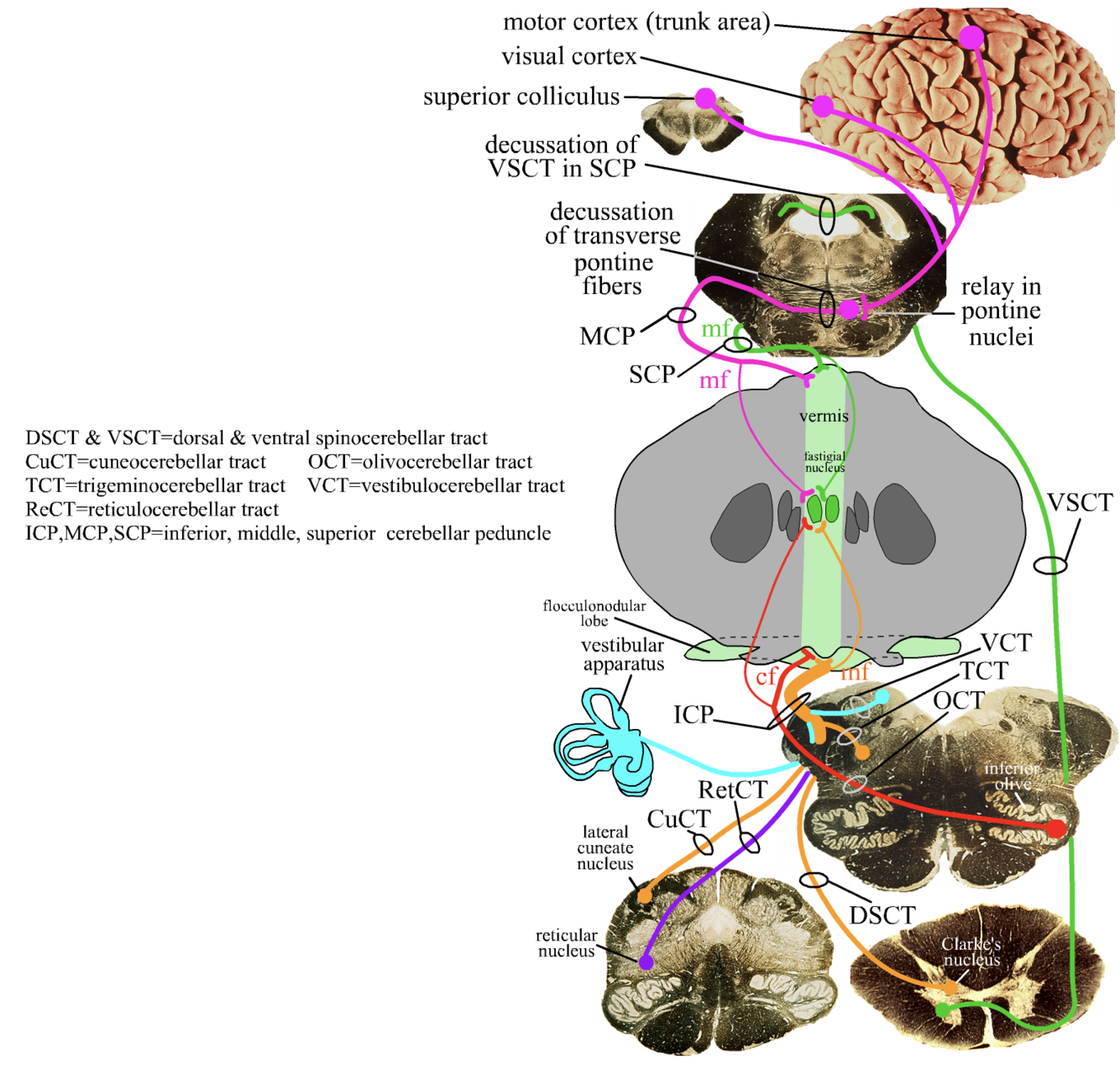
Input to vermis and flocculonodular lobe.
5 types:
- Corticopontine input
- pontocerebellar fibers
- Spinal and trigeminal input
- DSCT
- VSCT
- CuCT
- trigeminocerebellar tract (TCT)
- Vestibular input
- vestibulocerebellar tract (VCT)
- Reticular input
- reticulocerebellar tract (ReCT)
- Inferior olive input
- olivocerebellar tract (OCT)
Medial Zone
Corticopontine Input
- Carries:
- motor commands from trunk area of motor cortex
- visual info from visual cortex and superior colliculus
- Projects to ipsilaterally pontine n.
- From pontine n., decussates as transverse pontine fibers
- Enter cerebellum via MCP

Medial Zone
Spinal and Trigeminal Input
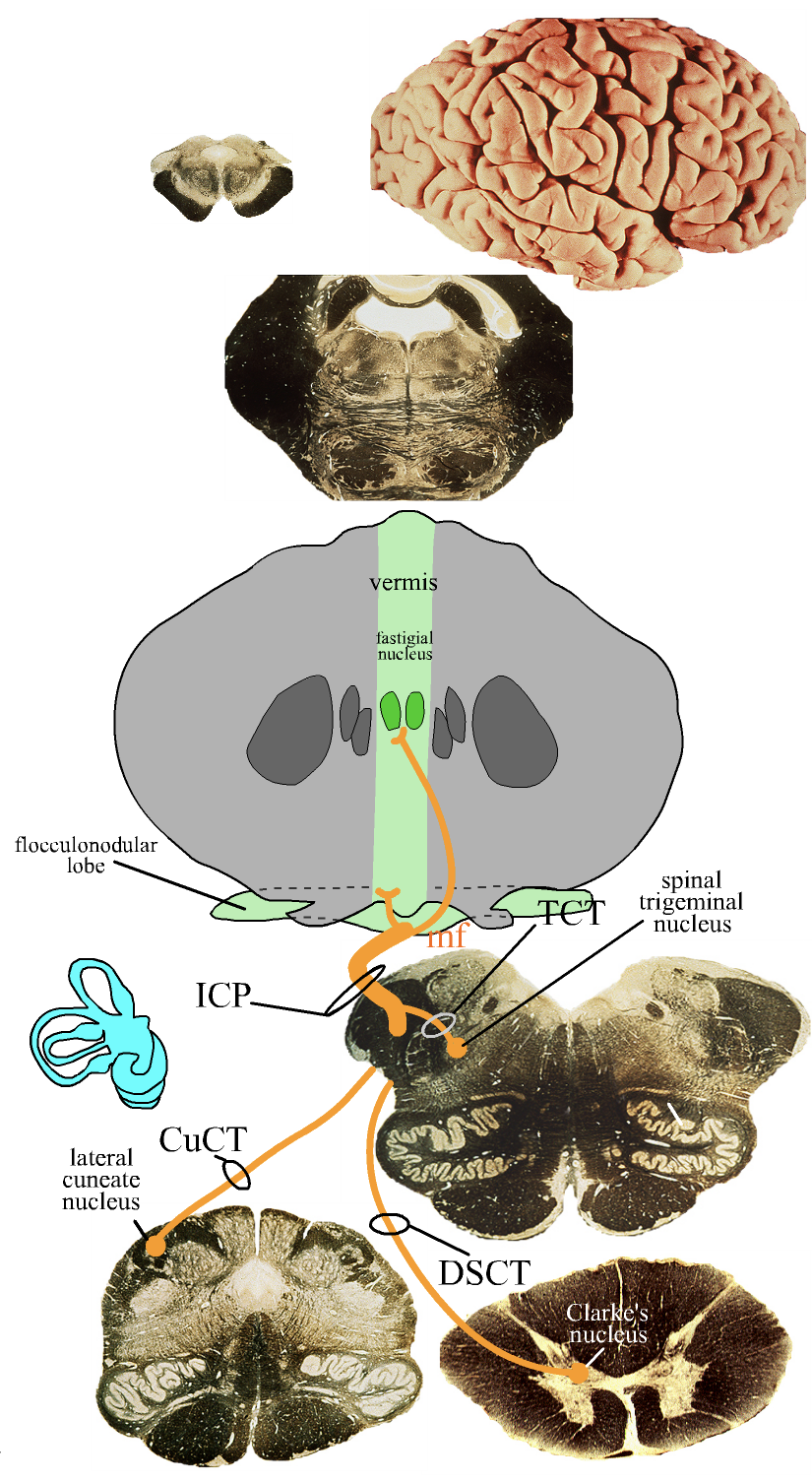
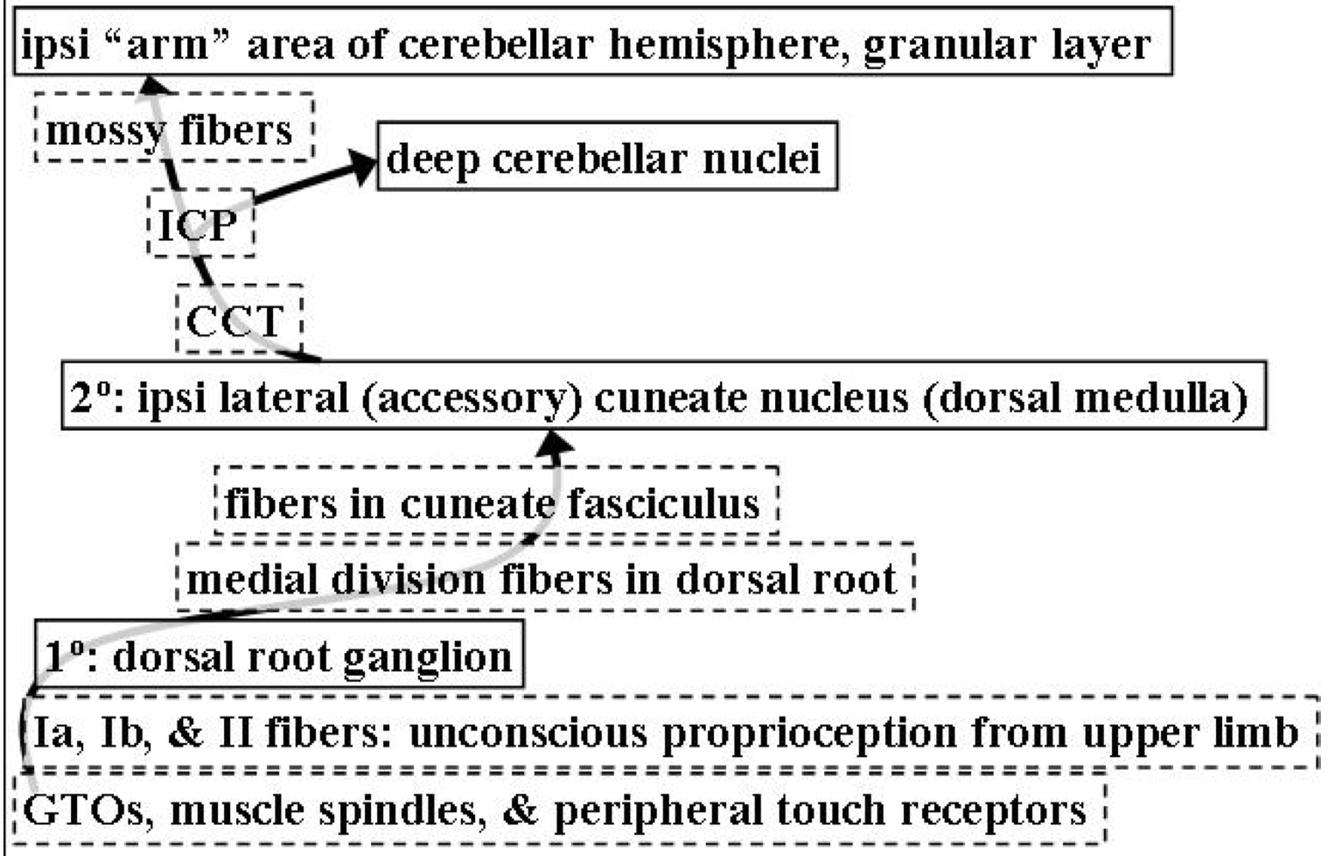
All inputs enter cerebellum ipsilaterally via ICP.
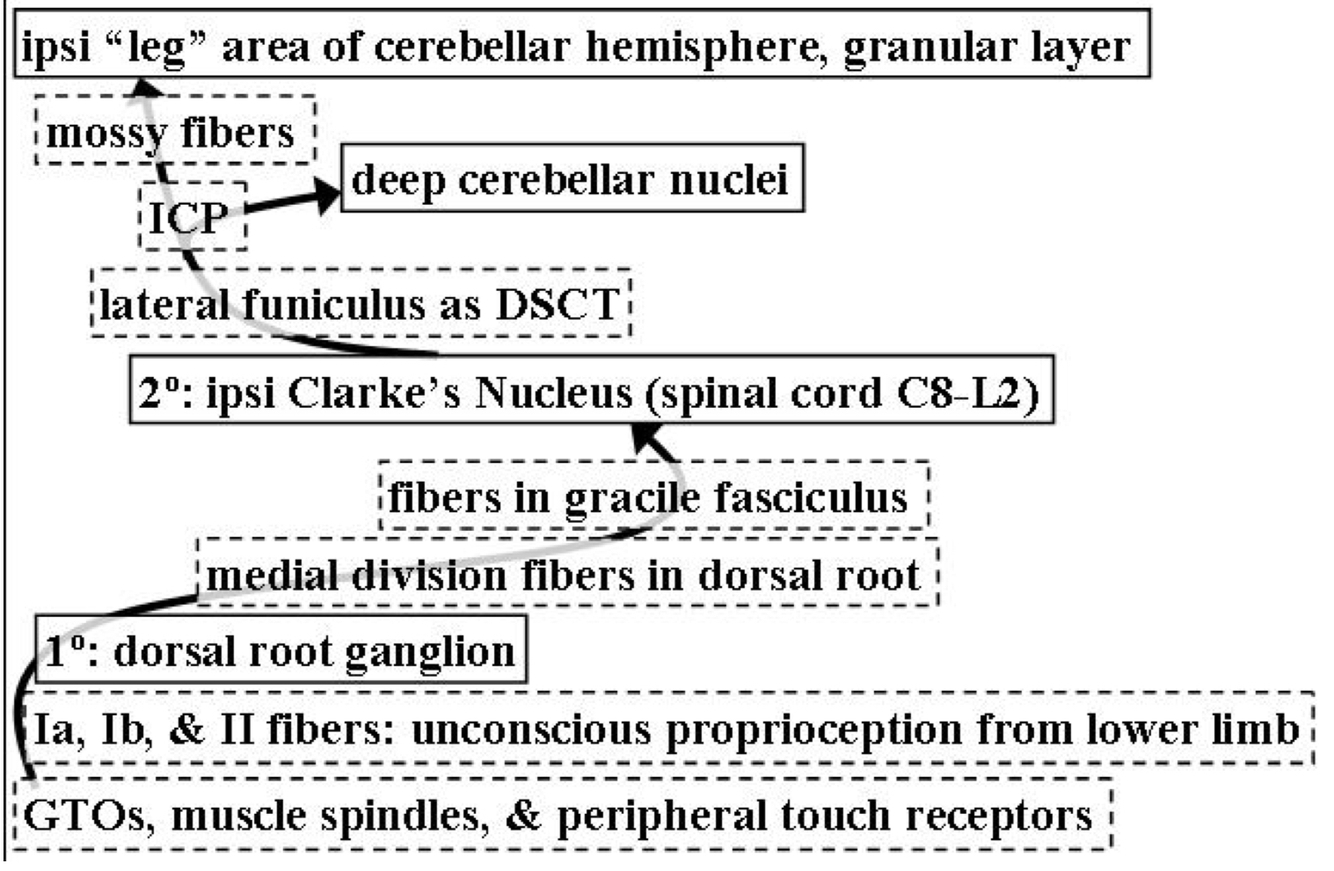
- Dorsal spinocerebellar tract (DSCT)
- carries ipsilateral lower body proprioception
- originate in Clarke’s n.
- Cuneocerebellar tract (CuCT)
- carries ipsilateral upper body proprioception
- originates in lateral (acc.) cuneate n.
- Trigeminocerebellar tract (TCT)
- carries info from face
- orginate in spinal trigeminal n.
DSCT
Input Pathway
CuCT
Input Pathway
Medial Zone
Spinal Cord Input
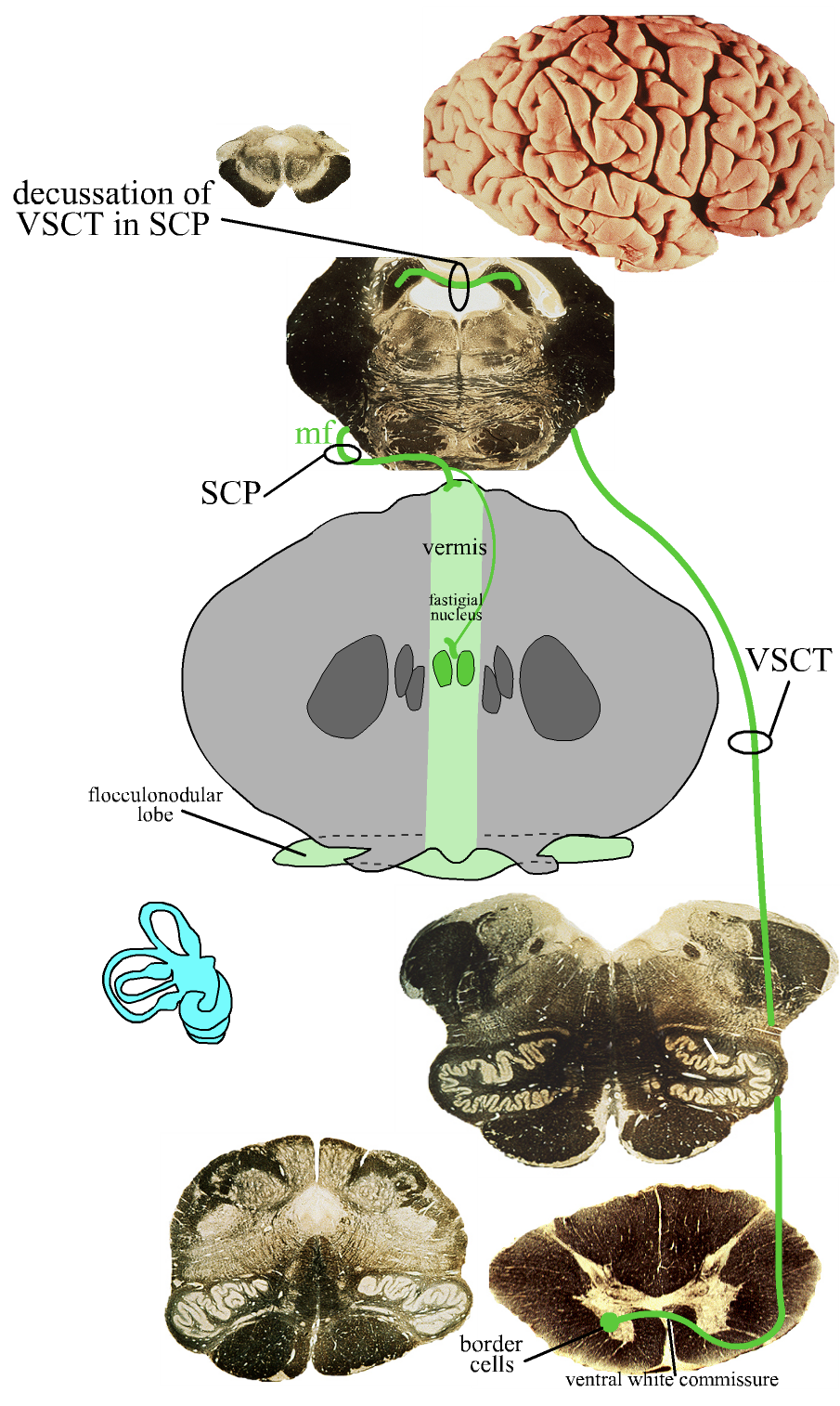
Ventral spinocerebellar tract (VSCT)
- Carries efferent copy of spinal cord LMN commands → “spy tract”
- Originates in spinal cord (border cells)
- Decussates twice:
- ventral white commissure → forms VSCT
- SCP → enter cerebellum
- Carries ipsi info to ipsi cerebellum
Medial Zone
Vestibular and Reticular Inputs
Both tracts enter ipsilateral cerebellum via ICP.
- Vestibulocerebellar tract (VCT)
- carries balance information
- originates from vestibular apparatus and vestibular n.
- Reticulocerebellar tract (RetCT)
- carries cutaneous information
- originate from lateral reticular n. of medullary reticular formation

Medial Zone
Inferior Olive Input
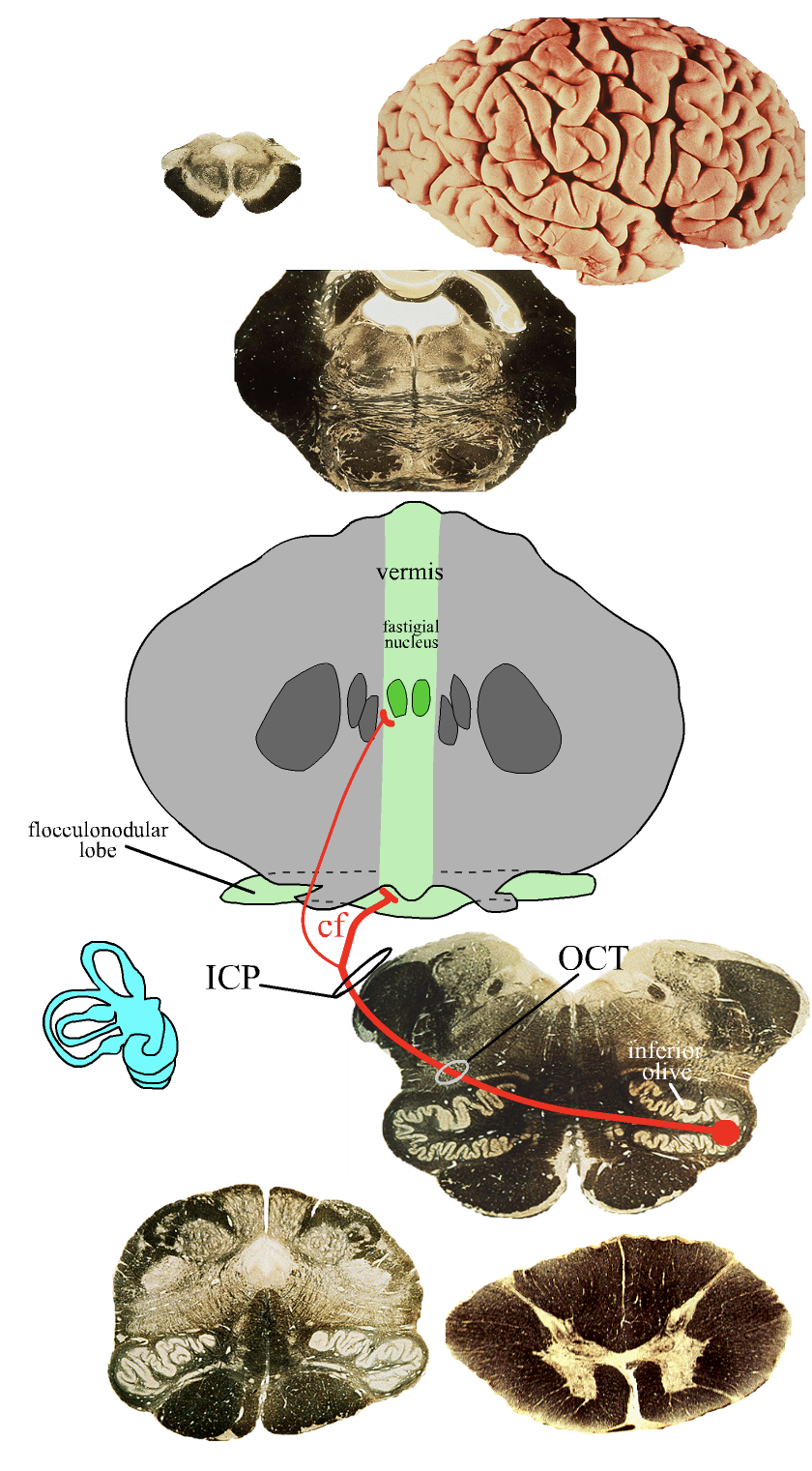
Olivocerebellar tract (OCT)
- carries info used for timing and motor learning
- originate from inferior olivary n. in medulla
- fibers decussate and enter contralateral cerebellum via ICP
- terminates as climbing fibers in vermis and flocculonodular lobe
- sends collaterals to fastigial n.


-
Craniofacial Complex37
-
Nervous System Development33
-
Blood Brain Barrier21
-
Neurotransmitters27
-
Intro to Nervous System29
-
Action Potentials and Channelopathies18
-
Neuronal Degeneration and Regeneration19
-
Neuronal Interactions24
-
Nerves, Spinal cord, and Pathways124
-
Spinal Cord Lesions16
-
Pain35
-
Hypothalamus63
-
CNS Pathways & ANS35
-
Limbic System70
-
Cerebral Cortex107
-
Cerebellum50
-
Basal Ganglia30
-
Motor Systems18
-
Brainstem13
-
Cranial Nerves15
-
Thalamus23
-
Aging and Alzheimers15
-
CVA, TBI, and Coma17



