- During a gang fight, a 16-year-old male is shot with a 22-caliber short bullet in the oc- ciput. Computed tomography (CT) shows that the bullet is lodged in the left medullary pyra- mid. The most prominent neurologic deficit is (A) Apallesthesia, right side (B) Exaggerated muscle stretch reflexes, left side (C) Plantar reflex extensor, right side (D) Fasciculations, right side (E) Hyperreflexia, left side
l-C. The bullet transected the left medullary pyramid, which contains the uncrossed corti- cospinal tract. This upper motor neuron (UMN) lesion has produced a right contralateral spas- tic paresis with all pyramidal signs.
- A 70-year-old retired Army colonel presents with a right-sided hemiparesis. Which of the following signs best localizes the lesion to the brainstem? (A) Loss of kinesthetic and pallesthetic sen- sation, right side (B) Lower facial weakness (numbness), right side (C) Exaggerated muscle stretch reflexes, right side (D) Tonic deviation of eyes to the right (E) Lateral strabismus
2-E. Lateral strabismus (exotropia) is seen in midbrain lesions (e.g., Weber syndrome) that tran- sect intra-axial fibers of the oculomotor nerve. The intact lateral rectus pulls the globe laterally.
- A 10-year-old boy has right arm and leg dys- taxia, nystagmus, hoarseness, along with mio- sis and ptosis on the right. Bronchoscopy re- veals a paretic vocal cord on the right. The lesion site responsible is most likely the (A) right dorsal motor nucleus of CN X (B) left red nucleus (C) dorsolateral medulla (D) dorsolateral pons (E) internal capsule
3-C. The lateral medullary syndrome is also called the posterior inferior cerebellar artery (PICA) syndrome. The dorsolateral medulla contains the nucleus ambiguus (larynx), hypothala- mospinal tract (Horner syndrome), inferior cerebellar peduncle (dystaxia), and vestibular nuclei (nystagmus).
- Neurologic examination reveals: miosis, ptosis, hemianhidrosis, left side; laryngeal and palatal paralysis, left side; facial anesthesia, left side; and loss of pain and temperature sensation from the trunk and extremities, right side. The lesion site responsible is in the (A) caudal medulla, ventral median zone, right side (B) rostral medulla, lateral zone, left side (C) rostral pontine base, left side (D) caudal pontine tegmentum, lateral zone, right side (E) rostral pontine tegmentum, dorsal median zone, left side
4-B. The lesion is a classic Wallenberg syndrome [posterior inferior cerebellar artery (PICA) syndrome] of the lateral medullary zone. Interruption of the descending sympathetic tract pro- duces ipsilateral Horner syndrome. Involvement of the nucleus ambiguus or its exiting intra- axial fibers accounts for lower motor neuron (LMN) paralysis of the larynx and soft palate. The ipsilateral facial anesthesia is due to interruption of the spinal trigeminal tract; the contralateral loss of pain and temperature sensation from the trunk and extremities is due to transection of the spinothalamic tracts. The combination of ipsilateral and contralateral sensory loss is called alternating hemianesthesia. Singultus (hiccup) is frequently seen in this syndrome and is thought to result from irritation of the reticulophrenic pathway.
- Neurologic examination reveals: severe pto- sis, eye “looks down and out,” right side; fixed dilated pupil, right side; spastic hemiparesis, left side; and lower facial weakness, left side. The lesion site responsible is in the (A) caudal pontine tegmentum, dorsal median zone, left side (B) rostral pontine tegmentum, dorsal lateral zone, right side (C) pontine isthmus, dorsal lateral tegmen- tum, left side (D) rostral midbrain, medial basis pedunculi, right side (E) rostral midbrain, medial tegmentum, left side
5-D. This constellation of deficits constitutes Weber syndrome, which affects the basis pedun- culi and the exiting intra-axial oculomotor fibers. Severe ptosis (compare mild ptosis of Horner syndrome), the abducted and depressed eyeball, and the internal ophthalmoplegia (fixed, dilated pupil) are third nerve signs. The contralateral hemiparesis results from interruption of the cor- ticospinal tracts; lower facial weakness is due to interruption of the corticobulbar tracts. The combination of ipsilateral and contralateral motor deficits is called alternating hemiplegia. The corticospinal tract is closely related with three cranial nerves (CN III, CN VI, and CN XII); third nerve signs put the lesion in the midbrain, sixth nerve signs put the lesion in the pons, and twelfth nerve signs put the lesion in the medulla. With the exception of the trochlear nerve, all cra- nial nerves have ipsilateral signs. Transection of the corticospinal tract rostral to the decussation results in a contralateral spastic hemiparesis. The trochlear nucleus, an exception, gives rise to intra-axial axons that cross the midline and exit just caudal to the frenulum of the superior medullary velum. A lesion of the trochlear nucleus results in a contralateral superior oblique palsy.
- Neurologic examination reveals: sixth nerve palsy, right side; facial weakness, left side; hemiparesis, left side; and limb and gait dystaxia, right side. The lesion site responsible is in the (A) caudal pontine tegmentum, lateral zone, right side (B) caudal pontine tegmentum, dorsal median zone, left side (C) caudal medulla, ventral median zone, right side (D) rostral pontine tegmentum, lateral zone, left side (E) caudal pontine base, median zone, right side
6-E. These signs point to the base of the pons (medial inferior pontine syndrome) on the right side and include involvement of the exiting intra-axial abducent fibers that pass through the uncrossed corticospinal fibers; this results in an ipsilateral lateral rectus paralysis [lower motor neuron (LMN) lesion] and contralateral hemiparesis. Contralateral facial weakness results from damage to the corticobulbar fibers prior to their decussation. Involvement of the transverse pontine fibers destined for the middle cerebellar peduncle results in cerebellar signs. Again, the involved cranial nerve and pyramidal tract indicate where the lesion must be to account for the deficits. An ipsilateral sixth nerve paralysis and crossed hemiplegia is called the Millard-Gubler syndrome.
- Neurologic examination reveals: paralysis of upward and downward gaze, absence of con- vergence, and absence of pupillary reaction to light. The lesion site responsible is the (A) rostral midbrain tectum (B) caudal midbrain tectum (C) rostral pontine tegmentum (D) caudal pontine tegmentum (E) caudal midbrain tegmentum
7-A. These deficits indicate the Parinaud syndrome, dorsal midbrain syndrome. This condition frequently is the result of a tumor in the pineal region (e.g., germinoma or pinealoma); a pinealoma compresses the superior colliculus and the underlying accessory oculomotor nuclei that are responsible for upward and downward vertical conjugate gaze. Patients usually have pupillary disturbances and absence of convergence.
- Neurologic examination reveals: bilateral medial rectus paresis on attempted lateral gaze, monocular horizontal nystagmus in the abducting eye, and unimpaired convergence. The lesion site responsible is in the (A) midpontine tegmentum, dorsomedial zones, bilateral (B) rostral midbrain tectum (C) caudal midbrain tectum (D) caudal pontine base (E) rostral midbrain, bases pedunculorum
8-A. The medial longitudinal fasciculus (MLF) is located in the dorsomedial midpontine tegmen- tum. MLF syndrome is frequently seen in multiple sclerosis and less often in vascular lesions. Another pontine lesion results in one-and-a-half syndrome; it includes the MLF syndrome and a lesion of the abducent nucleus (CN VI). See Chapter 17.
- Neurologic examination reveals: ptosis, miosis, and hemianhidrosis, left side; loss of vi- bration sensation in the right leg; loss of pain and temperature sensation from the trunk, ex- tremities, and face, right side; and severe dys- taxia and intention tremor, left arm. The lesion site responsible is in the (A) rostral midbrain tegmentum, right side (B) rostral pontine tegmentum, dorsal medial zone, left side (C) pontine isthmus, dorsal lateral zone, left side (D) rostral medulla, lateral zone, left side (E) caudal medulla, lateral zone, right side
9-C. These deficits correspond to a lesion in the dorsolateral zone of the pontine isthmus, lat- eral superior pontine syndrome. Interruption of the descending sympathetic pathway to the cilio- spinal center of Budge (Tl—T2) results in Horner syndrome (always ipsilateral). Involvement of the lateral aspect (includes the leg fibers) of the medial lemniscus results in a loss of vibration sensation and other dorsal column modalities. Damage to the trigeminothalamic and spinothal- amic tracts at this level results in contralateral hemianesthesia of the face and body. Infarction of the superior cerebellar peduncle leads to severe cerebellar dystaxia on the same side.
- Neurologic examination reveals: weakness of the pterygoid and masseter muscles, left side; corneal reflex absent, left side; and facial hemianesthesia, left side. The lesion site re- sponsible is in the (A) midpontine tegmentum, lateral zone, left side (B) midpontine base, medial zone, left side (C) caudal pontine tegmentum, lateral zone, left side (D) caudal pontine tegmentum, dorsal medial zone, left side (E) foramen ovale, left side
10-A. These signs indicate the lateral midpontine syndrome. This lesion involves the motor and principal trigeminal nuclei and the intra-axial root fibers of the trigeminal nerve as it passes through the base of the pons. All signs are ipsilateral and refer to CN V. The afferent limb of the corneal reflex has been interrupted. This syndrome results from occlusion of the trigeminal artery, a short circumferential branch of the basilar artery.
- Neurologic examination reveals: loss of the stapedial reflex, loss of the corneal reflex, in- ability to purse the lips, and loss of taste sen- sation on the apex of the tongue. The lesion site responsible is in the (A) stylomastoid foramen (B) basis pedunculi of the midbrain (C) rostral lateral pontine tegmentum (D) caudal lateral pontine tegmentum (E) rostral medulla
11-D. These signs constitute the lateral inferior pontine syndrome [anterior inferior cerebellar artery (AICA) syndrome]. The neurologic findings are all signs of a lesion involving the facial nerve (CN VII). The facial nerve nucleus and intra-axial fibers are found in the caudal lateral pontine tegmentum. A lesion of the stylomastoid foramen would not include the absence of the stapedial reflex or the loss of taste sensation from the anterior two-thirds of the tongue. The stapedial nerve and the chorda tympani exit the facial canal proximal to the stylomastoid foramen.
- Paramedian infarction of the base of the pons involves which of the following struc- tures? (A) Trapezoid body (B) Descending trigeminal tract (C) Rubrospinal tract (D) Pyramidal tract (E) Ventral spinocerebellar tract
12-D. The base of the pons includes the corticospinal (pyramidal), corticobulbar, and corticopontine tracts, pontine nuclei, and transverse pontine fibers. At caudal levels, intra-axial abducent fibers of CN VI pass through the lateral pyramidal fascicles.
- All of the following statements concerning the anterior spinal artery are correct EXCEPT (A) it is a branch of the vertebral artery (B) it irrigates the medullary pyramid (C) it irrigates the root fibers of the hypoglos- sal nerve (D) it irrigates the inferior olivary nucleus (E) it irrigates the medial lemniscus
13-D. The anterior (ventral) spinal artery, a branch of the vertebral artery, irrigates the ventral median zone of the medulla, which includes the pyramid (corticospinal tracts), the medial lem- niscus, and the exiting intra-axial root fibers of the hypoglossal nerve (CN XII). The inferior oli- vary nucleus lies in the paramedian zone of the medulla and is supplied by the short lateral branches of the vertebral artery.
- All of the following statements concerning the posterior inferior cerebellar artery (PICA) are correct EXCEPT (A) it is a branch of the vertebral artery (B) it supplies the vestibular nuclei in the medulla (C) it supplies the medial lemniscus in the medulla (D) it supplies the inferior cerebellar peduncle (E) it supplies the lateral spinothalamic tract
14-C. The posterior inferior cerebellar artery (PICA), a branch of the vertebral artery, perfuses the lateral zone of the medulla, which includes the medial and inferior vestibular nuclei, the in- ferior cerebellar peduncle, and the lateral spinothalamic tract.
- All of the following statements concerning the anterior inferior cerebellar artery (AICA) are correct EXCEPT (A) it gives rise, in most cases, to the labyrin- thine artery (B) it supplies the cochlear nuclei (C) it supplies the facial nucleus (D) it supplies the medial longitudinal fasci- culus (MLF) (E) it supplies the spinal trigeminal tract and nucleus
15-D. The anterior inferior cerebellar artery (AICA) usually (85% of cases) gives rise to the labyrinthine artery. The AICA supplies the lateral zone of the caudal pontine tegmentum (in- cluding the cochlear nuclei, the facial nucleus, and intra-axial fibers) and the spinal trigeminal nucleus and tract. The medial longitudinal fasciculus (MLF) is irrigated by paramedian pene- trating branches of the basilar artery.
- All of the following statements concerning internuclear ophthalmoplegia (INO) are cor- rect EXCEPT (A) it results from a lesion in the dorsal pon- tine tegmentum (B) it has no effect on convergence (C) it is frequently seen in multiple sclerosis (D) it results in monocular horizontal nystag- mus (E) it results in a lateral rectus palsy on at- tempted lateral conjugate gaze
16-E. Internuclear ophthalmoplegia (INO) results from a lesion of the medial longitudinal fas- ciculus (MLF), which extends in the dorsomedial tegmentum from the abducent nucleus of CN VI to the oculomotor nucleus of CN III. Transection of the MLF results in medial rectus palsy on attempted lateral gaze and monocular nystagmus in the abducting eye. Convergence is normal. Bilateral MLF syndrome is a common ocular motor manifestation of multiple sclerosis.
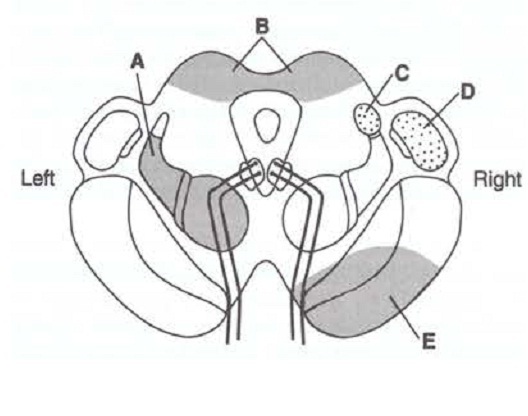
Match the items with lettered structure
- Paralysis of upward gaze
- Loss of pain and temperature on the left side of the body
- Deviation of the tongue to the left side and the uvula to the right side
- Intention tremor on the right side
- Complete third nerve palsy on the right side
- Loss of vibration sensation in the right extremities
- A Babinski sign on the left side
- Lesion leads to terminal axonal degeneration in the right transverse gyrus of Heschl
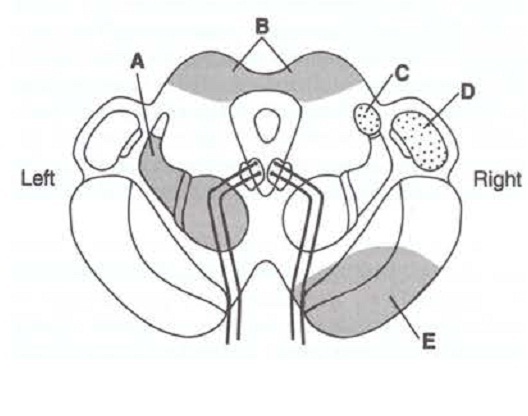
17-B. Paralysis of upward gaze results from compression of the mesencephalic tectum by a tu-
mor in the pineal region; this is called Parinaud syndrome.
18-C. Loss of pain and temperature on the left side of the body is due to a lesion on the right
side of the lateral spinothalamic tract.
19-E. Deviation of the tongue to the left side results from transection of the right corticobulbar
fibers (CN XII) located in the medial aspect of the crus cerebri. Deviation of the uvula to the right
side results from transection of the right corticobulbar fibers (CN X) found in the medial aspect
of the crus cerebri.
20-A. Transection of the left dentatothalamic tract results in an intention tremor on the right
side. The dentatothalamic tract decussates in the caudal midbrain, below the level of this lesion.
21-E. A complete third nerve palsy on the right side results from transection of the oculomotor
nerve fibers as they pass through the right side of the crus cerebri.
22-A. A loss of vibration sensation in the right extremities results from destruction of the left
medial lemniscus.
23-E. A Babinski sign on the left side results from transection of the corticospinal tract within
the middle three-fifths of the crus cerebri.
24-D. Destruction of the right medial geniculate body results in terminal axonal degeneration
of the auditory radiation in the right transverse gyrus of Heschl.

-
CHAPTER 514
-
CHAPTER 69
-
CHAPTER 718
-
CHAPTER 826
-
CHAPTER 17
-
CHAPTER 29
-
CHAPTER 39
-
CHAPTER 410
-
CHAPTER 917
-
CHAPTER 1326
-
CHAPTER 1012
-
CHAPTER 1111
-
CHAPTER 1221
-
CHAPTER 1743
-
CHAPTER 1824
-
CHAPTER 1927
-
CHAPTER 2020
-
neuroanatomy 3rd Comprehensive Examination 1 - 5050
-
CHAPTER 1417
-
Chapter 1518
-
CHAPTER 1621
-
neuroanatomy 3rd Comprehensive Examination 51 - 9747
-
neuroanatomy 3rd Comprehensive Examination 98 - 12023
-
neuroanatomy 3rd Comprehensive Examination 121 - 14424
-
neuroanatomy 3rd Comprehensive Examination 145 - 18945
-
CHAPTER 2122
-
CHAPTER 2227
-
CHAPTER 2326
-
CHAPTER 248



